

Why Choose GCSE Astronomy? Is It Worth It?
Why choose GCSE Astronomy? Discover what students enjoy, how it connects with maths, what the exams involve and whether this unusual option suits you.
Choosing a GCSE can feel strangely permanent. You are handed a list of subjects, given a deadline and asked to predict what your future self will enjoy. Astronomy often sits apart from the familiar options. It sounds fascinating, but also difficult, mathematical and perhaps a little mysterious.
So, why choose GCSE Astronomy? The short answer is that it turns curiosity about space into a serious scientific qualification. Students learn about planets, stars, galaxies and cosmology, but they also make observations, interpret data and use maths to explain what they see. Those who enjoy the course often value that combination: the scale of the ideas, the practical connection with the night sky and the satisfaction of understanding phenomena that once seemed unreachable.
It is not the right option for everyone. Yet for a student who likes asking why, spotting patterns and connecting maths with physics, it can be an unusually rewarding choice.
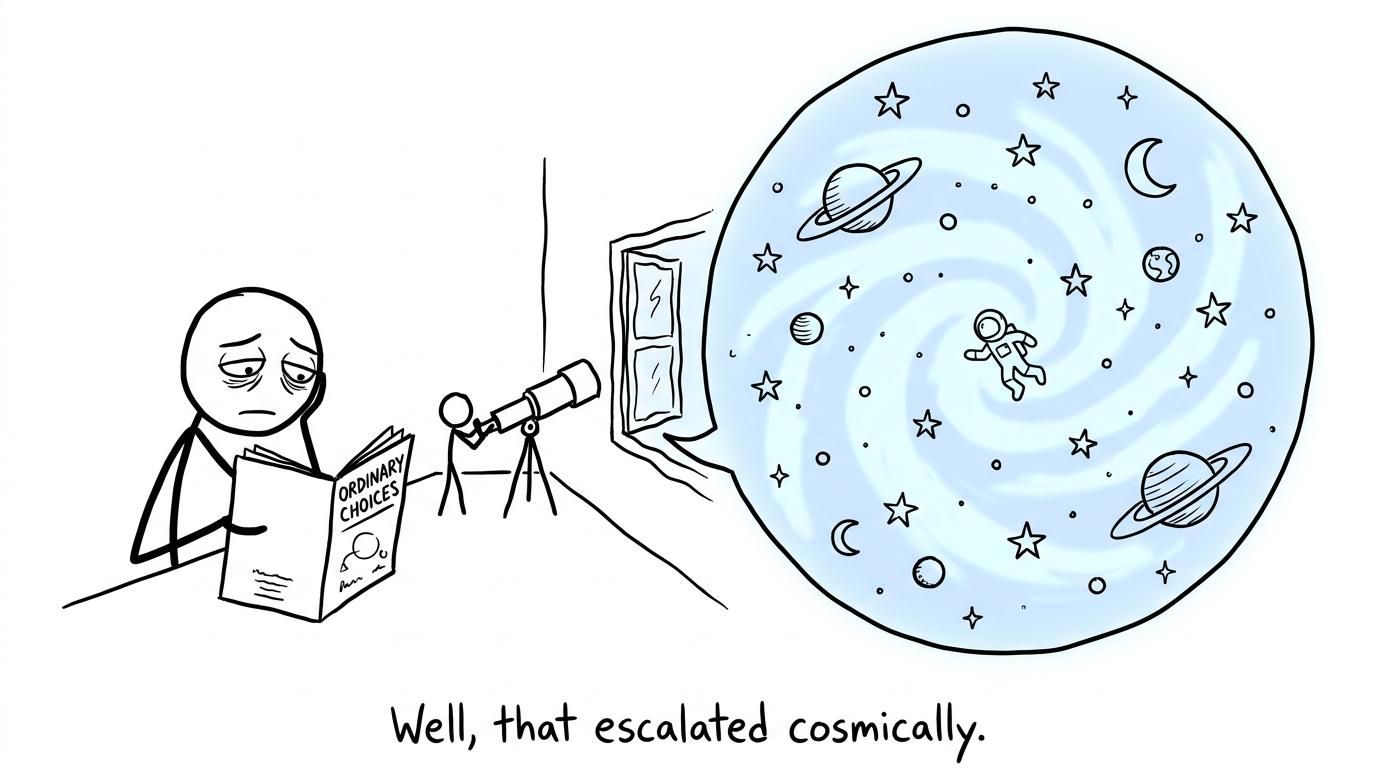 A student discovers that one GCSE option opens a rather large window onto the universe
GCSE Astronomy at a glance
Before choosing the subject, check whether these features appeal to you:
- The current Pearson Edexcel GCSE Astronomy specification is untiered, so there are no separate foundation and higher papers.
- The content ranges from the Earth-Moon-Sun system and planetary motion to telescopes, stellar evolution and cosmology.
- Assessment consists of two externally examined papers, each lasting 1 hour 45 minutes and worth 100 marks.
- Paper 1 covers naked-eye astronomy; Paper 2 covers telescopic astronomy.
- Each paper contributes 50%50\%50% of the qualification.
- At least 20%20\%20% of the written examination marks assess mathematical skills.
- Students must complete at least one unaided and one aided observation during the course.
- Observational understanding is assessed in the written examinations rather than through a separately marked coursework component.
Availability matters too. Pearson Edexcel currently provides the GCSE Astronomy qualification, but not every school offers it. Some schools teach it as an option, while others may run it outside the normal timetable. Ask exactly when lessons and observations happen before committing.
What students who enjoy GCSE Astronomy tend to value
There is no single experience shared by every Astronomy student. Published school accounts and student-facing course descriptions nevertheless return to several consistent themes: genuine observation, links with maths and physics, big scientific questions, and the pleasure of studying something distinctive.
The subject makes the night sky understandable
Looking upwards is easy. Knowing what you are seeing takes work.
GCSE Astronomy gives names, models and measurements to familiar sights. The phases of the Moon stop being disconnected shapes. The movement of stars across the sky becomes evidence of the Earth's rotation. Apparent planetary motion can be interpreted using models of the Solar System.
That change in perception is one reason the course can feel worthwhile. Knowledge does not remove the wonder. It gives the wonder structure.
The specification begins relatively close to home, with Planet Earth, the lunar disc and the Earth-Moon-Sun system. It later moves through planetary motion, telescopes, starlight, stellar evolution, galaxies and cosmology. Students therefore build outwards, from observations they can make themselves to questions about the development of the Universe.
Observation makes it more than a textbook subject
Every candidate must undertake one unaided and one aided observation. An unaided activity might use naked-eye observations or simple equipment such as a shadow stick. An aided observation may involve binoculars, a telescope, a camera or suitable robotic-telescope data, depending on the task and arrangements made by the centre.
The important part is not simply seeing an object. Students have to think scientifically about location, timing, equipment, atmospheric conditions, safety, reliability and the limitations of their results.
This can be satisfying because the inconveniences are real. Clouds arrive. Light pollution interferes. An observation may need to be repeated. Astronomy quietly teaches that evidence does not always appear on demand.
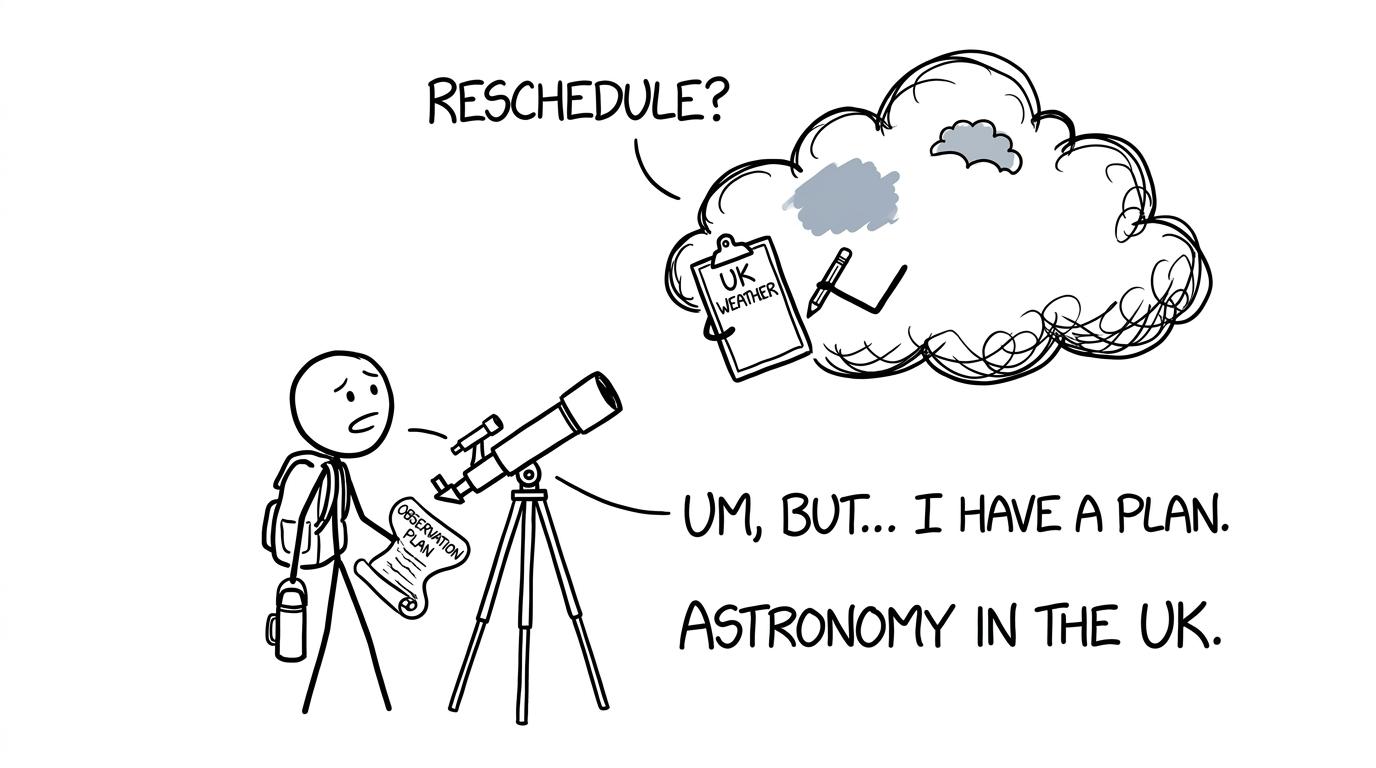 A GCSE astronomer attempts to negotiate an observing slot with British weather
The observation tasks do not produce a separate coursework mark under the current specification. However, teachers must certify their completion, and the examinations assess knowledge and application of observational skills. Treating the tasks as optional would therefore be a serious mistake.
Maths begins to feel useful rather than decorative
In an ordinary maths exercise, a graph can sometimes feel like an object created only to be marked. In astronomy, graphs, ratios and calculations answer physical questions.
The specification includes mathematical skills such as:
- standard form and orders of magnitude;
- ratios, fractions, percentages and inverse-square relationships;
- rearranging and substituting into equations;
- means and appropriate significant figures;
- interpreting and plotting graphs;
- gradients and intercepts;
- angles, coordinates and basic geometry;
- units including astronomical units, light-years and parsecs.
At least 20%20\%20% of the examination marks assess mathematics in an astronomical context. The minimum mathematical demand is broadly based on Key Stage 3 skills, although applying those skills to unfamiliar scientific situations can still be challenging.
If very large or small quantities feel awkward, MathsGenie's standard form revision can strengthen an essential skill. Angular measurements and geometric reasoning also become easier when your core SOHCAHTOA and trigonometry skills are secure.
This overlap benefits GCSE maths revision as well. Astronomy gives numerical methods another setting in which to become familiar.
It rewards explanation, not just recall
Astronomy contains facts and specialist vocabulary, but remembering definitions is not enough. The papers include multiple-choice, short-answer, calculation, graphical and extended-open-response questions.
Students may need to apply knowledge to unfamiliar information, interpret evidence or evaluate an observational method. Across both papers, Pearson allocates assessment to knowledge and understanding, application, and analysis or evaluation.
That breadth appeals to students who enjoy understanding how pieces fit together. A strong answer often depends on a chain of reasoning: identify the relevant idea, connect it to the situation and communicate the conclusion precisely.
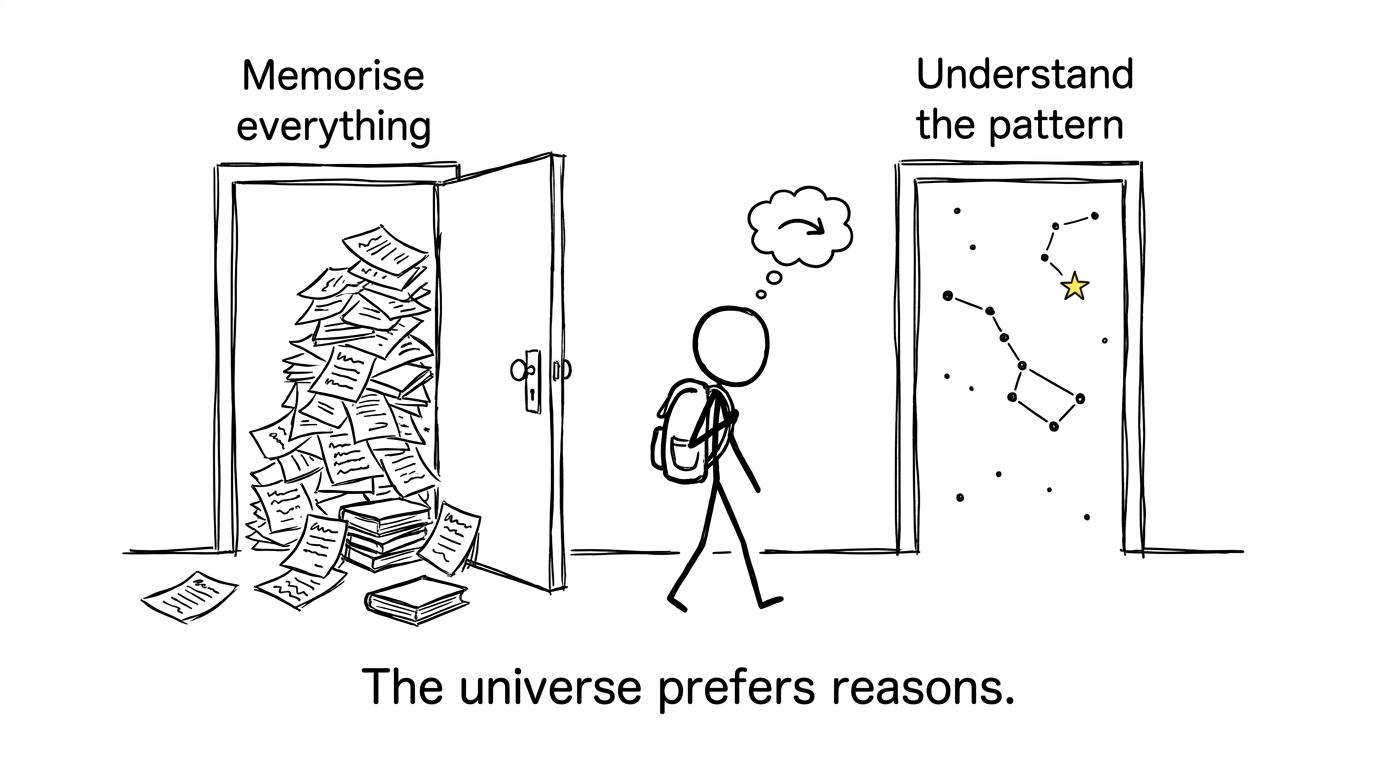 A student chooses understanding a pattern over balancing an impossible tower of notes
The scale of the course keeps changing
Some subjects stay at roughly the same scale. Astronomy does not.
One lesson may concern shadows, timekeeping or lunar features. Another may examine exoplanets, the life cycle of stars or evidence for an expanding Universe. This variation is intellectually demanding, but it is also part of the appeal.
The course combines historical models with modern observation. Students see how ideas changed when evidence improved. That is a useful scientific lesson: being wrong is not the opposite of progress when a model is tested, revised and replaced by something better.
How GCSE Astronomy supports future choices
GCSE Astronomy is valuable as a qualification in its own right, but it is not normally a compulsory gateway to an astronomy career. The Royal Astronomical Society's careers guidance emphasises that routes into professional astronomy commonly rely on strong post-16 physics and maths, followed by an appropriate university course and often postgraduate research.
Astronomy can still help a student discover whether that direction genuinely interests them. It develops data handling, scientific communication, evaluation, problem-solving and observational planning. It also complements GCSE Physics and can provide useful context for later work in physics, astrophysics, engineering or computing.
Do not choose it only because you think it will guarantee a particular career. Choose it if you would value the knowledge and skills even if your plans later change. Interests evolve. Transferable habits remain.
For students considering A Level Maths or Physics, strengthening GCSE foundations now is sensible. MathsGenie's free GCSE maths revision resources provide topic lessons, practice questions and solutions, while a realistic GCSE maths revision timetable can prevent an additional subject from crowding out core exam preparation.
Questions to ask before choosing GCSE Astronomy
Interest matters, but practical details matter too. Ask your school or examination centre:
- Is the course taught within the timetable or after school?
- How long will the course take?
- Who supervises and certifies the observations?
- What aided equipment or robotic-telescope access is available?
- What happens when weather prevents an observation?
- How will Astronomy fit around your compulsory GCSE workload?
- Which specification issue and examination series will you follow?
You should also read the current Pearson specification rather than relying on an old course description. Assessment arrangements can change, and older resources may refer to controlled assessment or separately marked coursework that does not match the present qualification.
Common mistakes when choosing and revising Astronomy
Choosing it because space sounds easy
Fascination is a good starting point, not a complete revision strategy. The course has sixteen substantial topics, technical terminology, calculations and extended responses. Enjoyment helps you persist; it does not remove the work.
Assuming it is just another physics module
There is overlap with physics, but GCSE Astronomy has its own observational methods, coordinate systems, historical models and specialist content. Revise from the Astronomy specification rather than treating general science notes as complete coverage.
Underestimating the maths
A formula and data sheet is provided in the examinations, but it cannot decide which relationship to use or check your units for you. Secure numerical foundations early, then practise applying them in context.
Leaving observations too late
Weather and visibility cannot be controlled. Plan early, record conditions carefully and follow your teacher's safety instructions. Never improvise solar observation: unsafe direct viewing can permanently damage eyesight.
Reading notes without testing recall
Recognition can feel like knowledge until the question paper is opened. Use retrieval, exam questions and mark schemes. Maths students can follow the same effective cycle described in MathsGenie's guide to using past papers properly: attempt, mark, diagnose, practise and reattempt.
Is GCSE Astronomy worth choosing?
It may be worth choosing if you enjoy maths and science, remain curious when an answer requires patience, and like the idea of connecting classroom models with genuine observations. It is less suitable if the timetable would overload you, if you strongly dislike data and calculations, or if you are choosing it only because the title sounds exciting.
The students most likely to be glad they picked it are not necessarily those who already know the most about space. They are the ones willing to look carefully, question evidence and keep going when the Universe, or the weather, refuses to cooperate.
Before deciding, check the arrangements at your school and look honestly at your existing workload. Then protect the mathematical foundation that Astronomy will repeatedly call upon. Use MathsGenie's revision lessons and practice questions for weak topics, learn when to begin GCSE past-paper practice, and use GCSE predicted maths papers nearer your exams to test your readiness.
MathsGenie does not replace your Astronomy specification or its subject papers. It does something equally important: it makes the maths underneath the science more dependable. Start with one weak skill, practise it, check the mark scheme and use the video solution when you are stuck. The sky may be enormous. Your next step can still be small.











