

When Should You Start Revising for GCSEs?
When should you start revising for GCSEs? Use a practical timeline to plan weekly revision, avoid cramming and make steady progress calmly towards exam day.

A parent looks at the calendar and sees exams getting closer. Their child sees homework, football, birthdays, tired evenings and a revision plan that has not quite begun. Both are wondering the same thing: when should you start revising for GCSEs?
The practical answer is to begin light revision during the autumn term of Year 11, then move into structured weekly revision from January or February. Aim to start focused exam preparation at least 8-12 weeks before your first exam. Starting earlier gives you more opportunities to revisit topics, but starting late does not mean you have failed. It simply means your plan must become more selective.
There is no single perfect date. Your best starting point depends on your mock results, target grades, subjects and existing knowledge. What matters most is beginning with a manageable routine rather than waiting for a mythical Monday when motivation suddenly becomes effortless.
Your GCSE revision starting checklist
Before filling every evening on a timetable, establish four things:
- Find the dates of your mocks and final examinations.
- List your subjects and identify the weakest topics in each one.
- Decide how many revision sessions can realistically fit around school and rest.
- Schedule opportunities to learn, retrieve, practise and review.
The GCSE revision timetable guide explains how to turn those decisions into a repeatable weekly structure. If you are unsure about the total workload, the guide to how many hours you should revise for GCSEs covers that question separately.
The best time to start GCSE revision
Imagine a Year 11 student called Maya. This is a hypothetical example, but the situation is familiar. In October, Maya decides she should revise everything. She creates an ambitious colour-coded timetable, misses Tuesday because of homework and quietly abandons the whole plan by Friday.
The problem is not October. It is the belief that starting revision means immediately working at maximum intensity.
A better approach changes with the school year.
September to December: build foundations
During the autumn term, revision should be light and diagnostic. Consolidate material taught in school, prepare for assessments and notice which topics are beginning to slip.
One or two short sessions per subject each week may be enough, depending on your workload. The purpose is not to complete every past paper. It is to prevent small misunderstandings from becoming large gaps.
For maths, a student might use the topic lessons and practice questions in the GCSE Maths revision area. A short test can reveal whether a topic has genuinely been remembered or merely looked familiar in a notebook.
January to February: begin structured revision
For many students, January or February is the sensible point to begin a consistent GCSE revision routine. Mock results provide useful evidence, most courses are well under way, and there is still time to revisit difficult material more than once.
This is where revision planning becomes important. Give weaker topics more attention, but continue reviewing stronger ones so they remain secure. The guide to finding your weakest GCSE topics can help you make those decisions using marks rather than guesswork.
A useful weekly cycle is:
- Learn: revisit a method, concept or section of content.
- Retrieve: close the notes and recall what you know.
- Practise: answer questions without copying an example.
- Mark: use the mark scheme carefully.
- Fix: redo errors and schedule the topic again.
Research into learning supports spacing revision over time and retrieving information from memory. That makes an earlier, sustainable start more useful than one intense burst followed by several inactive weeks.
Build this spaced weekly structure in the MathsGenie Revision Planner if arranging every session by hand starts to feel like revision in itself.
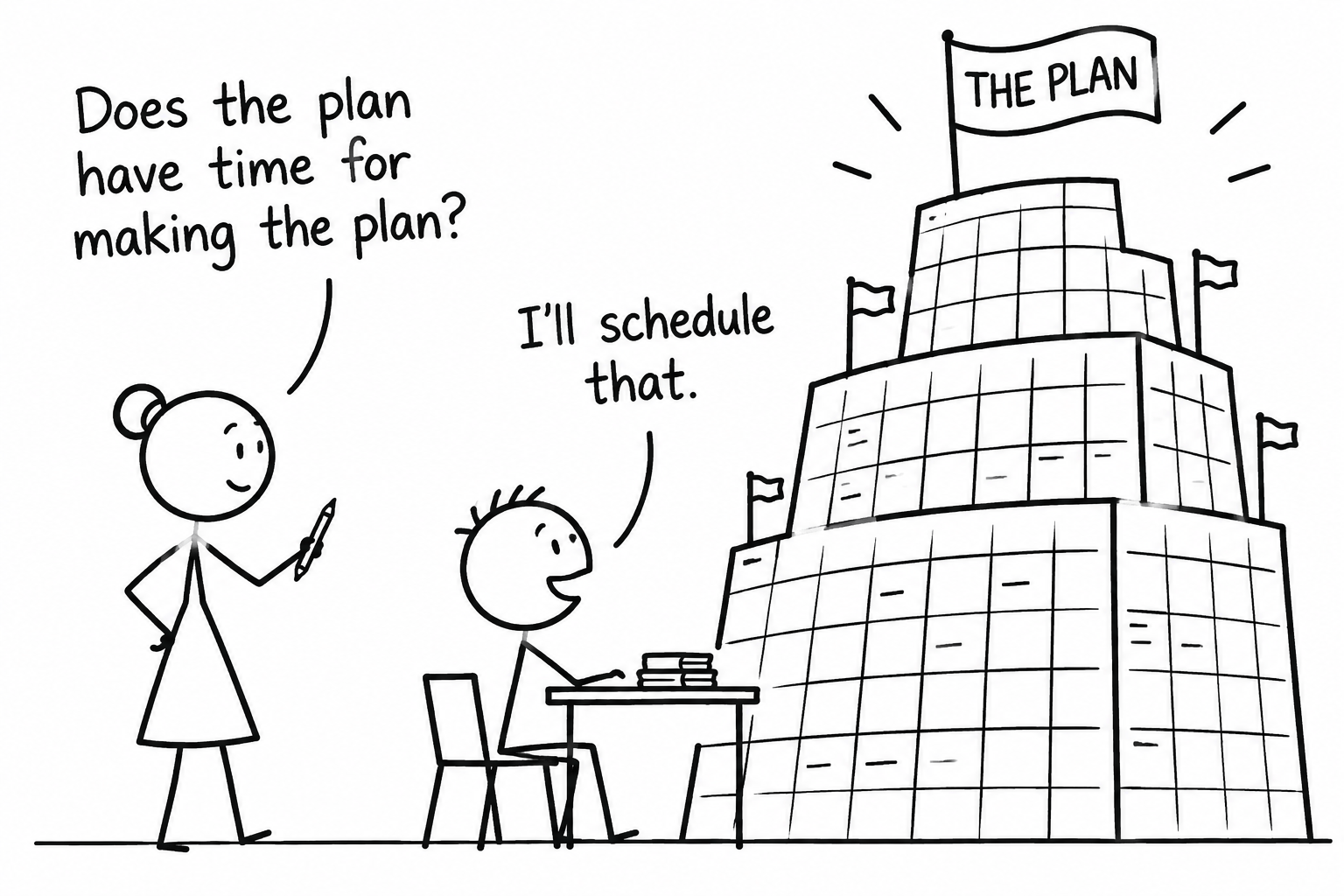 A student and parent wonder whether planning the revision plan needs its own place in the calendar
The final 8-12 weeks: shift towards exam practice
As exams approach, revision should become more specific. Continue repairing subject knowledge, but add timed questions, past papers and careful marking.
The GCSE papers collection organises past papers, predicted papers and mini tests by subject and exam board. This matters because Edexcel, AQA, OCR and Eduqas specifications and paper structures are not interchangeable. Check that every resource matches your course and tier.
Full papers are valuable, but they are not always the right starting point. If one topic is causing trouble, focused GCSE maths mini tests can provide quicker feedback. Longer timed practice becomes more useful once enough of the course has been covered.
The final two weeks: consolidate rather than panic
In the last fortnight, avoid trying to relearn every page of every textbook. Use recent test results and marked papers to choose the gaps most likely to improve your performance.
Review key facts and methods, practise working under time pressure and protect your sleep. This stage is about making knowledge accessible in the examination, not proving how many hours you can remain at a desk.
What if you are starting GCSE revision late?
Start today, but start selectively.
If exams are six weeks away, list every subject and choose a small number of high-priority areas in each one. Give priority to topics that appear on your specification, have been identified by teachers and repeatedly cost you marks.
If exams are two weeks away, focus on retrieval, exam-style questions and correcting recurring mistakes. Do not spend half a day designing a beautiful timetable. A simple plan followed consistently is more valuable than an elaborate plan followed once.
Students who are short of time can also use shorter tests before committing to full papers. MathsGenie's 45-minute GCSE maths tests offer timed practice with mark schemes and worked solutions where available.
Starting late changes the order of priorities. It does not remove the value of starting.
How parents can support the starting point
Parents often notice the calendar before students do. That can produce a familiar cycle: the parent asks about revision, the student hears criticism, and the conversation becomes about effort rather than planning.
A calmer question is: “What is the first exam or mock, and what needs to happen before it?”
Help your child find exam dates, create a workable space and break the first task into something concrete. Avoid measuring progress only in hours. Completed questions, corrected errors and topics successfully recalled provide better evidence that revision is working.
Parents can also help protect rest. A plan should survive ordinary school life. If it assumes perfect energy every evening, it is not yet a realistic plan.
Common GCSE revision planning mistakes
Waiting until you feel motivated
Motivation often follows action rather than preceding it. Make the first session small enough to begin, such as recalling one topic and answering a short set of questions.
Starting at maximum intensity
A demanding Easter schedule cannot simply be copied into January. Increase the workload gradually so that revision remains sustainable alongside lessons and homework.
Revising every topic equally
Equal time feels fair, but it is rarely efficient. Use mock papers, mini tests and teacher feedback to identify where another session could recover the most marks.
Reading instead of retrieving
Notes can create a comforting sense of familiarity. Close the book, write down what you remember and then check the gaps. Revision should regularly require an answer, not just recognition.
Treating the timetable as permanent
A revision timetable is a working document. If a test shows that algebra is secure but probability remains weak, the next week should change. A plan becomes useful when it responds to evidence.
Turn your start date into a schedule
Knowing when to begin is only the first step. The harder gap is turning the weeks before fixed exam dates into sessions you can actually follow, especially when school and ordinary life interrupt the paper plan.
Build your day-by-day schedule in the MathsGenie Revision Planner.















