

What to Bring to Your GCSE Physics Exam
What to bring GCSE Physics exam day: permitted equipment, calculator rules, banned items and calm last-minute checks for every GCSE student.

There is a particular kind of exam-morning panic that has nothing to do with physics. It begins with a simple thought: Have I packed the right calculator? Then come the other doubts. Can you take a water bottle? Do you need a protractor? What happens to your phone?
Searching what to bring GCSE Physics exam should lead to a straightforward answer: take at least two black ink pens, an HB pencil, an eraser, a sharpener, a ruler, a compliant scientific calculator and any additional equipment named by your school or on the paper. Keep everything in a transparent pencil case. A clear, label-free water bottle is normally permitted.
Leave phones, watches, earbuds, notes and unauthorised materials outside the exam room. The details below explain the rules, including the less obvious ones that can cause problems.
Your GCSE Physics exam equipment checklist
Pack this the night before:
- At least two working black ink pens
- An HB pencil for graphs and diagrams
- An eraser and pencil sharpener
- A ruler with clear millimetre markings, ideally 30 cm30\text{ cm}30 cm long
- A compliant scientific calculator with working batteries
- A protractor if required by your paper or recommended by your centre
- A transparent pencil case
- A clear water bottle with its label removed, if wanted
- Your candidate card or identification, if your centre requires it
- Any approved access-arrangement equipment agreed with the exams officer
Requirements can vary between papers and exam boards. AQA papers may specify a ruler and protractor, while Pearson Edexcel GCSE Physics papers commonly list a calculator and ruler, with a protractor where relevant. OCR and Eduqas papers also state their required materials on the front cover.
Your school's instructions and the front of the question paper are the final authority. If either asks for something additional, follow that instruction.
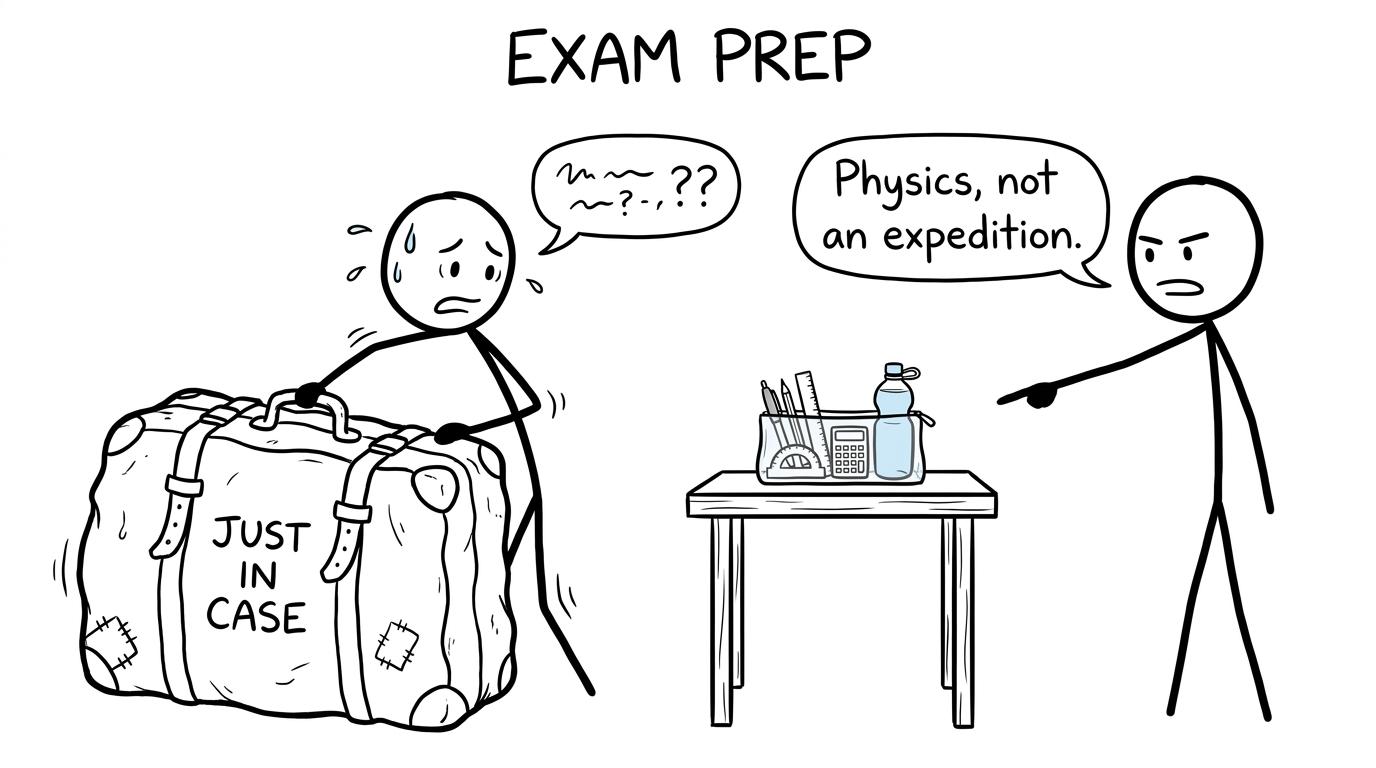 A student discovers that Physics needs a pencil case rather than an expedition suitcase
What you should bring into the exam
Two black ink pens
JCQ instructions require candidates to write clearly in black ink. Bring at least two pens because equipment tends to fail at exactly the moment it becomes inconvenient.
Use pencil only where appropriate, such as for graphs and diagrams. Coloured pencils or inks may be permitted for diagrams when the paper allows them, but your written answers should remain in black ink.
Avoid gel pens, erasable pens and blue ink. Exam scripts are often scanned for marking, so clear black ink is the safe standard.
A pencil, ruler, eraser and sharpener
Physics papers frequently include graphs, circuit diagrams, rays, scale drawings and measurements. A sharp HB pencil and a ruler with a clean edge help you produce accurate work.
A transparent 30 cm30\text{ cm}30 cm ruler is useful for drawing a line of best fit across a large graph. Pack an eraser and sharpener too, rather than relying on another candidate. Equipment must not be borrowed during the examination.
If graph work is a weak area, revisit drawing linear graphs before attempting a timed physics paper.
A suitable scientific calculator
Calculators are standard equipment for GCSE Physics and Combined Science physics papers unless the question paper says otherwise. Your calculator must comply with JCQ and exam-board regulations.
It must not provide:
- Communication with another machine or the internet
- Symbolic algebra manipulation
- Symbolic differentiation or integration
- Language translation
- Access to stored formulae, text, dictionaries or databanks
Clear any stored information before entering the exam. Remove cases, lids or covers containing printed instructions or formulae, and do not bring an instruction booklet or prepared program.
Check the batteries and practise using the exact calculator you will take. You should be comfortable entering powers, roots, brackets and standard form. Physics expressions such as
Ek=12mv2 E_k = \frac{1}{2}mv^2 Ek=21mv2can punish a missing bracket or square even when your physics is correct. MathsGenie's standard form revision guide can help you become quicker with scientific notation and calculator displays.
 A scientific calculator feels unusually appreciated after having its batteries checked
A protractor when the paper requires one
A protractor may be needed for ray diagrams, angles of incidence and reflection, or other scale work. Some papers explicitly list one; others do not.
Check your exam-board paper and your centre's equipment notice. If your centre permits it, keeping a clear protractor in your exam pencil case avoids having to remember which particular paper needs one.
A pair of compasses is not routine equipment for most GCSE Physics papers. Bring one only if your school or paper tells you to.
A transparent pencil case and water bottle
Any pencil case taken into the room must be see-through. Do not fill it with revision cards, scraps of paper or packaging containing text.
You may normally take in water in a transparent bottle with the label removed. Some centres apply additional rules, so check their candidate handbook. Do not assume that coffee, an energy drink or an opaque reusable bottle will be accepted.
Food is usually kept outside unless your centre has authorised it for a medical reason. Speak to the exams officer in advance about medication, glucose treatments or other health requirements.
Do you need to bring an equation sheet?
No. Do not print and carry your own equation sheet into the exam.
For current GCSE Physics and Combined Science arrangements, the official equation sheet is supplied by the centre with the paper where applicable. Its layout and contents depend on the exam board and examination series. Your school should confirm the arrangements for your paper.
Practise with the official sheet before exam day so that you know where equations are located. Having a formula available does not remove the need to choose it, rearrange it and use consistent units. MathsGenie's changing the subject of a formula revision and conversions and units guide target two of the maths skills most likely to matter.
What to leave at home or outside the exam room
The important word in exam regulations is possession. An unauthorised item can create a malpractice issue even if it is switched off and you never intended to use it.
Do not have any of these with you at your desk or in your pockets:
- A mobile phone of any kind
- Any watch, including analogue, digital and smart watches
- Earphones, earbuds or headphones
- Smart glasses, tablets, music players or other communication devices
- Revision notes, flashcards, books or paper containing information
- Notes written on your hand, equipment or clothing
- Calculator instructions, printed formulae or unauthorised programs
- Correction fluid, correction tape or correcting pens
- Erasable pens or gel pens for answers
- A dictionary, unless specifically authorised
- An opaque pencil case
Highlighters must not be used in your answers. JCQ rules allow them for highlighting words or phrases in the question paper or supplied resource material, but leaving them outside your case removes the risk of accidentally using one in an answer.
Bags and coats must go wherever your centre instructs. Do not simply put your phone inside a bag under your desk. If you accidentally enter with a prohibited item, tell an invigilator before the examination starts.
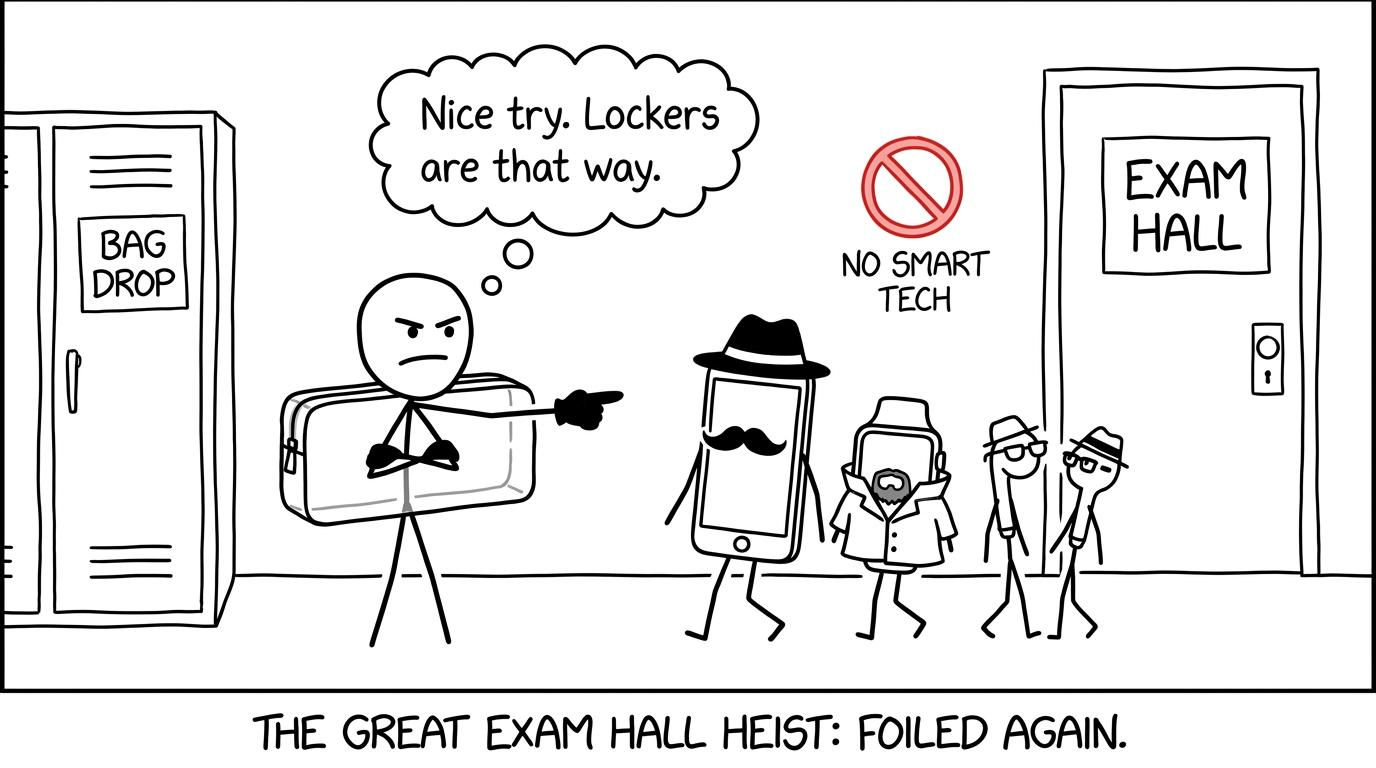 Phones and smart devices discover that disguises do not work on exam invigilators
Your calm night-before routine
Preparation works best when it removes decisions. Do these checks before going to bed:
- Confirm the exam date, start time, room, board, paper and tier
- Read your centre's candidate instructions
- Put all permitted equipment into a transparent case
- Test the calculator and clear its memory
- Remove the calculator cover if it contains instructions
- Remove the label from your water bottle
- Decide where your phone and watch will be stored
- Set an alarm and plan your journey
Then stop reorganising. The benefit of packing early is not merely that you remember everything. It is that your attention is still available for the paper.
For a realistic final check, complete an AQA GCSE Physics past paper or an Edexcel GCSE Physics past paper using only the equipment you will have in the hall. Mark it afterwards, then use the Edexcel Physics question bank to repair one specific weakness.
Common exam-equipment mistakes
Packing only one pen
One pen may be enough until it stops working. Two black ink pens create a simple layer of protection at almost no cost.
Taking a phone in because it is switched off
Switched off does not mean authorised. Follow your centre's storage procedure and check every pocket before entering.
Wearing an ordinary watch
The prohibition covers all watches, not just smart watches. Exam rooms should provide a visible clock and time warnings.
Forgetting to check the calculator
A calculator with weak batteries, an unfamiliar mode or a cover full of printed formulae is not ready for an exam. Test it the evening before, not while the invigilator is reading instructions.
Bringing a personal equation sheet
The authorised sheet is supplied by the centre. Your annotated revision copy must remain outside.
Assuming every Physics paper has identical requirements
Equipment can differ by board and paper. Consult your timetable, school notice and front-cover instructions rather than relying on what a friend taking another specification has packed.
Walk in prepared, then let the revision do its job
The right equipment cannot answer a six-mark explanation. But it can prevent avoidable stress, produce a cleaner graph and ensure that a calculation reaches the page exactly as you intended.
Pack the small things early. Leave the prohibited things outside. Then focus on the work that genuinely changes marks: understanding physics, handling equations and practising under exam conditions.
Use MathsGenie's free Edexcel GCSE Physics revision guides alongside practice questions, mark schemes, video solutions, mini tests, past papers and predicted papers. Add weak topics to your revision planner, practise with your real exam equipment and arrive knowing that the practical details have already been settled.










