

What to Bring to the GCSE Bengali Exam
What to bring to the GCSE Bengali exam, including permitted stationery, banned devices, dictionary rules and a practical exam-morning checklist.
There is a particular kind of exam-morning panic that has nothing to do with vocabulary. It begins with a small question: Am I actually allowed to take this in? Suddenly, the dictionary on your desk looks suspicious and the watch on your wrist feels dangerous.
If you searched what to bring GCSE Bengali exam, the short answer is simple: take at least two black pens in a clear pencil case, any school-required identification, and an unlabelled transparent water bottle if you want one. Leave dictionaries, notes, phones, watches, earbuds and smart devices at home or hand them in exactly as your school instructs.
The details matter, though. GCSE Bengali includes different assessments, while International GCSE Bangla is a separate qualification. Your paper instructions and your school's exams officer always have the final word.
Your GCSE Bengali exam checklist
Pack these items the evening before:
- At least two working black ballpoint pens
- A transparent pencil case or small clear plastic bag
- A pencil and eraser, although most Bengali responses should be written in black ink
- A transparent water bottle with its label removed, if your school permits water
- Any candidate card or identification specifically requested by your school
- Details of the exam time, room and arrival instructions
Check your exam entry as well. AQA GCSE Bengali is not the same qualification as Pearson Edexcel International GCSE Bangla. Confirm the awarding body, component, foundation or higher tier where applicable, and start time rather than relying on what a friend is sitting.
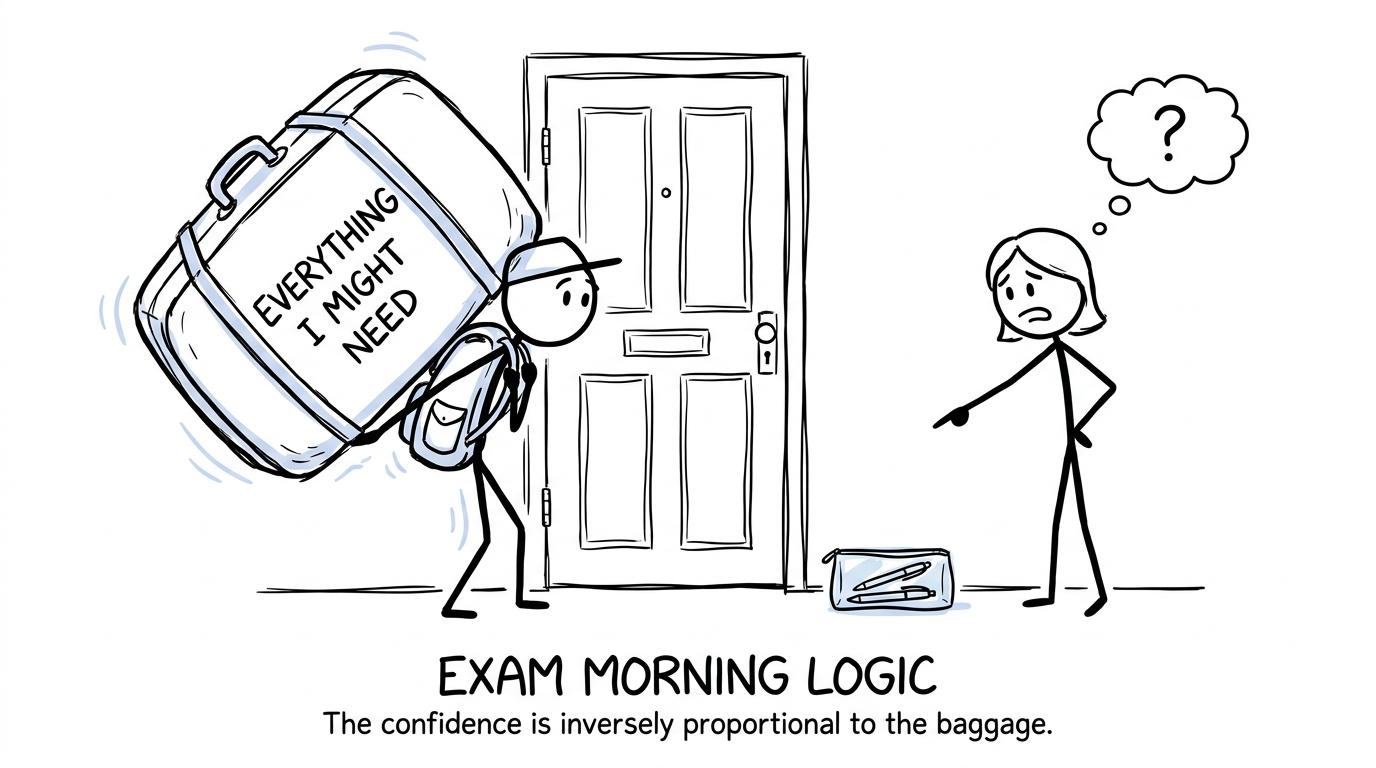 A student discovers that a tiny clear pencil case is calmer than an enormous exam suitcase
What you are allowed to bring
Two or more black pens
Current JCQ candidate instructions require written answers to be clear and in black ink. Take two black ballpoint pens at a minimum. Three is sensible if you know one pen has a habit of failing at inconvenient moments.
Avoid relying on a fountain pen or anything likely to smudge. Exam scripts are commonly scanned for marking, so a reliable black ballpoint pen is the safest choice. Blue ink is not an acceptable substitute unless the instructions on the paper explicitly say otherwise.
A clear pencil case
Any pencil case taken into the exam room must be see-through. A transparent case lets an invigilator confirm quickly that it contains only ordinary stationery.
Keep it sparse. Pens, a pencil and an eraser are enough for a Bengali written paper unless your school tells you to bring something else. Decorative cases, tins and opaque pouches should stay outside the room.
A pencil and eraser
A pencil can be useful for permitted planning or non-verbal responses, but final written answers should follow the instructions printed on the paper. Do not assume that a Bengali response written entirely in pencil will be treated in the same way as one written clearly in black ink.
An eraser is allowed as ordinary stationery. It is better to cross out an incorrect ink response neatly than to use correction fluid or tape.
A clear, unlabelled water bottle
JCQ's exam-day checklist permits a clear water bottle, but it must not have a label. Some centres set additional rules about bottle size or where it is placed, so check your school's instructions.
Water is optional. The useful principle is to remove decisions from the morning: fill the bottle and remove its label the night before.
School-requested identification
JCQ rules do not create one universal identification requirement for every school candidate. Your centre may nevertheless ask for a candidate card, timetable or photographic identification, particularly if you are sitting as a private candidate.
Bring only what your exams officer has requested. A revision card is not an identification card and must not enter the exam room.
What to leave at home or hand in
The safest rule is uncomplicated: if an item can store information, communicate, translate, record, play audio or tell the time, do not keep it on you in the exam room.
| Item | GCSE Bengali exam rule |
|---|---|
| Mobile phone | Prohibited, even if switched off |
| Analogue, digital or smart watch | Prohibited |
| Earphones, earbuds or AirPods | Prohibited |
| Smart glasses, tablets or music players | Prohibited |
| Revision notes or vocabulary lists | Prohibited |
| Bengali or bilingual dictionary | Not permitted for AQA GCSE Bengali |
| Computer spellchecker or translation tool | Not permitted unless specifically authorised |
| Correction fluid, tape or correcting pen | Prohibited |
| Erasable pen | Prohibited |
| Gel pen | Must not be used for answers |
| Highlighter | Must not be used in answers |
| Opaque pencil case | Prohibited inside the exam room |
Possession matters. JCQ warns that having unauthorised material is a breach of the rules even when a candidate did not intend to use it. A switched-off phone in a pocket is still a phone in your possession.
If you accidentally bring a prohibited item, do not hide it. Follow your centre's collection procedure or hand it to an invigilator before the examination begins.
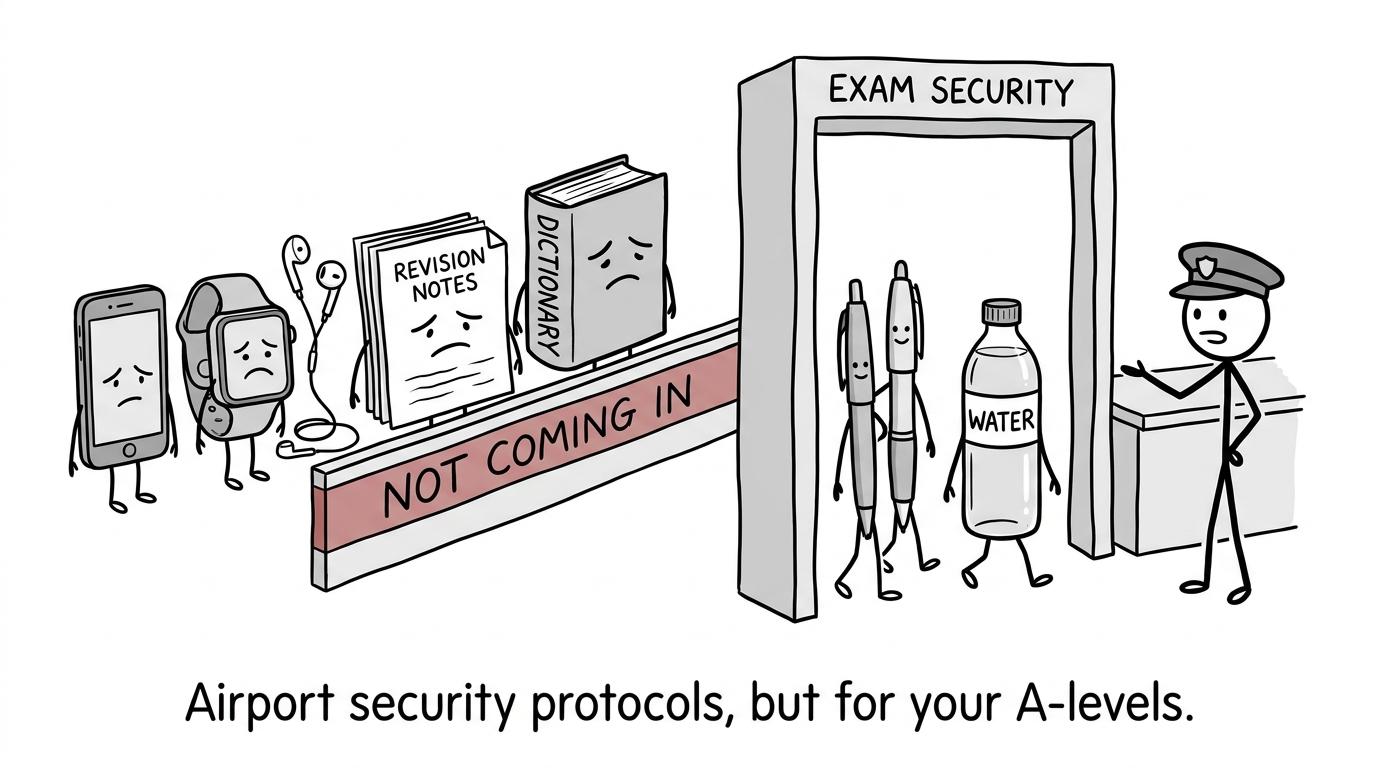 Exam stationery passes through an imaginary airport while banned technology waits behind the barrier
The GCSE Bengali dictionary rule
A dictionary feels like an obvious language-exam tool. That is precisely why students sometimes pack one without checking.
For AQA GCSE Bengali, access to dictionaries is not permitted during the listening, speaking, reading or writing assessments. That restriction also applies during the supervised preparation time for the speaking test. Pearson Edexcel International GCSE Bangla likewise states that dictionaries are not permitted, but it is a different qualification with a different assessment structure.
Do not bring:
- A Bengali-English dictionary
- An English-Bengali dictionary
- A Bengali-only dictionary
- A vocabulary book
- A dictionary application
- A translation device
An approved access arrangement is different from deciding independently to use a dictionary. If you have an agreed access arrangement, your special educational needs coordinator or exams officer will organise it. Do not supply your own resource unless the centre explicitly instructs you to do so.
Does the equipment change between Bengali papers?
Listening
Bring your normal clear pencil case and black pens. The centre provides and controls the recording arrangements. Personal headphones, earbuds and audio equipment must not be brought into the room unless the centre has formally arranged the equipment as part of the assessment.
Listen to the invigilator's instructions about reading time and when you may begin writing. Do not test or touch centre equipment unless asked.
Reading and writing
Black pens are the essential equipment. A calculator, geometry set and ruler do not help with the skills being assessed and should not clutter your desk. Dictionaries and prepared vocabulary remain prohibited.
Use only the answer spaces and additional sheets supplied by the centre. Add your candidate details to supplementary sheets when instructed.
Speaking
The speaking assessment is organised by your school rather than approached like an ordinary written paper. Under the AQA specification, candidates may make notes on the additional answer sheet provided during supervised preparation and may use those notes for the permitted part of the test. Those notes are controlled by the centre and handed in at the required point.
That does not mean you may arrive with prepared prompts, model answers or vocabulary cards. Bringing your own notes would breach the conditions. Your teacher will explain the precise procedure before the assessment.
A calm packing routine for the night before
Exam preparation works best when important choices are made before anxiety arrives. Use this routine:
- Check the awarding body, component, tier, date and start time.
- Read your school's candidate instructions.
- Put two or three black pens in a clear pencil case.
- Add a pencil and eraser.
- Remove the label from your transparent water bottle.
- Take your watch off and leave it at home.
- Put revision notes away from your exam bag.
- Decide how and when you will travel.
- Set an alarm that leaves time for delays.
Then stop packing. More equipment does not create more readiness.
The same principle helps with maths. Before another GCSE paper, use the MathsGenie revision planner to organise what remains, or follow the GCSE maths night-before plan instead of attempting an unfocused late-night revision marathon.
What to do when you arrive
Arrive at the time specified by your school, not merely at the printed start time. Centres need time to seat candidates and complete checks.
Before entering:
- Check your pockets for a phone, watch, notes or earbuds.
- Follow the centre's procedure for bags and electronic devices.
- Tell an invigilator immediately if you still have an unauthorised item.
- Enter silently when instructed.
- Wait before writing anything.
- Check that you have the correct paper and tier.
Once formal examination conditions begin, do not talk to another candidate. Raise your hand if you need additional paper, feel unwell or think something is wrong with the materials. An invigilator can explain procedures, but cannot explain the meaning of an exam question.
Common mistakes to avoid
Assuming a switched-off phone is allowed
It is not. The issue is possession, not whether the device is active. Use your school's secure hand-in system or leave the phone elsewhere.
Wearing an ordinary analogue watch
The ban covers all watches, not only smartwatches. Examination rooms should provide a visible clock or another approved way to monitor time.
Packing a dictionary because it is a language exam
GCSE Bengali assesses what you can understand and produce without dictionary support. Leave printed and electronic dictionaries at home.
Bringing prepared speaking notes
Only notes produced under the official supervised conditions may be used in the way specified by the awarding body. Personal prompts prepared beforehand are not allowed.
Using correction fluid or an erasable pen
Cross out mistakes neatly and continue. Correction fluid, correction tape and erasable pens are prohibited under the candidate instructions.
Following a generic checklist instead of the paper
Rules can vary by qualification and component. The front of the question paper, your awarding body's specification and your exams officer's instructions take priority over any general article.
Prepare once, then focus on the paper
The point of an exam checklist is not to make the morning feel more official. It is to protect your attention. When your pens work, your phone is safely elsewhere and your dictionary has never entered the bag, there is less noise between you and the paper.
Use the same quiet preparation across your GCSEs. Start from the free GCSE maths revision hub, organise sessions with the one-month GCSE revision plan, and confirm that you are practising the correct content through the GCSE topics by exam board and tier guide.
When it is time to test yourself, use Edexcel GCSE maths past papers or the relevant board collection, mark every attempt carefully and repair weak topics with MathsGenie's revision lessons, practice questions and video solutions. Mini tests and predicted papers can then sharpen your final preparation.
Pack the Bengali essentials tonight. Leave the prohibited items behind. Then let the exam measure your language skills rather than your ability to improvise at the door.











