

What Is A Level Latin? Course and Exams Explained
What Is A Level Latin? Explore the OCR course, four exam papers, skills, workload and entry requirements, and decide whether it suits you after GCSE.
Choosing A Levels can feel strangely permanent. At GCSE, your timetable was largely built for you. Now every subject choice seems to say something about the person you will become.
So, what is A Level Latin? It is an advanced language and literature qualification in which students translate original Latin, analyse grammar, study Roman prose and poetry, and write critically about set texts. In England, the current OCR A Level Latin qualification is assessed through four written examinations. Half of the course focuses on language and half on literature.
It is demanding, but its appeal is unusually clear: Latin combines the precision of solving a puzzle with the interpretation of history and literature.
A Level Latin at a glance
Before looking more closely, here is the essential checklist:
- The qualification normally takes two years.
- OCR is the exam board offering the current A Level Latin qualification in England.
- You study advanced vocabulary, grammar, syntax and word forms.
- You translate unseen prose and verse into English.
- You choose between prose composition and comprehension in one language paper.
- You study prescribed prose and verse literature in Latin and in translation.
- Assessment is entirely by written examination, with no coursework.
- The course builds on GCSE Latin, although OCR does not formally require the GCSE qualification.
- Individual schools and colleges may set their own entry grades.
That last distinction matters. An exam board can say that GCSE Latin is not a formal requirement while a sixth form can still decide that students need a particular grade. Always check the published entry criteria of the school or college you are considering.
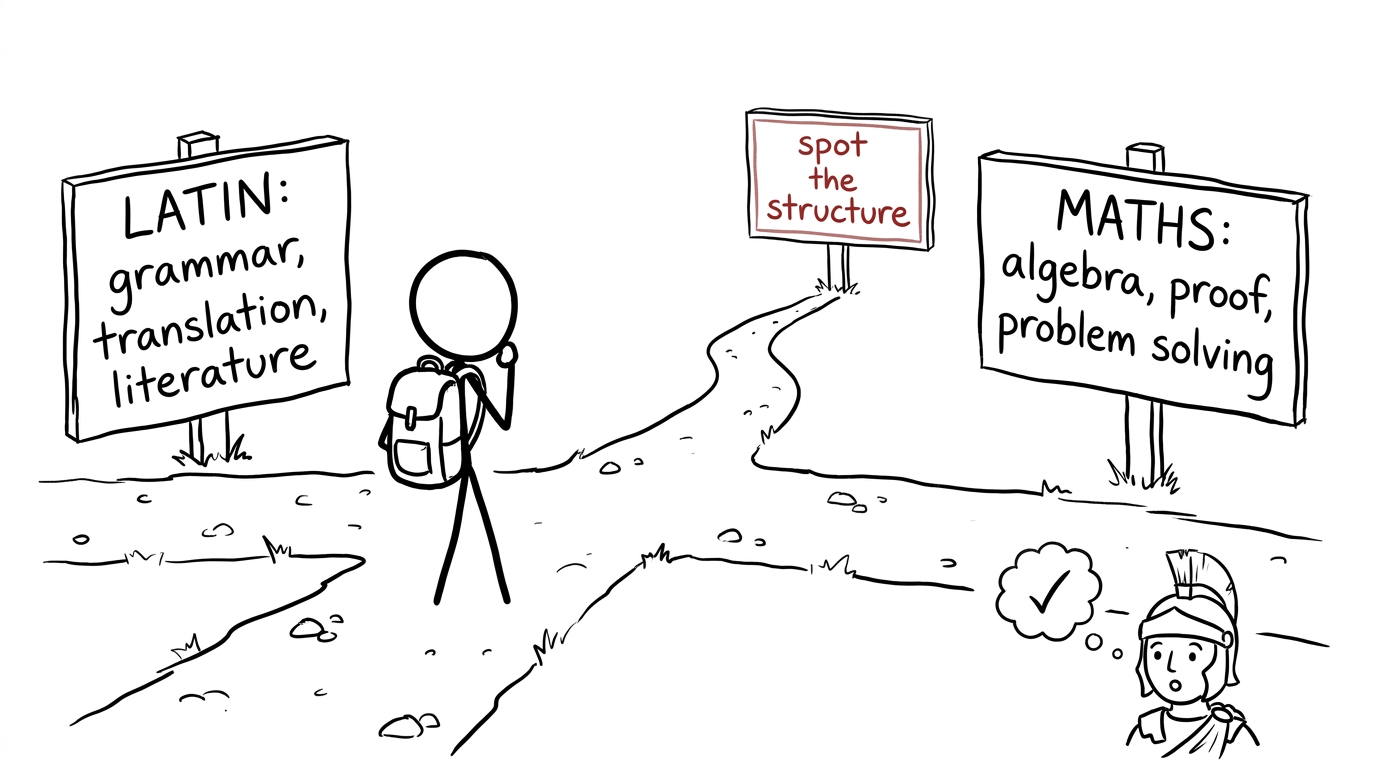 A student discovers that Latin and maths both reward spotting structure
What do you study in A Level Latin?
A Level Latin is not simply a longer GCSE vocabulary test. The course develops two connected areas: language and literature.
Latin language
You learn to recognise a wider range of vocabulary, accidence and syntax. Accidence concerns how words change their forms, while syntax concerns how those words work together in a sentence.
A Latin sentence can place words in an order that feels unfamiliar to an English reader. You therefore learn to use evidence from case endings, verb forms, agreement and context rather than translating mechanically from left to right.
The language course includes:
- nouns, pronouns and adjectives across different cases;
- verbs in a wide range of tenses, moods and voices;
- participles, infinitives, gerunds and gerundives;
- subordinate clauses and indirect statements;
- translation of unseen prose and poetry;
- analysis of grammatical forms;
- either comprehension or translation from English into Latin.
OCR does not restrict the full A Level to one defined vocabulary list. Wider reading and regular vocabulary learning therefore become important. The goal is not to memorise every word ever written in Latin. It is to build enough knowledge, pattern recognition and judgement to approach unfamiliar passages intelligently.
Prose and verse literature
The other half of the qualification involves close study of Roman writing. You examine prescribed prose and verse passages in the original Latin, alongside additional material in English translation that establishes the wider context.
This is where the subject moves beyond decoding. You consider how an author creates emphasis, persuades an audience, presents a character or controls the pace of a scene. You may discuss features such as word order, imagery, sound, rhetoric and metre, but always in relation to meaning.
Set texts change according to the examination cycle. Do not rely on an older student’s reading list or an old online summary. Your teacher should confirm the texts assigned to your exam year using the current OCR specification.
How is A Level Latin assessed?
OCR A Level Latin, qualification code H443, has four externally assessed written papers.
| Paper | Length | Marks | Qualification weighting |
|---|---|---|---|
| Unseen Translation | 111 hour 454545 minutes | 100100100 | 33%33\%33% |
| Prose Composition or Comprehension | 111 hour 151515 minutes | 505050 | 17%17\%17% |
| Prose Literature | 222 hours | 757575 | 25%25\%25% |
| Verse Literature | 222 hours | 757575 | 25%25\%25% |
Together, the two language papers contribute 50%50\%50% of the qualification. The prose and verse literature papers contribute the remaining 50%50\%50%.
Unseen Translation
This paper tests translation from Latin into English. Students translate an unseen prose passage and an unseen verse passage. They are also required to scan two lines of verse, identifying the metrical pattern.
An unseen passage is not supposed to be instantly familiar. The task is to remain methodical when the whole answer is not obvious. Secure endings, careful sentence division and sensible English matter more than an inspired guess.
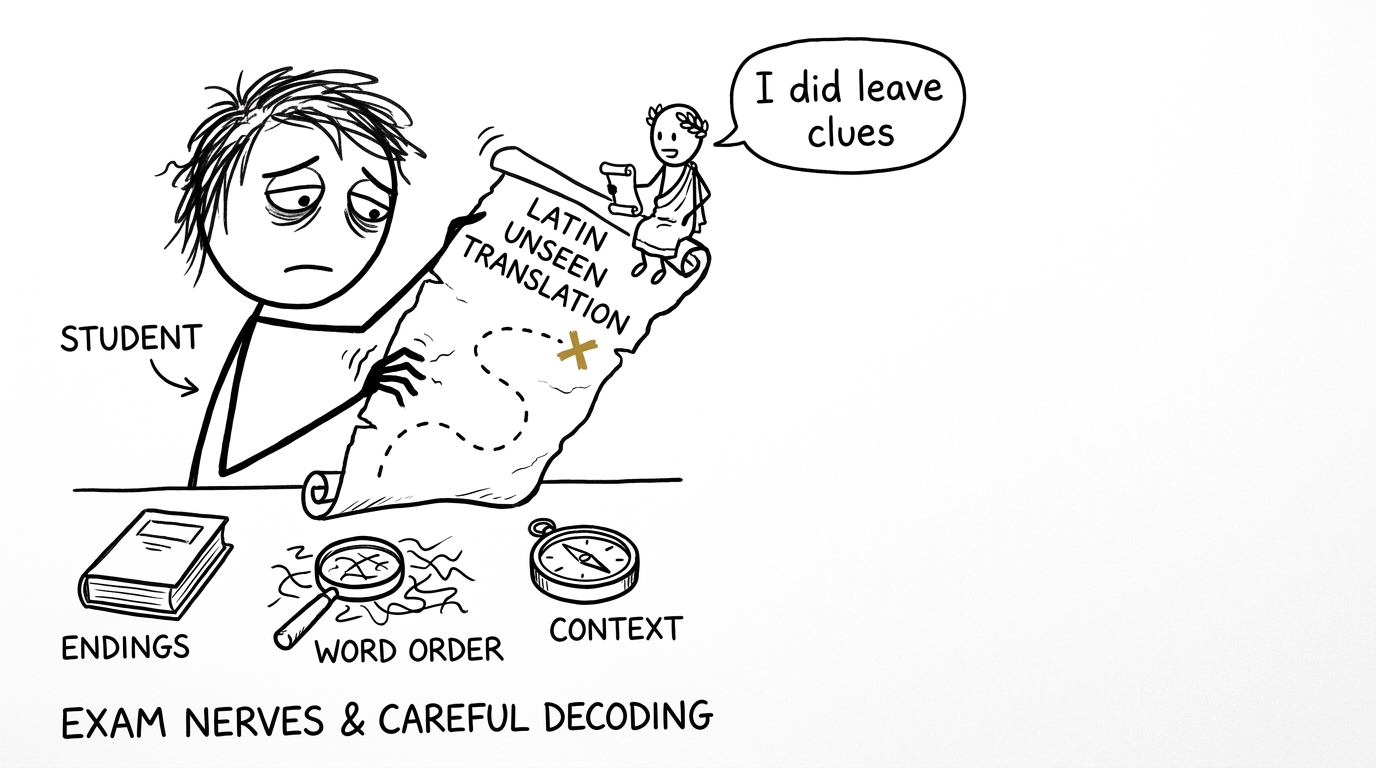 A student treats an unseen Latin passage as a mystery map with clues
Prose Composition or Comprehension
For this component, candidates take either a prose composition route or a comprehension route.
Prose composition involves translating a continuous English passage into Latin. Comprehension tests understanding of an unseen Latin prose passage through questions, shorter translations and grammatical analysis. Your school will normally teach the route it considers most suitable, so ask how that choice is made.
Prose Literature and Verse Literature
These papers test knowledge of the prescribed texts and the ability to analyse them critically. You need to understand the Latin, know the wider narrative or historical setting, and support interpretations with precise references.
Success is not just recalling a prepared list of techniques. An observation only becomes useful when you explain its effect and connect it to the author’s purpose, tone, argument or characterisation.
Is A Level Latin difficult?
Yes, A Level Latin is academically demanding. That does not mean it is reserved for people who translate effortlessly at GCSE.
The main challenge is accumulation. Vocabulary, endings and constructions build over time, while literature requires both detailed knowledge and extended analytical writing. Missing several weeks of small tasks can create a larger gap than one dramatic revision session can repair.
The subject may suit you if you enjoy:
- finding patterns in complicated material;
- working carefully rather than rushing;
- language, literature, history or mythology;
- explaining how evidence supports a conclusion;
- improving through regular, independent practice.
There is a useful connection with maths here. Translation and algebra are different disciplines, but both reward disciplined attention to structure. In maths, a symbol has a role within an expression. In Latin, an ending helps establish a word’s role within a sentence. In both subjects, a small overlooked detail can alter the entire answer.
If you are protecting your GCSE maths grade while researching A Level choices, use the GCSE Maths revision hub to keep topic work organised. Clear GCSE revision guides can reduce the time spent searching for explanations and leave more room for your other subjects.
Do you need GCSE Latin first?
The OCR specification states that A Level Latin builds on the knowledge and skills developed at GCSE, but prior attainment of GCSE Latin is not formally required by OCR.
In practice, the course begins at an advanced level. Many schools therefore require GCSE Latin, often with a particular minimum grade. Requirements vary between institutions, and a grade quoted by one sixth form is not a national rule.
If you have not taken GCSE Latin, ask the course provider three direct questions:
- Will it accept a student without the qualification?
- What grammar and vocabulary must be learnt before September?
- Is bridging tuition or independent preparation available?
Do not assume that enthusiasm alone removes the knowledge gap. Equally, do not assume that the absence of a GCSE makes the route impossible. The answer depends on the provider and the support available.
What skills can A Level Latin develop?
A Level Latin develops close reading, accurate written expression, grammatical awareness and evidence-based argument. It also requires students to move between detail and context: first identifying what a particular word is doing, then explaining how it contributes to a whole speech, poem or narrative.
These skills can support further study in subjects including Classics, ancient history, English, languages, history, law and linguistics. Some university Classics courses require or prefer previous Latin for particular routes, while others provide beginners’ pathways. University requirements change, so check current course pages before shaping your A Level choices around one future degree.
Latin should not be chosen merely because it sounds impressive. A qualification becomes valuable when you can study it well, explain what it taught you and connect its skills to your next step.
How to balance Latin with GCSE and A Level maths
The quiet risk in a mixed subject combination is not difficulty. It is irregularity. Both Latin and maths punish long gaps because each new idea rests on earlier knowledge.
A practical weekly rhythm is:
- short Latin vocabulary retrieval on several days;
- one focused grammar session;
- regular translation rather than one long monthly attempt;
- scheduled maths topic practice;
- one timed or mixed assessment task;
- correction time after every test.
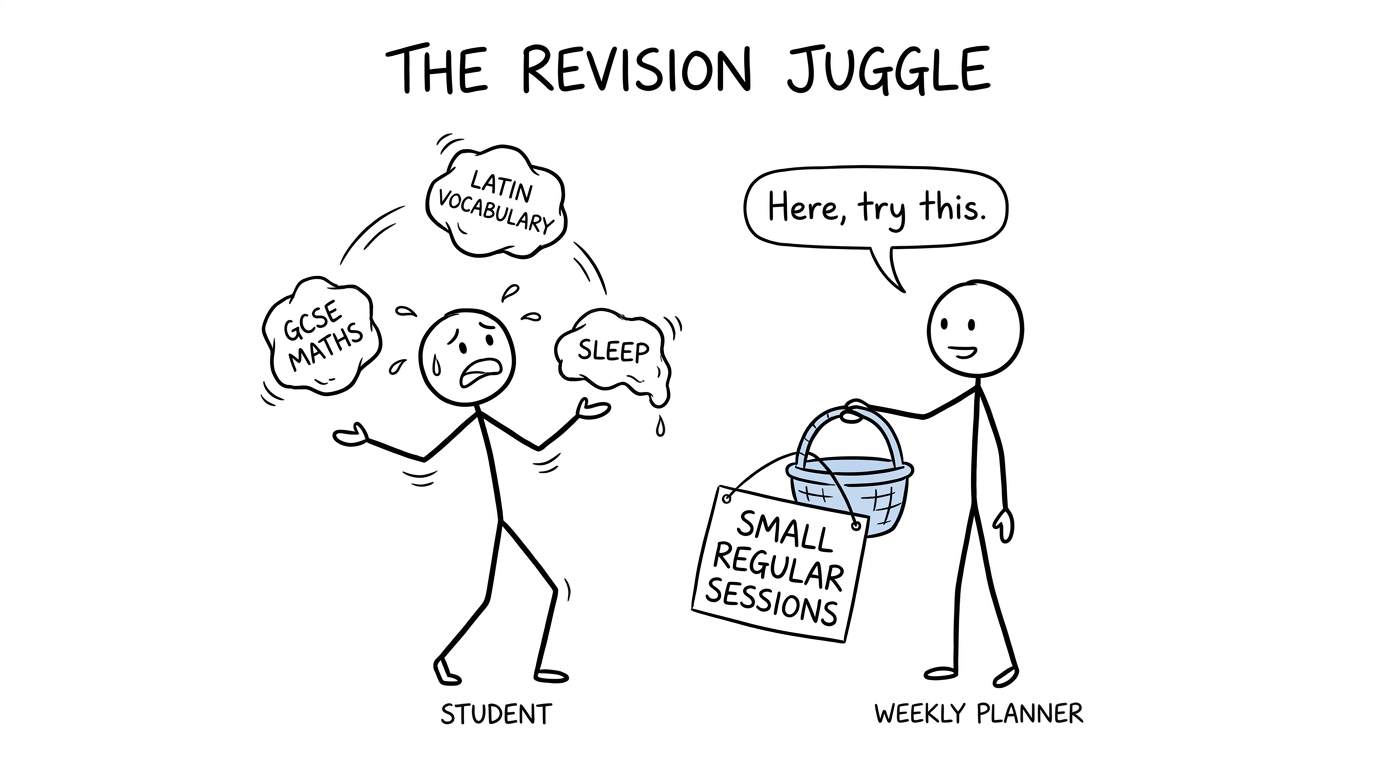 A weekly planner rescues a student juggling Latin, maths and sleep
For your current exams, the GCSE one-month maths revision plan shows how to turn a large syllabus into manageable sessions. You can diagnose weaker areas with MathsGenie’s GCSE revision resources and mini tests, then use board-specific practice such as Edexcel GCSE Maths past papers.
If you plan to take both subjects after Year 11, the A Level Maths revision hub provides lessons, questions and papers across the main exam boards. Later in the course, A Level predicted papers can add fresh exam-style practice after your foundations are secure.
Common mistakes when deciding whether to take Latin
Assuming it is only translation
Translation is central, but literature accounts for half of the qualification. You must be willing to analyse writing and construct supported arguments as well as learn grammar.
Treating school entry grades as national rules
OCR does not formally require GCSE Latin, but individual schools may impose their own requirements. Check locally rather than relying on a friend’s sixth form prospectus.
Looking at the wrong set texts
Prescribed literature changes between exam cycles. Make sure any books or revision materials match the year in which you will sit the examination.
Choosing it for prestige alone
Two years is a long time to spend on a subject you do not enjoy. Choose Latin because its combination of language, literature and ancient culture interests you, not because the title sounds unusual.
Revising through rereading
Recognition is not retrieval. Cover vocabulary and recall it, parse forms without notes, translate fresh passages and plan literature responses from memory. Then use feedback to decide what to revisit.
Is A Level Latin right for you?
A Level Latin is a two-year course in advanced Latin language and Roman literature, assessed through four OCR examinations. It asks you to translate unfamiliar prose and poetry, understand sophisticated grammar, study prescribed texts and explain how writers create meaning.
The best next step is simple: read your sixth form’s course description, ask about entry requirements and set texts, and look at a current specimen or past paper with your Latin teacher. Notice your reaction. Difficulty is expected; curiosity is the more important signal.
Meanwhile, keep your present grades moving. Use MathsGenie’s free revision lessons and practice questions to repair topic gaps, mini tests to check recall, and mark schemes and video solutions to understand lost marks. Then build exam confidence with past papers and predicted papers. Subject choices shape the next two years, but dependable revision habits shape what you can do with them.











