

Week Before A-Level Results Day: 7-Day Plan
Week before A-Level results day: use this calm seven-day checklist to prepare for Clearing, organise UCAS details and plan your next steps for 2026.
The week before A-Level results day can feel strangely difficult. The examinations are finished, the marking is out of your hands, yet your mind keeps trying to calculate every possible outcome.
Preparing for A-Level results does not mean predicting your grades. It means making sure that, whatever appears on the screen or results sheet, you know your next sensible step. For students receiving A-Level, AS or T Level results in 2026, results day is Thursday 13 August.
This seven-day checklist helps you prepare calmly, including for Clearing, without allowing results day to consume your final week.
Your final-week overview
By results morning, aim to have:
- confirmed when and how your school or college releases results;
- tested your UCAS Hub sign-in details;
- reviewed your firm and insurance offers;
- researched several realistic Clearing alternatives;
- collected your UCAS details and relevant documents;
- prepared a quiet place, charged phone and note-taking system;
- spoken to someone you trust about the support you may want.
Clearing preparation is insurance, not a forecast. Creating a Plan B does not make Plan A less likely.
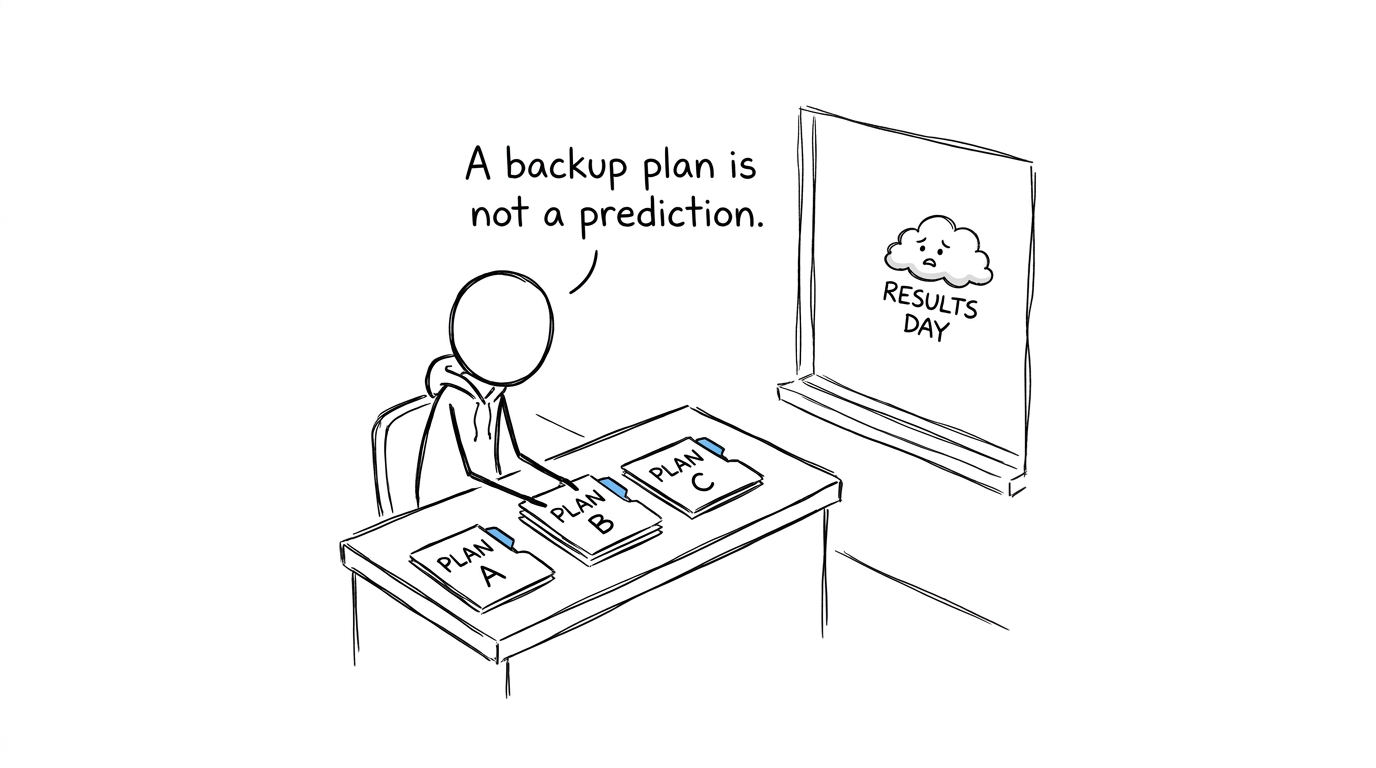 A student calmly organises Plan A, Plan B and Plan C before results day
Seven days before: confirm the practical details
Check your school or college website, emails and student portal. Find out when results become available, whether you should attend in person and who will be available to advise you.
Then sign in to UCAS Hub. Check that your contact details are current and that you can access the email address attached to your application. Keep your UCAS Personal ID secure and accessible.
Do this now rather than on results morning. A forgotten password is a small problem on an ordinary day and a large distraction on a busy one.
Six days before: revisit your offers
Read the exact conditions for your firm and insurance choices. Record the university, course title, course code and required grades in one document.
Do not try to convert remembered marks from Edexcel, AQA, OCR or Eduqas papers into a final grade. Grade boundaries are set after examinations have been marked, so online guesses cannot confirm your result.
If waiting has renewed your interest in the subject, the free A-Level Maths revision hub remains available for reviewing topics and preparing for what comes next.
Five days before: build a Clearing shortlist
Clearing is a route for finding courses with vacancies. Researching it does not commit you to using it.
Choose a small number of courses you would genuinely consider. For each one, note:
- the university and course name;
- location and accommodation considerations;
- published entry requirements;
- course structure and optional modules;
- the official admissions or Clearing telephone number;
- two reasons the course suits you;
- questions you need the university to answer.
Use official UCAS and university information when checking current vacancies. Course availability can change, particularly around results day.
Four days before: prepare your information
Create one results-day folder, either on paper or digitally. Include your UCAS Personal ID, offer details, personal statement, GCSE results, predicted A-Level grades and Clearing shortlist.
Your Clearing number will appear in UCAS Hub if you become eligible, so you cannot necessarily prepare that number in advance. You can, however, know where to find it.
Universities normally need to speak to the applicant. A parent or trusted adult can support you, but should not take over unless the university has permission to discuss your application with them.
Three days before: practise a Clearing conversation
You do not need a theatrical sales pitch. Prepare short, honest notes covering:
- why you are interested in the subject;
- why that particular course appeals to you;
- relevant academic interests or experience;
- the questions you want to ask;
- any circumstances you may need to explain.
Practise saying your UCAS ID, grades and course title clearly. During a real call, write down the adviser’s name, any offer conditions and the deadline for responding. Do not add a Clearing choice in UCAS Hub until the university instructs you to do so following an offer.
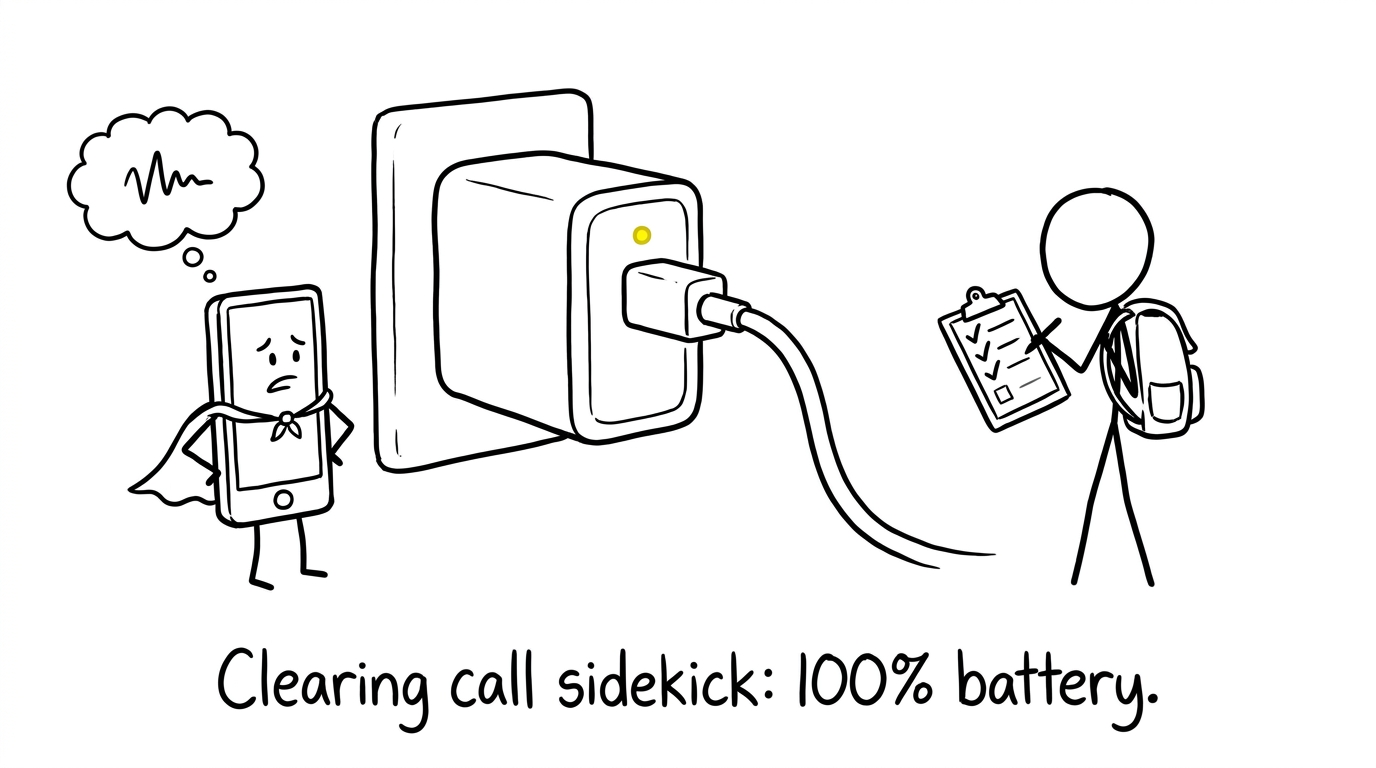 A fully charged superhero phone waits beside a Clearing checklist
Two days before: decide how you want support
Tell a parent, carer, friend or teacher what would actually help. You might want someone beside you, available by telephone or ready to give you quiet space.
Agree not to compare results immediately with friends. Their grades do not alter your options. Also decide what you will do if your place is confirmed, if you narrowly miss an offer or if you enter Clearing. A simple decision tree reduces the number of choices you must make while emotional.
One day before: stop researching
Check your folder once, charge your phone and laptop, place a charger nearby and set an alarm. Keep results day free if possible.
Then stop refreshing forums and speculative grade-boundary posts. Eat normally, do something absorbing and aim for a regular bedtime. Rest cannot change your result, but it can improve how clearly you respond to it.
If you are considering a maths resit later, avoid making that decision before seeing your results and receiving advice. Resources such as Edexcel A-Level Maths revision, A-Level predicted papers, topic-by-topic A-Level questions and AQA sequences and series revision will still be there when you have a considered plan.
Common mistakes during the final week
Treating Clearing as failure
Clearing is an application route, not a judgement about your ability. Researching alternatives gives you more control.
Relying on one backup course
Vacancies and entry requirements can change. Prepare several courses you would honestly be willing to accept.
Letting someone else manage everything
Support is valuable, but you should understand your choices and be ready to speak for yourself.
Accepting the first option in panic
Ask about course content, accommodation, costs and deadlines. An available place is not automatically the right place.
Planning a resit immediately
Wait for your confirmed grades, speak to your school or college and investigate the practical implications. If a resit becomes appropriate, return to MathsGenie’s free revision resources for lessons, practice questions, past papers, predicted papers, mark schemes, video solutions and mini tests.
Meet results day with a plan
The useful work in the week before A-Level results day is quiet work: checking details, researching alternatives and deciding whom you will call. None of it predicts what your envelope or UCAS Hub will show. It simply gives your future self a clearer path.
Save this results day and Clearing preparation guide, complete one task each day and then step away. Whatever your result, MathsGenie remains ready for your next chapter, whether that means preparing for university, strengthening your maths or planning a well-supported resit.











