Using Mock Results to Choose Foundation or Higher
Using mock results to choose foundation or higher: a calm GCSE Maths guide for students and parents, with tier checks, practice and clear next steps.
November mock season can make one number feel much larger than it is. A paper comes back, the mark is circled, and suddenly it seems to predict everything that will happen in summer.
It does not.
Using mock results to choose foundation or higher means looking beyond the headline grade. A mock is diagnostic evidence: it shows which topics are secure, where marks were lost and how a student responded to that particular paper under timed conditions. It should inform the tier decision, not make the decision alone.
For most students, the practical question is this: which tier offers the best combination of an achievable grade, suitable questions and room to progress? The answer becomes clearer when November's result is followed by careful review and targeted practice through December.
The foundation or higher checklist
Before changing tier, consider all of the following:
- the grade and raw mark across the complete set of mock papers
- whether the mock matched the correct exam board specification
- performance on shared grade 4 and grade 5 content
- marks lost through missing knowledge, weak method or exam technique
- results from classwork, topic tests and earlier assessments
- how the student performs after two to four weeks of targeted revision
- the student's likely summer target and any sixth-form entry requirement
- the maths teacher's recommendation
The final entry is normally managed by the school. Students and parents should treat this checklist as a structure for a productive conversation, rather than attempting to select a tier from one grade boundary.
What each GCSE Maths tier allows
Foundation tier is designed to award grades 1-5. Higher tier is designed for grades 4-9, with a narrow grade 3 safety net available when a candidate narrowly misses grade 4. This broad structure applies across the main GCSE Maths specifications in England, including Edexcel, AQA and OCR.
The overlap matters. Grades 4 and 5 can be achieved on either tier, but the experience of reaching them is different.
| Foundation tier | Higher tier |
|---|---|
| Grades 1-5 are available | Grades 4-9 are available, with a narrow grade 3 safety net |
| Questions build towards grade 5 content | Includes substantially more demanding algebra, geometry and problem-solving |
| Grade 5 is the maximum | Grades above 5 remain available |
| Often appropriate when securing grade 4 or 5 is the priority | Often appropriate when grade 6 or above is a realistic goal |
Foundation is not the lesser choice, and higher is not automatically the braver one. A good tier entry places a student where their knowledge can produce the strongest possible outcome.
A student consistently working towards grade 4 may be able to demonstrate more of what they know on foundation. Another student whose November mock produced a grade 5, but who showed secure algebra and collected marks throughout the higher paper, may have clear potential to move towards grade 6 or beyond.
November: read the mock as evidence
Imagine a Year 11 student receiving a higher-tier mock result in late November. The grade is below their target, so the first reaction is disappointment. Yet the marked papers reveal something more useful.
They answered most number and statistics questions accurately. They lost several marks because they did not show working. Two algebra topics had not yet been taught. On the final questions, they selected sensible methods but made arithmetic errors.
That is not the same situation as a student who found most of the paper inaccessible. The grades might match, but the evidence does not.
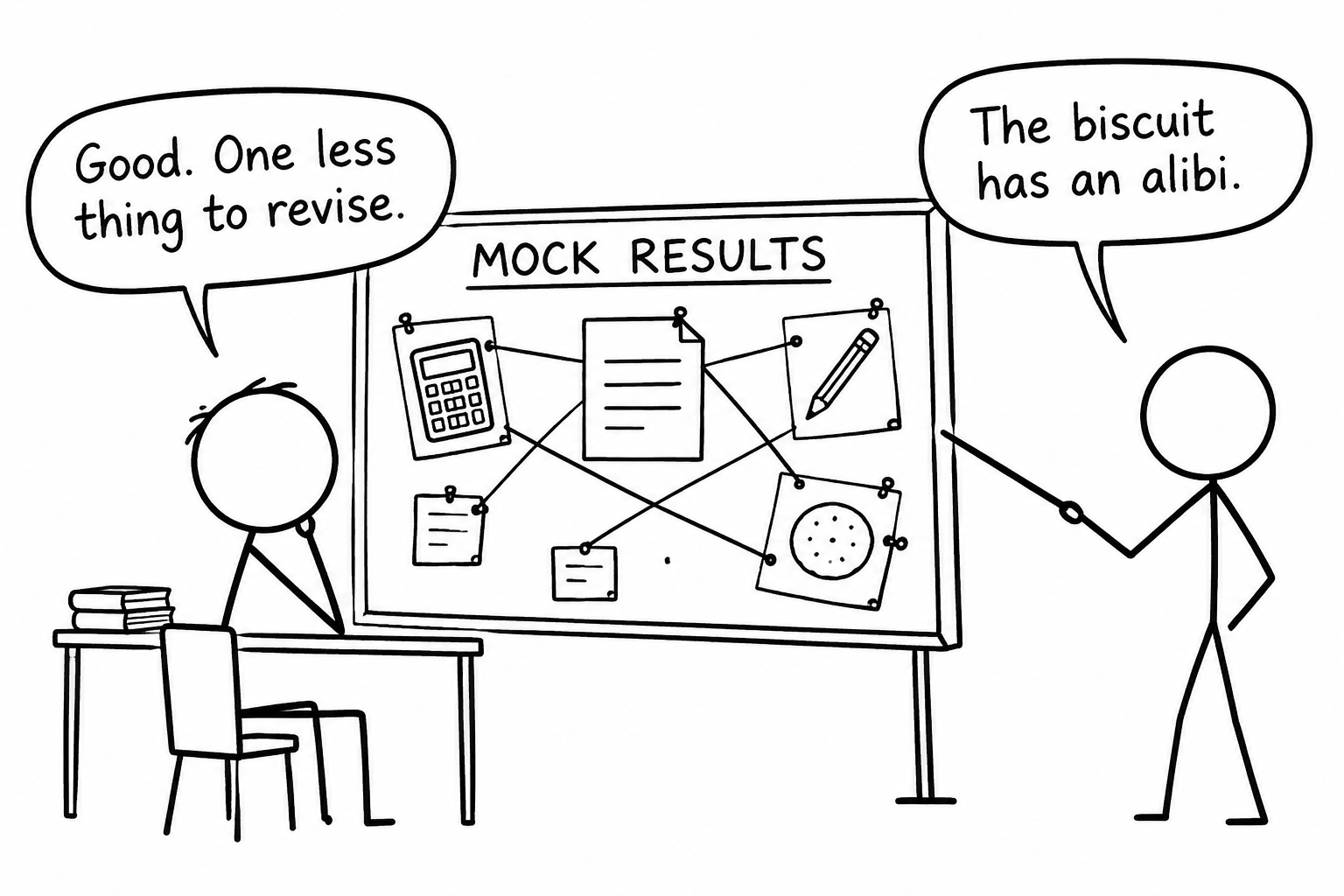 A student investigates mock results using a detective board while a biscuit receives an alibi
When reviewing GCSE maths mocks, sort lost marks into four groups:
- Knowledge: the topic or fact was not known.
- Method: the topic was recognised, but the process was incomplete.
- Accuracy: the method was sound, but arithmetic or algebra went wrong.
- Exam technique: the question was misread, working was omitted or time was poorly managed.
This classification changes the next step. Missing knowledge calls for a revision lesson and focused questions. Accuracy needs slower checking. Timing improves through papers under controlled conditions. A tier change is most relevant when a large proportion of the paper remains inaccessible even after teaching and practice.
Students can use the MathsGenie GCSE resources to revisit weak topics through revision lessons, exam-style practice questions and video support. The purpose is not to redo everything. It is to repair the gaps exposed by the mock.
December: test whether the picture changes
A mock result is a snapshot. December provides the chance to see whether it was representative.
Choose three to five weaknesses that affected several questions. Revise each topic, complete focused practice and check answers carefully against the available solutions or mark schemes. Then attempt a fresh selection of exam questions without notes.
The MathsGenie Revision Planner can turn those topics into a realistic weekly routine. Short, repeated sessions are usually more informative than one long weekend spent rereading notes.
After two to four weeks, look for movement in three areas:
- Access: Can the student now begin more questions independently?
- Accuracy: Are routine marks becoming dependable?
- Resilience: Can the student continue after meeting an unfamiliar problem?
This second set of evidence is important. If targeted revision produces a clear improvement on higher-tier questions, the November grade may have reflected unfinished learning. If progress remains limited and large sections are still inaccessible, foundation may offer the more productive route to a secure grade 4 or 5.
For a realistic follow-up, use the GCSE Mock Exam Builder to assemble a paper from past-paper questions. Edexcel students can also go directly to the Edexcel Maths Exam Builder. Keep the conditions consistent, record the result and compare topic-level performance rather than relying only on the final grade.
How parents can support the decision
Parents are most helpful when they reduce the emotional temperature. Instead of asking, "Why was the grade low?", try three calmer questions:
- Which questions could you do confidently?
- Where did the marks disappear?
- What would give us better evidence before the tier decision?
The aim is not to campaign automatically for higher or to retreat automatically to foundation. Ask the teacher which topics have not yet been covered, how the mock compared with classroom work and what performance would indicate readiness for higher tier.
MathsGenie's guide to supporting GCSE Maths revision without nagging offers a useful framework for keeping revision collaborative. If a structured block of practice is needed, the GCSE one-month Maths revision plan can help turn broad concern into manageable actions.
Common mistakes when choosing a tier
Treating one mock grade as a verdict
Mocks vary in content and difficulty. Grade boundaries also vary between exam series, so an old boundary should not be treated as a permanent conversion from marks to grades. Consider several papers and several forms of assessment.
Choosing higher because it sounds more impressive
The tier name does not appear as a badge of effort. The awarded grade matters. Higher tier is valuable when its additional grade range is realistic, not simply because it contains harder questions.
Choosing foundation immediately after a disappointing result
A weak result may reflect untaught content, avoidable timing problems or a small group of repairable gaps. Review the scripts before drawing a conclusion.
Looking only at the total mark
Two identical totals can tell different stories. A student collecting marks throughout a higher paper is in a different position from one relying on a narrow set of early questions.
Revising randomly before the next assessment
General revision creates activity, but targeted revision creates evidence. Use mark schemes, mini tests, practice questions and video solutions to address the precise weaknesses identified in the mock. Predicted papers and full past papers are more useful once enough of the specification has been covered.
Turn the mock into a better decision
By December, the goal is not to erase November's result. It is to understand it.
A sensible foundation or higher decision combines mock performance, topic-level evidence, recent improvement, the student's target grade and the teacher's professional judgement. It also remains open to review while the school is still able to adjust entries.
Mocks are valuable because they arrive early enough for something to change. Start with the marked papers, identify the questions that matter most, then build a targeted practice paper in the MathsGenie Mock Exam Builder. Sit it under timed conditions, review it carefully and take the new evidence into the next conversation with your teacher.