

Area of a Triangle Using Sine GCSE Maths Mocks
Area of a triangle using sine GCSE maths revision made clear: learn the formula, practise two worked mock questions and avoid common calculator mistakes.
A triangle in a mock gives you two lengths, an angle and some empty working space. The challenge is recognising the method before exam pressure makes every trigonometry formula look plausible.
For area of a triangle using sine GCSE maths questions, look for two sides and the angle between them. Use
A=12absinCA = \frac{1}{2}ab\sin CA=21absinCThis is Higher tier content. Identify the included angle, substitute accurately and keep your calculator in degree mode. Most mistakes come from choosing the wrong values or entering them incorrectly.
Your mock revision checklist
Before attempting questions, check that you can:
- recognise the included angle between two sides;
- use A=12absinCA=\frac{1}{2}ab\sin CA=21absinC;
- check your calculator is in degree mode;
- find an area, missing side or acute included angle;
- show working and round only at the end;
- include square units for area.
Start with the Finding the Area of Any Triangle revision lesson, then identify what needs attention.
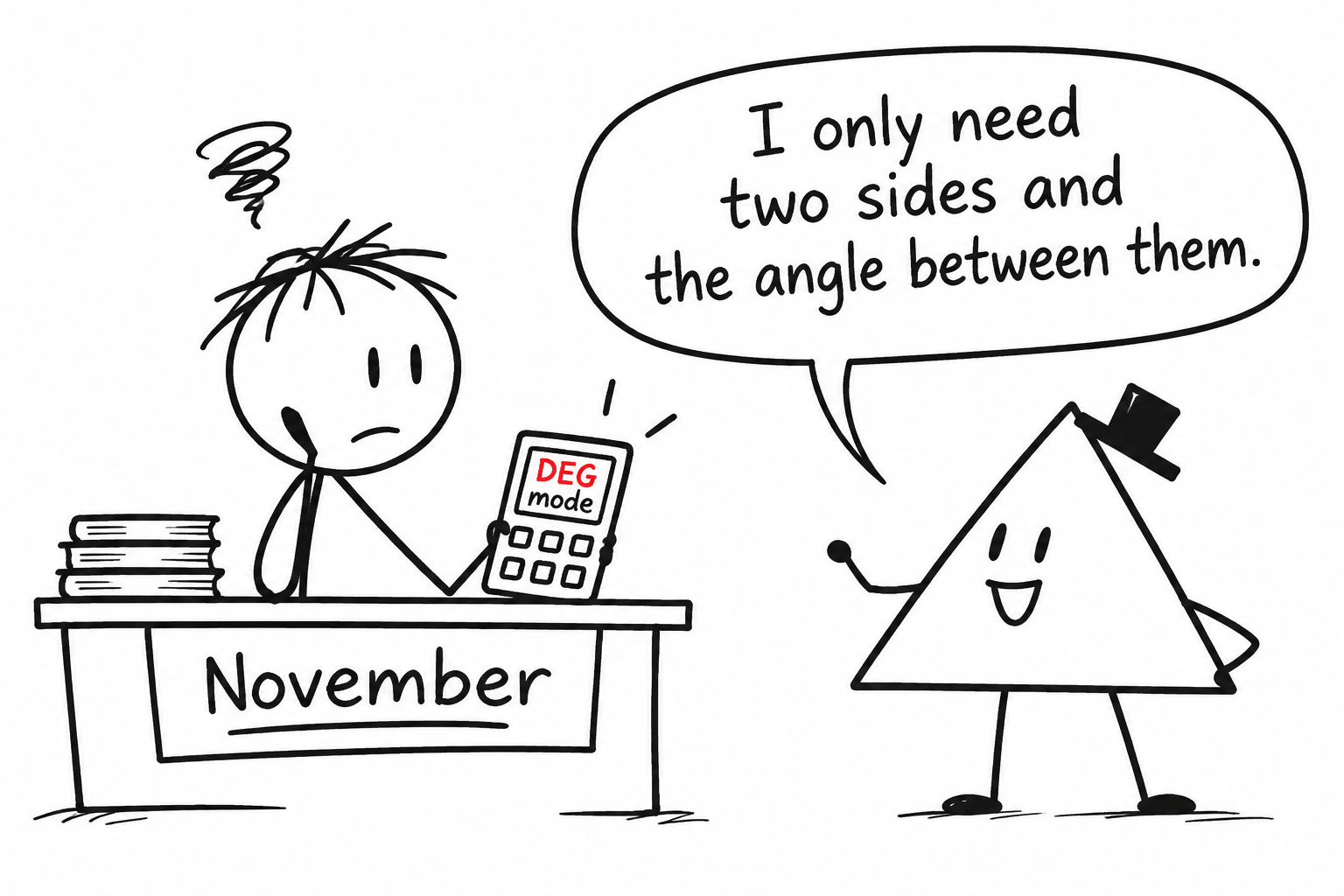 A stick-figure student considers a triangle's surprisingly modest demands
Understanding the area formula
The sides aaa and bbb must meet at angle CCC. This matters more than the letters printed on a diagram. A question might label its vertices PPP, QQQ and RRR, or give lengths without algebraic labels. Choose the two known sides and the angle directly between them.
The formula extends the familiar triangle area rule:
A=12×base×perpendicular heightA = \frac{1}{2}\times \text{base}\times \text{perpendicular height}A=21×base×perpendicular heightTaking side aaa as the base, the perpendicular height is bsinCb\sin CbsinC. Substitution gives
A=12×a×bsinC.A = \frac{1}{2}\times a\times b\sin C.A=21×a×bsinC.It is the ordinary area rule with a hidden perpendicular height. Remembering that connection helps you reconstruct the formula if your memory goes blank.
The triangle does not need to be right-angled. The formula also works when the included angle is obtuse, because its sine remains positive. The perpendicular height may fall outside the triangle when you extend the base, but the same area relationship still holds.
A reliable method for mock questions
Mark the two known sides and check that the angle lies between them. Write the formula, confirm degree mode, then substitute. Keep the calculator value until the final step and round as instructed.
Writing the formula first also makes your method visible. If a later arithmetic slip occurs, clear working may still earn method marks according to the relevant mark scheme.
Check that both lengths use the same unit before multiplying. If one measurement is in metres and another in centimetres, convert first. Afterwards, pause for a size check: the area cannot exceed half the product of the two selected side lengths, since the sine of an interior angle cannot exceed 111.
Worked exam-style question: finding an area
A triangle has sides measuring 9.2 cm9.2\text{ cm}9.2 cm and 13.5 cm13.5\text{ cm}13.5 cm, with an included angle of 47∘47^\circ47∘. Calculate its area to 333 significant figures.
The lengths meet at the given angle, so:
A=12absinCA = \frac{1}{2}ab\sin CA=21absinC A=12×9.2×13.5×sin47∘A = \frac{1}{2}\times 9.2\times 13.5\times \sin 47^\circA=21×9.2×13.5×sin47∘ A=45.417… cm2A = 45.417\ldots\text{ cm}^2A=45.417… cm2Therefore, to 333 significant figures,
A=45.4 cm2.A = 45.4\text{ cm}^2.A=45.4 cm2.Notice the square units. Writing cm\text{cm}cm would describe a length rather than an area.
Use the area of any triangle exam booklet to practise recognising this structure without being told which formula to select.
Worked exam-style question: finding an angle
A triangle has area 58 cm258\text{ cm}^258 cm2 and two sides of lengths 12 cm12\text{ cm}12 cm and 11 cm11\text{ cm}11 cm. The included angle CCC is acute. Calculate CCC to 111 decimal place.
Begin with the formula and substitute:
A=12absinCA = \frac{1}{2}ab\sin CA=21absinC 58=12×12×11×sinC58 = \frac{1}{2}\times 12\times 11\times \sin C58=21×12×11×sinCSimplify:
58=66sinC58 = 66\sin C58=66sinCDivide both sides by 666666:
sinC=5866\sin C = \frac{58}{66}sinC=6658Apply inverse sine:
C=sin−1(5866)C = \sin^{-1}\left(\frac{58}{66}\right)C=sin−1(6658)Therefore, to 111 decimal place,
C=61.5∘.C = 61.5^\circ.C=61.5∘.The word acute matters. Supplementary angles have the same sine, so an obtuse angle can produce the same area. Here, the question requires the acute solution returned by inverse sine.
For further practice identifying corresponding information and rearranging trigonometric equations, try the GCSE Sine Rule lesson and questions. Keep the two formulae distinct: the sine rule relates sides and opposite angles; the area formula uses an included angle.
Rearranging for a missing side
When the area, included angle and one side are known, the same formula can find the other side. Isolate the unknown by dividing by everything multiplying it:
a=2AbsinC.a=\frac{2A}{b\sin C}.a=bsinC2A.Write the denominator in brackets when entering this expression into your calculator. This keeps the multiplication together and helps prevent a correct rearrangement becoming an incorrect calculation. A missing side needs length units, whereas a calculated area needs square units.
Common mistakes to avoid
Choosing an angle that is not included
The angle must lie between the selected sides. If it is elsewhere, you cannot immediately combine it with those lengths in 12absinC\frac{1}{2}ab\sin C21absinC.
Forgetting the factor of one half
Entering absinCab\sin CabsinC doubles the area. Write 12\frac{1}{2}21 before touching the calculator.
Treating a sloping side as the height
In A=12bhA=\frac{1}{2}bhA=21bh, the height must be perpendicular to the base. The sine formula extracts that perpendicular component from a sloping side.
Using the wrong calculator setting
Check for degree mode before starting. When finding an angle, isolate sinC\sin CsinC and use sin−1\sin^{-1}sin−1. Here, inverse sine does not mean 1sinC\frac{1}{\sin C}sinC1.
Rounding early or omitting units
Keep full calculator accuracy through intermediate steps. Round the final answer as requested and use square units for area.
For help choosing between methods, read How to Get Better at GCSE Trigonometry.
A focused plan before your mocks
Begin with direct area calculations, then mix in missing sides and angles. Finally, attempt questions without notes and mark them immediately. Record whether each error came from recognising the method, rearranging, calculator entry or rounding. That distinction tells you what to practise next.
When reviewing a solution, cover it and repeat the question independently. Recognising someone else's working feels reassuring, but reproducing the method reveals whether you can use it under exam conditions. Revisit any uncertain question in a later session.
The MathsGenie Revision Planner can help organise your revision. Combine revision lessons, practice questions and mini tests with past papers and video solutions so you practise recognising this method among unrelated topics.
Turn the method into a dependable mark
The goal is a short, repeatable decision: identify two sides and their included angle, then apply the sine area formula. Once that feels familiar, you can concentrate on accurate substitution and presentation.
Return to the free MathsGenie lesson, complete a fresh set of questions and check your working. When you are ready for mixed practice, explore the MathsGenie Mock Exam Builder and use your mistakes to guide the next revision session.















