

The Sine Rule GCSE Maths: Revision for Your Mock
The sine rule GCSE maths explained for December mocks, with two worked exam questions, common mistakes and a focused revision plan to build your confidence.
December mocks can make a familiar triangle feel surprisingly unfamiliar. You recognise the diagram, but cannot decide which numbers belong in the formula. For the sine rule GCSE maths questions, the starting point is simple: identify a side and its opposite angle, then match a second pair to find the missing length or angle.
Imagine a Year 11 student revising after school before their December mocks. They can remember the formula, but hesitate whenever the triangle is rotated. Their most useful next step is to practise recognising those opposite pairs, then writing the calculation clearly.
Here is a focused revision session, with two original exam-style questions to help you do exactly that.
Your sine rule mock revision checklist
Before attempting a question, check that you can:
- Match each side to the angle directly opposite it.
- Recognise when the sine rule is useful.
- Rearrange the formula for a missing side or angle.
- Use degree mode and inverse sine on your calculator.
- Keep full calculator accuracy until the final answer.
The sine rule belongs to GCSE Higher tier trigonometry. Use your school's mock topic list to check what your December paper will cover. MathsGenie's Edexcel sine rule revision page and AQA sine rule revision page provide a focused place to begin.
Understand the sine rule before memorising it
The sine rule connects the sides of a triangle with the sines of their opposite angles:
asinA=bsinB=csinC\frac{a}{\sin A}=\frac{b}{\sin B}=\frac{c}{\sin C}sinAa=sinBb=sinCcHere, side aaa is opposite angle AAA, side bbb is opposite angle BBB, and side ccc is opposite angle CCC.
Opposite means across the triangle from the angle, rather than one of the sides forming it. That relationship stays the same when the triangle is rotated or drawn differently.
You normally need only two fractions. Choose the two containing your known information and the quantity you want to find.
For a missing side, the side-over-sine arrangement is convenient:
asinA=bsinB\frac{a}{\sin A}=\frac{b}{\sin B}sinAa=sinBbFor a missing angle, you may prefer the equivalent arrangement:
sinAa=sinBb\frac{\sin A}{a}=\frac{\sin B}{b}asinA=bsinBBoth express the same relationship. Choosing a convenient arrangement simply makes rearranging easier.
How to recognise a sine rule question
Look for a complete opposite pair: one known side and the known angle opposite it.
You can then use another known angle to find its opposite side, or another known side to find its opposite angle. Sometimes you must first calculate the third angle using the angle sum of a triangle:
A+B+C=180∘A+B+C=180^\circA+B+C=180∘If you have two sides and their included angle, with no complete opposite pair, consider the cosine rule. If you have a right-angled triangle, ordinary right-angled trigonometry may be more direct.
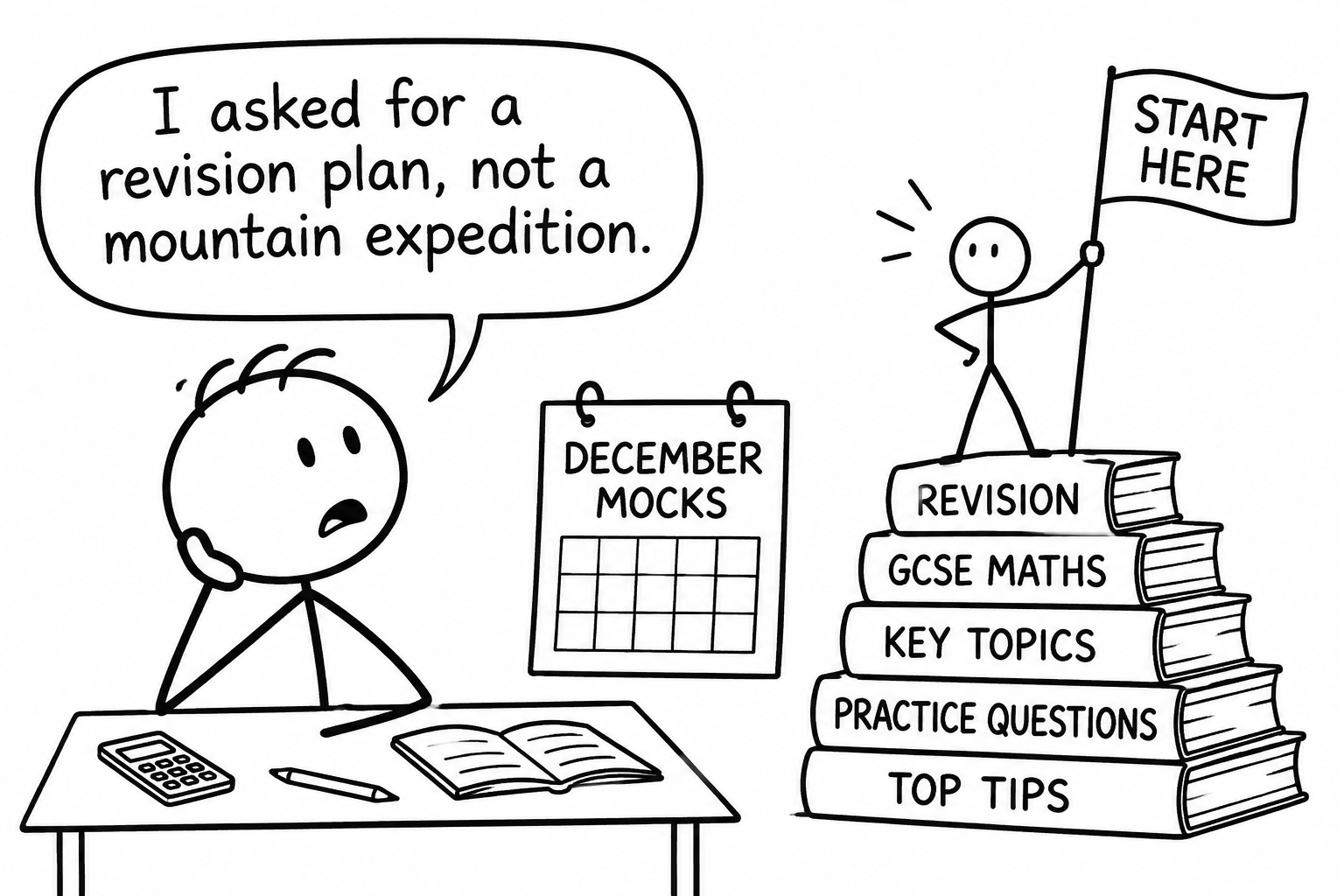 A stick-figure student faces a mountain of revision books while a tiny expedition guide offers encouragement before December mocks.
Two sine rule exam questions worked through
These original questions practise the two main calculations. Before reading each solution, write down the opposite pairs yourself.
Finding a missing side
Question: In triangle ABCABCABC, angle A=40∘A=40^\circA=40∘, angle B=65∘B=65^\circB=65∘, and side a=12 cma=12\text{ cm}a=12 cm. Calculate side bbb, giving your answer to three significant figures.
The known opposite pair is 12 cm12\text{ cm}12 cm and 40∘40^\circ40∘. The missing side bbb is opposite 65∘65^\circ65∘.
Substitute those pairs into the sine rule:
bsin65∘=12sin40∘\frac{b}{\sin 65^\circ}=\frac{12}{\sin 40^\circ}sin65∘b=sin40∘12Multiply both sides by sin65∘\sin 65^\circsin65∘:
b=12sin65∘sin40∘b=\frac{12\sin 65^\circ}{\sin 40^\circ}b=sin40∘12sin65∘Enter the full expression into a calculator in degree mode:
b=16.919… cmb=16.919\ldots\text{ cm}b=16.919… cmTherefore, to three significant figures:
b=16.9 cm\boxed{b=16.9\text{ cm}}b=16.9 cmCheck the size: 65∘65^\circ65∘ is larger than 40∘40^\circ40∘, so its opposite side should be longer. Our answer is greater than 12 cm12\text{ cm}12 cm, which fits.
Finding a missing angle
Question: In triangle ABCABCABC, side a=7 cma=7\text{ cm}a=7 cm, side b=10 cmb=10\text{ cm}b=10 cm, and angle B=52∘B=52^\circB=52∘. Calculate angle AAA, giving your answer to one decimal place.
The complete opposite pair is 10 cm10\text{ cm}10 cm and 52∘52^\circ52∘. Use the angle-over-side arrangement:
sinA7=sin52∘10\frac{\sin A}{7}=\frac{\sin 52^\circ}{10}7sinA=10sin52∘Multiply both sides by 777:
sinA=7sin52∘10\sin A=\frac{7\sin 52^\circ}{10}sinA=107sin52∘Now use inverse sine:
A=sin−1(7sin52∘10)A=\sin^{-1}\left(\frac{7\sin 52^\circ}{10}\right)A=sin−1(107sin52∘)Therefore:
A=33.5∘\boxed{A=33.5^\circ}A=33.5∘This is sensible because the shorter side should face the smaller angle.
There is also an angle check to make. Supplementary angles have the same sine, so the other candidate is approximately 146.5∘146.5^\circ146.5∘. Combined with the given 52∘52^\circ52∘, that exceeds 180∘180^\circ180∘, so it cannot belong to this triangle. Other questions can allow two possible triangles; always check the information given.
Common slips that can cost marks
The student in our imagined revision session now has two correct solutions. The next task is identifying which habits will keep those solutions reliable under time pressure.
- Matching a side with an adjacent angle. Mark opposite pairs before substituting anything.
- Using the sine rule without enough information. Find a complete opposite pair first, or reconsider the method.
- Rearranging incorrectly. Write the substituted equation before moving terms. This makes your method easier to follow and check.
- Stopping at the sine value. When finding an angle, apply inverse sine after calculating the ratio.
- Using radians. Check that your calculator is in degree mode.
- Rounding halfway through. Keep the full expression or calculator value until the final line.
- Ignoring the requested accuracy. Significant figures and decimal places require different rounding decisions.
Also include units for lengths and a degree symbol for angles. A quick size check can reveal a swapped pair before you move on.
Turn understanding into mock readiness
For your next short session, start with one question without notes. If you get stuck, identify the exact step: choosing the rule, pairing the information, rearranging, or using the calculator.
Use MathsGenie's sine rule lesson and worked solutions to revisit that step, then attempt a fresh question independently. Checking a solution is most useful when you can explain why your own working went wrong.
Return to the topic another day, mixing sine rule questions with other triangle problems. That makes you practise choosing a method as well as carrying it out. MathsGenie's free maths revision resources give you a starting point for lessons and exam practice.
Before December mocks, aim to make your first line dependable: identify the opposite pairs and write the equation. Then build a targeted practice paper in Mock Exam Builder, work through it independently, and use your mistakes to choose what to revise next.















