

The Cosine Rule GCSE Maths Mock Revision Guide
The cosine rule GCSE maths guide for Year 11 mocks, with a clear method, two worked exam questions, common errors and a focused revision plan to use now.
December mocks have a habit of making familiar topics feel unfamiliar. A Year 11 student can recognise a cosine rule question, remember most of the formula, and still pause over which side belongs where. The good news is that the cosine rule GCSE maths method rests on one dependable idea: each angle must be matched with the side directly opposite it.
The cosine rule is Higher tier content. You need it to find a missing side when you know two sides and the included angle, or to find an angle when all three sides are known. This guide explains both versions and works through two exam-style questions.
Your cosine rule mock revision checklist
Before your mock, make sure you can:
- label the side opposite the required angle correctly
- decide between the cosine rule, sine rule and Pythagoras
- find a missing side using the standard formula
- rearrange the formula to find an angle
- use inverse cosine correctly
- keep full calculator values until the final answer
- give suitable units and rounding
Start with the Edexcel cosine rule revision lesson or the AQA cosine rule revision lesson, depending on your exam board. Both provide focused practice around the skill you will need in a mock.
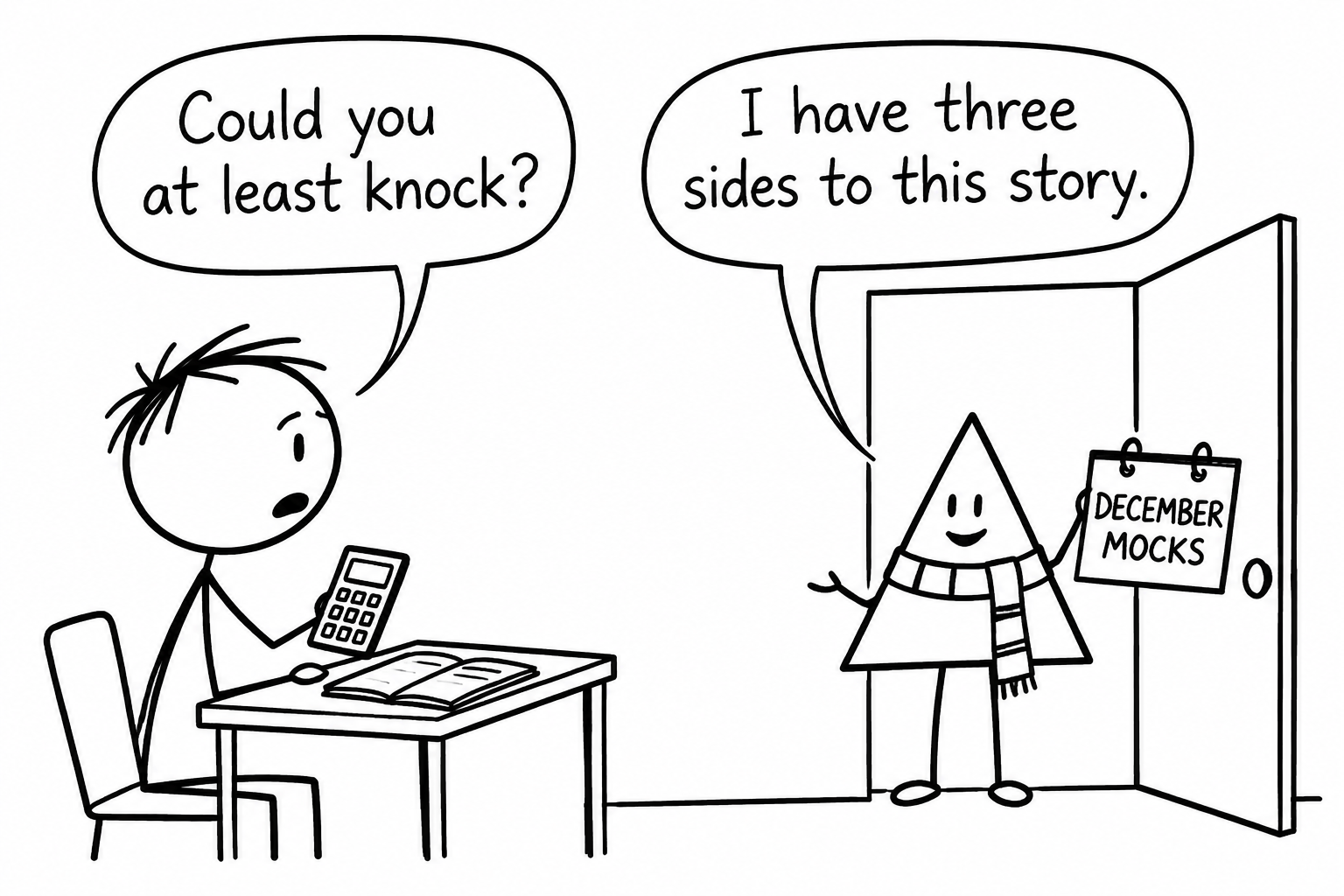 A Year 11 student meets a triangle arriving for December mocks
What is the cosine rule?
For a triangle with sides aaa, bbb and ccc, where angle AAA is opposite side aaa, the cosine rule is:
a2=b2+c2−2bccosAa^2=b^2+c^2-2bc\cos Aa2=b2+c2−2bccosAThe lettering matters less than the matching. The side alone on the left must be opposite the angle used on the right. The other two sides form that angle.
To find an angle, rearrange the formula:
cosA=b2+c2−a22bc\cos A=\frac{b^2+c^2-a^2}{2bc}cosA=2bcb2+c2−a2Then use inverse cosine:
A=cos−1(b2+c2−a22bc)A=\cos^{-1}\left(\frac{b^2+c^2-a^2}{2bc}\right)A=cos−1(2bcb2+c2−a2)A quick sketch can prevent several lines of incorrect working. Mark the required angle, circle its opposite side, and assign that side the letter aaa. The remaining sides become bbb and ccc in either order.
When should you use the cosine rule?
Use the cosine rule in either of these situations:
- You know two sides and the angle between them, and need the third side.
- You know all three sides and need an angle.
If you know an opposite side-angle pair, the GCSE sine rule lesson may provide the more direct route. If the triangle is right-angled, Pythagoras or basic trigonometry will usually be simpler.
This decision is part of the question. In a mock, you may not be told which rule to use. Train yourself to identify the information before reaching for a formula.
Exam-style question: finding a missing side
A triangle has sides of length 7 cm7\text{ cm}7 cm and 10 cm10\text{ cm}10 cm. The angle between them is 60∘60^\circ60∘. Find the length of the third side, giving your answer to three significant figures.
Call the missing side aaa. It is opposite the known angle, so substitute b=7b=7b=7, c=10c=10c=10 and A=60∘A=60^\circA=60∘:
a2=72+102−2×7×10×cos60∘a^2=7^2+10^2-2\times7\times10\times\cos 60^\circa2=72+102−2×7×10×cos60∘ a2=49+100−140×0.5a^2=49+100-140\times0.5a2=49+100−140×0.5 a2=79a^2=79a2=79The formula gives a2a^2a2, not aaa, so take the square root:
a=79a=\sqrt{79}a=79 a=8.888…a=8.888\ldotsa=8.888…Therefore, to three significant figures:
a=8.89 cm\boxed{a=8.89\text{ cm}}a=8.89 cmA useful sense check is that the answer must form a possible triangle with the other two sides. Since 8.898.898.89 is less than 7+107+107+10 and greater than 10−710-710−7, it is plausible.
Exam-style question: finding an angle
A triangle has side lengths 6 cm6\text{ cm}6 cm, 8 cm8\text{ cm}8 cm and 11 cm11\text{ cm}11 cm. Find the angle opposite the 11 cm11\text{ cm}11 cm side. Give your answer to one decimal place.
The angle required is opposite the longest side, so let a=11a=11a=11. The other sides are b=8b=8b=8 and c=6c=6c=6.
Use the rearranged formula:
cosA=b2+c2−a22bc\cos A=\frac{b^2+c^2-a^2}{2bc}cosA=2bcb2+c2−a2Substitute the values:
cosA=82+62−1122×8×6\cos A=\frac{8^2+6^2-11^2}{2\times8\times6}cosA=2×8×682+62−112 cosA=64+36−12196\cos A=\frac{64+36-121}{96}cosA=9664+36−121 cosA=−2196\cos A=\frac{-21}{96}cosA=96−21Now use inverse cosine:
A=cos−1(−2196)A=\cos^{-1}\left(\frac{-21}{96}\right)A=cos−1(96−21) A=102.635…∘A=102.635\ldots^\circA=102.635…∘Therefore:
A=102.6∘\boxed{A=102.6^\circ}A=102.6∘The negative cosine value is not an error. It indicates that AAA is obtuse, which is reasonable because it lies opposite the longest side.
How to revise the cosine rule before December mocks
Reading the formula repeatedly can create familiarity, but familiarity is not the same as being able to use it under time pressure. A better cosine rule mock revision plan moves from recognition to retrieval.
Relearn the matching idea
Watch the lesson or study a worked solution, then close it. Write the formula from memory and explain why side aaa must be opposite angle AAA. If that explanation is secure, the letters in an unfamiliar diagram become less intimidating.
Separate the two question types
Complete a short set of missing-side questions, followed by a short set of missing-angle questions. The goal is to make the different endings automatic: square root for a side, inverse cosine for an angle.
Use MathsGenie's practice questions, video solutions and mark schemes to check not only the answer but the structure of your working. A free MathsGenie revision planner can place this practice alongside your other mock topics.
Mix the cosine rule with nearby topics
Try a mini test containing the sine rule, Pythagoras, basic trigonometry and the cosine rule. Mixed practice forces you to choose a method, which is closer to a real exam than completing ten nearly identical questions.
Practise in exam conditions
Once the method feels secure, complete cosine rule exam questions without notes. Then review each lost mark. Was it a formula problem, a labelling problem, a calculator problem or a rounding problem?
You can also use Edexcel GCSE Maths past papers with their mark schemes and worked solutions. Past papers are most valuable when you record the reason for each error rather than simply checking the final answer.
Common cosine rule mistakes examiners see
The most damaging slips are usually small ones:
- Mismatching the angle and opposite side. If you use angle AAA, the isolated side must be aaa.
- Using an angle that is not included. For a missing-side question, the known angle must sit between the two known sides.
- Losing the minus sign. The formula contains −2bccosA-2bc\cos A−2bccosA.
- Forgetting the square root. After finding a2a^2a2, continue to a=a2a=\sqrt{a^2}a=a2.
- Using cosine instead of inverse cosine. To recover an angle from its cosine value, use cos−1\cos^{-1}cos−1.
- Leaving the calculator in radians. GCSE angle answers are normally required in degrees, so check for degree mode.
- Rounding too early. Examiner reports regularly warn that premature rounding can lose final accuracy marks. Keep the full calculator value until the final line.
- Giving no working. A correct formula and substitution may earn method marks even if a later calculator slip occurs.
- Ignoring units or accuracy instructions. Give lengths in the stated unit and follow instructions such as three significant figures or one decimal place.
Turn one topic into reliable mock marks
A December mock does not require perfect confidence before you begin. It requires a method you can retrieve, apply and check. Learn the side-angle matching, practise both forms of the rule, and review every error while it is still useful.
MathsGenie brings the lesson, practice questions, mini tests, mark schemes, video solutions, predicted papers and past papers into one revision journey. When you are ready to test the topic properly, use the GCSE Mock Exam Builder to build a targeted practice paper around your weaker areas. Sit it under timed conditions, mark it, and let the mistakes decide what you revise next.















