

Similar Shapes GCSE Maths Mock Revision Guide
Similar shapes GCSE maths made clear with scale factors, two worked exam questions, common mistakes and a focused plan for your Year 11 mock.
A December mock can make one topic feel much larger than it really is. For many Year 11 students, that topic is similar shapes GCSE maths: diagrams covered in lengths, scale factors and just enough missing information to create doubt.
The central idea is simpler than the questions sometimes look. Similar shapes have the same form, corresponding angles are equal, and corresponding lengths are in the same ratio. Once you identify the matching sides and decide whether the question concerns length, area or volume, the route becomes much clearer.
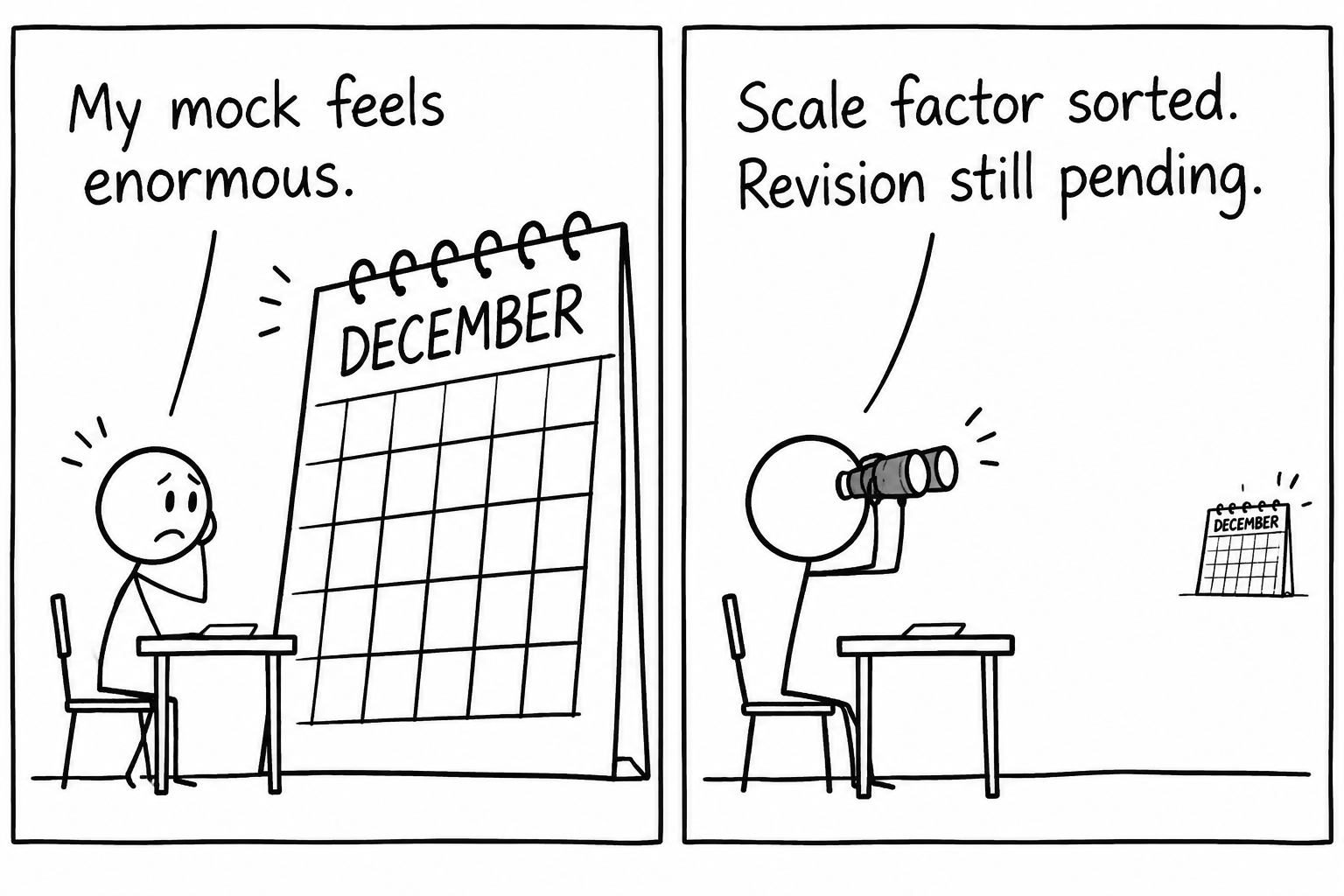 A student uses scale factor thinking to make a looming mock calendar feel smaller
Your similar shapes mock revision checklist
Before your mock, make sure you can:
- identify corresponding sides in the same relative positions
- calculate a linear scale factor in the correct direction
- multiply or divide by that scale factor to find a missing length
- square the linear scale factor when comparing areas
- cube the linear scale factor when comparing volumes
- work backwards from an area or volume ratio
- show enough working to make your method clear
- check whether an answer should be larger or smaller
Use the free MathsGenie GCSE revision resources to place similarity alongside the other topics on your mock specification. A short, targeted session is usually more useful than rereading several pages of notes without answering anything.
The method behind similar shapes GCSE maths
Two shapes are mathematically similar when corresponding angles are equal and corresponding sides are proportional. They can be different sizes or orientations, but every length must change by the same linear scale factor.
Suppose a length changes from 4 cm4\text{ cm}4 cm to 10 cm10\text{ cm}10 cm. The scale factor from the smaller shape to the larger shape is
104=2.5.\frac{10}{4}=2.5.410=2.5.Every corresponding length is multiplied by 2.52.52.5. Direction matters. From the larger shape back to the smaller one, the scale factor is
410=0.4.\frac{4}{10}=0.4.104=0.4.Those numbers are reciprocals because the transformation is being reversed.
The power of the scale factor depends on what is being measured:
| Measurement | Scale factor rule |
|---|---|
| Length | kkk |
| Area | k2k^2k2 |
| Volume | k3k^3k3 |
This distinction is the heart of most higher-tier similarity questions. If the linear scale factor is 333, lengths are multiplied by 333, areas by 32=93^2=932=9, and volumes by 33=273^3=2733=27.
Why? Area measures in two dimensions, so both dimensions scale. Volume measures in three dimensions, so three dimensions scale. It is not a rule to memorise in isolation; it describes what enlargement does.
A reliable routine for similar shapes exam questions
When a diagram looks busy, slow the process down:
- Match the sides. Use positions, angle markings and the shape's structure rather than assuming that sides match because they look alike.
- Write the direction. Note whether you are moving from small to large or large to small.
- Find the linear scale factor. Use a complete pair of corresponding lengths.
- Choose the correct power. Use kkk for length, k2k^2k2 for area or k3k^3k3 for volume.
- Apply and check. Ask whether the answer has the expected size and units.
That routine is worth practising until it feels ordinary. Under mock pressure, dependable habits matter more than clever shortcuts.
Worked question: finding a missing length
Two similar triangles have corresponding sides of 6 cm6\text{ cm}6 cm and 15 cm15\text{ cm}15 cm. Another side of the smaller triangle is 8 cm8\text{ cm}8 cm. Find the corresponding side of the larger triangle.
First calculate the scale factor from the smaller triangle to the larger triangle:
k=156=2.5.k=\frac{15}{6}=2.5.k=615=2.5.Now multiply the corresponding smaller length by 2.52.52.5:
8×2.5=20.8\times 2.5=20.8×2.5=20.The missing side is
20 cm.\boxed{20\text{ cm}}.20 cm.A quick reasonableness check supports the answer. The larger known side is 2.52.52.5 times the smaller one, so the missing side must also be 2.52.52.5 times as long. Using a different multiplier for the second pair would contradict similarity.
After reviewing the method, use MathsGenie practice questions rather than stopping after one successful example. Understanding becomes reliable only when you can recognise the method in an unfamiliar diagram.
Worked question: using volume to find a length
Two similar solid models have volumes of 64 cm364\text{ cm}^364 cm3 and 1000 cm31000\text{ cm}^31000 cm3. A corresponding length on the smaller solid is 6 cm6\text{ cm}6 cm. Find the corresponding length on the larger solid.
The volume scale factor is
100064=15.625.\frac{1000}{64}=15.625.641000=15.625.This is not the linear scale factor. For similar solids, the volume scale factor is k3k^3k3, so
k3=15.625.k^3=15.625.k3=15.625.Take the cube root:
k=15.6253=2.5.k=\sqrt[3]{15.625}=2.5.k=315.625=2.5.Apply this to the length:
6×2.5=15.6\times 2.5=15.6×2.5=15.Therefore, the corresponding length is
15 cm.\boxed{15\text{ cm}}.15 cm.The important step is converting the volume ratio into a length ratio. Multiplying 666 directly by 15.62515.62515.625 would mix a three-dimensional comparison with a one-dimensional measurement.
Common slips in similar shapes mock revision
Matching the wrong sides
A rotated or reflected diagram can make correspondence less obvious. Do not rely on which side appears to be at the top. Trace around both shapes in the same order and use equal angles to help identify matching vertices.
Reversing the scale factor
If you calculate larger divided by smaller but then apply that factor while moving from larger to smaller, the answer goes in the wrong direction. Write a small label such as “small to large” before calculating.
Using the linear factor for area or volume
If k=4k=4k=4, the area scale factor is 42=164^2=1642=16, not 444, and the volume scale factor is 43=644^3=6443=64. Start by identifying the type of quantity in the question.
Forgetting roots when working backwards
Given an area ratio, take a square root to recover the linear scale factor:
k=area scale factor.k=\sqrt{\text{area scale factor}}.k=area scale factor.Given a volume ratio, take a cube root:
k=volume scale factor3.k=\sqrt[3]{\text{volume scale factor}}.k=3volume scale factor.Losing accuracy too early
Keep exact values or several calculator digits during your working, then round only when the question asks you to. Premature rounding can shift the final answer outside an accepted range.
Omitting units
Lengths use units such as cm\text{cm}cm, areas use squared units such as cm2\text{cm}^2cm2, and volumes use cubed units such as cm3\text{cm}^3cm3. Units also provide a useful clue about which scale-factor rule is needed.
A focused plan before the December mock
Begin with a short diagnostic set. Separate mistakes into three categories: matching sides, calculating the scale factor, and choosing the correct power. This tells you what to revise next.
Then alternate review and retrieval. Watch a revision lesson or video solution, close it, and answer a similar question without guidance. Mark the work carefully using the provided mark scheme. A mark scheme is not merely a score sheet; it shows whether your written method would communicate enough reasoning in an exam.
Finish with mixed practice. Similarity questions do not always announce themselves clearly, and they may connect with area, volume, ratio or algebra. Use MathsGenie past papers to practise recognising the topic within a complete paper, then review every dropped mark.
You can also use MathsGenie predicted papers as timed practice nearer the mock. Check that any resource you choose matches your tier and exam board, whether that is Edexcel, AQA, OCR or Eduqas.
Turn the topic into marks
Similar shapes become manageable when each question is reduced to three decisions: which sides correspond, which direction you are scaling, and whether the comparison involves length, area or volume.
Do not aim to make revision feel impressive. Aim to make the method repeatable. Build a targeted practice paper in MathsGenie's Mock Exam Builder, include similar shapes exam questions, and use your errors to choose the next set. That cycle of attempt, feedback and correction is how an uncertain topic becomes a dependable source of marks.















