

Typing Answers Under Timer for GCSE English Language
Typing answers under timer for GCSE English Language can build speed and structure, if typing is your exam method. Learn how to practise effectively.
The timer starts. You know what you want to say, but translating a good idea into a complete paragraph suddenly feels slow. Halfway through, you begin watching the clock instead of the question.
If you searched for typing answers under timer GCSE English Language, the short answer is: yes, timed typing can improve your speed and structure, but mainly when typing is how you will complete the real exam. It works best when you practise planning, writing and checking together. Simply typing as fast as possible may increase your word count without improving the quality of your answer.
If you will handwrite the exam, typed practice can still help you develop ideas and paragraph structures, but it will not fully prepare your hand for sustained writing. Your timed practice should eventually match the conditions you will face.
The quick checklist
Timed typed practice is likely to be useful when:
- a word processor is your established way of working at school
- your school has confirmed that you can type in the examination
- you use questions from your own exam board and specification
- spelling and grammar checks are switched off during realistic practice
- you measure completeness and quality, not only words per minute
- you review each attempt before repeating it
- you practise planning and checking within the time limit
It is less useful when you type informally with autocorrect, pause the timer whenever you get stuck, or plan to handwrite the real paper without doing equivalent handwritten practice.
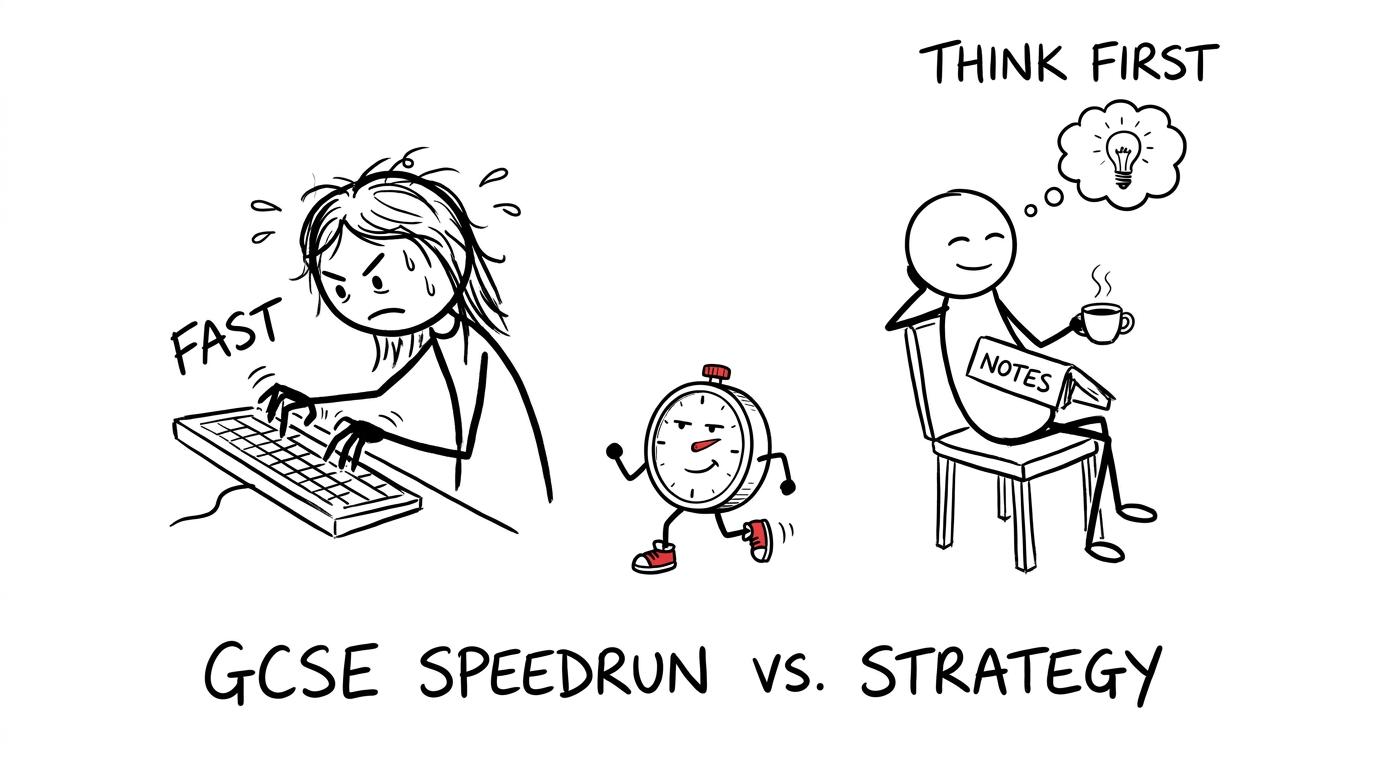 A student racing a timer while planning waits calmly
Does timed typing actually improve writing speed?
Regular timed practice can make the physical process of typing more automatic. You become more familiar with the keyboard, hesitate less over punctuation and learn how long different answers take you. That can leave more attention available for selecting evidence, analysing language and organising an argument.
However, research comparing handwriting and typing in assessments does not support one simple conclusion for every student. Performance can depend on keyboard familiarity, English proficiency, the task and the individual candidate. Some students produce more when typing; others perform similarly in both modes or work better by hand.
This distinction matters because typing speed is not the same as English Language performance. A useful basic measure is:
writing rate=words producedminutes used\text{writing rate}=\frac{\text{words produced}}{\text{minutes used}}writing rate=minutes usedwords producedYet an examiner awards marks for the qualities identified in the mark scheme, not for reaching a particular word count. An answer can become longer without becoming more perceptive, accurate or convincing.
A better review therefore asks three questions:
- Did I complete the answer within the available time?
- Did each paragraph have a clear purpose?
- Did the response meet the relevant assessment objectives?
Improvement means producing a stronger, complete response within the time, not merely producing more words.
Can typing under a timer improve answer structure?
Yes, but the timer does not create structure by itself. Structure improves when your practice includes a repeatable decision-making process.
Before writing, identify the task, choose the main ideas and decide the order in which they will appear. During writing, give each paragraph one clear job. Afterwards, check whether the argument develops rather than circles around the same point.
This resembles effective maths revision. Completing more questions is not automatically progress; reviewing where marks were lost is what turns activity into learning. The diagnostic approach in GCSE Revision: Find Your Weakest Topics Fast can be adapted to English: record whether each problem came from planning, analysis, organisation, technical accuracy or timing.
Typing offers one particular advantage during practice: editing is quick. You can move a sentence or replace a vague phrase without rewriting a page. But unrestricted editing can also become a trap. If you continually polish the opening, you may never finish the response. Give planning and checking their own time boundaries.
Match practice to the examination you will sit
AQA, Edexcel, OCR and Eduqas do not use identical papers, questions or timings. Use the specification, sample assessment materials and mark schemes for your board rather than copying a generic schedule from social media.
For example, AQA GCSE English Language currently has two written papers, each lasting one hour and forty-five minutes and carrying eighty marks. That does not mean every board should use the same question timings. Your teacher’s guidance and your board’s current materials should determine your plan.
The broader principle is familiar to maths students: revise the correct board, tier and paper format. MathsGenie’s GCSE Maths Revision hub organises free resources by exam board, while the GCSE Maths topics by exam board and tier guide explains why apparently similar qualifications still require specification-aware preparation.
Check whether you can type in the real exam
Do not assume that practising on a laptop means you can choose one on examination day.
Under current JCQ rules, a centre may provide a word processor when it reflects the candidate’s normal way of working within the centre and is appropriate to their needs. The school or college controls the examination arrangements. In exam conditions, spelling and grammar checking and predictive text are normally switched off, and the device must not provide access to unauthorised applications or AI tools.
Speak to your teacher, SENCO or exams officer well before the examination period. Ask:
- whether typing has been approved as your normal way of working
- which questions you will type and whether any short responses will be handwritten
- what software and keyboard will be provided
- whether you have any separate access arrangements
- how your typed script will be saved and printed
If typing is confirmed, practise without the digital assistance that will be unavailable. If it is not confirmed, complete your final timed responses by hand.
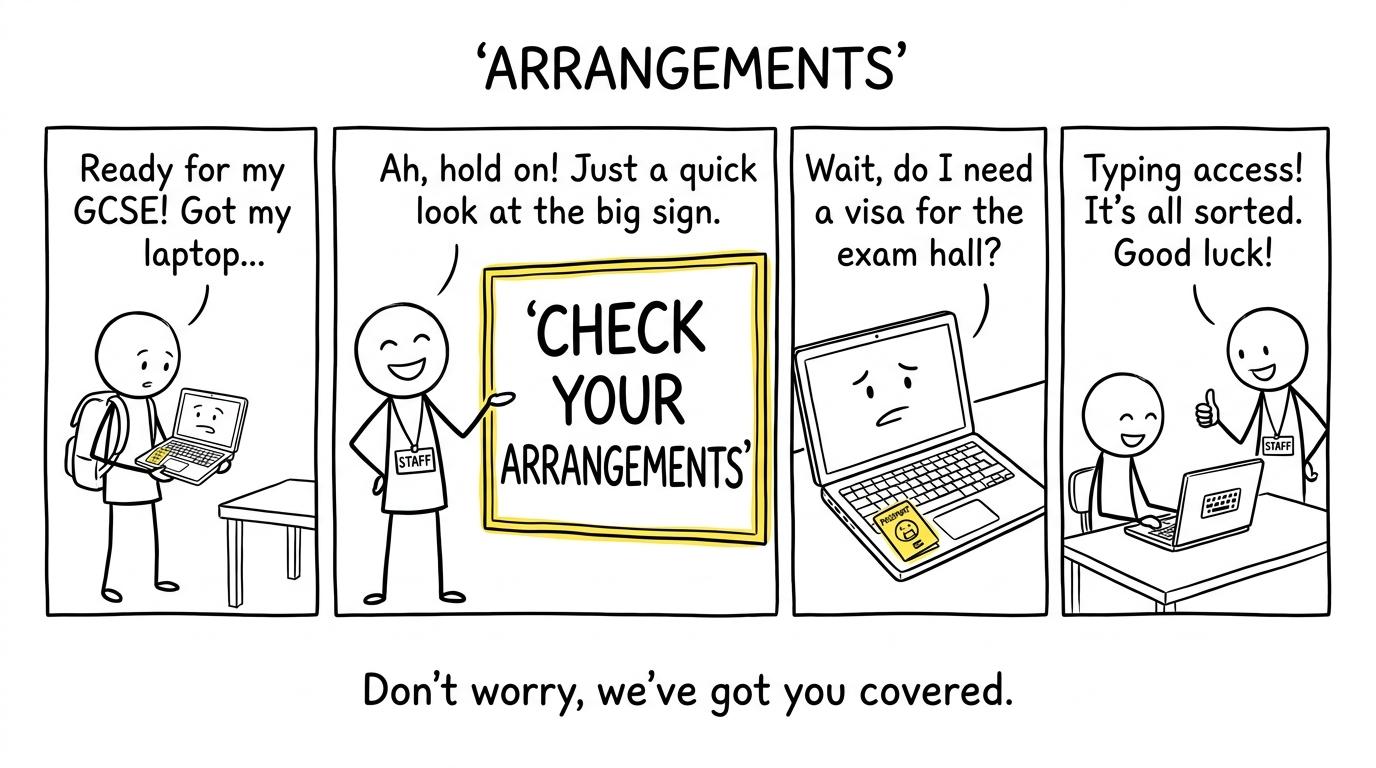 A confused laptop checking its exam arrangements
A deliberate timed-practice routine
Establish an honest baseline
Complete one appropriate response using the method you expect to use in the examination. Keep the timer running and avoid checking notes. Record whether you finished, how long you spent planning and which parts felt rushed.
Do not make a judgement from one attempt. The question may have suited you unusually well or badly. Look for patterns across several responses.
Practise one pressure at a time
A full paper combines reading, interpretation, planning, writing, accuracy and stamina. Trying to improve everything at once makes it difficult to see what changed.
Begin with short, focused sessions. You might concentrate on making planning quicker, sustaining paragraph development or leaving enough time to check. Then combine these skills in longer timed sections. This progression mirrors the advice in When Should You Start GCSE Past Papers?: targeted practice should come before repeated full-paper simulation.
Review against the mark scheme
After each response, label the main limitation. Was the problem speed, insufficient evidence, repeated analysis, weak sequencing or technical accuracy? Choose one adjustment for the next attempt.
This is deliberate practice: attempt, inspect, adjust and retest. The same loop sits behind MathsGenie’s guidance on stopping GCSE content from being forgotten. Repetition helps most when feedback changes the next repetition.
Increase realism gradually
Move from individual questions to timed sections and finally to complete papers. Use the keyboard you are likely to have, sit at a desk, remove your phone and disable autocorrect, predictive text and grammar suggestions.
A sensible final stage includes reading time, planning, writing and checking without stopping the clock. Full conditions reveal transitions between tasks: the moments when students often lose time without noticing.
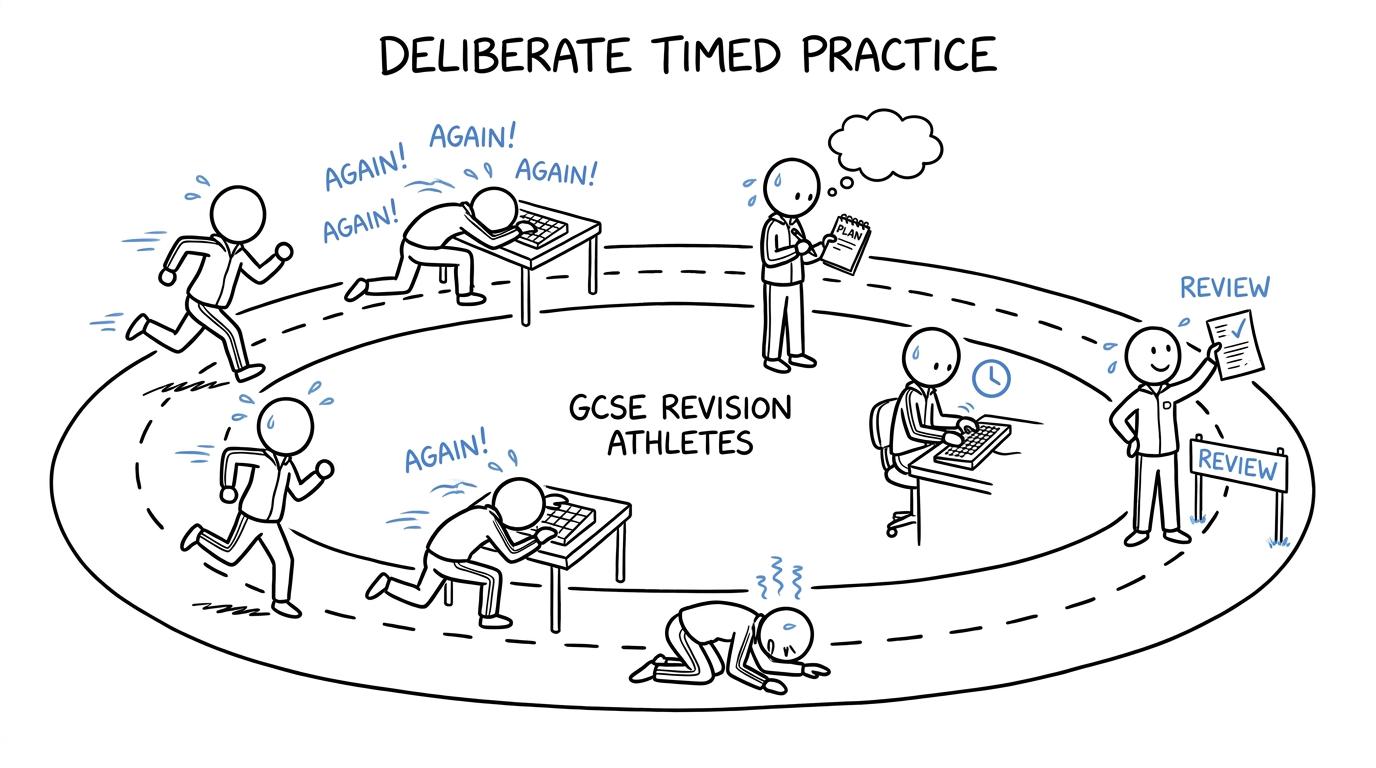 Two revision athletes discover that review beats endless sprinting
What if you will handwrite the examination?
Typing can still be useful for exploring ideas, improving sentence control and reorganising paragraphs. It can make feedback easier to apply because revisions are visible and quick.
But typed speed does not automatically transfer to handwriting speed. Handwriting involves different physical demands, and a handwritten script gives you fewer opportunities to rearrange material. If the examination will be handwritten, use typing for learning and editing, then test your performance through handwritten answers under realistic timings.
The principle is simple: learn in convenient ways, but rehearse in the way you will perform.
This also applies to GCSE maths. Watching a solution may build understanding, but marks depend on independently setting out a method on paper. MathsGenie’s one-week GCSE maths revision plan combines lessons, timed practice, marking and correction rather than relying on passive revision.
Lessons GCSE maths students can transfer
English and maths answers look different, but effective practice shares the same structure:
- use the correct specification and question style
- practise without support before checking the solution
- work under time limits only after learning the underlying skill
- mark honestly
- identify the precise reason for lost marks
- repeat the weak skill rather than restarting everything
For maths, use free GCSE revision lessons and exam questions before moving to timed papers. If you take Edexcel, the guide to revising Edexcel GCSE Maths without wasting time shows how lessons, topic questions, mark schemes and paper practice fit together.
Common mistakes with timed typed practice
Chasing words per minute
A high typing rate is useful only if the response remains relevant and controlled. Track whether you finished and met the mark-scheme requirements alongside your writing rate.
Using autocorrect during every session
This creates conditions that may not exist in the examination. Complete realistic attempts with spelling, grammar and predictive-text tools disabled.
Starting with full papers too soon
If paragraph construction is the weakness, repeatedly completing whole papers can rehearse the same mistake. Repair the smaller skill first, then rebuild stamina.
Ignoring planning time
Students sometimes regard planning as time lost. In reality, a brief, purposeful plan can prevent repetition and mid-answer indecision. The plan should be short enough to guide the writing without replacing it.
Never reviewing completed answers
Speed practice without feedback teaches you to reproduce your current habits faster. Compare the response with the question and mark scheme, then set one specific target.
Practising in the wrong format
Typing exclusively when you will handwrite, or practising with a different exam board’s questions, reduces realism. Confirm your arrangements and paper format early. Last-minute uncertainty is rarely helpful; the GCSE maths night-before plan makes the same case for choosing the correct resources before timed work begins.
Make the timer a source of evidence
Typing answers under a timer can improve GCSE English Language speed and structure when the practice is specific, realistic and reviewed. It is especially valuable for students who will use a word processor in the actual examination. For students who will write by hand, typed work is best treated as a tool for developing ideas before moving to handwritten rehearsal.
The timer is not there to frighten you. It gives you evidence: where you hesitate, where your structure weakens and where a better routine could save time.
Apply that same disciplined approach to maths with MathsGenie. Start with the GCSE Maths Revision hub, learn through free revision lessons and practice questions, then build examination confidence using mini tests, past papers, predicted papers, mark schemes and video solutions. Practise, review and return, because speed becomes useful only when accuracy comes with it.










