Tracking Revision Progress: GCSE Physical Education
Tracking revision progress GCSE Physical Education can reveal weak topics, but only if your spreadsheet leads to retrieval, feedback and focused practice each week.
Revision can become strangely convincing before it becomes useful. A neat spreadsheet fills with green cells, hours accumulate, and every topic appears to be under control. Then a closed-book question exposes a gap you did not know was there.
So, does tracking revision progress GCSE Physical Education in a spreadsheet or app improve results? It can help, but tracking alone does not cause learning. Its value comes from making you plan, test yourself, review feedback and revisit weak material. If updating the tracker replaces those activities, it merely feels productive.
That distinction matters for students balancing GCSE PE with maths. Both subjects reward knowledge, application and careful use of exam questions, even though their assessments are different. A good tracker directs your next revision session. A bad one becomes the revision session.
The short answer and practical checklist
Use a spreadsheet or app if it helps you:
- divide your exam board specification into manageable topics;
- record marks from closed-book questions rather than time alone;
- identify exactly why marks were lost;
- schedule another attempt after a gap;
- balance PE theory, practical preparation and other subjects;
- choose a clear action for your next session.
Do not use one if you spend longer formatting it than answering questions, record vague confidence ratings without evidence, or treat a completed topic as permanently learned.
The principle is simple: track evidence of learning, not the appearance of effort.
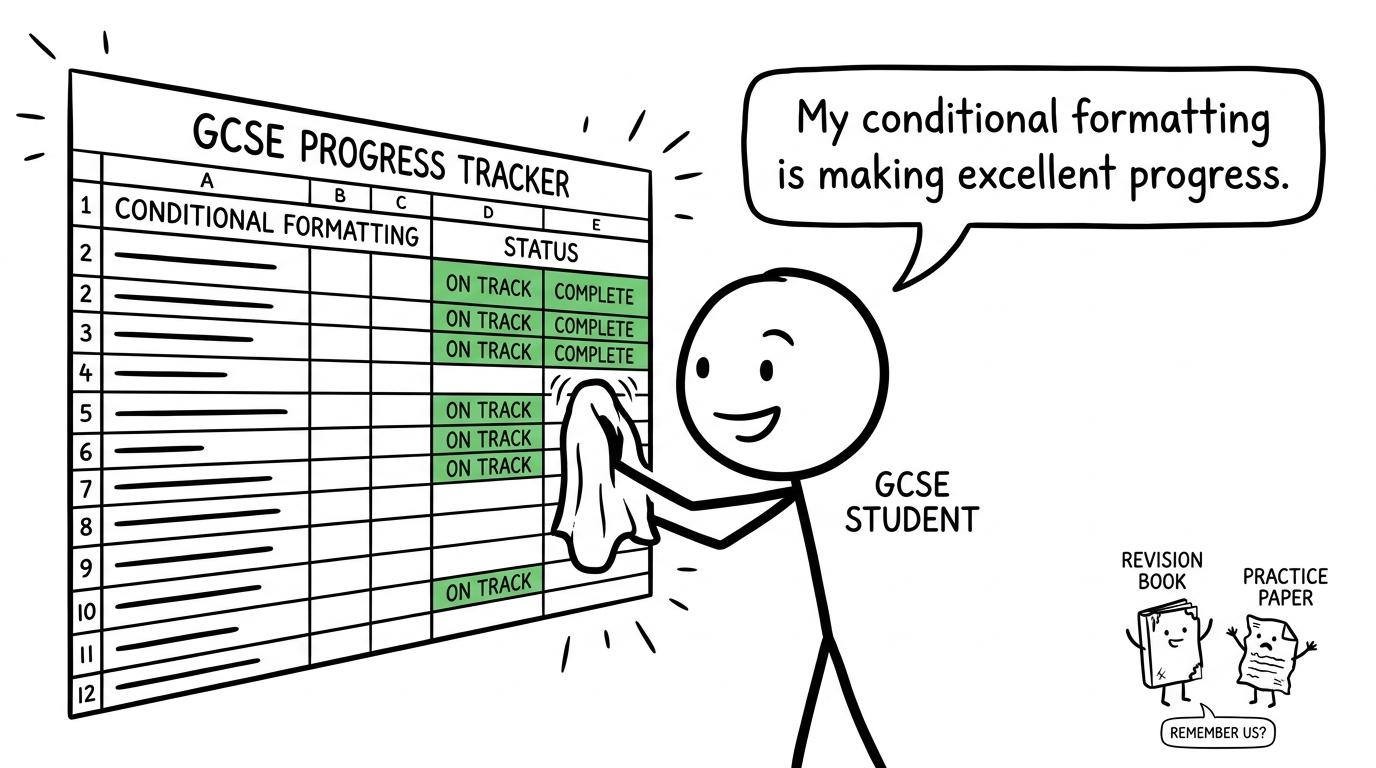 A student polishing a spreadsheet while practice work waits nearby
Why progress tracking can help GCSE PE revision
A spreadsheet is not a learning technique in itself. It is a decision-making tool. Its strongest purpose is to support the cycle of planning, monitoring and evaluating your learning.
This is consistent with evidence-informed guidance on metacognition and self-regulated learning. Students benefit when they set specific goals, monitor performance, evaluate what worked and adapt their approach. However, the evidence supports that wider process; it does not prove that opening a particular spreadsheet template will raise a grade.
Tracking becomes useful when it answers three questions:
- What can I currently recall and apply?
- Where is the evidence?
- What should I practise next?
GCSE Physical Education makes this especially relevant because the qualification includes several kinds of performance. Current specifications from boards such as AQA, Edexcel, OCR and Eduqas generally combine written assessment with non-exam assessment. Written papers commonly account for 60%60\%60% of the qualification, while practical performance and analysis account for the remaining 40%40\%40%, although students should always check their board's current specification and their school's assessment arrangements.
A tracker can organise these components, but it cannot measure them all in the same way. Theory can be monitored through quizzes and exam-question marks. Practical performance needs observation, teacher feedback and evidence from the relevant activity. Treating both as a single colour-coded percentage hides more than it reveals.
What should a useful revision spreadsheet contain?
The best tracker is often plain. Each column should help you make a revision decision.
| Column | What to record |
|---|---|
| Specification topic | The precise section, such as movement analysis or sports psychology |
| Last revised | The date you actively retrieved or applied the content |
| Activity used | Closed-book quiz, flashcards, exam questions or teacher feedback |
| Result | Marks earned and marks available |
| Error type | Knowledge, application, terminology, interpretation or timing |
| Next action | One specific task that addresses the error |
| Re-test date | When you will attempt fresh questions without notes |
| Re-test result | Evidence of whether the learning lasted |
Your percentage accuracy can be recorded as:
Accuracy=marks earnedmarks available×100%\text{Accuracy}=\frac{\text{marks earned}}{\text{marks available}}\times 100\%Accuracy=marks availablemarks earned×100%That figure is more informative than the number of minutes spent revising, but it still needs context. A high score achieved immediately after reading notes is weaker evidence than a similar score from a closed-book test several days later.
Use a notes column sparingly. A short entry such as “definition incomplete” or “did not apply the concept to the sporting example” is actionable. Copying half a textbook into one cell is not.
Track outputs rather than hours
Time matters because revision needs space in your week. Yet hours are an input, not an outcome. A student can spend 454545 minutes highlighting a chapter and retain less than another student who spends 202020 minutes retrieving key ideas, checking answers and correcting errors.
For PE theory, stronger outputs include:
- marks from exam-board-style questions;
- definitions recalled accurately without notes;
- extended responses checked against a mark scheme;
- misconceptions corrected after feedback;
- a successful re-test after a delay.
The same idea applies to GCSE maths. MathsGenie's GCSE Maths revision hub provides topic lessons, practice questions, papers and solutions that can generate meaningful evidence for your tracker. Instead of entering “revised algebra”, record the topic attempted, the marks earned and the mistake that determines your next action.
If fitting two subjects into the week feels difficult, the GCSE maths revision timetable guide offers a practical structure for balancing topic practice, review and timed work. GCSE maths has Foundation and Higher tiers; GCSE PE does not use that same tier structure, so keep each subject's assessment details separate.
Turn every entry into a revision action
A tracker earns its place only when it changes what you do next.
Suppose a row shows weak recall of a PE theory topic. The next action should not be “revise more”. It might be to complete a closed-book brain dump, compare it with your notes, answer a short set of questions and re-test the topic later.
For maths, a weak result should lead directly to a revision lesson and focused questions. The GCSE maths topics by exam board and tier guide can help you classify a gap correctly before choosing practice.
A dependable revision loop looks like this:
- retrieve what you know without notes;
- answer questions that require application;
- mark the work using reliable answers or a mark scheme;
- identify the precise cause of each lost mark;
- practise that weakness;
- return to it after a gap.
This is why a simple error log is usually more valuable than an elaborate dashboard. It points forwards.
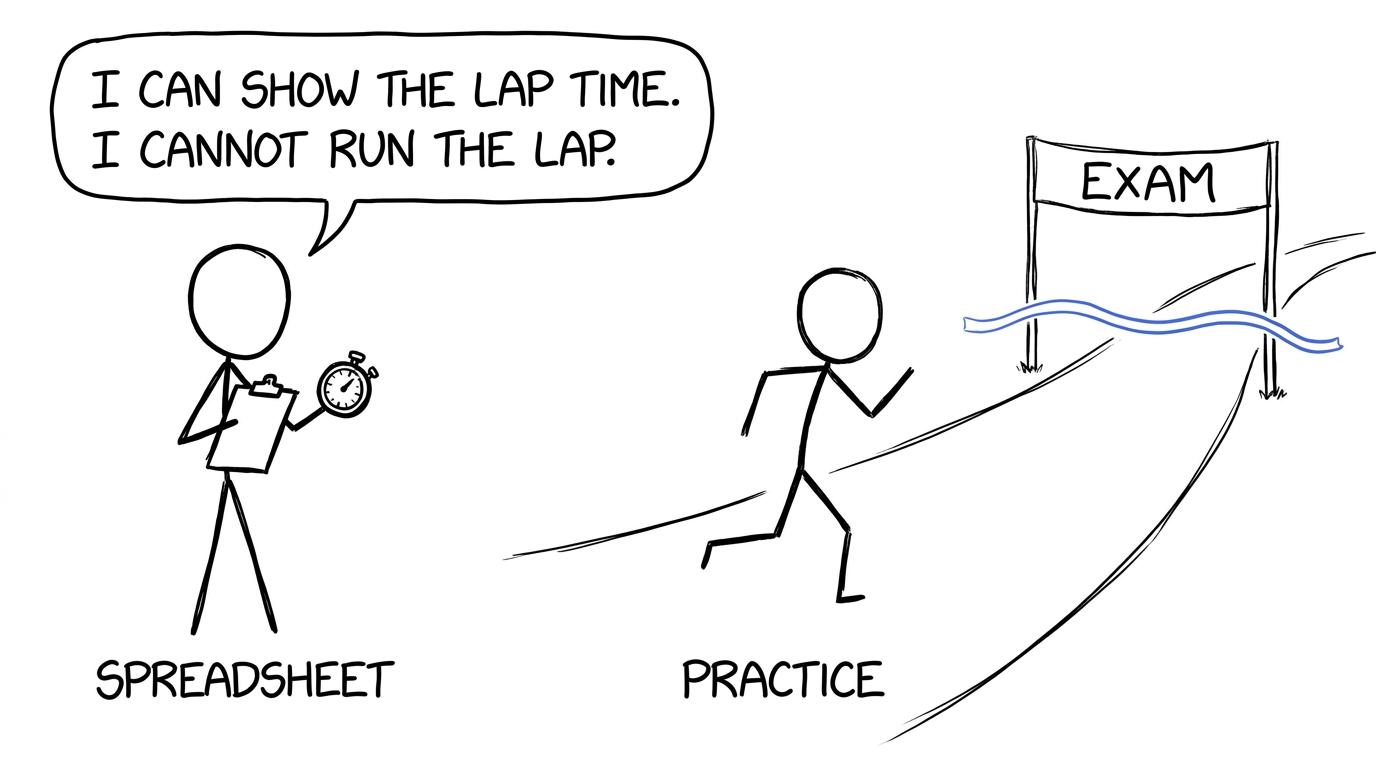 A spreadsheet coach watches while practice runs towards the exam
Spreadsheet or revision app: which is better?
Neither format has an automatic learning advantage. Choose the one that produces the least friction while preserving useful information.
A spreadsheet may suit you if
- you want complete control over columns and filters;
- you revise several subjects in one system;
- you like sorting topics by result or re-test date;
- you can resist unnecessary formatting.
An app may suit you if
- reminders help you return to topics;
- entering results on a phone is quicker;
- the app supports spaced review;
- its notifications do not become another distraction.
Paper can work too. The medium is less important than the behaviour. Your system should take only a few minutes to update and should make tomorrow's task obvious.
Avoid storing unnecessary personal or health information in a revision tool. For practical PE, record appropriate targets and teacher feedback rather than sensitive details.
How to combine tracking with effective revision
Use retrieval before review
Try to recall information before reopening notes. Retrieval exposes what is available from memory rather than what merely looks familiar on the page. Low-stakes quizzes, flashcards, brain dumps and closed-book questions can all serve this purpose.
Space your re-tests
Do not mark a topic as permanently complete after one successful session. Return to it after a gap. If recall remains secure, extend the interval before the next check. If performance falls, shorten the interval and repair the specific gap.
Use feedback immediately
Marks without analysis are blunt information. Review why each mark was lost and what a stronger answer required. This is particularly important for extended PE responses, where knowing a fact is not always enough; students may need to apply, analyse or evaluate it in context.
In maths, using GCSE past papers properly means marking carefully, diagnosing mistakes and returning to the relevant topic. Students taking Edexcel can use the Edexcel GCSE Maths past papers with mark schemes and available solutions.
Build from short checks to full papers
Early tracking should expose topic gaps through short tasks. Later, timed papers reveal whether knowledge survives mixed questions and exam pressure. The guide to when to start GCSE past papers explains how shorter diagnostic work can develop into full-paper practice.
Near the maths exams, Edexcel GCSE Maths predicted papers can provide fresh exam-style practice. Predicted papers should test your preparation, not replace revision of the full specification.
How often should you update the tracker?
Update it briefly after a meaningful task, not after every page read. A practical routine is:
- enter the result after marking;
- write one precise error or strength;
- choose the next action;
- set a re-test date;
- review priorities once each week.
A short daily routine is easier to sustain than a complicated administration session. MathsGenie's 20-minute GCSE maths revision routine shows how recall, exam questions, marking and logging can fit into a focused session.
You can also limit your tracker to three status labels:
- Not secure: unable to recall or apply the topic reliably;
- Developing: some success, but errors remain;
- Secure for now: successful closed-book performance, with another check scheduled.
“Secure for now” is more honest than “done”. Memory changes. Your spreadsheet should expect that.
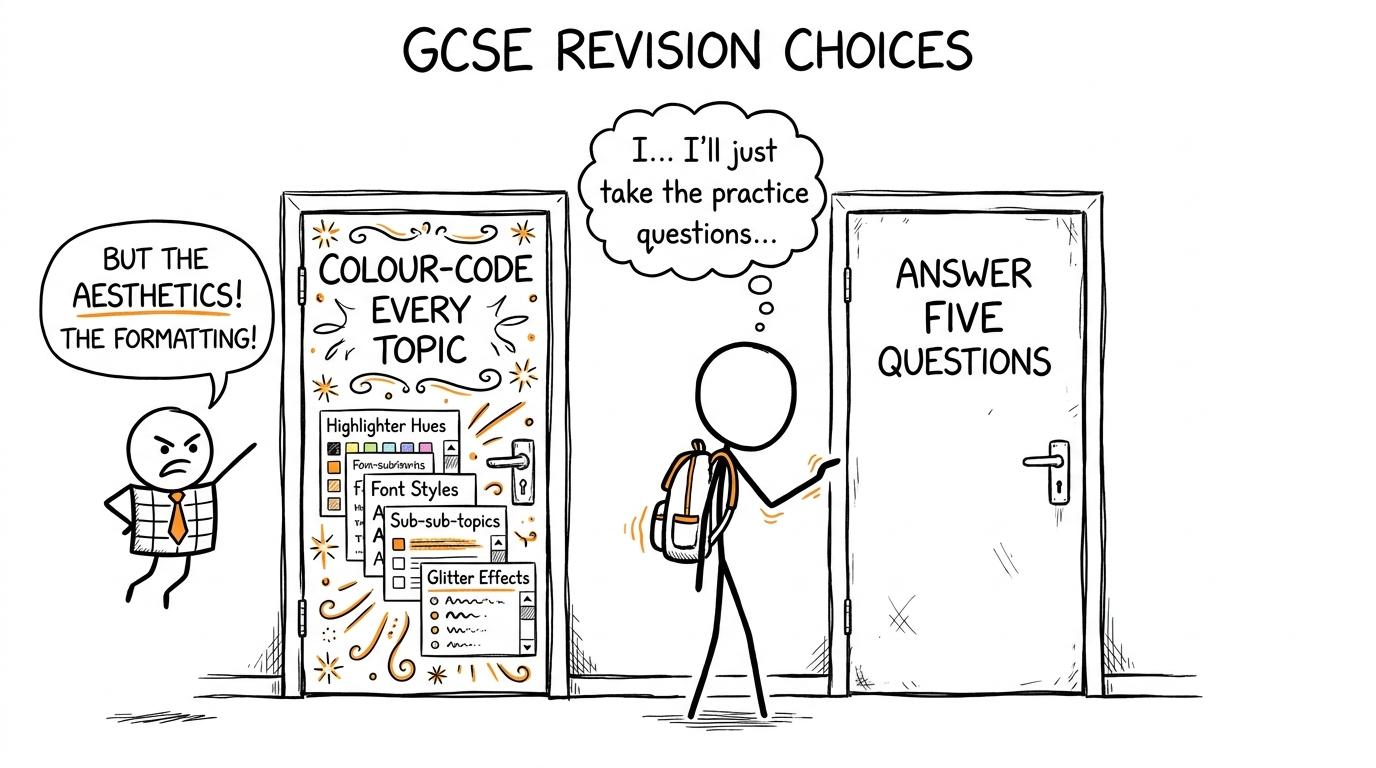 A student chooses practice questions over endless colour coding
Common mistakes when tracking revision progress
Recording time as proof of learning
Hours show commitment, not necessarily retention. Pair time with question marks, recall checks or specific teacher feedback.
Making every cell green too quickly
Completing notes is not the same as securing a topic. Change the status only after closed-book retrieval or application.
Tracking confidence without evidence
Confidence can be useful, but familiarity is deceptive. Attach it to a quiz, exam response or practical observation.
Revising only the lowest-scoring topic
Weak areas deserve attention, but stronger topics also need spaced review. Otherwise, today's strength can become next month's forgotten content.
Combining incompatible measures
A theory quiz percentage and a practical performance judgement describe different things. Keep separate fields rather than forcing them into one score.
Building the perfect dashboard
Conditional formatting cannot retrieve knowledge for you. Set a strict limit on tracker maintenance, then begin the task that produces evidence.
Make the tracker serve the work
Tracking revision progress can help with GCSE Physical Education because it turns a large specification into visible decisions. But the spreadsheet is only the map. Retrieval, practice, feedback and re-testing are the journey.
Keep your system small enough to use and honest enough to challenge you. Record marks rather than moods, errors rather than vague weaknesses, and next actions rather than promises.
Then apply the same discipline to maths. Start at the free GCSE Maths revision hub, choose a focused revision lesson, complete the practice questions and check your work with mark schemes or video solutions. Build towards mini tests, past papers and predicted papers, logging only the information that improves your next session.
A useful tracker does not make revision look impressive. It makes the next step impossible to misunderstand.