Tracking Revision Progress GCSE ICT: Does It Help?
Tracking revision progress GCSE ICT: learn when a spreadsheet improves GCSE maths revision, when it wastes time, and what evidence to record each week.
The search phrase tracking revision progress GCSE ICT usually hides a sensible question: if you record every revision session in a spreadsheet or app, will your results actually improve?
The honest answer is: tracking can help, but the spreadsheet itself does not create learning. A tracker is useful when it identifies weak topics, schedules another attempt and shows whether lost marks are falling. It becomes performative productivity when updating colours and charts replaces answering questions.
For a GCSE maths student, the best tracker is not the most impressive one. It is the smallest system that repeatedly sends you towards the right practice.
The short answer and checklist
Tracking revision progress is worthwhile if you:
- record evidence from questions, mini tests or papers;
- identify the exact reason marks were lost;
- turn each entry into a specific next action;
- revisit topics after a gap;
- spend far longer practising than updating the tracker.
It is unlikely to help if you mainly record hours, award yourself green boxes after watching videos or keep redesigning the spreadsheet.
A useful starting point is the GCSE maths revision hub, where you can move from revision lessons to practice questions, papers and solutions without turning resource hunting into another task.
A note about the term GCSE ICT
In England, the former standalone GCSE ICT qualification was discontinued. Current students may instead be taking GCSE Computer Science or a vocational digital qualification such as Digital Information Technology. Qualifications differ elsewhere in the UK, including digital technology courses in Wales.
That distinction matters. Building a spreadsheet may exercise general digital skills, but it does not automatically revise the content assessed by your course. Check the current specification supplied by your school and exam board rather than assuming that spreadsheet use counts as subject revision.
The tracking method in this article is aimed primarily at GCSE maths preparation. It can also organise Computer Science, digital technology and A Level revision, but the evidence entered must match the relevant qualification.
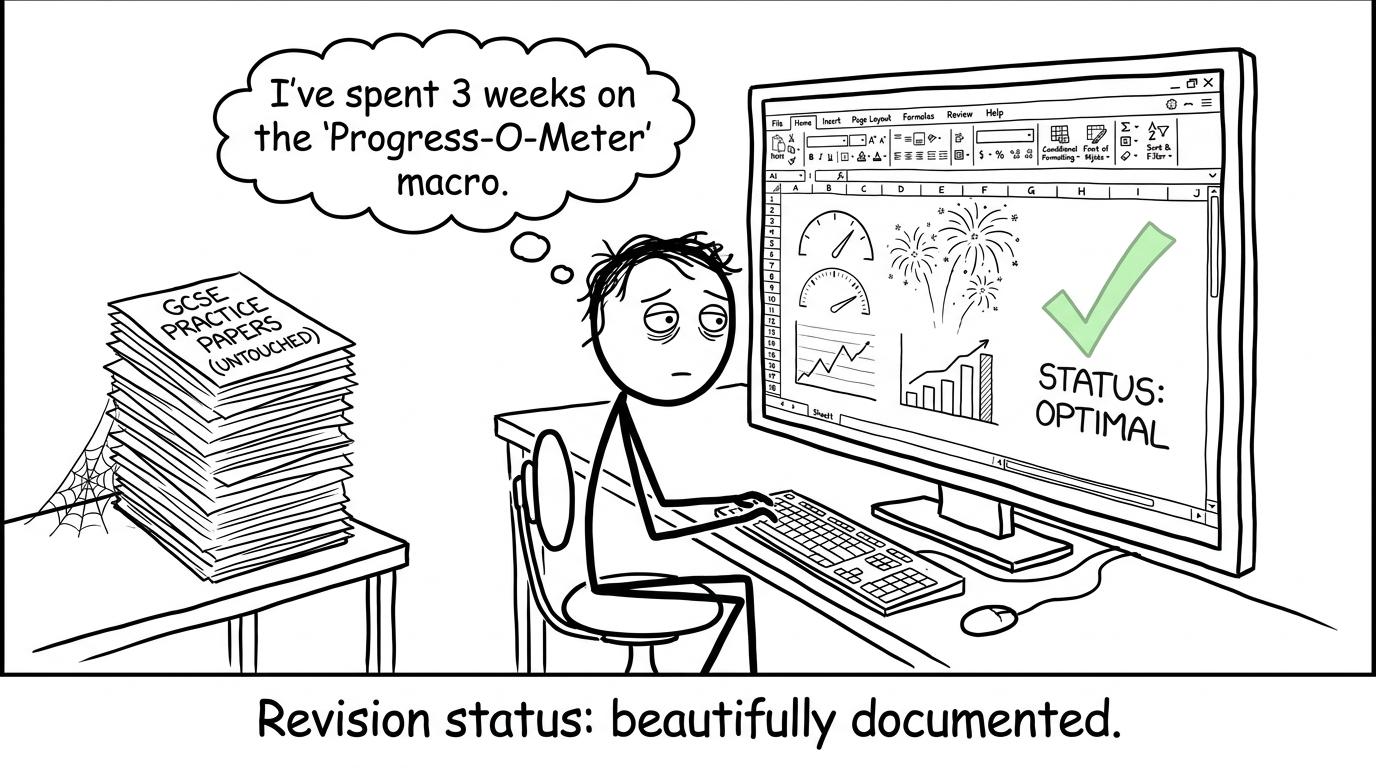 A student admires an elaborate revision dashboard while practice papers remain untouched
What a revision spreadsheet can genuinely improve
A good tracker supports planning, monitoring and evaluation. These are features of self-regulated learning: deciding what to do, checking what happened and adjusting the next attempt.
Research reviews from the Education Endowment Foundation support explicitly teaching pupils how to plan, monitor and evaluate learning. Retrieval practice can also expose gaps in memory, particularly when students receive feedback and use it to guide later revision.
Notice what the spreadsheet contributes. It does not perform the retrieval or solve the equation. It preserves the feedback so that you act on it.
It makes weak topics harder to avoid
Without a record, revision choices are often shaped by mood. Familiar topics feel reassuring, so they are chosen again. A tracker can reveal that simultaneous equations, bounds or circle theorems repeatedly cost marks even though percentages receives most of your attention.
Use the GCSE maths topics by exam board and tier guide to label topics precisely. Edexcel, AQA, OCR and Eduqas cover the national GCSE maths content, but their papers and specifications organise it differently. Your tracker should also identify whether you are sitting foundation or higher tier.
It supports spaced re-testing
Revisiting material over time is generally more useful than concentrating every attempt into one sitting. Your spreadsheet can place a re-test date beside each weakness, helping you return after the first correction is no longer fresh in your mind.
The important action is the re-test. A future date without a fresh attempt is only calendar decoration.
It replaces vague confidence with evidence
A confidence rating can be helpful, but it should not stand alone. Students sometimes feel confident because a solution looked understandable. The stronger question is whether they can answer a different question without prompts.
For a marked task, you may calculate:
Score percentage=marks earnedmarks available×100%\text{Score percentage}=\frac{\text{marks earned}}{\text{marks available}}\times 100\%Score percentage=marks availablemarks earned×100%The percentage is not a grade prediction by itself. Paper difficulty and grade boundaries vary. Its purpose is to compare attempts made under reasonably similar conditions and reveal whether performance is becoming more reliable.
What to put in a GCSE maths revision tracker
Keep one row per meaningful attempt, not one row per minute spent. Useful columns include:
| Column | What to record |
|---|---|
| Date | When the task was completed |
| Resource | Topic questions, mini test, past paper or predicted paper |
| Board and tier | For example, Edexcel higher or AQA foundation |
| Topic | A precise skill rather than a broad label such as algebra |
| Marks | Marks earned and marks available |
| Error type | Knowledge, method, accuracy, interpretation or timing |
| Correction | A brief statement of what must change |
| Next action | The exact lesson or question set to complete |
| Re-test date | When the skill will be attempted again |
| Re-test result | Evidence of whether the gap has closed |
Use MathsGenie's guide to finding your weakest topics to turn marked work into a manageable priority list. A tracker containing every possible GCSE topic can feel complete while telling you very little. A shorter list of current weaknesses is more actionable.
Use red, amber and green carefully
Colour can make patterns visible, but define each colour through performance:
- Red: you could not begin the question or the method was missing.
- Amber: you knew the approach but lost marks through an incomplete method, error or prompt.
- Green: you completed fresh questions independently and can repeat the method later.
Green should describe demonstrated recall, not exposure. Watching a revision lesson may prepare you to practise, but it is not proof of mastery.
Track outcomes rather than revision theatre
Hours are easy to count and difficult to interpret. One focused half-hour of questions, marking and correction may reveal more than a long evening of copying notes.
Instead of asking only how long you revised, record:
- how many marks were available;
- which marks were lost;
- why they were lost;
- what you changed afterwards;
- whether the same mistake returned.
The guide to using GCSE past papers properly explains the wider loop: complete a suitable paper, mark it carefully, log errors, repair weak topics and re-test them. That loop creates the progress. The spreadsheet simply keeps it visible.
Past papers should match your board and tier when you are measuring exam readiness. Predicted papers can then provide fresh exam-style material, but they are not promises about what will appear. MathsGenie's GCSE predicted papers are most valuable when you sit them, mark them and use the results to choose targeted revision.
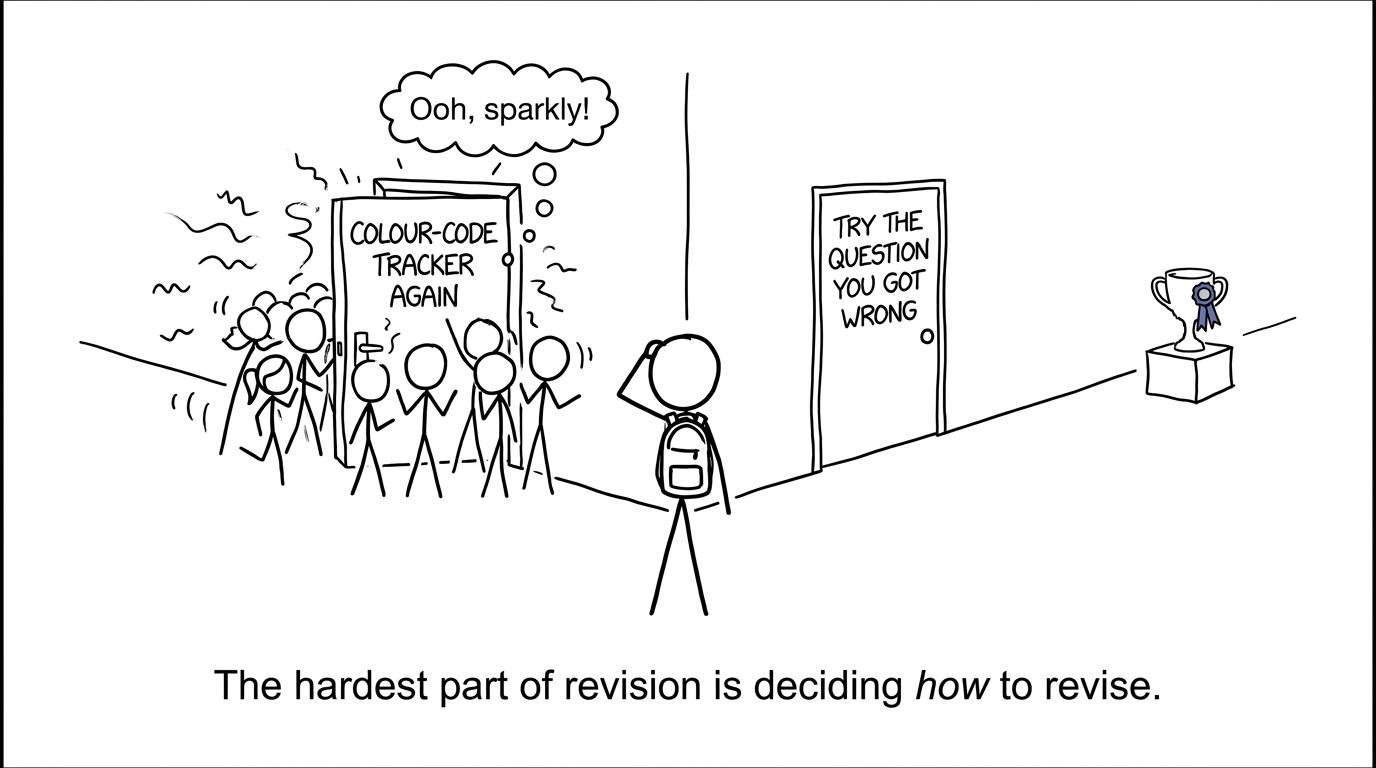 A student chooses between colour-coding a tracker and retrying a difficult question
Spreadsheet or revision app: which is better?
Neither format has an automatic academic advantage. Choose the tool with the least friction.
A spreadsheet is useful when you want custom columns, filters and a clear record of marks over time. It also makes your information portable. An app may be better if reminders, quick mobile entry or built-in question scheduling help you follow through.
The warning is the same for both: more features can create more maintenance. If entering a result takes longer than reviewing the mistake, simplify the system.
A paper checklist may even be better for some students. The quality of the revision cycle matters more than whether it lives in cloud software, an app or a notebook.
A simple weekly tracking routine
At the start of the week, choose a small number of weak skills from recent marked work. Use MathsGenie revision lessons and practice questions to rebuild each method, then test the skill without notes.
Later in the week:
- complete a mini test or timed paper section;
- mark it with the mark scheme;
- log only meaningful errors;
- choose the most important next action;
- schedule a re-test after a short gap.
Once you have covered most of the course, increase the proportion of timed paper practice. The guide on when to start GCSE past papers can help you move from topic work towards complete papers without abandoning targeted correction.
If exams are close, use the one-week GCSE maths revision plan to keep the tracker focused. A short deadline is not the moment to build a complicated dashboard. It is the moment to identify the marks most realistically available and practise earning them.
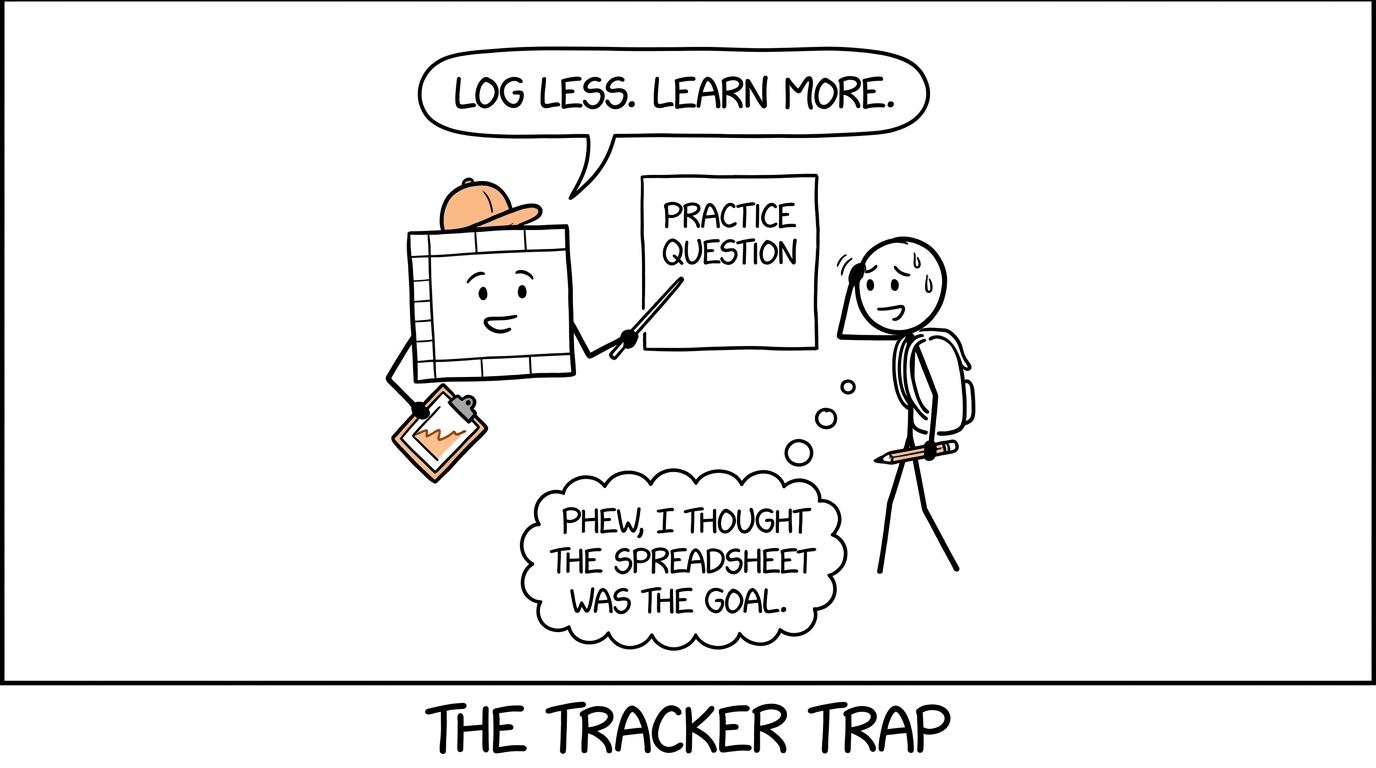 A tiny spreadsheet coach sends a relieved student back towards useful practice
Common mistakes when tracking revision progress
Recording completion instead of learning
A completed video, highlighted page or hour of revision says what activity occurred. It does not show what can now be recalled or applied. Follow learning activities with questions completed independently.
Using broad topic names
Writing geometry does not reveal the repair required. Record a narrower skill, such as bearings, similarity or circle theorems, so the next session has a clear starting point.
Making the spreadsheet too beautiful
Formatting can feel orderly when revision feels uncertain. Set a strict limit on tracker maintenance. A plain table used consistently is better than an abandoned dashboard.
Treating every low score as failure
A low score is useful diagnostic information when it changes what you do next. The purpose of practice is to expose weaknesses before the examination, not to create an uninterrupted line of reassuring results.
Forgetting to re-test
Correction can produce immediate familiarity. Re-testing later checks whether the method is genuinely available from memory. Keep weaknesses amber until they survive a fresh attempt.
Comparing unlike results
Do not assume that a percentage from a short topic test is directly comparable with one from a full past paper. Record the resource type, conditions, board and tier so the context remains visible.
Make the tracker serve the revision
Tracking revision progress can improve GCSE preparation, including the organisation of ICT-related subjects, but only indirectly. A spreadsheet helps when it converts marked evidence into better decisions. It wastes time when maintaining the record becomes a substitute for retrieval, problem-solving and feedback.
Start simply. Open the MathsGenie GCSE maths revision hub, choose one weak topic and complete questions without copying the solution. Mark them, record the exact gap and schedule another attempt. As your accuracy improves, move into mini tests, past papers and predicted papers.
MathsGenie brings free revision lessons, practice questions, mark schemes, video solutions and exam papers into one place. Let those resources do the teaching and testing. Let your tracker do one quieter job: point you towards the work that matters next.