

Tracking Revision Progress GCSE Drama: Does It Help?
Tracking revision progress GCSE Drama: learn when a spreadsheet improves retrieval, rehearsal and feedback, what to record, and what wastes time before exams.
Revision can look impressively organised without becoming more effective. A spreadsheet fills with green cells. An app celebrates a seven-day streak. Yet the script remains unfamiliar, the theatre evaluation is still vague, and the maths paper beside it has not been marked.
If you have searched for “tracking revision progress GCSE Drama”, the short answer is this: tracking can help, but the spreadsheet or app does not improve your grade by itself. It is useful only when it leads to better decisions, active recall, purposeful rehearsal, feedback and repeated practice. If maintaining the tracker replaces those activities, it merely feels productive.
That distinction matters for students balancing GCSE Drama with maths. Both subjects reward visible evidence of learning, not colourful evidence that revision was scheduled.
The quick checklist
A useful revision tracker should:
- cover the actual components of your exam board's specification;
- record completed learning, not optimistic intentions;
- include a result, difficulty rating or specific piece of feedback;
- identify the next action automatically;
- take less than a few minutes to update;
- encourage you to revisit weaker material;
- work alongside teacher feedback and mark schemes.
A tracker is probably wasting time if you spend longer formatting it than rehearsing, recalling or answering questions.
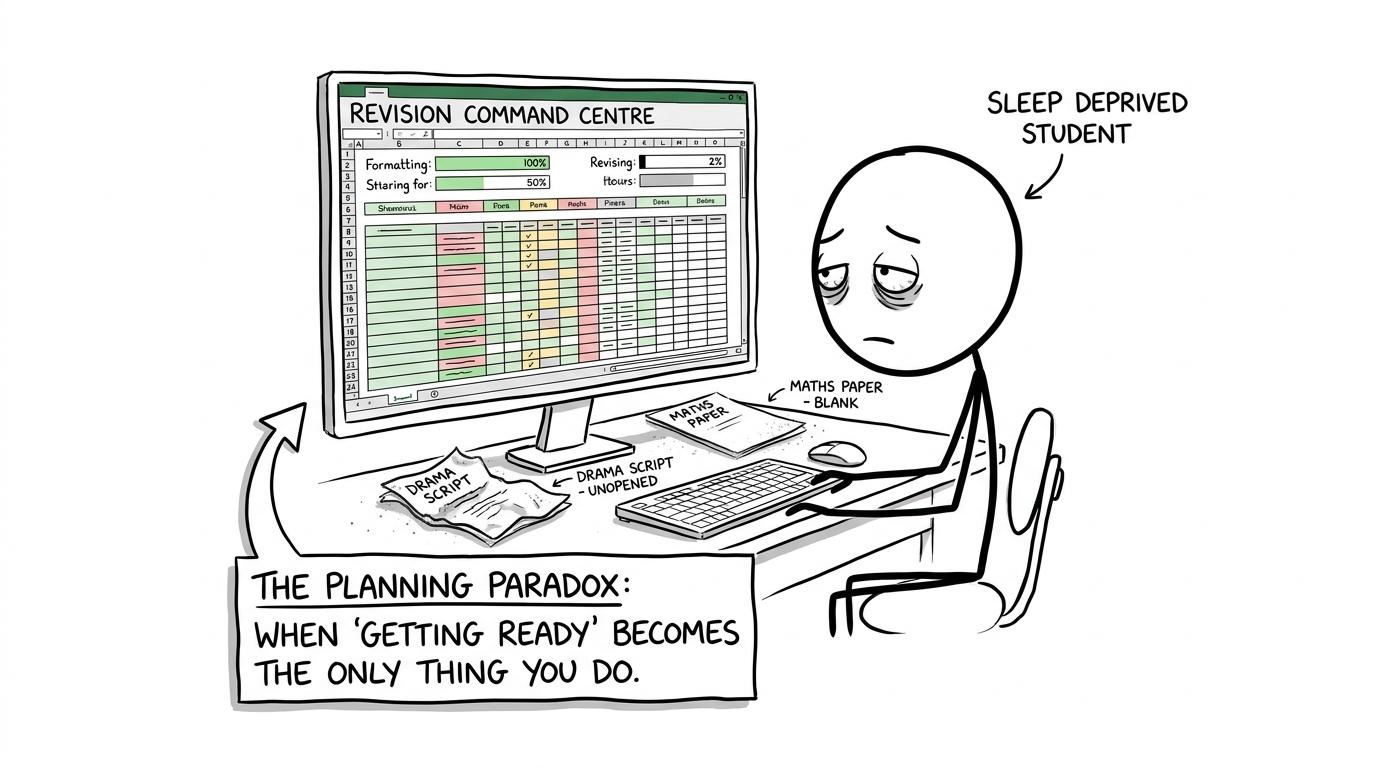 A student discovers that formatting a revision spreadsheet is not the same as revising
What progress means in GCSE Drama
GCSE Drama is not one single revision task. Across specifications from AQA, Edexcel, OCR and Eduqas, students combine practical creation and performance with knowledge, analysis and evaluation. The precise component names, set texts and assessment arrangements vary, so your current exam-board specification and teacher guidance should determine what enters your tracker.
In England, the common assessment objectives cover:
- creating and developing theatrical ideas, worth 20%20\%20%;
- applying theatrical skills in live performance, worth 30%30\%30%;
- demonstrating knowledge and understanding of drama and theatre, worth 30%30\%30%;
- analysing and evaluating your own work and the work of others, worth 20%20\%20%.
Current GCSE Drama qualifications normally allocate 40%40\%40% of the marks to written examination and 60%60\%60% to non-exam assessment. Individual boards organise those marks differently. AQA, for instance, currently divides its course into Understanding Drama, Devising Drama and Texts in Practice, while other boards use different component titles.
This means that “revised Drama for one hour” is not a meaningful progress record. What changed during that hour? You might have recalled theatre terminology, annotated a set-text extract, refined a performance choice, rehearsed a transition or improved an evaluation paragraph. Each creates different evidence.
Track outcomes rather than time alone
Time is useful for noticing whether one subject is being neglected. It is not proof of learning.
A stronger Drama log records:
- area: set text, live theatre, devising, performance or terminology;
- task completed: something observable and specific;
- evidence: a response, recording, rehearsal note or teacher comment;
- confidence: preferably based on performance without notes;
- problem found: the exact weakness revealed;
- next review: when and how you will test it again.
For example, “set text” is too broad. “Recalled staging choices for one scene without notes, then checked missing terminology” tells you what happened and what should happen next. This is not about producing more data. It is about making tomorrow's decision easier.
Why tracking can genuinely help
Research on metacognition and self-regulated learning supports teaching students to plan, monitor and evaluate their learning. Importantly, this evidence does not prove that spreadsheets themselves raise GCSE Drama grades. It supports the thinking process that a well-designed tracker can prompt.
It reveals neglected components
Students naturally return to tasks they enjoy or find comfortable. A performer might rehearse repeatedly while postponing written evaluation. Another student might make detailed notes but avoid performing without the script.
A simple weekly view makes imbalance visible. The tracker acts like a mirror: it cannot repair the weakness, but it can stop you pretending the weakness is not there.
It supports spaced revision
Learning tends to be more durable when practice is distributed across time rather than compressed into one long session. A tracker can schedule another attempt after a gap instead of marking a topic permanently “done”.
That matters for theatre terminology, quotations, production details and set-text knowledge. It also matters enormously in maths, where a method that felt secure on Monday may be difficult to retrieve the following week. MathsGenie's GCSE maths revision hub provides topic lessons and questions that can be returned to after these planned gaps.
It turns feedback into an action
Feedback is easy to read and surprisingly easy to ignore. A useful tracker converts it into a small task.
Instead of recording “teacher said evaluation needs detail”, record the missing skill: perhaps explaining the audience's response, naming a precise performance choice or linking an artistic intention to its effect. The next session should practise that skill.
The same principle works in maths. After completing an Edexcel GCSE Maths past paper, do not log only the total mark. Record the topics behind lost marks, use a revision lesson to repair them, then test them again.
When a spreadsheet only feels productive
Spreadsheets provide quick emotional rewards. Cells change colour immediately; knowledge changes more slowly. That can make organisation feel safer than genuine practice.
Tracking becomes pseudo-productivity when:
- you redesign categories instead of completing a task;
- you award yourself progress for rereading notes;
- confidence ratings are based on familiarity rather than recall;
- every tiny activity requires an update;
- streaks encourage easy tasks simply to keep the streak alive;
- the tracker contains data that never changes your next session.
The test is simple: what decision did the tracker improve? If it did not help you choose, adapt, revisit or seek feedback, the data probably had little value.
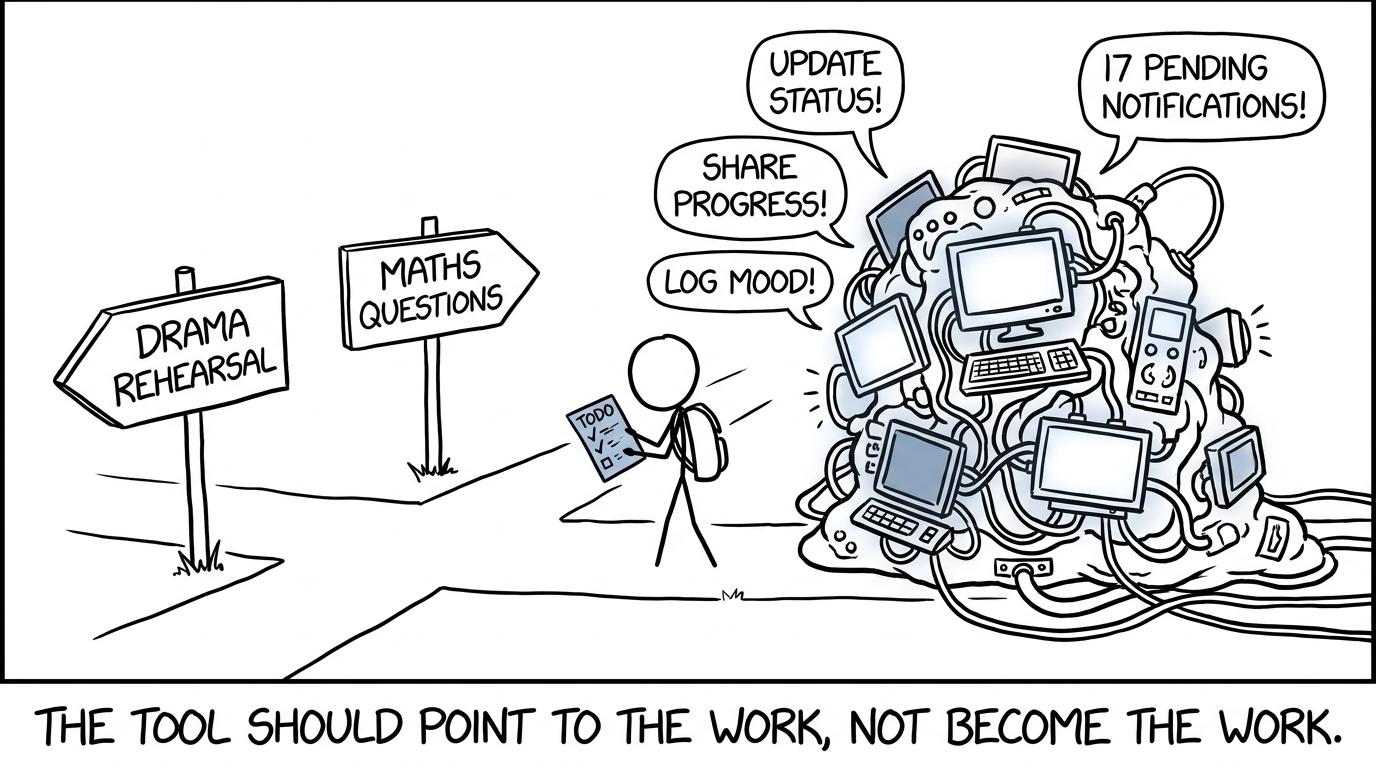 A small checklist guides revision while an overcomplicated app demands attention
Spreadsheet or app: which is better?
Neither format has an automatic learning advantage. Choose the tool with the least friction.
A spreadsheet works well when
- you want a complete view of Drama components and deadlines;
- you like filtering tasks by confidence or review date;
- you are balancing several GCSE subjects;
- you can resist excessive formatting;
- you update it briefly after revision.
An app works well when
- reminders help you revisit material;
- you mainly revise on a phone or tablet;
- recurring tasks are easy to schedule;
- the interface remains quick and uncluttered.
Paper may be better when
- digital tools distract you;
- opening an app leads to notifications;
- you only need a short weekly list;
- ticking off a completed task is enough.
The right system is the one you continue using without allowing it to occupy the revision session. Maths students who want a ready-made structure can also use the free MathsGenie revision planner rather than building an elaborate dashboard from nothing.
Build a tracker that leads to real practice
Keep the system small. One row should represent one meaningful learning attempt, not every minute of your evening.
Useful columns include:
- date;
- subject and component;
- precise task;
- result or evidence;
- error or feedback;
- next action;
- review date.
Avoid filling the tracker before doing the work. Decide on a task, complete it, check the result and then log only what will be useful later.
Use evidence appropriate to the subject
Drama evidence might be a rehearsal recording, an improved paragraph, accurate recall of terminology or feedback on a performance choice. Maths evidence might be a marked question set, mini-test result or recurring error identified from a paper.
MathsGenie's Edexcel GCSE Maths mini tests are useful because they produce quick evidence without requiring a full paper. If time is tight, the 20-minute maths revision routine shows how to combine retrieval, exam questions, marking and a short log.
Use a weekly review, not constant monitoring
At the end of each week, ask:
- Which task produced the clearest improvement?
- Which weakness appeared more than once?
- What have I avoided?
- What needs teacher feedback?
- What should be revisited next week?
Then choose a small number of priorities. Constantly checking progress can fragment attention; a brief weekly review keeps the tracker useful without making it the centre of revision.
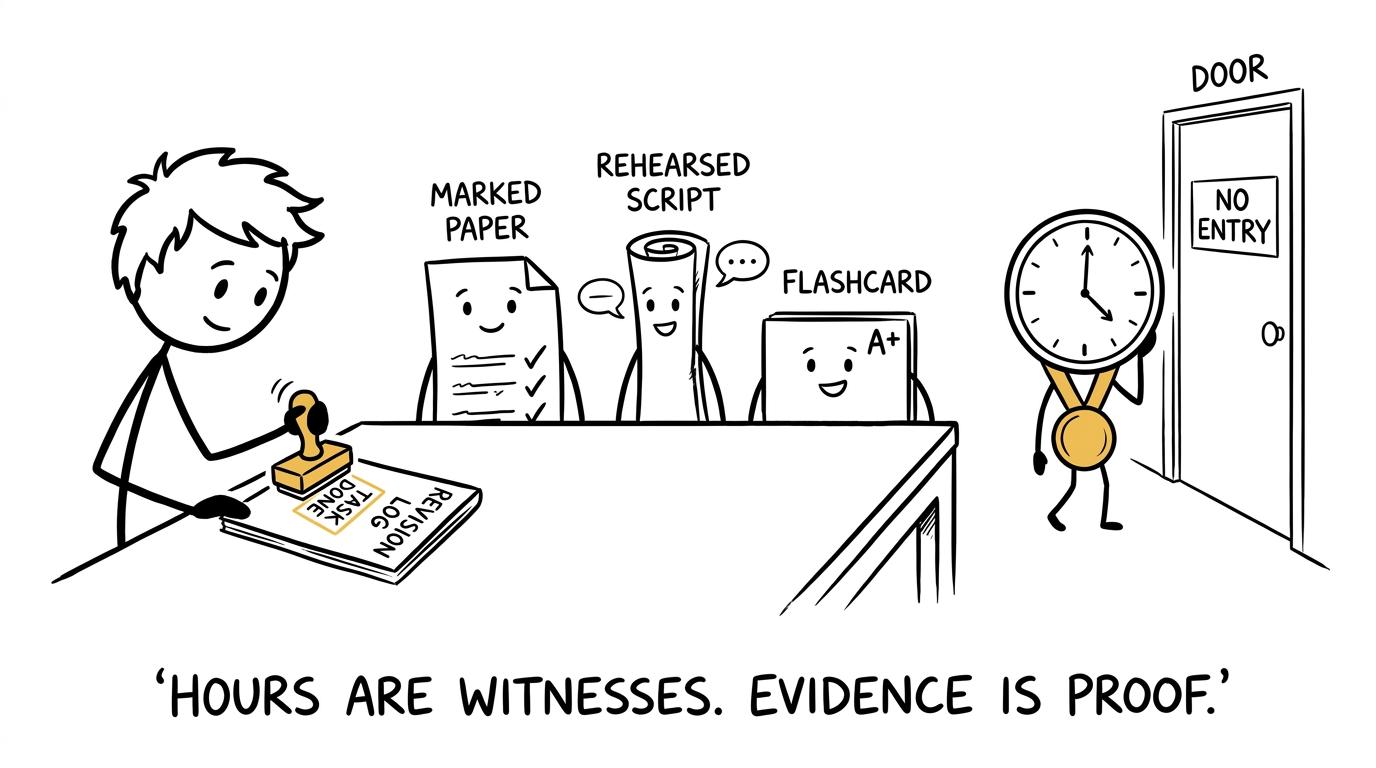 A revision log admits evidence of learning but turns away an empty clock
Applying the same system to GCSE maths
A Drama tracker can teach a valuable lesson for maths revision: measure what you can now do, not what you have looked at.
Start by confirming your board and tier. The GCSE maths topics by exam board and tier guide can help you map Foundation or Higher content. Then use a repeating cycle:
- attempt questions without support;
- mark them honestly;
- label the precise reason for each lost mark;
- return to the relevant lesson and practice questions;
- retest after a gap;
- use mixed papers to check whether the skill transfers.
The guide to using GCSE past papers properly explains why marking, error logging and retesting matter more than simply accumulating completed papers. Nearer the examination, GCSE predicted papers can provide further unseen practice, but they should follow topic repair rather than replace it.
Common mistakes when tracking revision progress
Treating completion as mastery
Watching a video or reading a scene is an activity, not proof that you can recall, explain or apply what you learned. Record the result of a check.
Using vague categories
“Drama”, “algebra” and “geometry” are too broad to guide the next session. Name the precise scene, concept, performance skill or mathematical method.
Recording hours but not evidence
A long session can contain little focused practice. Keep time if it helps with balance, but pair it with something observable.
Making the system too complicated
Too many colours, formulas, graphs and status labels increase maintenance. Remove any field that does not affect a future decision.
Ignoring exam-board requirements
Do not copy another student's checklist without checking that you share the same specification, set text, component and assessment arrangement. Follow your teacher's instructions for current non-exam assessment work.
Never changing the plan
A tracker should respond to evidence. If a marked answer or rehearsal exposes a weakness, move that weakness forwards. A schedule that cannot adapt is merely a calendar.
Make the tracker earn its place
Tracking revision progress can help with GCSE Drama when it creates a loop: plan a specific task, complete real practice, inspect the evidence and decide what happens next. The spreadsheet is not the engine. It is the dashboard.
Keep it deliberately plain. Let rehearsals, retrieval, written responses and feedback occupy most of your time. Then apply the same discipline to maths: use MathsGenie's free revision lessons and practice questions to repair weaknesses, mini tests to check recall, and past papers, predicted papers, mark schemes and video solutions to build exam readiness.
Open the GCSE maths revision area, choose one task your evidence says you need, and begin. Update the tracker afterwards, not instead.










