Tell Your Teacher You're Struggling With GCSE Japanese
Tell teacher struggling GCSE Japanese: learn why speaking up early helps, what to say, and how to protect your maths revision with a clear plan.

There is a particular kind of worry that grows quietly. You miss some vocabulary, struggle with a listening task, then tell yourself you will catch up at the weekend. The weekend passes. Before long, asking for help feels harder than the Japanese itself.
If your search was “tell teacher struggling GCSE Japanese”, the short answer is yes: tell your teacher as early as you can. You do not need to wait until your marks collapse, and you do not need a perfect explanation. A teacher can only respond to a difficulty they know about.
That matters when you are also preparing for GCSE maths. Quietly trying to repair one subject can consume the time and attention meant for another. Speaking up allows you to replace a vague, expanding worry with a specific plan.
Your quick action checklist
If GCSE Japanese is becoming difficult, take these steps:
- Identify whether the main problem is listening, speaking, reading, writing, vocabulary, grammar or character recognition.
- Collect one or two recent pieces of work that show where you became stuck.
- Speak to your Japanese teacher after a lesson or ask for a short meeting.
- Explain what you have already tried rather than simply saying the whole subject is impossible.
- Ask which two or three areas should come first.
- Agree one manageable action and a date for checking progress.
- Tell your form tutor, pastoral lead or parent or carer if the difficulty is affecting your wellbeing or several subjects.
- Protect your maths timetable instead of allowing Japanese catch-up to occupy every free evening.
You are not reporting a failure. You are giving your teacher useful information.
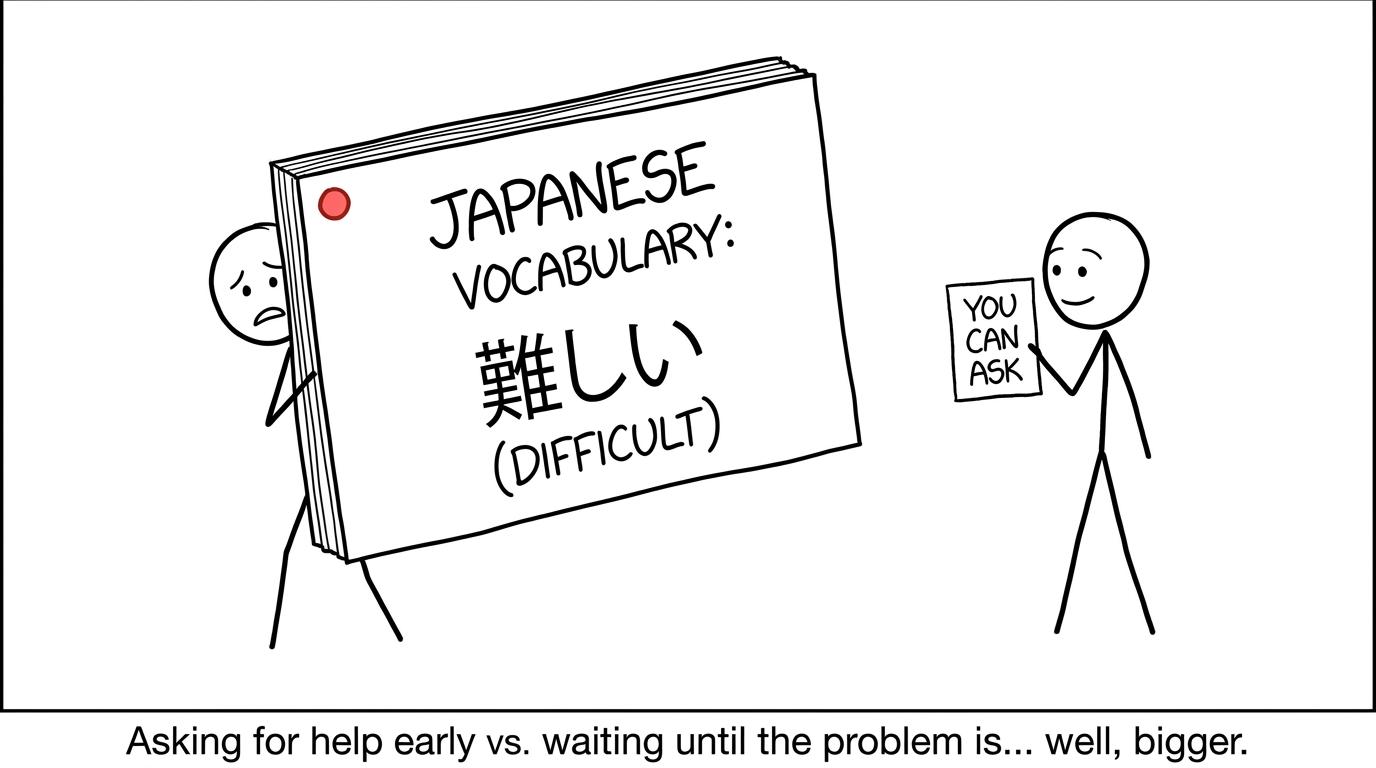 A worried student realising that asking for help is allowed
Why telling your teacher early tends to help
GCSE Japanese is not one isolated skill. Under the official GCSE modern foreign language framework, listening, speaking, reading and writing are separate assessment objectives, each carrying 25%25\%25% of the qualification. Grammar and accurate structures also contribute to speaking and writing marks.
This means that “I am struggling with Japanese” may hide several different problems. Perhaps you understand vocabulary on a page but cannot recognise it at listening speed. Perhaps you know what you want to say but hesitate during speaking practice. Perhaps grammar is reasonable, while kana or kanji recall slows down your reading.
Your teacher can help distinguish between these possibilities. That diagnosis matters because the wrong kind of extra work can create plenty of effort without much improvement. Recopying vocabulary may not solve a listening problem. Completing more reading may not address anxiety about speaking.
Early conversations also leave room for small adjustments. Your teacher might clarify a misunderstood structure, direct you towards the most important vocabulary, suggest a better recall method, arrange speaking practice or explain which specification content deserves priority. The exact support will depend on your school and course, so asking your own teacher is more reliable than following generic online advice.
Waiting usually makes the problem less precise. One uncertain topic becomes several missed tasks, and eventually the student no longer knows where the gap began. Asking early keeps the problem small enough to name.
What to say when “I’m struggling” feels too vague
You do not need to deliver a dramatic speech. A useful conversation can begin with one sentence:
“I’m finding GCSE Japanese difficult at the moment, especially listening and remembering characters. Could you help me decide what I should work on first?”
You could also say:
“I have been revising, but I am not sure whether I am using the right method. Could we look at my last assessment and choose my main priorities?”
These openings work because they include three helpful details: the subject, the difficulty and a request for a next step.
Be specific without diagnosing yourself
Try to describe what happens during a task:
- “I recognise the word when I read it, but not when I hear it.”
- “I run out of time in reading tasks because character recognition is slow.”
- “I can prepare speaking answers, but I struggle when the question changes.”
- “I am forgetting grammar that I understood in class.”
You are not expected to know the underlying cause. Teachers can observe patterns and help decide what support or practice is appropriate. If difficulties are broader, persistent or connected to an existing additional need, the teacher may suggest involving your form tutor, pastoral team or SENCo. That is a route to support, not a label you must give yourself.
Use email if speaking face to face feels difficult
A short email is enough:
Hello [Teacher’s name], I am finding GCSE Japanese harder recently, particularly [specific area]. I have tried [brief action], but I am still getting stuck. Could I speak to you about what to prioritise and how to practise it? Thank you.
Keep the message factual. You do not have to disclose personal information you are uncomfortable sharing. If anxiety, illness, caring responsibilities or another circumstance is affecting your work, you can ask to speak privately or involve a trusted adult.
Turn the conversation into a practical recovery plan
A helpful meeting should end with actions, not just reassurance. Ask questions such as:
- Which skill is currently costing me the most marks?
- Is this a knowledge gap, a recall problem or an exam-technique problem?
- What should I practise this week?
- Which task can I temporarily deprioritise?
- When can we review whether the plan is working?
The goal is not to “catch up with everything” immediately. It is to reduce uncertainty.
A simple plan might contain one short vocabulary-retrieval block, one focused grammar task, one listening activity and one speaking check across the week. Your teacher should help you choose activities suited to your specification and current level.
Record the agreed actions in a planner. The same principle works for maths: choose a weakness, practise it, check the feedback and return to it. The free MathsGenie revision planner can help you see where maths fits alongside Japanese and your other GCSE subjects.
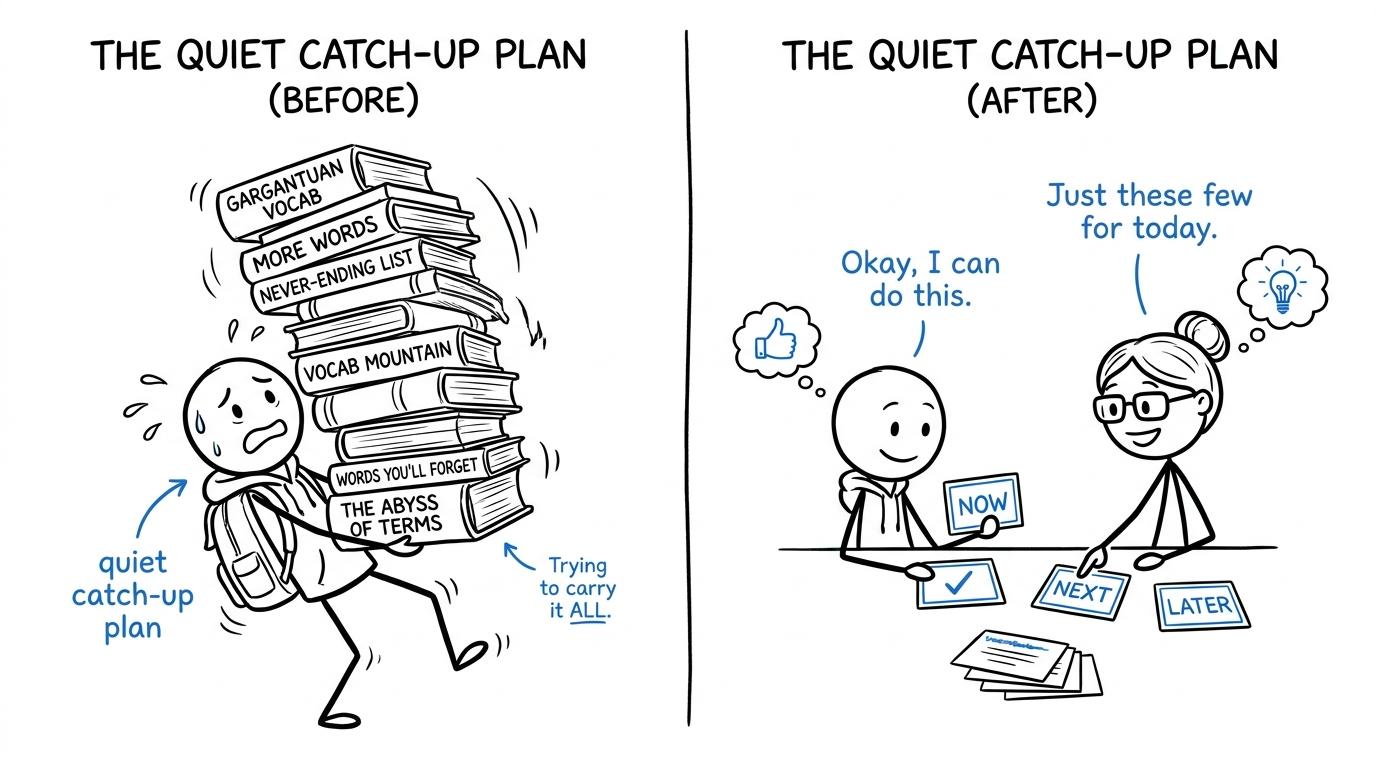 A quiet catch-up plan becoming a manageable teacher-supported plan
Why quietly catching up alone can backfire
Independent revision is valuable. Isolation is different.
When you work alone without knowing what caused the problem, you may spend hours on comfortable activities because they feel productive. You can also underestimate a foundational gap or overestimate how much material must be repaired. Both reactions waste time.
There is an emotional cost too. A hidden problem often feels larger because it has no boundaries. Once a teacher identifies the next step, the issue becomes a task rather than a verdict on your ability.
This does not mean your teacher will remove every difficulty. You will still need to practise. But good support makes that practice better directed. It also gives your teacher a chance to notice whether the plan is working and change it if necessary.
Protect your GCSE maths revision at the same time
Students rarely struggle with subjects in separate compartments. A stressful Japanese assessment can disrupt maths revision; a difficult maths mock can make Japanese vocabulary feel impossible. Time is shared, but attention is even more limited.
Start by giving each subject a defined space. For maths, use the GCSE maths revision hub to choose resources for your exam board rather than searching randomly. MathsGenie covers boards including Edexcel, AQA, OCR and Eduqas, with Foundation and Higher tier material.
Keep the maths routine small while you stabilise Japanese:
- Learn or revisit one weak topic through a revision lesson.
- Complete focused practice questions.
- Mark the work and identify the precise error.
- Retest the skill on another day.
If a full paper feels too demanding, use Edexcel GCSE maths mini tests or another suitable short task for your board. When you have enough time and concentration, move to Edexcel GCSE maths past papers or the relevant papers from the main GCSE hub.
Past papers should diagnose weaknesses, not merely produce a score. The guide to when to start GCSE past papers explains how to build from shorter topic work towards timed papers. Closer to the examination, GCSE predicted papers can provide additional exam-style practice, but they should supplement rather than replace official past papers.
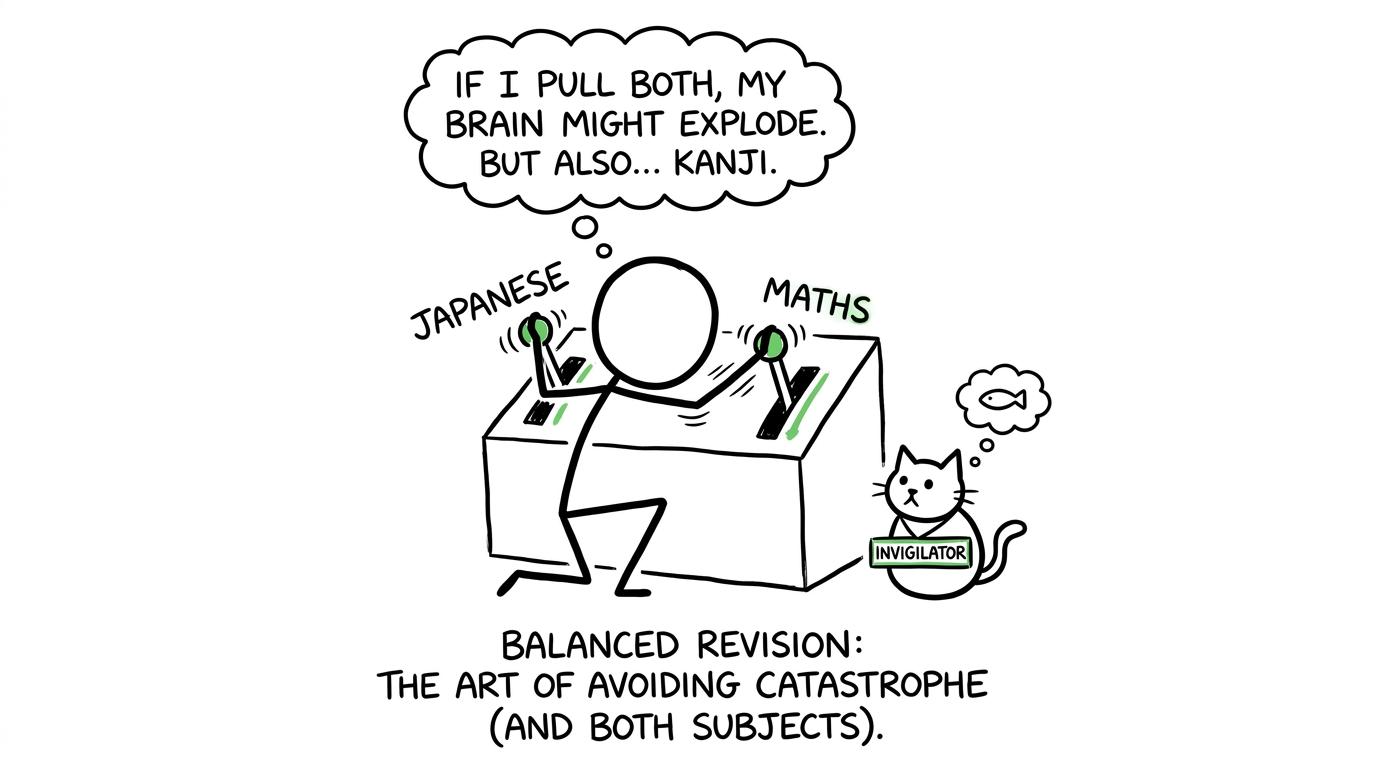 A student trying to balance Japanese and maths revision without turning both to maximum
Common mistakes when asking for help
Waiting for the next mock
A poor mock may confirm a problem, but you do not need to wait for one. Repeated confusion, unfinished homework or an inability to recall previously secure material already gives you something concrete to discuss.
Saying only “I’m bad at Japanese”
This describes a feeling, not a fixable task. Bring an assessment, homework page or list of situations where you become stuck. Specific evidence helps your teacher respond precisely.
Promising an unrealistic catch-up schedule
Trying to repair months of uncertainty in one weekend often produces exhaustion rather than secure learning. Ask your teacher to identify priorities and build a repeatable weekly routine.
Hiding the effect on other subjects
If Japanese catch-up is displacing maths revision, say so. Your form tutor or pastoral team may be able to help you organise deadlines and communicate with teachers.
Treating support as a substitute for practice
Speaking to your teacher is the beginning of the plan. Improvement still comes from completing the agreed activities, reviewing feedback and returning for a progress check.
Revising late into the night to compensate
Panic can make every unfinished task seem urgent. It is usually more useful to stop, choose tomorrow’s priority and protect your sleep. If an exam is close, use a calm checklist such as the GCSE maths night-before plan rather than attempting an uncontrolled catch-up session.
When to speak to someone else
Start with your Japanese teacher if the problem is mainly subject knowledge or exam technique. Speak to your form tutor, head of year, pastoral lead or another trusted teacher if you feel unable to approach that teacher, if several subjects are affected, or if the difficulty involves your wellbeing.
If you think an additional learning need may be involved, you or your parent or carer can ask the school’s SENCo for advice. Teachers can help recognise difficulties and coordinate support, but formal diagnoses belong with appropriately qualified professionals.
If your first conversation does not lead to a clear next step, try again with a more specific request. You can ask for a review date, involve a trusted adult or contact another appropriate member of staff. Asking once is not your only opportunity.
Asking early is a revision skill
Telling your teacher that you are struggling with GCSE Japanese is not an admission that you cannot do the subject. It is a decision to stop guessing.
A useful conversation turns “I am behind” into something narrower: a listening gap, uncertain grammar, slow character recall or a speaking skill that needs practice. Once the problem has a name, it can have a plan. And once Japanese has a realistic place in your week, maths no longer has to survive on whatever attention remains.
For the maths side of that plan, make MathsGenie your free revision base. Use revision lessons to rebuild understanding, practice questions and mini tests to strengthen individual skills, and past papers, predicted papers, mark schemes and video solutions to prepare for exam conditions. Ask for help early, plan honestly and let each revision session solve one identifiable problem.