Tell Your Teacher You're Struggling With GCSE Engineering
Tell your teacher you're struggling with GCSE Engineering early. Learn what support to request and how to rebuild the maths calmly before your exams.

A difficult engineering lesson can end with a surprisingly easy decision: say nothing. You tell yourself you will understand it at home, catch up at the weekend or ask once everyone else has left. Then one unclear formula becomes three, and the quiet gap begins to grow.
If you are wondering whether to tell teacher struggling GCSE Engineering is affecting your progress, the short answer is yes. Tell them early. A teacher cannot remove every difficulty, but they can identify what you have misunderstood, explain the next priority and help you stop a manageable gap becoming a larger one.
Speaking up is not an admission that you cannot do engineering. It is a practical response to evidence, which is, fittingly, an engineering habit.
A quick checklist before you speak to your teacher
You do not need a polished explanation. Start with these five steps:
- Identify one or two specific difficulties rather than saying the whole course is impossible.
- Find a recent question, drawing, calculation or piece of feedback that shows the problem.
- Ask for a short conversation at a suitable time.
- Request one clear next action, such as a topic to revise or a question set to complete.
- Agree when you will check your progress again.
If maths is part of the difficulty, open the GCSE Maths revision hub and note the topics that feel least secure. Arriving with a short list gives your teacher something concrete to work with.
 A student discovers the design flaw in hiding a problem
Why flagging the problem early usually helps
Struggling quietly can feel responsible because you are trying not to make a fuss. Unfortunately, silence hides useful information from the person best placed to respond.
Your teacher may assume that you understand a process because your practical work looks reasonable. They may not know that you are copying a formula without understanding it, losing track of units or spending hours correcting drawings. Once you explain the precise difficulty, they can distinguish between several different problems:
- missing subject knowledge;
- an insecure maths skill;
- uncertainty about the required standard;
- difficulty organising an extended task;
- weak exam technique;
- pressure, anxiety or another issue affecting your learning.
Those problems need different solutions. More revision is not automatically the answer. If the issue is unit conversion, revising materials for another two hours will not repair it. If the issue is interpreting a command word, completing more calculations may simply repeat the same mistake.
Official GCSE Engineering requirements combine knowledge, application and evaluation. Ofqual’s subject-level conditions allocate 60%60\%60% of the qualification to examination and 40%40\%40% to non-exam assessment. They also require mathematical skills to be assessed within engineering contexts, with at least 20%20\%20% of written-exam marks rewarding those skills. This is one reason an apparently small maths gap can affect several parts of the course.
Your exact assessment arrangements depend on your qualification and specification, so check them with your teacher rather than assuming that GCSE Engineering follows the same structure as another practical subject.
What should you actually say?
The first sentence is often the hardest because students think it must explain everything. It does not.
Try something direct:
I am struggling with the calculation side of GCSE Engineering, especially units and rearranging formulae. Could we identify what I should revise first?
Or:
I understand the practical task, but I am not sure my written explanation reaches the required standard. Could you show me where I am losing marks?
A useful conversation has three parts: the difficulty, the evidence and the request.
Describe the difficulty precisely
Replace “I am bad at engineering” with a narrower statement:
- “I cannot decide which formula applies.”
- “I lose track of the units when substituting values.”
- “I understand the design but cannot explain why it is suitable.”
- “I am behind on the planning section and do not know what to prioritise.”
Specific language makes support easier to provide. It also stops a temporary weakness turning into an identity.
Bring evidence
Show your teacher a marked question, unfinished calculation or feedback comment. Evidence helps them see whether the issue is knowledge, method, accuracy or communication.
For maths revision, you can use the diagnostic approach in finding your weakest GCSE Maths topics. Although that guide is organised around Edexcel Maths, the central habit (label the exact skill behind each lost mark) is useful wherever engineering draws on GCSE maths.
Ask for a next step
Useful questions include:
- Which topic should I fix first?
- Is there a model answer or specification section I should compare with my work?
- Should I redo this task or complete a different question?
- When can we check whether I now understand it?
The aim is not to leave with ten new jobs. It is to leave with the right first job.
The maths behind GCSE Engineering
Engineering uses maths as a language for describing real systems. The AQA GCSE Engineering specification, for example, includes arithmetic, ratio, percentages, standard form, significant figures, algebra, graphs, Pythagoras’ theorem and trigonometry. It also expects students to work with appropriate SI units and engineering formulae.
Common relationships include:
ρ=mV\rho = \frac{m}{V}ρ=Vmfor density,
P=FAP = \frac{F}{A}P=AFfor pressure, and
I=VRI = \frac{V}{R}I=RVfor current using Ohm’s law.
The difficulty is often not memorising a relationship. It is recognising the required quantities, using consistent units, substituting accurately and rearranging when the unknown appears in a different position.
Other engineering tasks may involve scale, area, volume, graphs, gradients and proportional reasoning. The similar shapes, area and volume guide is particularly useful when dimensions change and you must understand how length, area and volume scale differently.
Your GCSE Maths tier and board, such as Edexcel, AQA, OCR or Eduqas, affect the maths papers you sit. However, the underlying skills can transfer into engineering contexts. Your engineering teacher can help you identify which of those skills matters most for your specification.
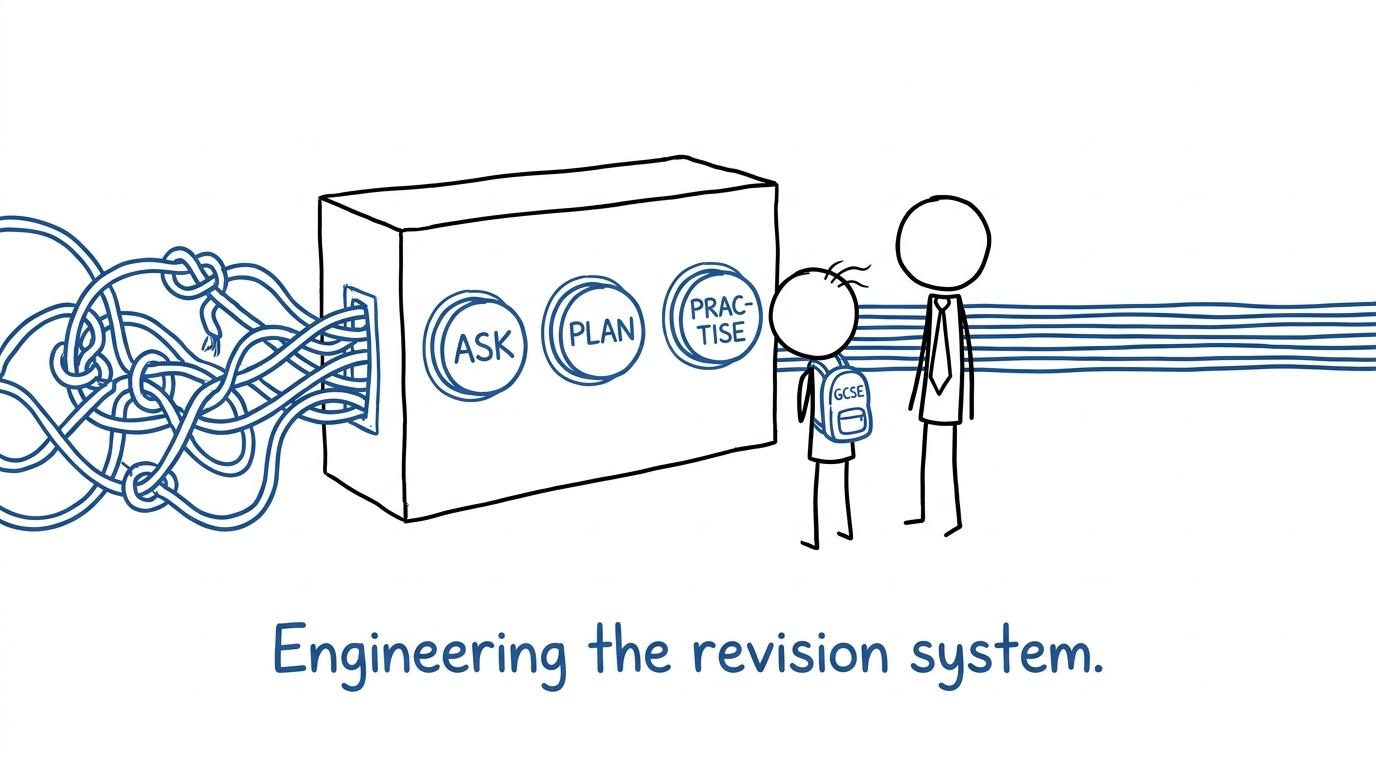 A teacher and student turn a tangled revision problem into a simple system
Turn the conversation into a recovery plan
A good conversation creates direction. Progress still comes from what happens afterwards.
Choose three priorities
Do not write “revise all engineering” at the top of a page. Choose no more than three immediate weaknesses, such as:
- conversions and units;
- substitution and rearranging formulae;
- interpreting graphs.
If your foundations need rebuilding, the best order for learning GCSE Maths topics can help you avoid attempting advanced applications before number, ratio and algebra are secure.
Use a learn, practise, mark, fix cycle
For each priority:
- review the method using a revision lesson or video;
- complete focused practice questions;
- mark them carefully;
- record the exact reason for each lost mark;
- retry the skill later without notes.
MathsGenie brings revision lessons, questions, solutions and assessment practice together, so you can move from understanding a method to testing it without creating a complicated resource hunt.
Short tests are useful when a full paper would hide the skill you are trying to repair. The Edexcel GCSE Maths mini tests, for example, provide focused timed practice with marking support. Students following another board should select resources that match their own course while still using topic questions to strengthen transferable skills.
Schedule the follow-up
Ask your teacher when you should show the new work or attempt another question. That follow-up matters because it turns “I will revise this” into a visible checkpoint.
A realistic timetable is better than an ambitious plan that survives for two evenings. Use the GCSE Maths revision timetable guide to place short topic sessions around lessons, homework and practical work.
 A giant toolbox of every topic is replaced by three manageable drawers
What if talking to your teacher feels difficult?
You can send a short email or ask your form tutor to help arrange the conversation. You might also speak to the head of department, a trusted teacher, your SENCO, pastoral lead or a parent or carer.
If the struggle involves persistent anxiety, low mood, sleep, bullying, additional learning needs or anything affecting your safety and wellbeing, say that clearly to a trusted adult. Government guidance expects school staff to identify pupils who may benefit from early help and to respond when concerns arise. You do not have to diagnose the cause before asking for support.
If your first conversation does not resolve the problem, do not conclude that support is unavailable. Explain what you tried, what remains difficult and what you need next. A written record of agreed actions can make the follow-up clearer.
Common mistakes when asking for help
Waiting for the next mock result
A disappointing result may confirm the problem, but you do not need to wait for one. Repeated confusion, unfinished work or growing avoidance already provides useful evidence.
Saying everything is difficult
That feeling may be genuine, but it gives your teacher no starting point. Choose one recent task and identify where your understanding stopped.
Expecting the teacher to create the whole plan
Support works best as a partnership. Ask for direction, then complete the agreed practice and return with evidence.
Doing full papers before repairing weak topics
Past papers are excellent for diagnosis and exam stamina, but repeated papers do not automatically teach a missing method. The guide to when to start GCSE past papers explains how to combine paper practice with targeted revision.
Using predicted papers as predictions of certainty
Predicted papers are fresh exam-style practice, not a guarantee of what will appear. Use Edexcel GCSE Maths predicted papers after repairing topic gaps, then mark them carefully and return to any weaknesses they expose.
Speaking up is part of solving the problem
Engineering is built around identifying faults before they become expensive. Revision works in much the same way. A hidden misunderstanding can spread through calculations, written explanations and practical decisions; a named misunderstanding can be investigated.
Tell your teacher early, bring one clear piece of evidence and ask for one practical next step. Then use MathsGenie to carry out the repair: revisit the relevant revision lesson, complete practice questions, check the mark scheme or video solution, and retest yourself with mini tests, past papers and predicted papers.
You do not need to solve the entire course tonight. Start by making the problem visible. Then fix the next part.