

Tell Parents You're Struggling With GCSE Drama
Tell parents struggling GCSE Drama with a calm, practical plan. Prepare what to say, avoid a lecture and agree useful next steps at home and school.
Falling behind in GCSE Drama can be strangely difficult to explain. From the outside, the subject may look like learning lines and performing. From inside the course, it can mean rehearsals, collaborative decisions, written analysis, devising evidence and the pressure of being assessed in front of other people.
If the thought behind your search is “tell parents struggling GCSE Drama”, the best approach is simple: choose a calm moment, explain the specific part you are finding difficult, show what you have already tried and ask for one or two practical forms of help. You do not need to defend your entire GCSE record. You are starting a conversation before the problem becomes harder to solve.
A quick conversation checklist
Before speaking to your parents or carers, prepare these five things:
- Identify the exact Drama task or component causing difficulty.
- Write down two or three facts rather than one sweeping conclusion.
- Choose a time when nobody is rushing or already annoyed.
- Say whether you want listening, advice or practical help.
- Finish by agreeing one next step and a time to review it.
That structure matters because worried people often rush towards solutions. Your parents may begin giving advice before they fully understand the problem. A clear opening makes that less likely.
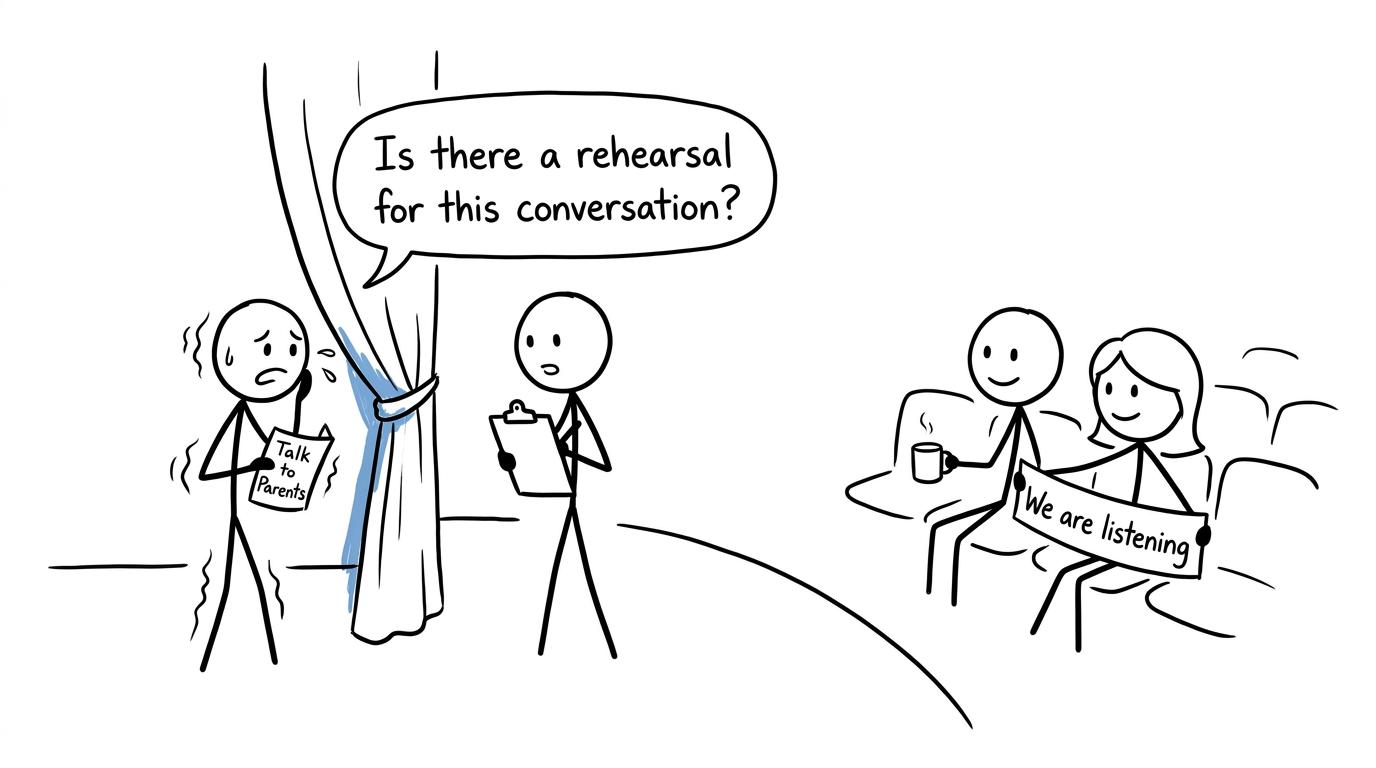 A nervous student asks whether a difficult family conversation has a rehearsal
Work out what “struggling” actually means
“I am bad at Drama” is a feeling, not a diagnosis. It gives your parents very little to work with and makes reassurance or criticism more likely than useful help.
GCSE Drama combines practical and written assessment. In England, the qualification includes substantial non-exam assessment alongside a written examination. Across AQA, Edexcel, OCR and Eduqas, the names and precise arrangements vary, so check your own specification and information from your teacher rather than relying on another student's course.
Your difficulty may be connected to:
- developing ideas for devised work;
- contributing confidently during rehearsals;
- learning or interpreting a scripted extract;
- keeping a portfolio or devising log up to date;
- analysing acting, direction or design choices;
- remembering evidence from live theatre;
- writing quickly enough under exam conditions;
- attendance, group tension or performance anxiety;
- balancing Drama deadlines with maths and other GCSE subjects.
Look for evidence. Perhaps your portfolio has unfinished sections, you cannot explain the intention behind your performance choices, or your teacher has said that your written evaluation lacks specific detail. Evidence turns “everything is going wrong” into “this is the part I need to fix”.
The same principle is useful in maths revision. MathsGenie's guide to finding your weakest GCSE topics explains why a precise weakness is easier to address than a general fear about a subject.
Prepare three points before you talk
You do not need a polished speech. A note on your phone containing three headings is enough.
What is happening?
Describe the observable problem. For example, you might be behind on your devising evidence, uncertain about a performance extract or struggling to turn practical ideas into written analysis.
Why is it happening?
Be honest without being harsh towards yourself. The reason could be unclear expectations, missed lessons, difficulty working with a group, competing deadlines or anxiety about performing. More than one cause may be involved.
What would help next?
Choose a realistic request. You might ask a parent to help you contact your teacher, protect one evening for portfolio work, listen while you practise lines or help you plan competing deadlines.
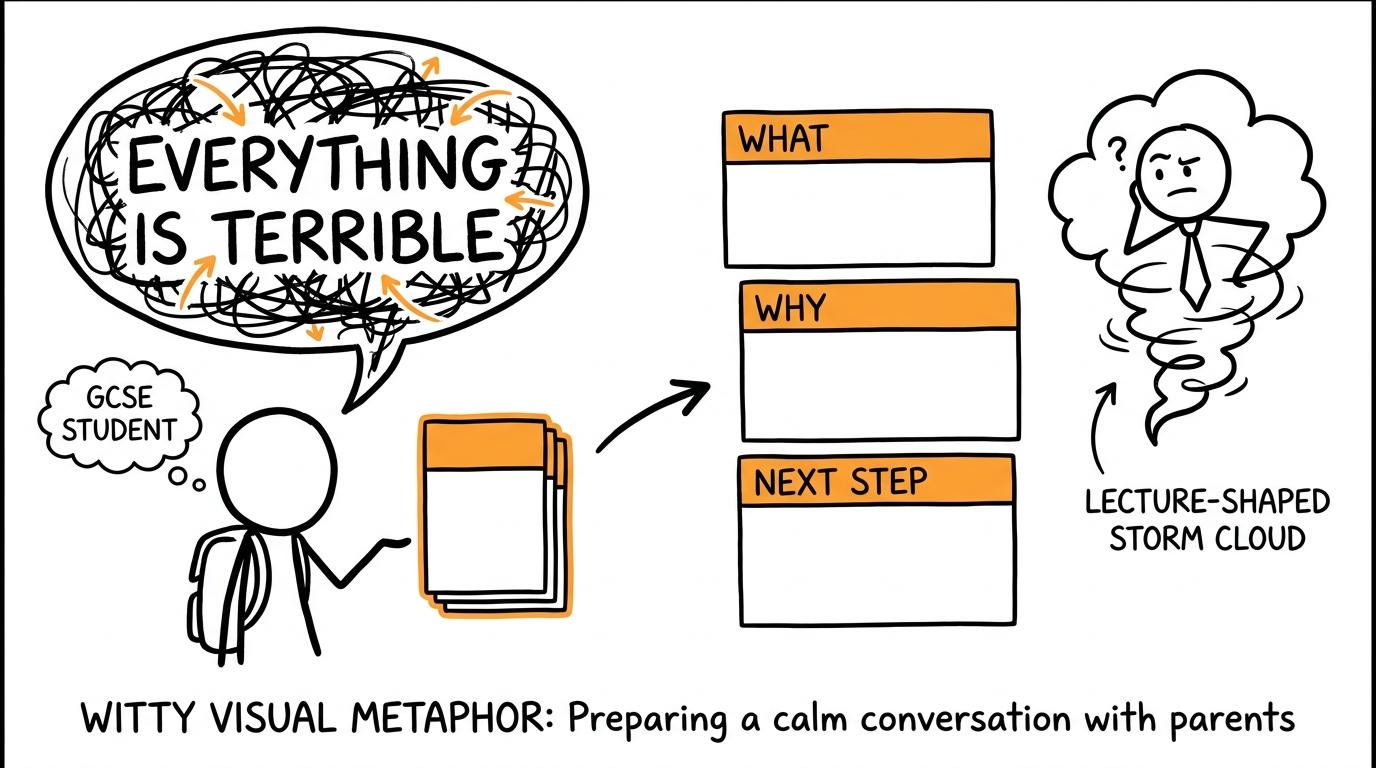 A student replaces one enormous worry with three manageable conversation cards
Choose a moment that reduces the chance of a lecture
Timing cannot guarantee a perfect response, but poor timing can make a difficult conversation harder. Avoid beginning as someone is leaving for work, dealing with another problem or trying to get everyone out of the door.
A walk, car journey or quiet household task may feel easier than a formal face-to-face meeting. Side-by-side conversations can reduce pressure. If speaking feels impossible, send a short message asking for a particular time to talk.
You could open with:
“I need to tell you that I am falling behind in one part of GCSE Drama. I am not asking you to solve it immediately. Could you listen for a few minutes, and then help me decide what to do next?”
That sentence establishes the subject, the purpose and the kind of response you need. It also signals that you are taking the situation seriously.
Keep the discussion focused when parents become worried
A lecture often begins with fear. Your parents may worry that one missed deadline means a failed subject, or that the problem reflects a lack of effort. Their first reaction may therefore be stronger than their considered response.
You can keep the conversation useful in several ways.
Use specific language
Replace “I cannot do any of it” with “I understand our performance idea, but I am behind on the written explanation of how it developed”. Specific language lowers the emotional temperature because it defines the size of the problem.
Acknowledge concern without accepting exaggeration
You can say:
“I understand why you are worried. I am worried too, which is why I am telling you now. Can we focus on what I need to do this week?”
This does not dismiss your parents. It redirects the conversation towards action.
Ask for listening before solutions
If advice arrives too quickly, try:
“Can I finish explaining the practical work, written work and deadlines first? Then I would like your ideas.”
Parents may not know how GCSE Drama is assessed. Explaining that the course contains performance, creative development and written analysis can prevent the conversation being reduced to “just learn your lines”.
Do not make promises you cannot control
Avoid promising a particular grade or saying everything will be fixed tomorrow. Promise actions instead: speaking to your teacher, completing a named section or attending an available rehearsal.
Ask for practical support, not surveillance
The strongest request is small enough to act on. Depending on the problem, you could ask your parents to:
- help arrange a conversation with your Drama teacher;
- give you a quiet, protected work period;
- check the wording of an email without taking it over;
- help map Drama, maths and other deadlines;
- listen to lines or a short explanation of your artistic intentions;
- check in once at an agreed time rather than asking every day.
You are looking for support that makes independent action easier. Constant monitoring can increase stress without improving the work.
A shared revision plan can reassure parents because it makes the wider picture visible. The GCSE maths revision timetable guide offers a useful structure for turning subjects and deadlines into manageable sessions. If exams are approaching, the one-month GCSE maths revision plan can help you protect maths preparation while creating space for Drama recovery work.
Involve your Drama teacher early
Your parents can support you, but your teacher knows the course, your exam board and the evidence still available. Ask what is incomplete, what has the greatest priority and what a realistic recovery plan looks like.
Useful questions include:
- Which component needs attention first?
- What evidence or work is currently missing?
- Is there an internal deadline before the final deadline?
- What can I complete independently?
- Is extra rehearsal or feedback available?
- When should we check my progress again?
If group work is part of the difficulty, describe the situation factually. Explain what has happened, how it affects your contribution and what support you are requesting. Avoid turning the meeting into a list of accusations.
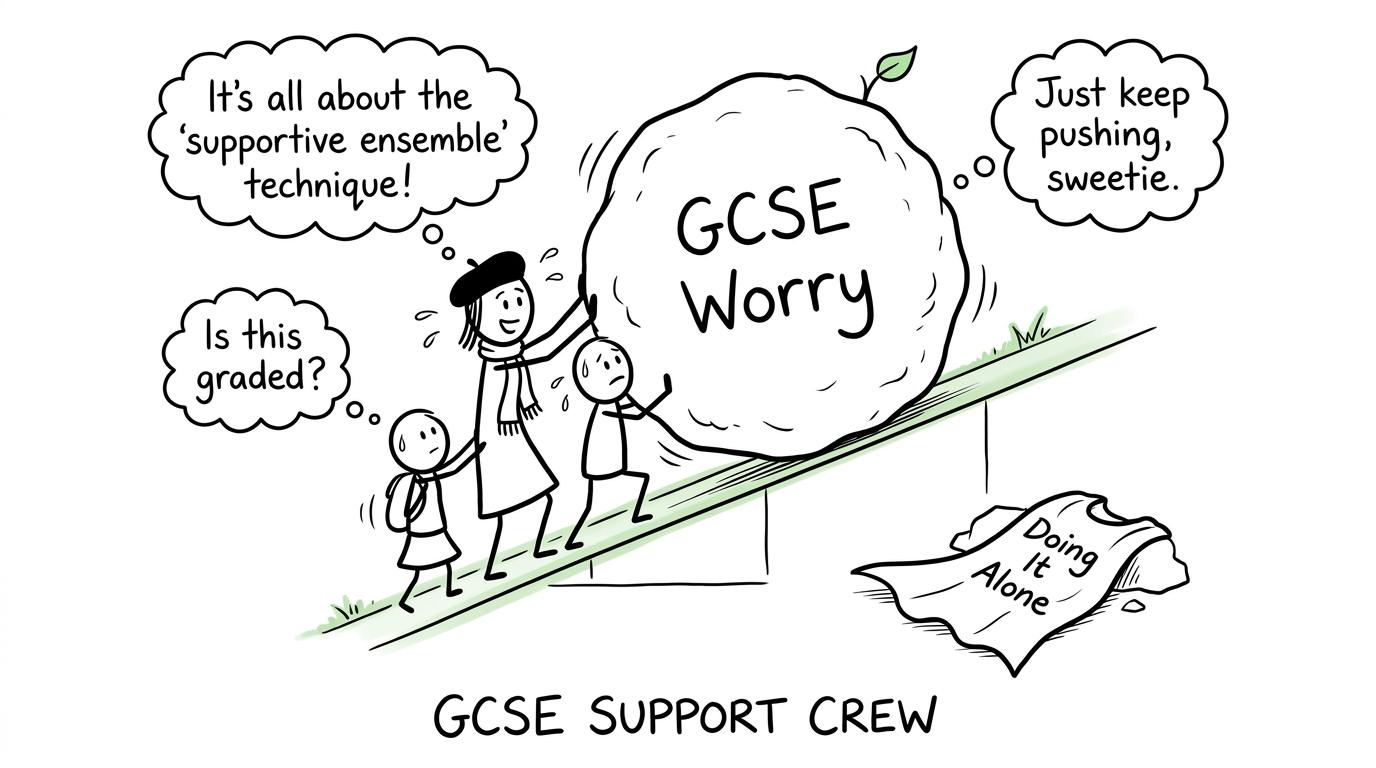 A student, parent and teacher work together instead of leaving one person to move the worry alone
Protect your maths revision while you catch up
A Drama problem can consume every available evening because practical deadlines feel immediate. Then maths revision disappears until the next mock. Replacing one academic problem with another is not a recovery plan.
Keep maths moving with short, defined sessions. Start at the GCSE Maths revision hub, choose one weak topic and use revision lessons followed by practice questions. A mini test or a short set is often more realistic during a demanding Drama week than an unfocused evening of revision.
When you have more time, use GCSE past papers properly: complete an appropriate paper, mark it honestly and repair the topics that cost marks. MathsGenie's past paper library brings papers and official mark schemes together, while the guide to using mark schemes as a revision coach explains how to turn errors into next actions.
If you take Edexcel, the Edexcel GCSE Maths past papers can be filtered by paper and exam series. Students following AQA, OCR or Eduqas should use the matching board resources from the main GCSE hub.
The aim is not to create a punishing schedule. It is to maintain a small amount of maths practice while giving the urgent Drama task enough focused attention.
If the first conversation goes badly
A poor first response does not mean asking for help was a mistake. Your parents may need time to move from surprise to problem-solving.
If voices rise, pause the discussion. Say that you want to continue when everyone is calmer. Later, try a written message using the same three points: what is happening, why it is happening and what help you need.
If you still cannot get useful support, speak to another trusted adult. This might be your Drama teacher, form tutor, head of year, pastoral lead or another relative. If the difficulty involves bullying, feeling unsafe, severe anxiety or a risk of harm, tell a trusted adult promptly rather than treating it only as a revision problem. In an immediate emergency, call 999999999.
Common mistakes when discussing GCSE Drama struggles
Waiting until the deadline has passed
Embarrassment encourages delay, but options usually narrow with time. Speak when you notice a pattern, not when you have developed a perfect explanation.
Starting with a verdict about yourself
“I am useless” invites an argument about your ability. Begin with the task, evidence and next step instead.
Raising every school problem at once
One conversation cannot repair Drama, maths, sleep, friendships and every deadline. Keep the first discussion centred on the most urgent issue.
Blaming the group for everything
Group difficulties can be genuine, but explain your own contribution and what support would improve the situation. That makes it easier for a teacher to act fairly.
Asking parents to fix the course for you
Your parents can help you communicate and plan. Your teacher must advise on assessment requirements, while you remain responsible for completing your own work.
Abandoning all other revision
Catching up in Drama should not mean ignoring maths until exam week. Use short lessons, practice questions and mini tests to keep important skills active.
Make the conversation the beginning, not the verdict
Telling your parents you are struggling can feel like admitting that something has already gone wrong. A better way to see it is that you are creating time, time to clarify the task, involve your teacher and make a plan while change is still possible.
Prepare three points. Ask to be heard before advice begins. Agree one practical action and a date to check progress. Then protect the rest of your GCSE preparation with a realistic revision planner.
For maths, make MathsGenie's free GCSE revision hub your next stop. Use revision lessons to rebuild understanding, practice questions and mini tests to strengthen it, then past papers, predicted papers, mark schemes and video solutions to prepare for the real exam. One honest conversation can reduce the uncertainty. One clear revision action can start rebuilding momentum.











