Tell Parents You're Struggling With GCSE Bengali
Tell parents you're struggling with GCSE Bengali calmly. Prepare evidence, explain what is difficult and ask for practical support without a lecture.

Sometimes the hardest part of falling behind is not the subject. It is saying it aloud.
If you need to tell parents struggling GCSE Bengali is becoming a problem, start with three things: choose a calm time, describe the exact skill you are finding difficult, and ask for one practical form of support. You do not need to defend your entire academic record. You only need to explain what is happening and agree on a useful next step.
That matters when Bengali carries more than an exam grade. It may be connected to family, culture or expectations, so admitting difficulty can feel unusually personal. But struggling with an assessed language skill does not mean rejecting the language or disappointing your family. It means you need a better revision plan.
A quick conversation checklist
Before speaking to your parents or carers:
- Check which part is causing trouble: listening, speaking, reading or writing.
- Gather evidence from a mock, teacher comment or marked task.
- Choose a quiet time rather than starting during an argument.
- Open with the problem, not an apology.
- Ask them to listen before offering advice.
- Make one specific request for help.
- Agree on a small plan and a time to review it.
- Speak to a teacher or another trusted adult if home does not feel like a safe place to raise it.
The aim is not to produce a perfect speech. It is to turn a private worry into a shared, manageable problem.
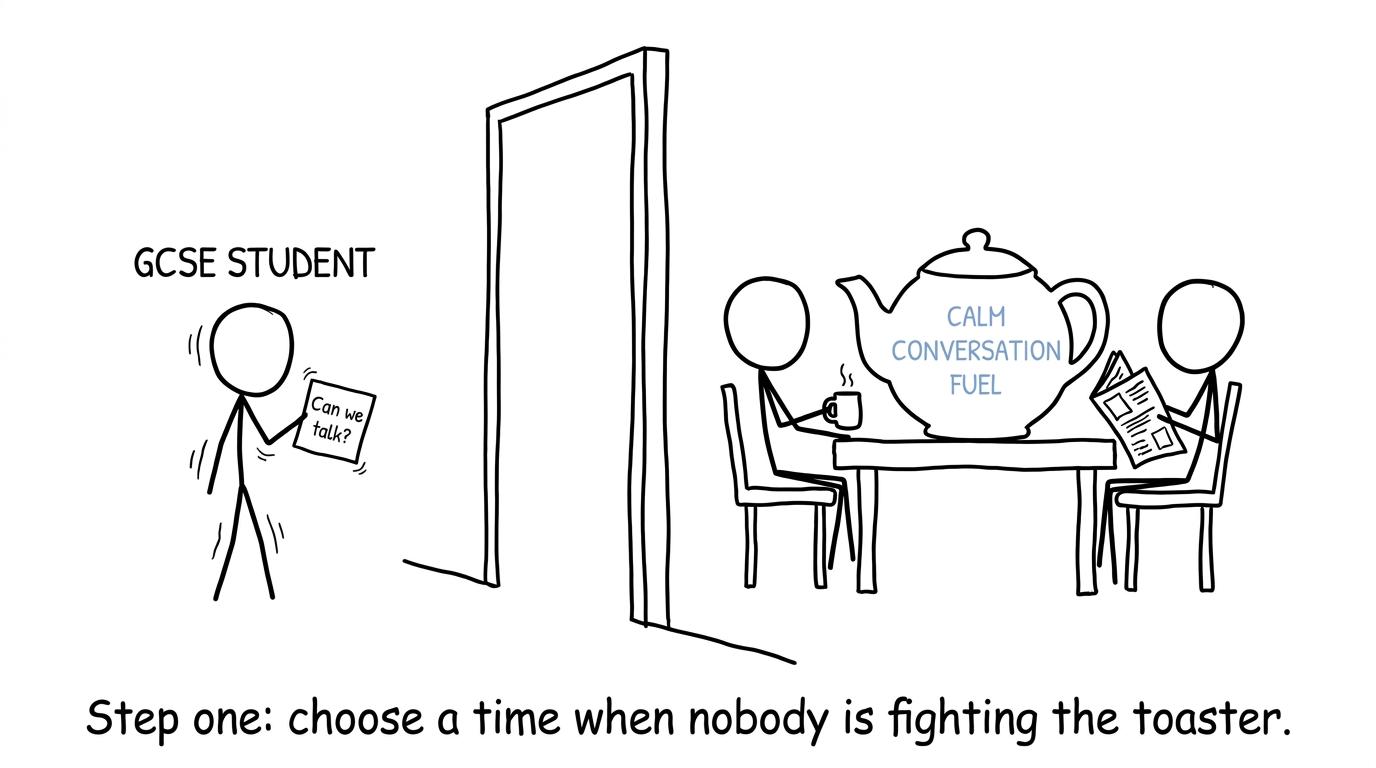 A student preparing to start a calm conversation beside an unusually large teapot
Work out what “struggling” actually means
“I am bad at Bengali” is emotionally powerful but practically useless. It gives your parents a large problem with no obvious starting point.
Current AQA GCSE Bengali assesses four skills: listening, speaking, reading and writing. Each contributes an equal share of the qualification. Students take either foundation or higher tier and must take all four components at the same tier. That means a weakness in one area deserves attention, but it does not erase everything you can already do.
Before the conversation, write down which description fits:
- You understand Bengali at home but struggle with formal reading.
- You can speak naturally but freeze during assessed speaking tasks.
- You know what you want to say but cannot write it accurately.
- You lose meaning when listening to unfamiliar speakers or recordings.
- Translation is difficult in one or both directions.
- You have missed lessons or started revision too late.
- Bengali is competing with maths and your other GCSE subjects for time.
Then attach evidence. A mock result, an unfinished task or a teacher’s comment is more useful than a vague prediction about failure. Evidence changes the conversation from “You are not working hard enough” to “This is the specific gap we need to address”.
The same principle helps in maths. The MathsGenie guide to finding your weakest GCSE topics recommends identifying the precise source of lost marks rather than labelling yourself as generally weak. A named difficulty can be practised. A judgement about your ability cannot.
Choose a moment that gives the conversation a chance
Timing will not guarantee a calm response, but poor timing can make one less likely.
Avoid beginning when someone is leaving for work, dealing with another problem or already frustrated. Ask for a short conversation later instead:
“Could we talk about Bengali after dinner? I am falling behind in one part of the course, and I want your help making a plan.”
This opening does several jobs. It signals that the conversation matters, gives your parents time to listen and shows that you are looking for a solution.
If speaking face to face feels overwhelming, send a short message first. You might also write down your opening sentence and the three points you want to cover. Notes are not evidence that you are weak. They are a way to stay clear when you feel nervous.
Use a structure that prevents the conversation drifting
A useful conversation can be built from four short parts.
State what is happening
Begin with a factual sentence:
“I am keeping up with some parts of GCSE Bengali, but I am falling behind in writing and translation.”
This is clearer than beginning with “You are going to be angry” or “I have ruined everything”. Those statements invite a discussion about emotions before the actual difficulty has been explained.
Explain what you have noticed
Add evidence and context:
“My last marked task showed that I understood the topic, but I could not write accurately enough under time pressure.”
You are not making excuses. You are helping your parents understand the difference between knowing Bengali socially and meeting the requirements of a GCSE paper.
Say what you have already tried
Mention genuine attempts, even if they have not worked:
- revising vocabulary;
- practising with a relative;
- completing a past-paper section;
- asking your teacher for feedback;
- attending support at school.
Do not invent effort to make the conversation easier. An honest sentence such as “I have been avoiding it because I did not know where to begin” is more useful than claiming that nothing works.
Make a specific request
Parents may lecture when they can see the worry but cannot see the solution. Give them a practical role:
“Could you help me contact my teacher?”
“Could we protect two quiet revision slots each week?”
“Could you listen while I practise speaking without correcting every sentence immediately?”
“Can we review the plan next weekend rather than discussing my grade every day?”
A specific request turns concern into action.
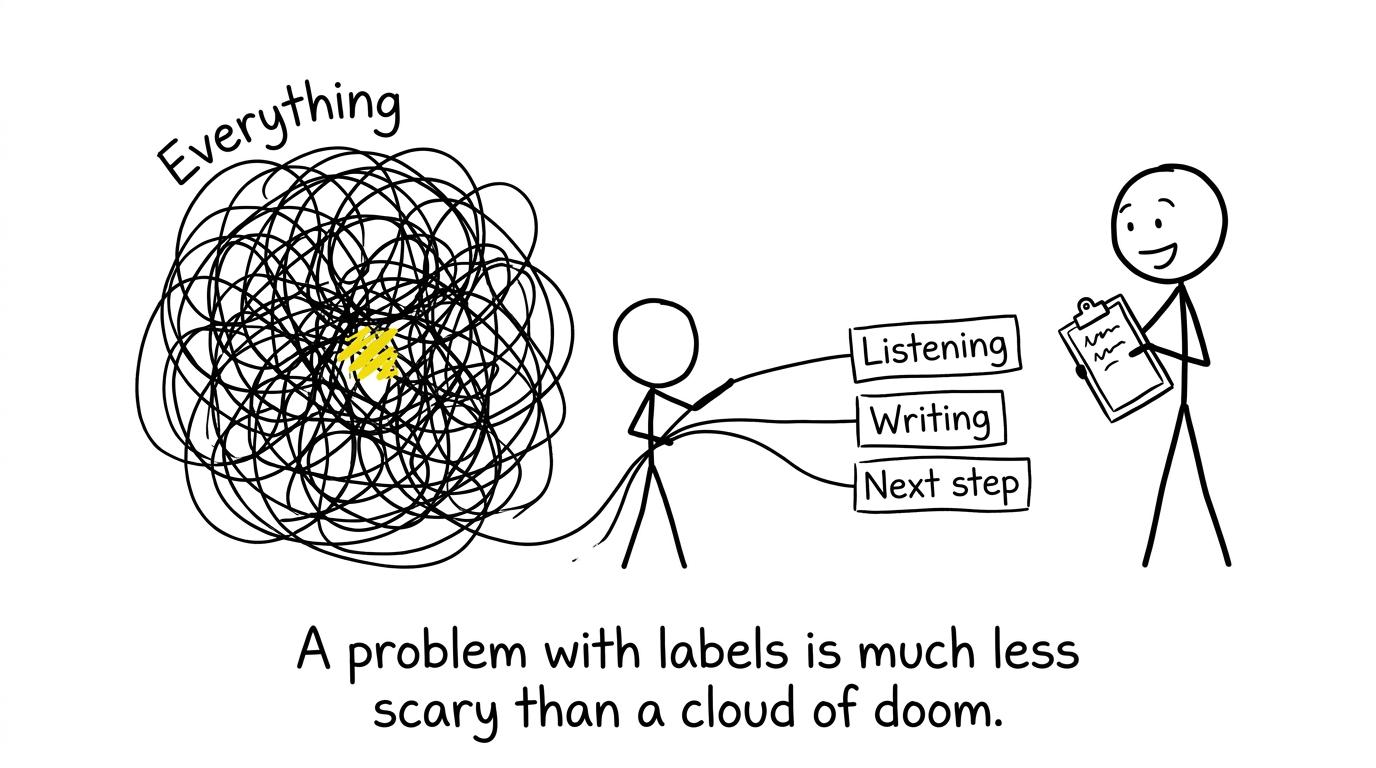 A student separating a giant tangle into clear, labelled revision problems
Explain why speaking Bengali is not the same as sitting GCSE Bengali
Parents may reasonably assume that using Bengali at home should make the examination straightforward. Home fluency is valuable, but an assessment can demand a different kind of control.
The qualification tests comprehension and communication across spoken and written contexts. Depending on the paper, students may need to respond in English or Bengali, translate, write for specified purposes and perform structured speaking tasks. Formal vocabulary, spelling, accuracy, timing and familiarity with the question format all matter.
You can explain this without sounding defensive:
“Speaking at home helps me, but the exam also tests formal reading, accurate writing, translation and timed responses. Those are the parts I need to practise.”
Also check the exact qualification with your school. In England, the accredited GCSE Bengali qualification is offered by AQA, but some schools or examination centres may discuss international qualifications separately. Do not rely on a relative’s older paper or assume that another language follows an identical format. Ask your teacher to confirm the specification, tier and assessment arrangements you are following.
What to do if the conversation starts becoming a lecture
You cannot control your parents’ first reaction. You can, however, keep returning to the purpose of the conversation.
Try a calm interruption:
“I understand why you are worried. Could I finish explaining what the teacher said, and then we can decide what to do?”
If the discussion moves towards comparisons with siblings or cousins, redirect it:
“I know they had a different experience. I need help with my current writing tasks and revision time.”
If you are asked why you did not say something earlier, answer briefly and honestly:
“I was embarrassed and hoped I could fix it alone. I am bringing it up now because I do want to improve.”
Do not attempt to win every side argument. Keep returning to three anchors: the evidence, the difficult skill and the next action.
If voices rise, suggest a pause. A delayed useful conversation is better than an immediate argument in which nobody listens.
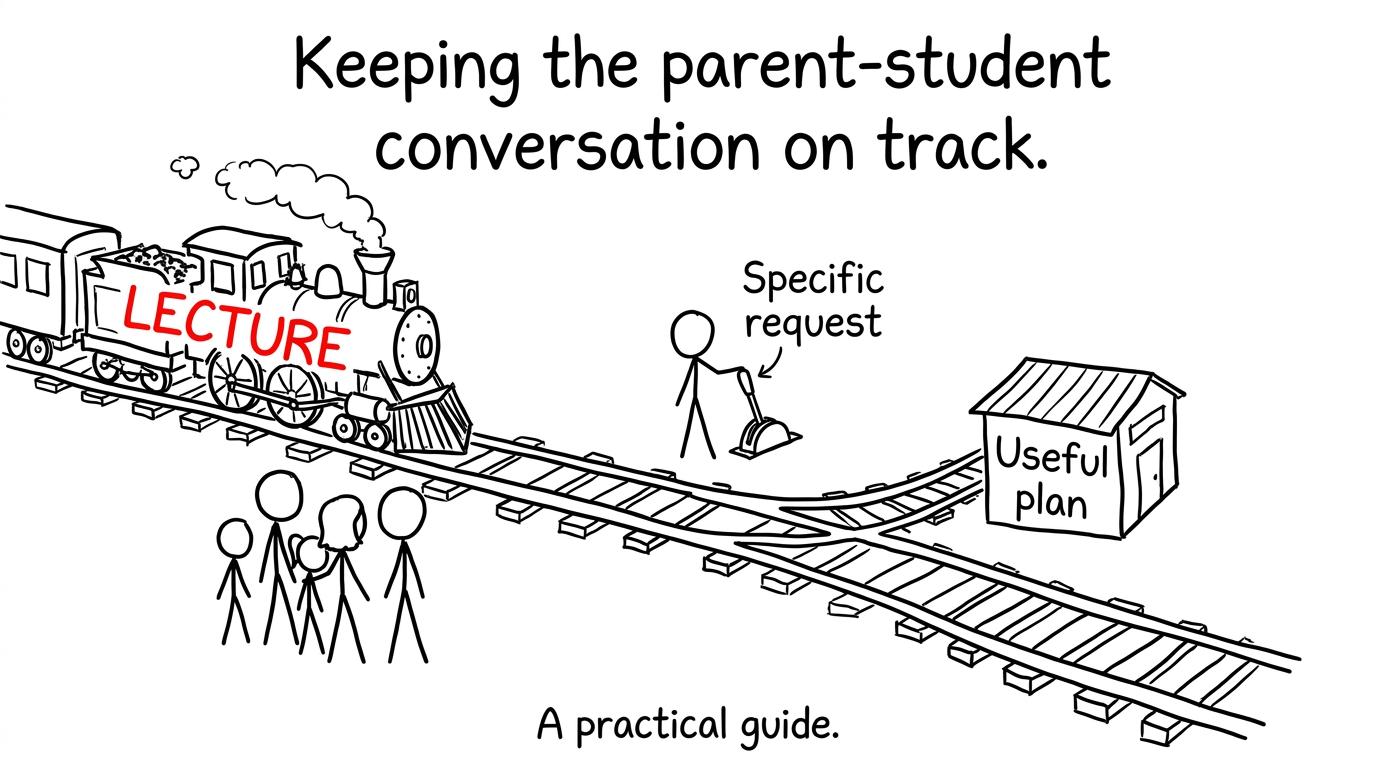 A student diverting the runaway lecture train towards a useful plan
Build a plan that protects Bengali and maths revision
The conversation will feel more credible if you arrive with a plan that respects your full GCSE workload. Bengali should not consume every evening, but it should not survive on whatever time happens to remain either.
Use a simple weekly structure:
- one session for the weakest Bengali skill;
- one shorter retrieval or vocabulary session;
- one task completed in exam-style conditions;
- one review of errors or teacher feedback;
- protected sessions for maths and other priority subjects;
- catch-up space if schoolwork disrupts the week.
The GCSE revision timetable guide explains how to plan around genuine weaknesses while leaving room for rest and missed sessions. On especially busy days, the principles in the short MathsGenie revision routine can help you begin with one tightly defined task rather than waiting for a perfect evening.
For maths, use the GCSE maths revision hub to choose your exam board and work at the correct foundation or higher level. The GCSE maths topics by board and tier guide can help you see what needs protecting in your timetable.
The method transfers across subjects: practise, mark, identify the gap and return to it. MathsGenie’s guide to using past papers properly shows why completing a paper is only the beginning. The improvement happens when you investigate the errors.
Agree on what support should look like
Well-meaning support can become constant monitoring. Decide together what would actually help.
Useful support might include:
- arranging a conversation with your Bengali teacher;
- finding a quiet place to revise;
- reducing interruptions during agreed sessions;
- helping you locate appropriate specification materials;
- providing a calm speaking-practice partner;
- checking progress once a week rather than every evening.
Be realistic about what family members can teach. A fluent speaker may be excellent for conversation but unfamiliar with the mark scheme or formal assessment requirements. Teacher feedback should guide exam preparation.
For maths, parents do not need to teach every method either. You can show them a visible routine using AQA GCSE maths past papers and mark schemes, or use Edexcel GCSE maths mini tests for shorter checks. The goal is accountable independence, not permanent supervision.
Common mistakes when telling parents you are struggling
Waiting until the problem becomes a crisis
Silence can feel safer today while making the eventual conversation harder. Raise the issue when there is still time to contact your teacher and adjust your revision.
Describing yourself instead of the difficulty
“I am lazy” and “I am terrible at languages” are verdicts, not diagnoses. Name the paper, skill or revision habit that needs attention.
Beginning during an argument
If the conversation starts as part of another disagreement, your GCSE concern may be treated as one more complaint. Ask for a separate time.
Asking for help without saying what help means
“Help me revise” is broad. Ask for quiet time, a teacher meeting, speaking practice or a weekly check-in.
Promising an impossible transformation
A plan involving every evening and no rest is unlikely to last. A smaller repeatable routine is more convincing.
Allowing Bengali to erase the rest of your timetable
One struggling subject can absorb all your attention. Keep maths moving through focused lessons, practice questions and short tests, then build towards Edexcel predicted maths papers or the appropriate papers for your board.
Assuming you must manage an unsafe reaction alone
If you fear intimidation, punishment or harm, speak first to a trusted teacher, safeguarding lead, pastoral member of staff or another safe adult. If exam stress is persistently affecting sleep, mood or daily life, ask for support from school or a health professional. Asking for help is the appropriate next step, not a failure of independence.
Turn the conversation into the first useful action
The best conversation does not end with a grand promise. It ends with something concrete: an email to a teacher, a protected revision slot, a speaking-practice arrangement or a date to review progress.
You are not admitting that you cannot succeed. You are recognising that secrecy is not a revision strategy.
Once the plan is agreed, keep your wider GCSE preparation steady with MathsGenie. Start from the free GCSE revision hub, use revision lessons and practice questions to repair specific maths gaps, check understanding with mini tests, and build exam confidence through past papers, predicted papers, mark schemes and video solutions. One honest conversation can reduce the pressure. One well-chosen action can begin changing the result.