

Teach Back Method GCSE English Literature: Does It Work?
Teach back method GCSE English Literature guidance: learn how explaining texts aloud exposes gaps, strengthens recall and improves focused revision.
Revision can feel convincing long before it becomes effective. You reread a chapter, recognise every quotation and think, “I know this.” Then someone asks why the writer used that image, or how the context changes its meaning, and the answer disappears.
The teach back method GCSE English Literature approach is a good revision method because explaining a text aloud forces you to retrieve knowledge, organise ideas and notice what you cannot yet explain. It is more demanding than quiet rereading, but that difficulty is useful. However, it should support rather than replace quotation recall, essay planning, timed writing and feedback.
For students balancing English Literature with GCSE maths, the wider lesson matters: familiarity is not the same as knowledge you can use under exam conditions.
The short answer: should you teach Literature to someone else?
Yes, provided you use the method carefully.
A productive teach-back session should:
- focus on one character, theme, relationship or key moment;
- begin without notes so that genuine recall is required;
- explain what happens, how the writer presents it and why it matters;
- include relevant textual evidence and context;
- invite questions rather than deliver a memorised speech;
- finish by checking notes or an authoritative resource;
- turn every hesitation or error into a specific revision task.
The listener does not need to be an English expert. A parent, friend, sibling or study partner can ask simple questions such as “Why?”, “Where is the evidence?” and “Could that mean something else?” You can even explain the material to an empty chair, record yourself or teach a houseplant. The learning comes from generating and checking the explanation, not from the botanical knowledge of the audience.
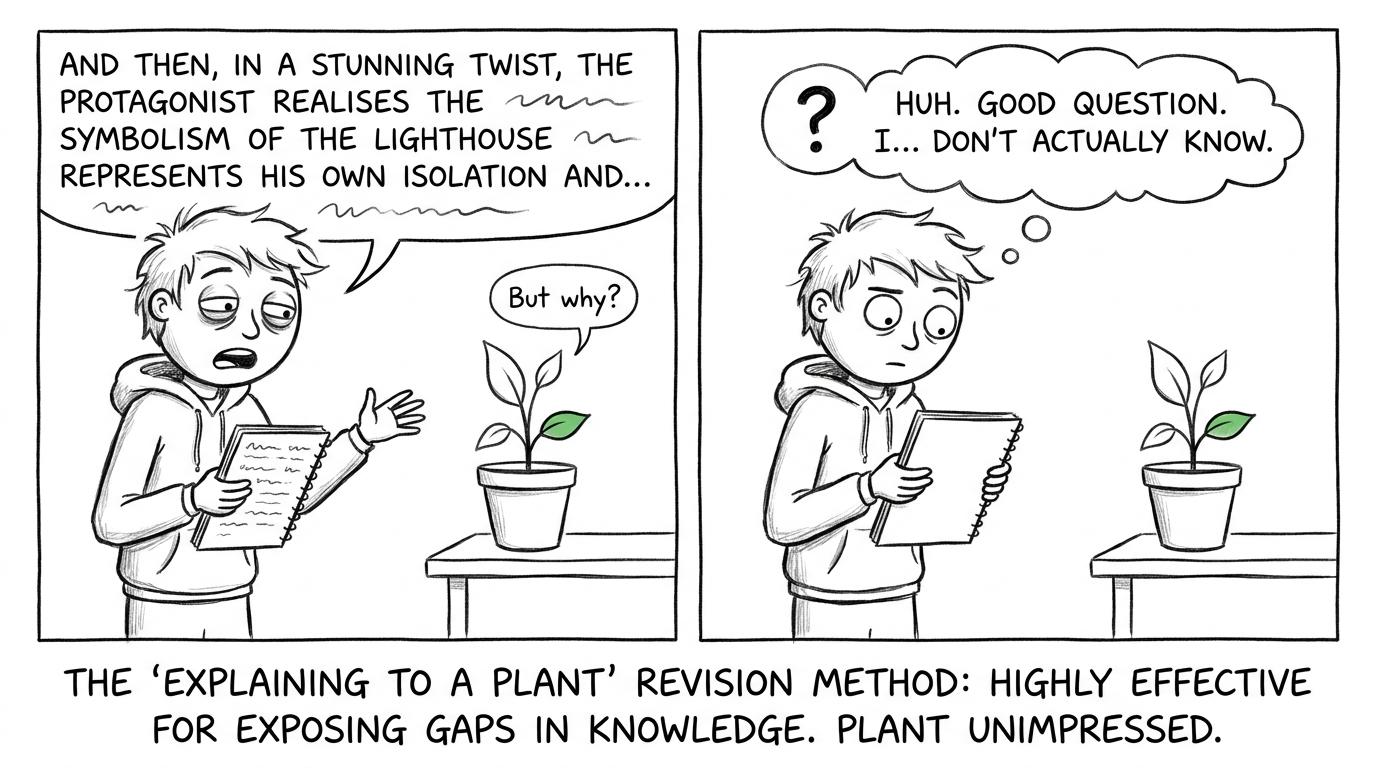 A GCSE student discovers a gap while teaching a houseplant
Why explaining aloud exposes hidden gaps
Quiet revision often gives you prompts. The page supplies the character’s name, the quotation and the interpretation before your memory has to do anything. Recognition feels smooth, so it is easy to mistake it for secure recall.
Teaching changes the conditions. Once the book and notes are closed, you must bring the information to mind yourself. You also have to decide which ideas belong together and express them in an order another person can follow.
This combines several useful learning processes:
- Retrieval: recalling knowledge without immediately looking at the answer.
- Self-explanation: connecting evidence, methods, themes and interpretations.
- Metacognition: monitoring what you know and identifying what remains uncertain.
- Elaboration: answering how and why questions rather than listing isolated facts.
Research on retrieval practice and self-explanation supports these underlying processes. Evidence specifically comparing teaching with every other form of active recall is more mixed, so teaching should not be treated as a magical shortcut. Its practical strength is simple: a vague idea can hide in a notebook, but it struggles to survive a clear follow-up question.
What a strong GCSE English Literature explanation contains
The exact assessment language differs between AQA, Edexcel, OCR and Eduqas, so use the specification and teacher guidance for your course. Across GCSE English Literature papers, however, successful responses generally require more than remembering the plot.
Your teach-back should help you practise the following layers.
Accurate knowledge of the text
Explain the relevant event, relationship or development accurately. If you confuse who says a line, when an event occurs or why a character acts, record the gap immediately.
Plot knowledge is the foundation, not the finished response. Retelling everything that happens will not, by itself, produce an analytical essay.
A defensible interpretation
State what the writer may be suggesting about the character or theme. Then explain the reasoning behind that interpretation. A useful listener keeps asking, “What makes you think that?”
Literary interpretation can allow more than one defensible reading. The aim is not to recite a single supposedly perfect meaning. It is to make a clear argument and support it with the text.
Carefully selected evidence
Recall short, flexible quotations or precise textual references. Explain why each one supports your argument rather than dropping it into the conversation and moving on.
If the wording is uncertain, say so and verify it afterwards. Repeating an inaccurate quotation confidently only rehearses the mistake.
Analysis of the writer’s choices
Move from naming a method to explaining its effect. Discuss language, form or structure when it genuinely supports the interpretation. Technique spotting without analysis is still technique spotting, even when spoken fluently.
Relevant context
Explain context as something that illuminates the writer’s ideas or the text’s possible meanings. Avoid attaching a memorised historical fact to every paragraph. Requirements vary by component and exam board, so check where contextual understanding is assessed in your specification.
How to run a useful teach-back session
Choose a narrow focus. “Teach the whole play” is too large; “explain how responsibility develops through one character” is manageable. Gather your text, class notes and any teacher-approved resources, but keep them closed at first.
Speak for a short, fixed period. Cover the central argument, evidence, writer’s choices and relevant context. If you get stuck, pause and write down the precise question you cannot answer. Do not rescue yourself instantly by opening the book.
Next, ask the listener to challenge the explanation. Helpful prompts include:
- What is your main argument?
- Which moment best supports it?
- Why did the writer choose that word or structural feature?
- Is there another possible interpretation?
- How does this connect to the text as a whole?
- Which part are you least certain about?
Finally, check everything. Correct errors, fill the gaps and condense the result into a brief essay plan or retrieval prompt. Revisit the same focus later rather than assuming one fluent explanation has made it permanent.
This follows the useful revision cycle of planning, monitoring and evaluating. Maths students can apply the same cycle when following a structured GCSE maths revision timetable: choose a skill, attempt it from memory, check the evidence and schedule the next action.
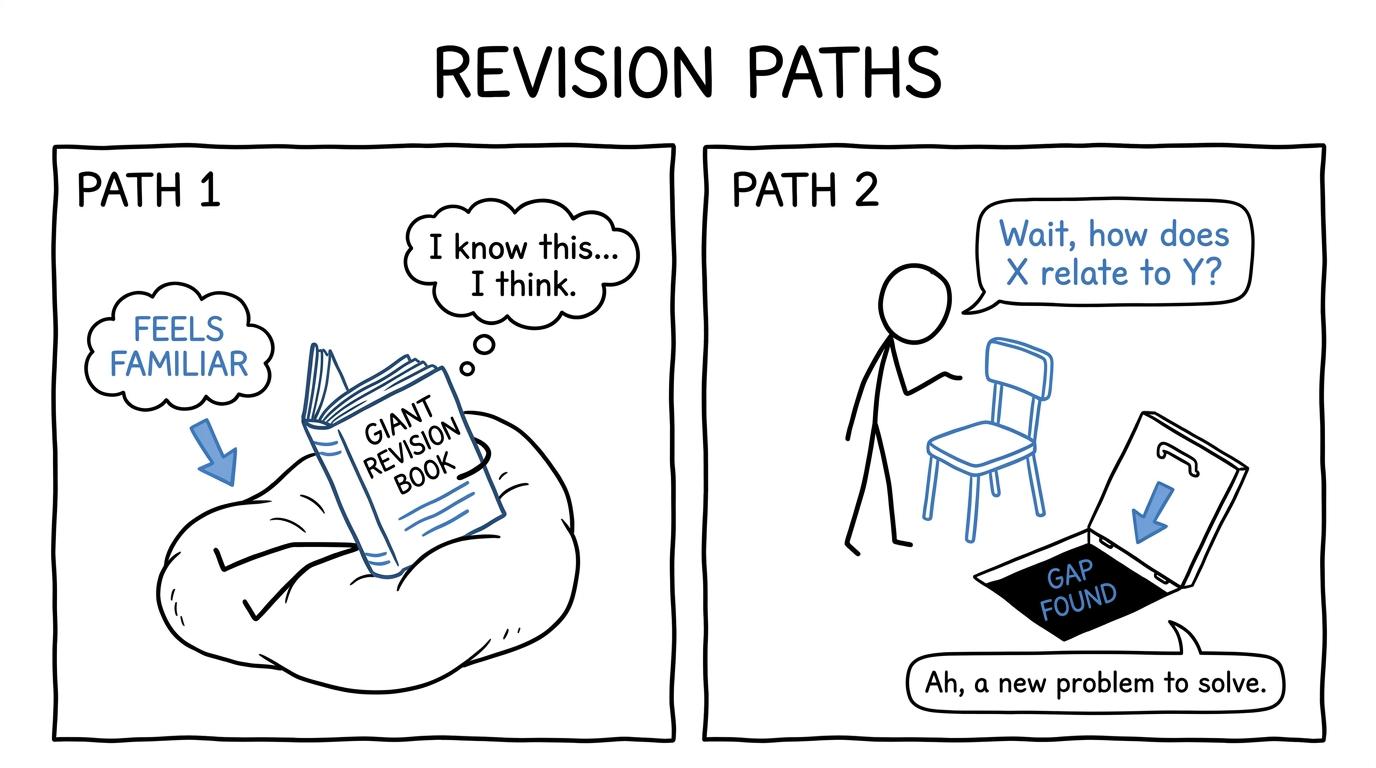 Quiet rereading meets the trapdoor of a missing explanation
Turn hesitation into a revision plan
The most valuable moment in teach-back revision is often the pause. A pause is information.
Classify each difficulty so that the repair matches the problem:
| What went wrong? | Best next action |
|---|---|
| You forgot an event or character detail | Revisit the relevant section, then retrieve it again later |
| You could not recall evidence | Build a small quotation set and test it from memory |
| You named a method but could not analyse it | Ask how the choice shapes meaning or the reader’s response |
| Your context felt bolted on | Link it directly to the writer’s purpose or central argument |
| Your explanation wandered | Reduce it to one clear claim supported by selected evidence |
| You knew the idea but could not shape an essay | Create a plan, then complete timed writing |
This diagnostic mindset is equally valuable in maths. MathsGenie’s guide to finding your weakest GCSE topics explains how evidence should direct revision. In English, the evidence is a failed explanation or weak paragraph. In maths, it may be a lost method mark or repeated algebra error. Either way, “revise more” is too vague; the next action should name the gap.
Why teach-back cannot replace exam practice
Speaking and writing overlap, but they are not identical. A conversation allows pauses, gestures and clarification. An exam answer must form a coherent argument on paper within a time limit.
After teaching a topic aloud, convert the knowledge into the format the examination rewards. That may mean planning a response, selecting evidence for an unseen question or writing under timed conditions. Use teacher feedback, assessment criteria and your exam board’s materials to evaluate the result.
The same principle applies in GCSE maths. Explaining why a method works can deepen understanding, but marks are earned by interpreting questions, showing sufficient working and reaching accurate conclusions. MathsGenie’s GCSE maths revision hub brings together topic lessons, worksheets, exam questions and papers so explanation leads into performance.
When time is limited, a short GCSE maths revision routine can combine recall, questions and marking. For longer preparation, the one-month GCSE revision plan shows how to make revision measurable rather than merely busy.
Using teach-back across English and maths
Teaching back transfers well between subjects, but the content of a good explanation changes.
In English Literature, explain an interpretation, connect it to evidence and consider alternative readings. In maths, explain why each step is valid, which information matters and how you would recognise a similar problem. In both subjects, avoid looking at the solution until you have made a genuine attempt.
Follow explanation with subject-specific practice:
- For English Literature, use essay plans, timed responses and feedback.
- For maths, use targeted questions, mini tests and mark schemes.
- For both, record errors and retrieve the corrected idea on another day.
As maths exams approach, past-paper timing guidance can help you decide when to move from topic work to full papers. If a paper reveals an old weakness, redoing past papers effectively is more useful than simply collecting another score.
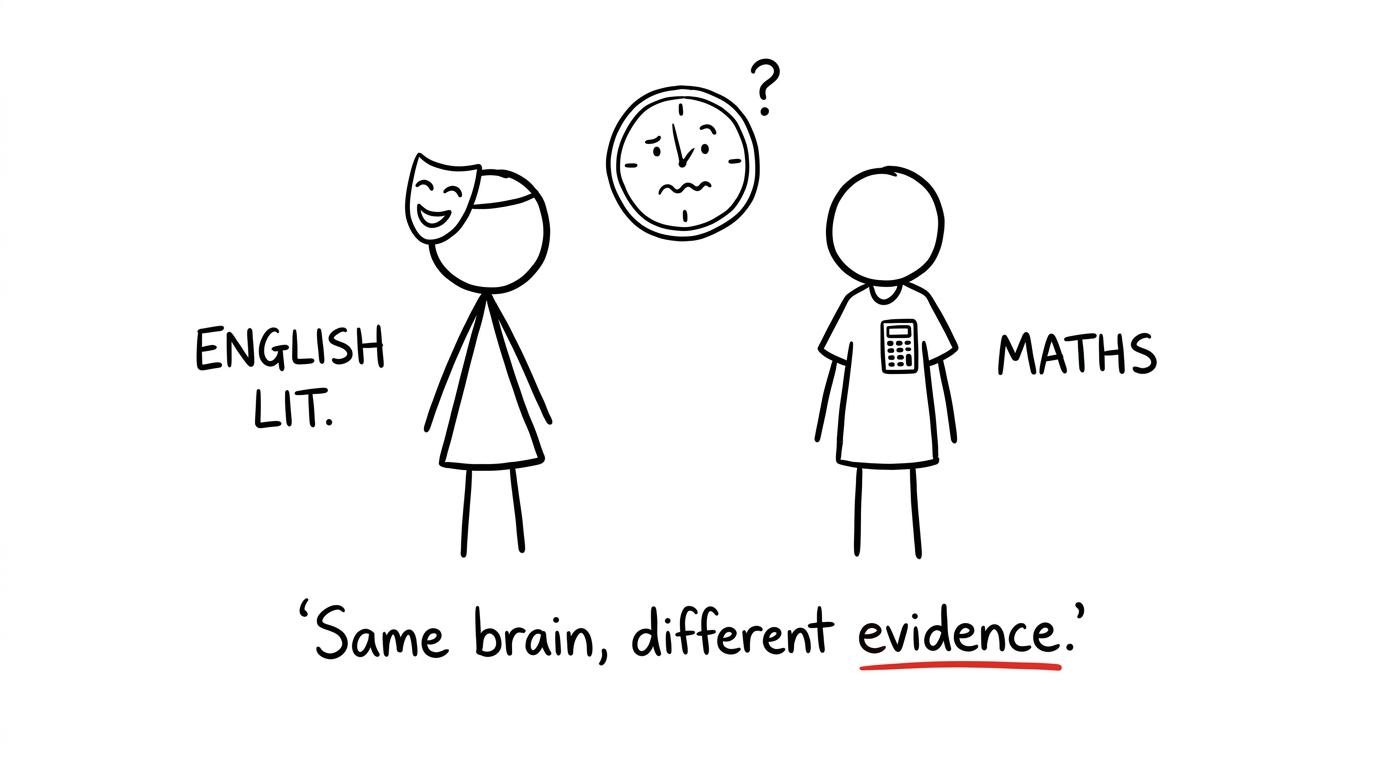 A student switches between English Literature and maths revision
Common teach-back revision mistakes
Reading from notes while “teaching”
This tests reading fluency rather than independent recall. Start with closed notes, mark uncertainties and check afterwards.
Choosing a topic that is too broad
A huge topic encourages shallow plot summary. Narrow the focus to one theme, relationship, turning point or interpretive question.
Memorising a polished script
A script can sound impressive while remaining inflexible. Change the question, invite interruptions and explain the same idea in different words.
Letting the listener supply every answer
Hints can become another form of passive revision. Ask the listener to note the gap and give you time to retrieve before helping.
Practising errors without checking
Confidence is not verification. Compare quotations and claims with the text, reliable notes and your course materials after every session.
Replacing writing with talking
Teach-back develops recall and understanding; timed writing develops selection, structure and control. You need both.
Spending too long on comfortable material
Fluent explanations are satisfying, but weak areas offer more useful information. Use your gaps to decide what comes next, just as an efficient Edexcel GCSE maths revision strategy prioritises diagnosis and targeted practice.
Make explanation the beginning, not the finish
Teaching GCSE English Literature to someone else is worthwhile because speech makes vagueness visible. You discover whether you can retrieve the evidence, connect it to an interpretation and defend your reasoning when a simple question interrupts the comfortable story that you already know it.
Keep the method honest: close the notes, choose a narrow focus, welcome questions, verify your claims and follow the conversation with exam-style writing. Then carry the same habit into maths. Explain the method, attempt questions, mark them carefully and return to whatever still feels fragile.
Start at the free MathsGenie GCSE maths revision hub. Use the revision lessons to rebuild understanding, practice questions and mini tests to expose gaps, then past papers, predicted papers, mark schemes and video solutions to turn that understanding into marks. Good revision does not merely feel familiar; it gives you evidence that you can perform.










