

Switching to A Levels: An IB Student’s Guide
Switching to A levels from the IB? Learn when it is possible, how assessment differs, and how to build a safe transition plan for maths in the UK.
The hardest part of changing qualifications is rarely deciding which course sounds better. It is discovering whether the change can be made without losing time, missing essential content or weakening your university options.
If you are considering switching to A levels from the International Baccalaureate, the short answer is yes: it can be possible. However, your school or sixth form must approve the change, and moving after the course has begun may require you to restart Year 12. Before deciding, confirm the timetable, subject entry requirements, exam board, syllabus gaps and effect on predicted grades in writing.
The IB and A levels are both widely recognised routes into UK universities. A switch is therefore not automatically an academic upgrade. It is a change from a broad programme to a more specialised one, and it only makes sense when that structure suits your goals better.
Your switching checklist
Before leaving the IB, ask your current school and prospective A level provider:
- Is there an available place in each subject you want?
- Will your previous qualifications satisfy the provider's entry requirements?
- Would you enter Year 12 from the beginning or join an existing class?
- Which exam board and specification does each subject follow?
- Which topics has the class already completed?
- How will predicted grades be produced?
- Are there non-exam assessments or practical requirements to catch up?
- Does your proposed combination meet the requirements of likely university courses?
- What are the final dates for changing courses and making examination entries?
Do not withdraw from your IB programme until the new provider has confirmed these details. An informal conversation is helpful, but a written offer and transition plan are safer.
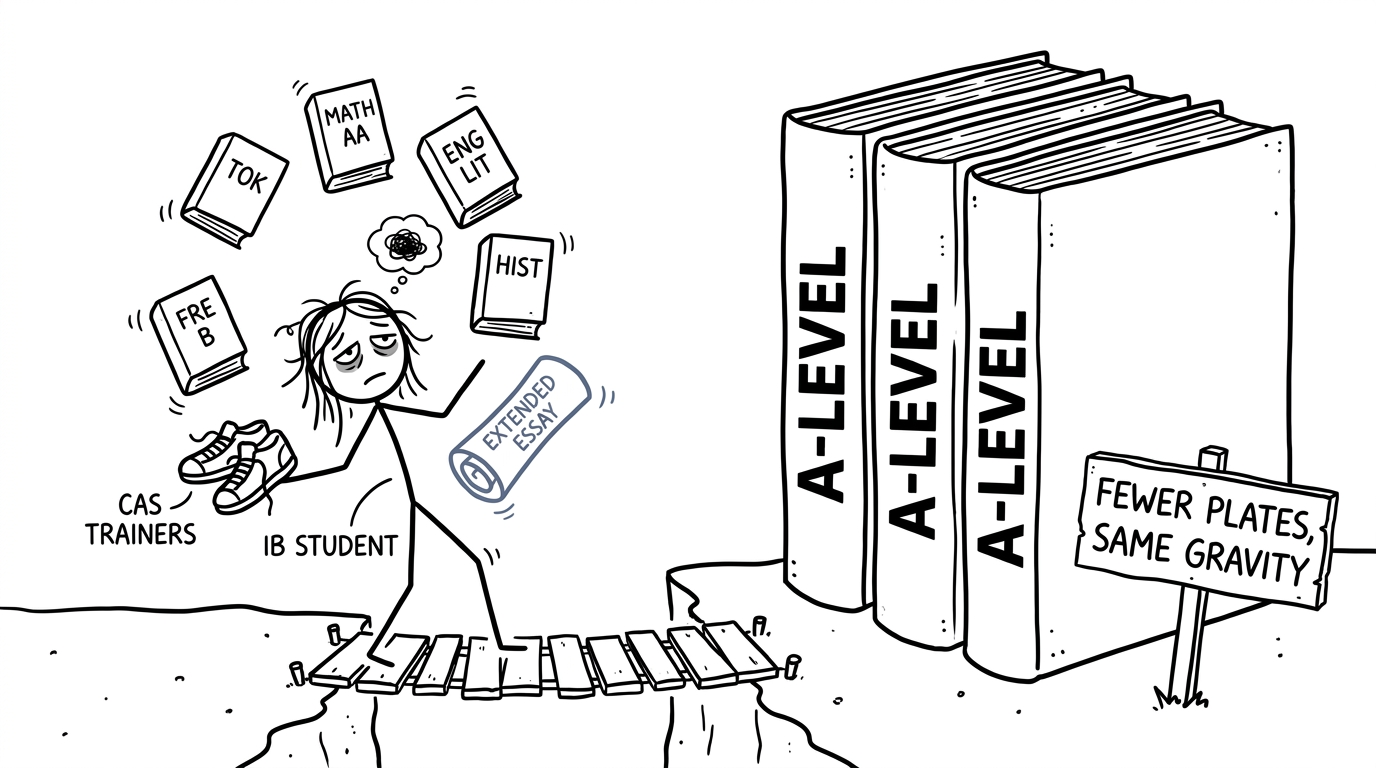 An IB student balancing six books while looking towards three enormous A level books
How A levels differ from the IB Diploma
The full IB Diploma normally involves six subjects alongside its core: Theory of Knowledge, the Extended Essay and Creativity, Activity, Service. Students usually take three subjects at Higher Level and three at Standard Level. IB mathematics is offered as Analysis and Approaches or Applications and Interpretation, each available at SL and HL.
A level students usually specialise in three subjects, although some providers allow four, particularly at the beginning of Year 12. There is no national requirement to combine languages, sciences, humanities and mathematics. This gives you more freedom to concentrate on a particular academic direction.
In England, reformed A levels are linear qualifications. Assessment is mainly at the end of the course, while non-exam assessment is retained where it is needed to assess particular skills. AS qualifications are standalone and do not contribute to the final A level grade. Arrangements elsewhere in the UK can differ, so check the qualification offered by your provider rather than assuming every course follows the English model.
| Feature | IB Diploma | A levels in England |
|---|---|---|
| Breadth | Six subjects plus the IB core | Usually three specialised subjects |
| Subject levels | Higher Level and Standard Level | One A level standard per subject |
| Typical assessment pattern | External examinations plus internal assessment | Mainly linear assessment at the end of the course |
| Independent core work | Extended Essay, Theory of Knowledge and CAS | No equivalent national compulsory core, although a provider may offer an EPQ |
| Mathematics choice | AA or AI at SL or HL | Mathematics, with Further Mathematics available separately at some providers |
The practical difference is depth. Dropping three subjects may create more room, but each retained A level demands sustained knowledge across a full specification. Fewer subjects do not necessarily mean less demanding work.
When switching is most realistic
Before the courses begin
This is generally the simplest point to change. You can choose A levels using the provider's normal admissions process, begin the specification with your class and build evidence for predicted grades from the start.
Entry conditions vary by school and subject. A sixth form may require a particular GCSE, IGCSE, MYP or equivalent result for A Level Mathematics, sciences, languages or Further Mathematics. Ask the provider how it evaluates your exact qualifications rather than trying to convert them yourself.
During the first term
An early switch may still be manageable if places exist and the specifications overlap. Even then, familiar topic names can hide differences in notation, emphasis and question style. Your teachers should compare what you have studied with the precise AQA, Edexcel, OCR or Eduqas specification used by the new class.
A short diagnostic assessment can reveal whether you need to catch up in content, algebraic fluency or exam technique. If mathematics is one of your choices, use the A Level Maths revision hub to locate resources for the relevant exam board.
Later in Year 12 or during the second IB year
This is more complicated. A levels are not simply three IB Higher Level subjects with different certificates, and completed IB work does not automatically become A level credit. You may have missed months of specification content, internal assessments or practical work. The provider may therefore require you to restart Year 12.
Restarting can feel like lost time. Yet entering final examinations with unresolved gaps can cost much more. The useful question is not, “Can I join this class?” It is, “Can I complete the entire specification and produce reliable evidence for predicted grades?”
Choosing A levels with university entry in mind
UK universities commonly publish separate requirements for A level and IB applicants. They may specify overall grades, particular subjects or, for IB students, Higher Level grades and a total Diploma score. Both routes can support a strong application when the required subjects are present.
Start with possible degree subjects, even if your plans are not final. Check the official entry requirements for several universities and note:
- required subjects;
- preferred subjects;
- minimum grades;
- whether Mathematics or Further Mathematics is expected;
- any GCSE or equivalent requirements;
- how alternative qualifications are considered.
For a mathematics-heavy degree, A Level Mathematics may be essential and Further Mathematics may be required or strongly preferred by some courses. For other degrees, a different combination may preserve more options. Never choose subjects only because they appear easier to timetable.
Changing systems does not erase your earlier education. Your IB experience may have strengthened independent research, written communication, modelling and organisation. The aim is to carry those skills into a narrower programme rather than starting from zero.
Moving from IB Maths to A Level Maths
There is meaningful overlap between the courses, including algebra, functions, trigonometry, calculus, statistics and probability. But the order, depth and use of technology differ. IB AA, IB AI and A Level Mathematics are not interchangeable specifications.
A sensible transition audit separates topics into three groups:
- Secure: you can answer unfamiliar questions without notes.
- Familiar but fragile: you recognise the topic but make procedural errors.
- Not yet covered: your IB class has not studied the required A level material.
Compare this audit with the new exam board's specification and teaching sequence. Edexcel students can use the Edexcel A Level Maths revision page, which brings together topic lessons, question banks, worksheets, videos and exam resources.
Do not rush directly into advanced calculus because it feels appropriately “A level”. Reliable manipulation of indices, surds, quadratics, functions, graphs and trigonometry supports almost everything that follows. If these foundations are uncertain, revisit the GCSE Maths revision hub or the Edexcel GCSE revision guides before building upwards.
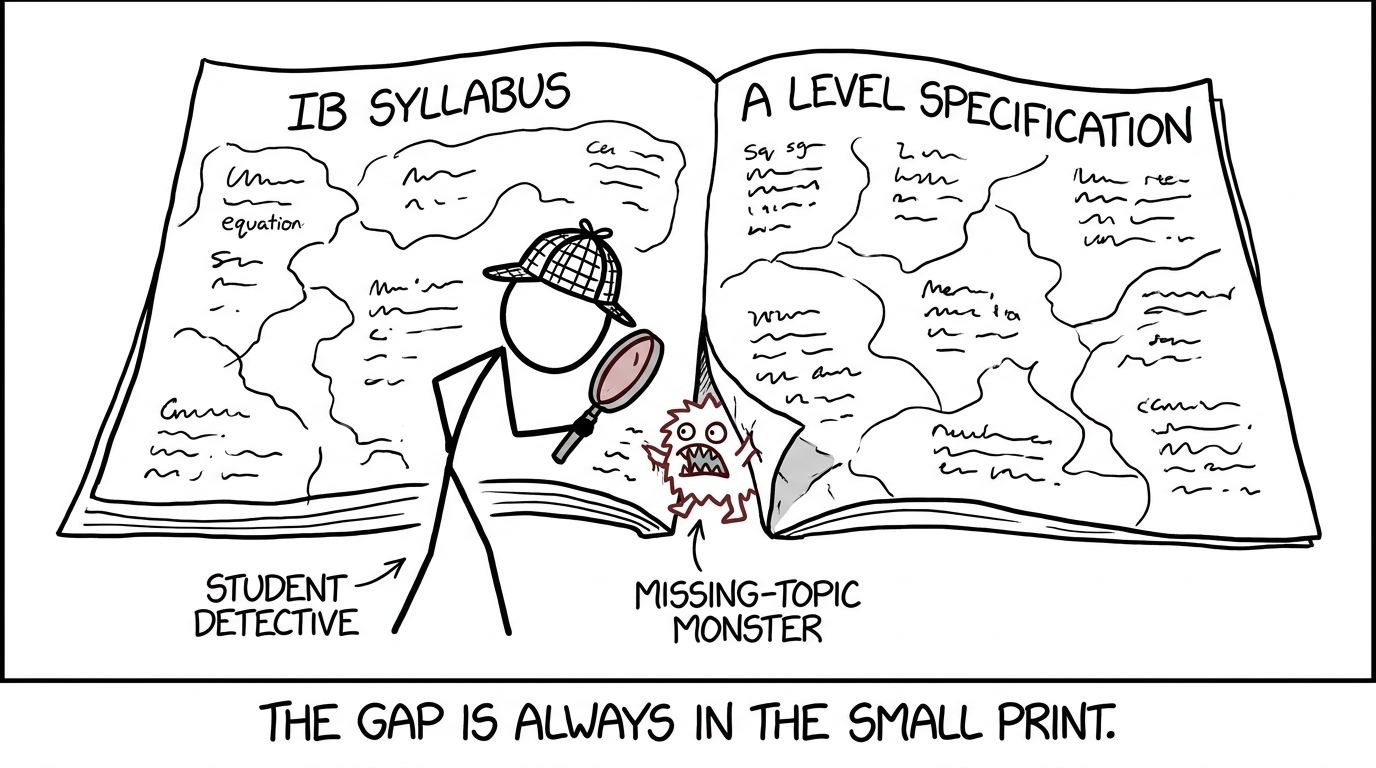 A student detective comparing the IB syllabus with an A level specification
A practical transition plan
Map the specification first
Obtain the exact specification and your new teacher's topic sequence. Make a list of missed units, then rank them by dependency. Algebra and functions should usually come before techniques that rely on them.
If calculus is a gap, for example, MathsGenie's A Level integration resources combine revision material with focused practice. Use the equivalent board-specific resources if you are studying AQA, OCR or another specification.
Use a learn, practise, test cycle
For each missing topic:
- learn or review the method through a revision lesson;
- answer focused practice questions without copying a solution;
- mark the work and record why marks were lost;
- retest the topic after a short delay;
- add it to mixed practice once it is secure.
The MathsGenie revision planner can help distribute this work rather than allowing catch-up tasks to accumulate beside normal lessons.
Delay full papers until they are informative
A complete paper taken too early may mostly measure content you have not been taught. Begin with topic questions and mini tests. Then move to timed sections and finally full Edexcel A Level Maths past papers, using the mark schemes and available solutions to understand how marks are awarded.
Nearer the examination, Edexcel A Level Maths predicted papers can provide fresh practice. They should supplement specification coverage and past papers, not replace them.
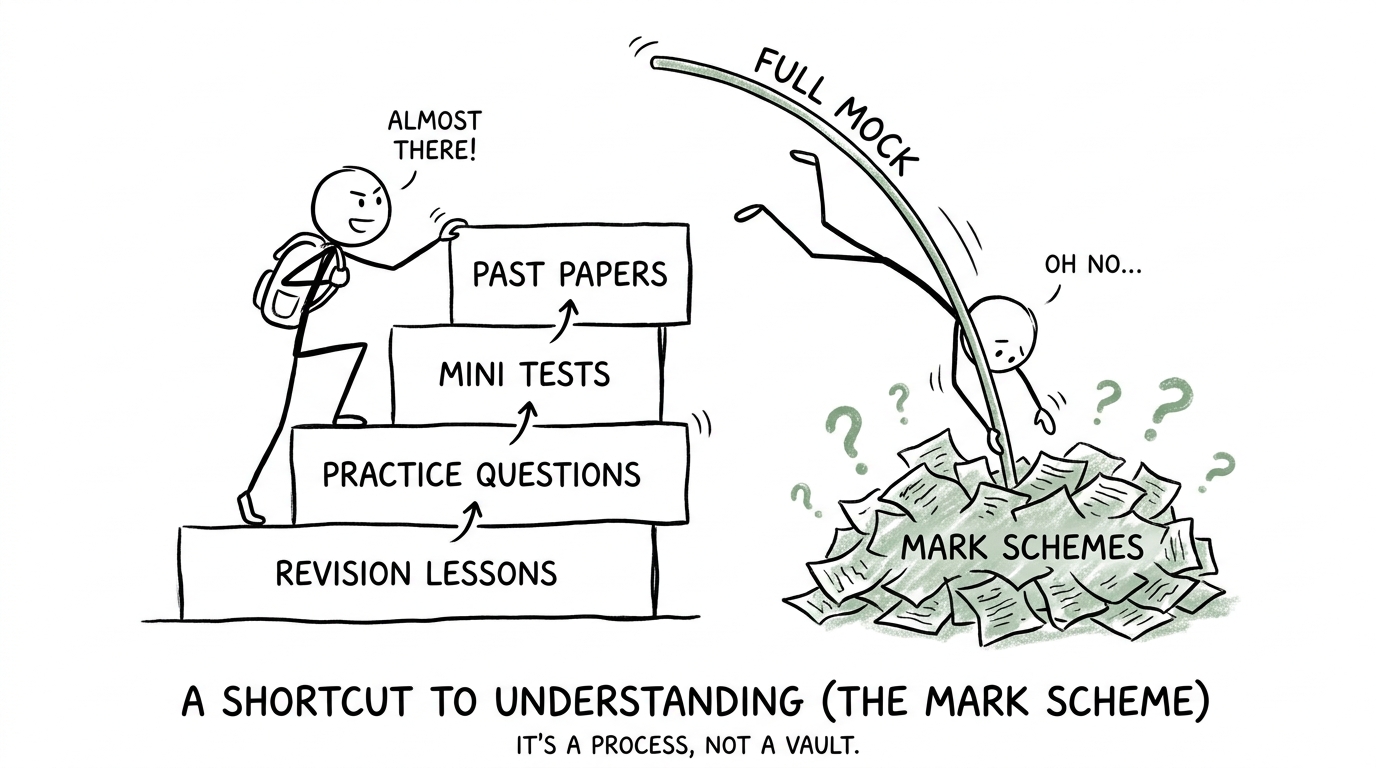 A student climbing revision steps while another tries to pole-vault directly into a full mock
Common mistakes when switching to A levels
Assuming fewer subjects means an easier programme
Specialisation removes breadth, but it increases the importance of every chosen subject. A weak grade cannot be hidden among six Diploma subjects when an offer is based on three A levels.
Comparing qualification labels instead of specifications
IB Higher Level and A level are both advanced courses, but their content and assessment are not identical. Compare individual topics, required skills and papers.
Switching to escape one difficult period
A poor test result, a demanding internal assessment or temporary overload may be solvable without changing qualifications. Discuss workload, subject changes within the IB and available support before making an irreversible decision.
Ignoring predicted grades
Universities may make decisions using predicted results. Ask how the new school will gather enough evidence after a late transfer and whether joining later affects its prediction timetable.
Revising without diagnosing gaps
Random practice feels productive but can leave prerequisite weaknesses untouched. Use a specification audit, teacher assessment and error log to decide what comes next.
Make the decision around fit, not prestige
Switching from the IB to A levels can be a sensible choice when you want greater subject specialisation, your proposed combination supports your university plans and a provider can offer a realistic route through the complete specifications. It is a poor choice when it is based only on the hope that three subjects must be easier than six.
Confirm the administrative details first. Then map the academic gap and build a weekly catch-up plan. MathsGenie can support that process with free revision lessons, practice questions, mini tests, past papers, predicted papers, mark schemes and video solutions. Start with the guide to the GCSE-to-A-level transition, choose your exam board, and turn the uncertainty of changing systems into a sequence of manageable next steps.











