

Switch GCSE Design and Technology to Engineering
Switch GCSE Design and Technology to Engineering mid-year: understand school approval, NEA catch-up, exam entries, workshop access and maths preparation.
A subject can feel right on options evening and wrong once the lessons become real. Perhaps Design and Technology is not what you expected. Perhaps engineering looks closer to the way you enjoy solving problems. If you want to switch GCSE Design and Technology to Engineering mid-year, the short answer is: it may be possible, but your school must approve it, offer a suitable qualification and decide that you can realistically catch up.
This is not simply an exchange of names on a timetable. Engineering may follow a different specification, assessment structure and practical project. The later you ask, the harder the move usually becomes, particularly once non-exam assessment has started.
The mid-year switching checklist
Before expecting an answer, find out:
- the exact title, exam board and specification code of the engineering course;
- whether there is room in the engineering class;
- whether both subjects occupy compatible timetable blocks;
- how much theory and practical work you have missed;
- whether the engineering non-exam assessment, or NEA, has begun;
- whether your existing Design and Technology work can count towards anything;
- whether workshop safety training or specialist equipment is required;
- when your school must make or amend examination entries;
- how the change would affect your other GCSE revision.
The decision normally involves your subject teachers, head of department, options or curriculum lead and examinations officer. A parent or carer may also need to confirm the request.
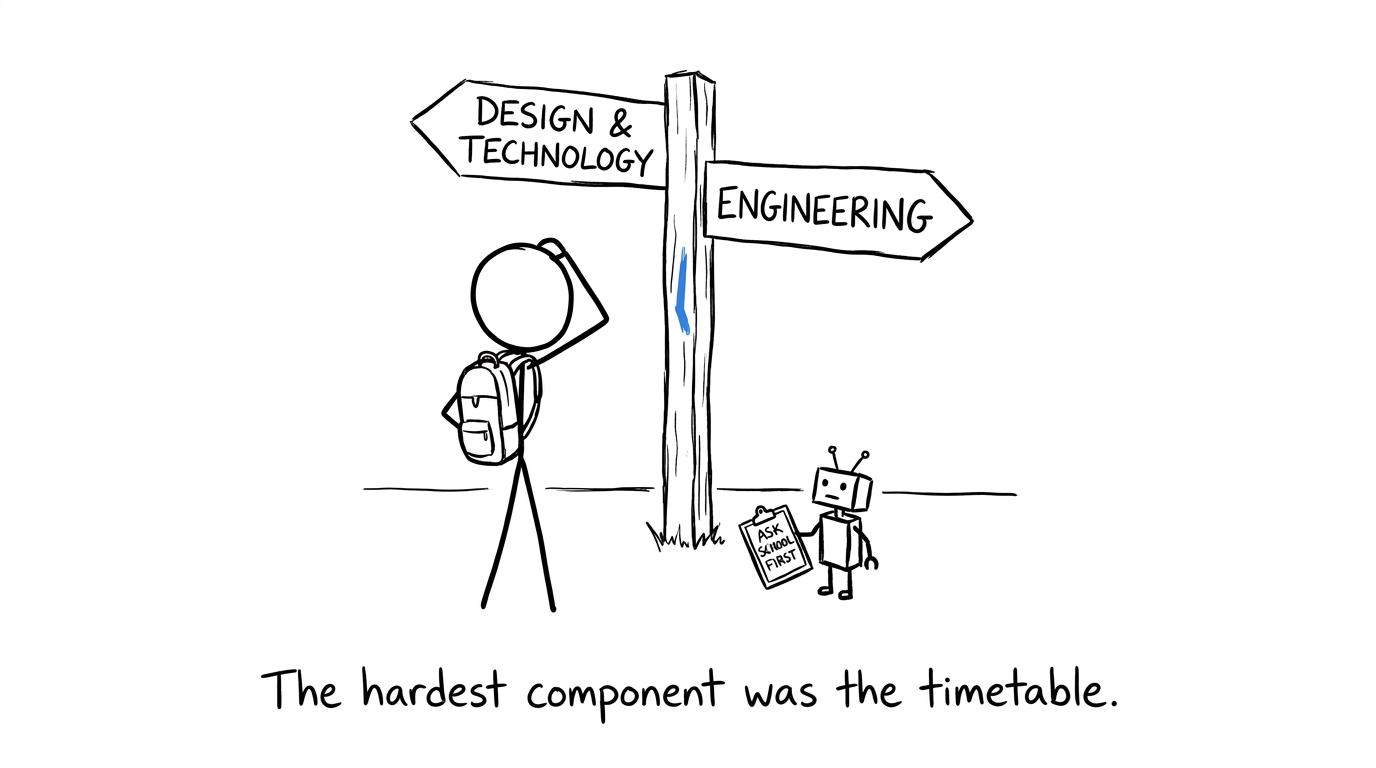 A student choosing between Design and Technology and Engineering while a robot recommends asking the school
Is it actually possible to switch?
There is no universal rule saying that every student can, or cannot, change GCSE subjects mid-year. Schools control their curriculum, class sizes, teaching arrangements and internal deadlines. AQA's GCSE Engineering specification also makes clear that course-entry requirements are at the discretion of schools and colleges.
A switch is more plausible near the beginning of Year 101010, before substantial assessed work has been completed. It becomes more difficult later in Year 101010 or during Year 111111, when the engineering class may already be developing its assessed product and covering specialist content.
Your school is likely to consider four questions:
- Can it be timetabled? Engineering and Design and Technology may not run in the same option block.
- Can it be taught safely? You may need induction before using workshop machinery, tools or processes.
- Can the missed content be recovered? Similar subject names do not mean identical specifications.
- Can the assessment be completed properly? Teachers must be able to supervise, authenticate and mark the required work under the relevant rules.
A willingness to work hard matters, but it cannot solve an impossible timetable or replace controlled practical assessment.
First confirm what “GCSE Engineering” means
Schools sometimes use “engineering” as a broad classroom label. The course might be AQA GCSE Engineering, but it could instead be a Level 111/222 technical award, vocational award or Cambridge National. Those qualifications have different assessment arrangements and should not automatically be treated as interchangeable GCSEs.
Ask for the qualification title, awarding body, specification code and assessment breakdown in writing. Do not assume that Edexcel, AQA, OCR and Eduqas all offer identically structured courses simply because those names appear elsewhere on your timetable.
For the regulated GCSE qualifications in England, Design and Technology has an assessment balance of 50%50\%50% examination and 50%50\%50% non-exam assessment. GCSE Engineering has 60%60\%60% examination and 40%40\%40% non-exam assessment. Engineering examinations must also allocate at least 20%20\%20% of their marks to mathematical skills, compared with at least 15%15\%15% in GCSE Design and Technology examinations.
That difference is important. Engineering is not simply Design and Technology with more machinery. It places its own emphasis on engineering materials, manufacturing processes, systems, testing, practical skills and the effects of modern technologies.
What happens to work you have already completed?
This is often the point that decides whether the switch is realistic.
Work completed for Design and Technology will not normally become Engineering NEA merely because both courses involve designing and making. The briefs, assessment objectives, evidence requirements and teacher-supervision arrangements are different. Your new teacher must follow the specification for the qualification you are entering.
Before agreeing to the move, the engineering department may need to audit:
- the theory units already taught;
- practical processes completed by the class;
- safety demonstrations you missed;
- software or machinery you have not used;
- research, design, manufacture and evaluation evidence already produced;
- the remaining supervised time available.
If the gap is manageable, the school may create a formal catch-up plan involving lunchtime sessions, independent theory work and additional supervised practical time. If the NEA gap is too large, refusing the switch may be the responsible decision rather than a judgement about your ability.
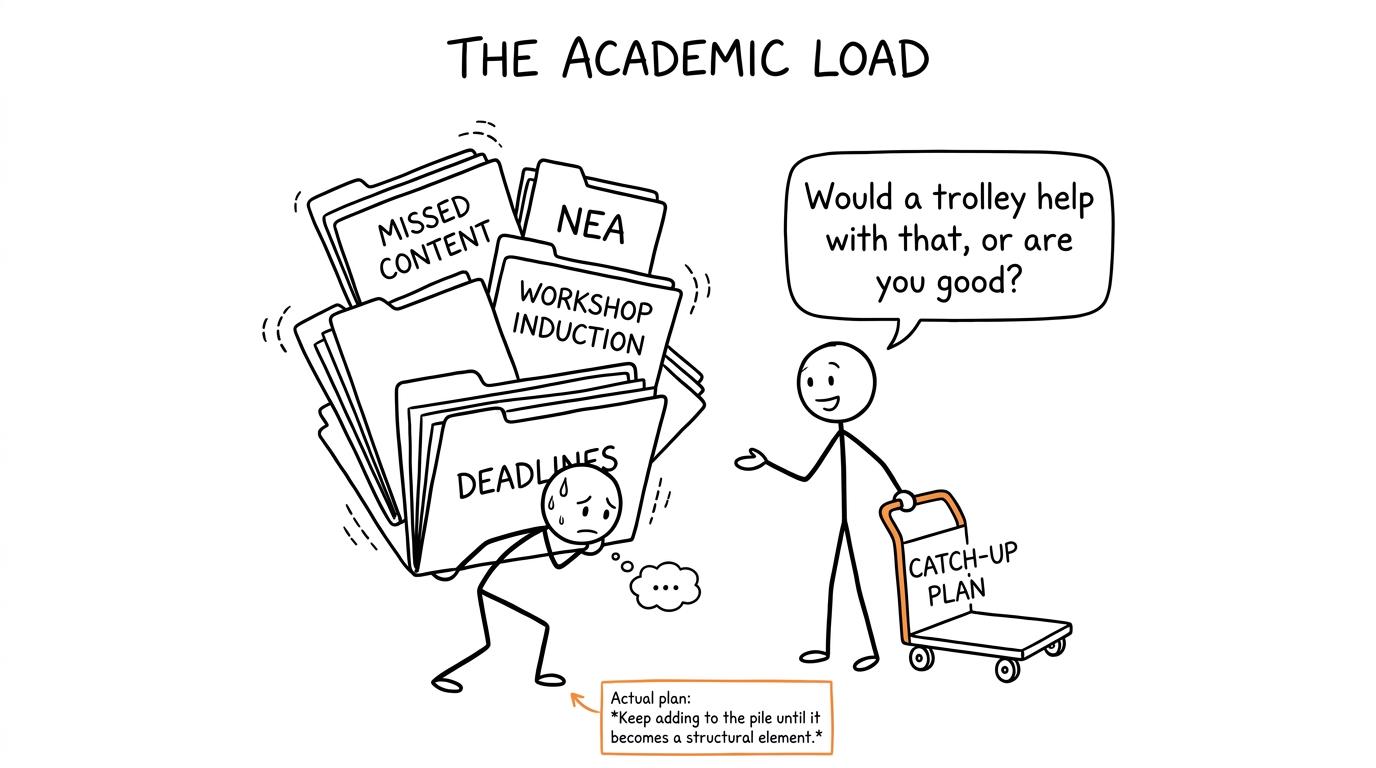 A student carrying missed-content folders while a teacher offers a catch-up-plan trolley
What it actually takes to make the change
Make a specific request
Explain why engineering fits your interests and learning style better. “I dislike D&T” gives the school little to work with. A stronger request identifies what you understand about the engineering course, what you have missed and how you would catch up without neglecting English, maths and science.
Ask for a meeting rather than relying on a corridor conversation. Useful questions include:
- Which qualification would I enter?
- What assessed work has already started?
- Which parts of the course must I catch up?
- How many supervised practical sessions would be needed?
- Who makes the final decision, and by when?
Complete a content audit
Request the engineering specification or department topic list. Divide it into content you already understand, content that overlaps with Design and Technology, and genuinely new material.
Overlap may reduce the learning gap, but it does not erase it. Understanding materials in D&T may help with engineering, while knowledge of iterative design may support evaluation. You could still need unfamiliar work on systems, production, calculations or manufacturing techniques.
Agree to measurable conditions
A sensible school may offer a conditional transfer. You might need to complete specified theory units, pass a safety induction and submit catch-up tasks by fixed dates. Ask for these conditions clearly so that “catch up quickly” becomes an actual plan.
Confirm the examination entry
Only the school or approved examination centre can make or amend the entry. Awarding organisations publish entry and amendment deadlines, and late changes may create fees or administrative complications. Your examinations officer must check the current rules for the relevant series.
Do not confuse changing subjects with a transferred-candidate arrangement. JCQ transferred-candidate rules concern sitting written examinations at a different centre in particular circumstances. They specifically exclude NEA, portfolios and practical components. They are not a shortcut for moving unfinished coursework between subjects.
The maths you will need for GCSE Engineering
Engineering rewards the habit of turning a physical situation into quantities, units and relationships. The most useful GCSE maths areas include:
- ratios, proportion and scale;
- percentages and tolerances;
- rearranging and substituting into formulae;
- unit conversions;
- area, surface area and volume;
- graphs and gradients;
- speed, density and pressure;
- accuracy, bounds and sensible rounding.
Typical relationships include:
density=massvolume\text{density}=\frac{\text{mass}}{\text{volume}}density=volumemassand
pressure=forcearea.\text{pressure}=\frac{\text{force}}{\text{area}}.pressure=areaforce.The calculation is only part of the skill. You must select compatible units, show a method and interpret whether the result is reasonable.
Start with the GCSE Maths revision hub, where you can choose Edexcel, AQA, OCR, Eduqas, WJEC or CCEA resources. The GCSE maths topics by exam board and tier guide can help you identify relevant foundation or higher content.
For particularly useful engineering skills, revise Conversions and Units and the Speed and Density revision guide. The underlying mathematics transfers across boards even though you should always practise with resources matching your own specification.
Protecting your maths revision during the switch
Changing subjects creates extra work at exactly the time when GCSE maths begins to demand regular practice. The danger is not only an engineering backlog. It is allowing the backlog to consume every evening.
Use a weekly plan with separate blocks for engineering catch-up and maths maintenance. The GCSE maths revision timetable offers a practical structure. Keep each maths session simple:
- learn or review one method;
- complete focused practice questions;
- mark the work immediately;
- record the exact cause of each lost mark;
- retest the skill on another day.
If you are unsure what to prioritise, use the process in Find Your Weakest GCSE Topics. Once topic gaps are smaller, move into board-specific papers such as the Edexcel GCSE Maths past papers. Nearer the examinations, GCSE predicted papers can provide additional practice, but they should complement official past papers rather than replace them.
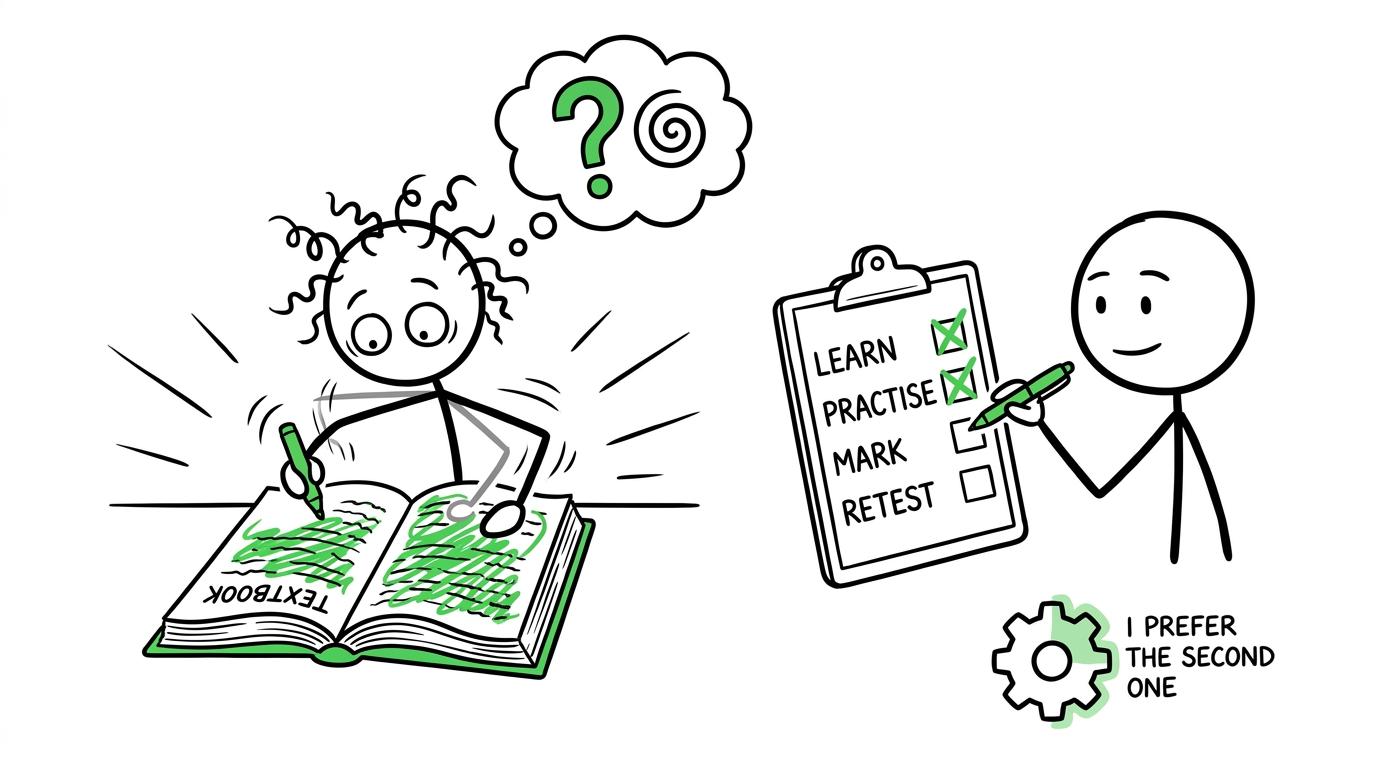 One student highlights everything while another follows a learn-practise-mark-retest checklist
Common mistakes when requesting a switch
Assuming similar subjects have transferable coursework
There may be useful knowledge overlap, but assessed evidence must satisfy the new qualification's rules. Get a teacher's written explanation of what must be started again.
Waiting for the perfect moment
The practical window usually narrows as teaching and NEA progress. Ask promptly, while accepting that the school needs time to investigate.
Ignoring the exact qualification
“Engineering” could describe several qualifications. Decisions about assessment, progression and catch-up are impossible without the full title and specification.
Promising unlimited catch-up
A plan requiring every lunch break and evening may collapse quickly. Calculate the hours available alongside your other GCSEs and protect sleep, attendance and core-subject revision.
Treating a refusal as a verdict on your future
A school may say no because of class capacity, safety, supervision, assessment rules or the timetable. You can still explore engineering through later courses, apprenticeships, A Levels and technical qualifications. Strong maths and science results will keep many of those routes open.
Make the decision with evidence
A mid-year switch can work when the course exists, the timetable aligns, the missed content is recoverable and the assessed work can still be completed legitimately. It becomes much less realistic when those conditions are missing.
Ask now. Confirm the qualification. Request a content and NEA audit. Get the catch-up expectations in writing. Then decide whether the move improves your education as a whole, rather than solving one uncomfortable lesson at the cost of several others.
Whatever your school decides, keep building the mathematical skills that engineering relies on. Use MathsGenie's free revision lessons, practice questions, mini tests and video solutions to repair individual gaps, then test your progress with past papers, mark schemes and predicted papers. A subject change may alter your timetable. A steady revision system changes what you can do with it.











