Switch Exam Board GCSE Statistics: Mid-Course Guide
Switch exam board GCSE Statistics with confidence. Learn what schools must arrange, what changes between specifications, and how to revise effectively.
A change of exam board can make a settled course suddenly feel uncertain. The textbook looks wrong, familiar topic labels disappear, and the past papers you saved may no longer match the exam ahead.
The reassuring answer is that a school can usually switch exam board GCSE Statistics mid-course, provided it can teach the receiving specification and complete the correct examination entry in time. Because current GCSE Statistics qualifications are linear, students normally take all required papers from one board, at one tier, in the same examination series. Work completed under the previous board does not become an examination result that can simply be transferred.
The real question is therefore not whether everything must be relearned. Much of the core statistical content overlaps. The task is to identify the differences, close the gaps and practise the new board's question style.
Your immediate checklist
If your school announces a change, find out:
- the full name and code of the new specification;
- whether you will take foundation or higher tier;
- which topics have already been covered;
- which new-board topics remain untaught;
- whether the paper structure or examination time changes;
- when teaching will move fully to the new specification;
- which past papers and mark schemes your class should now use;
- whether any access arrangements need updating administratively.
Your teacher and examinations officer handle the official entry. Your job is to obtain a clear revision map and start using resources matched to the receiving board.
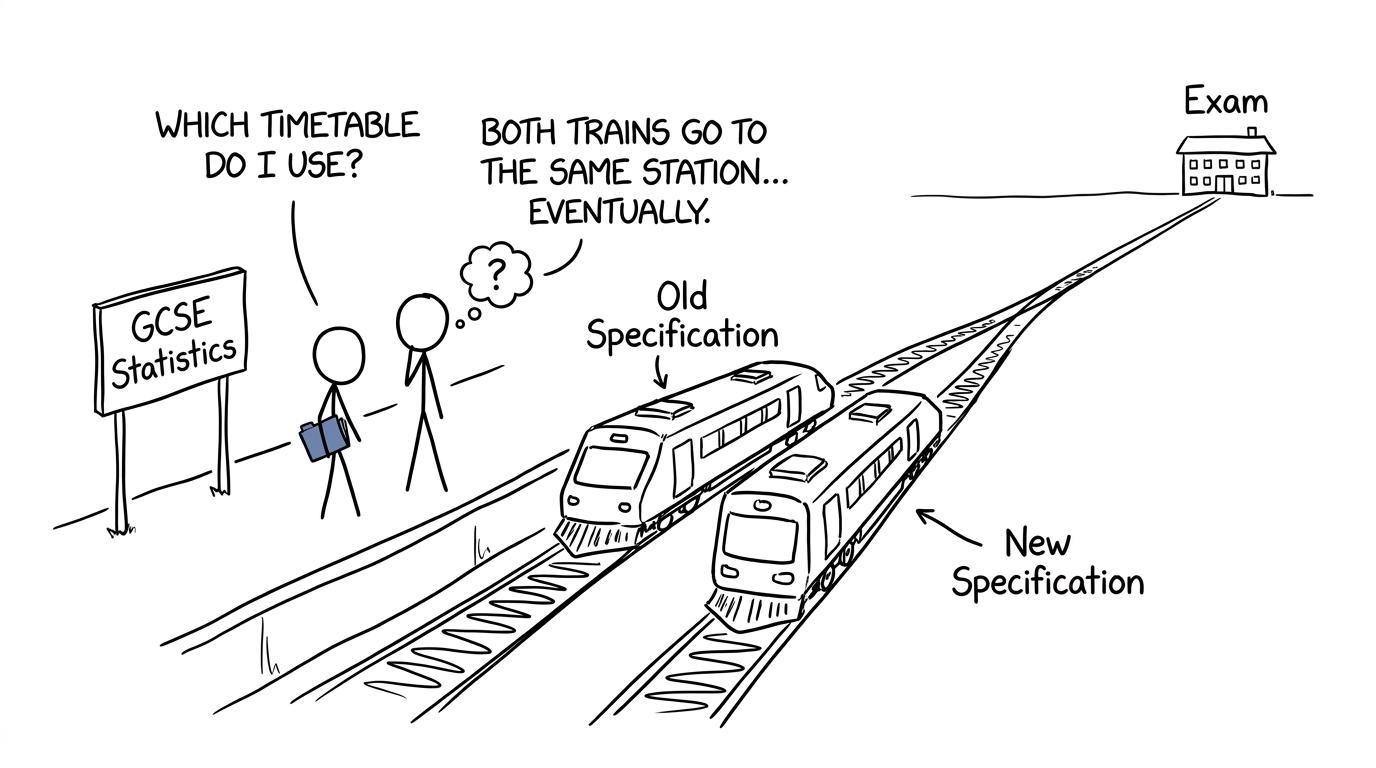 A student choosing between two GCSE Statistics specification trains heading towards the same exam station
Is switching exam board mid-course actually allowed?
There is no general rule requiring a school to remain with the same awarding organisation for the whole teaching period. A school may change because of available support, staffing, specification design, examination structure or wider curriculum planning.
However, the school must be approved to make entries with the receiving board and must follow that board's entry procedures and deadlines. Entries are made by examination centres, not directly by students. If you are enrolled at a school, you cannot normally choose a different board independently while expecting the school to teach and administer it.
Schools also cannot enter a student for the same subject with different awarding organisations in the same examination series. The final entry must identify one specification, one permitted tier and the required set of papers.
Do not confuse changing exam board with being a transferred candidate. A transferred-candidate arrangement usually concerns where an examination is sat while the original entry remains with the entering centre. Changing from one GCSE Statistics specification to another is a curriculum and entry decision.
What happens to the work you have already completed?
It does not disappear. Statistical understanding travels better than specification labels suggest.
The Department for Education sets subject content common to GCSE Statistics specifications in England. Consequently, major ideas such as data collection, sampling, representation, summary statistics, probability, interpretation and the statistical enquiry cycle are likely to remain useful.
But common national content does not make specifications identical. Awarding organisations can arrange topics differently, vary their terminology and place different emphasis on particular contexts or techniques. Higher-tier details may also differ.
Your previous classwork should therefore be sorted into three categories:
- Secure and shared: content required by both specifications.
- Shared but presented differently: familiar ideas that need practice in the new question style.
- New or expanded: content that must be taught or revised specifically for the receiving board.
This is why starting the entire course again is usually inefficient. A specification comparison is far more useful than treating every page of the old exercise book as obsolete.
What can change between GCSE Statistics specifications?
Paper structure and timing
Current GCSE Statistics qualifications are linear, meaning the required examinations are taken at the end of the course. AQA and Pearson Edexcel both use two equally weighted written papers, but their published paper durations are not the same. This alone can alter your timing strategy.
Both papers must come from the same specification, tier and examination series. You cannot combine a paper from the old board with one from the new board.
Topic boundaries and terminology
One specification may group ideas under broad sections, while another may divide them into more detailed statements. A technique that appears prominently in one textbook may be embedded within a wider enquiry question elsewhere.
Create a line-by-line comparison using the official specifications supplied by your teacher. Do not rely only on chapter titles. Similar titles can hide different depth, and different titles can describe substantially overlapping content.
Question style and mark schemes
Knowing a method is not quite the same as showing it in the form an examiner rewards. Boards may phrase commands differently or structure extended responses in different ways.
Pay particular attention to words such as calculate, compare, interpret, assess and justify. In Statistics, a numerical result is often only part of the answer. Conclusions may need context, supporting evidence and a comment on reliability or limitations.
Tier decisions
GCSE Statistics is tiered. Foundation tier normally makes grades 111 to 555 available, while higher tier normally covers grades 444 to 999, with a limited grade-333 safety net for candidates who narrowly miss grade 444.
A board change should prompt the school to confirm your tier rather than assume the old decision automatically remains appropriate. Ask which tier you are being prepared for and make sure every paper you practise matches it.
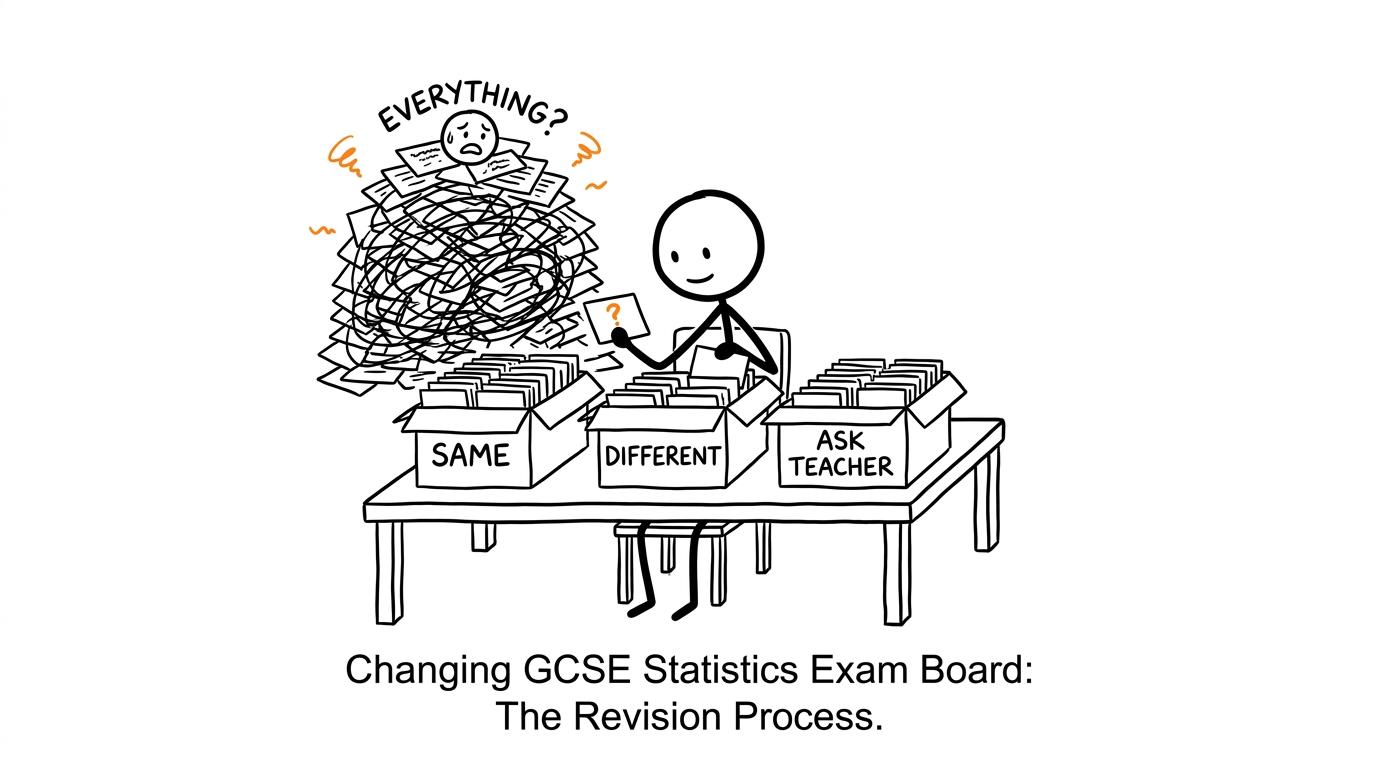 A student calmly sorting revision cards into same, different and ask teacher boxes
How to adjust your revision without starting again
Confirm the destination before revising harder
Write the board, qualification code and tier at the front of your folder. Check these details against a current course document or paper cover.
MathsGenie's GCSE Statistics revision hub lets you select resources by exam board. If the receiving specification is Pearson Edexcel, move to the dedicated Edexcel GCSE Statistics revision page rather than continuing with mixed materials.
This simple step prevents a common waste of effort: answering good Statistics questions that do not accurately reflect your final specification.
Build a specification gap list
Ask your teacher for a topic checklist showing:
- content already taught and still required;
- content taught but no longer required in the same depth;
- new content created by the switch;
- higher-tier-only material relevant to your entry;
- topics that need new-board examination practice.
Keep the list short enough to use. A colour-coded spreadsheet may look impressive, but a one-page checklist that guides tomorrow's revision is more valuable.
Diagnose before trying to repair
Complete a mixed set of questions from the receiving board without notes. Mark it carefully and classify each lost mark as:
- missing knowledge;
- incorrect method;
- weak interpretation;
- unfamiliar wording;
- avoidable examination error.
A board switch often creates unfamiliarity rather than a complete knowledge gap. Those are different problems. Missing knowledge needs a lesson; unfamiliar wording needs repeated exposure to authentic paper styles.
MathsGenie's guide to a GCSE Statistics resit revision plan uses the same diagnose-repair-test principle and can be adapted for a mid-course change.
Practise topic by topic, then mix the content
Use revision lessons and practice questions to repair the identified gaps. For an Edexcel course, targeted resources such as index numbers exam questions and standard deviation practice can help you focus on a precise weakness.
Once the gaps are smaller, move to mixed questions. Statistics papers require you to choose a method rather than merely repeat the method named in a worksheet heading.
Learn the receiving board's mark-scheme language
After every practice session, compare your response with the mark scheme. Look beyond the final answer and ask:
- Was a conclusion required in context?
- Did the response need supporting figures?
- Was a sampling method described precisely?
- Did the evaluation identify a genuine limitation?
- Were units, labels or assumptions required?
A Pearson Edexcel higher-tier specimen paper can reveal the shape and pacing of the assessment before you commit newer past papers to timed practice.
Protect unseen papers
Do not use every full paper immediately. Start with selected questions while learning the new style, then save some complete papers for timed conditions nearer the examination.
Track raw marks, but do not convert them using another board's boundaries. Grade boundaries vary by board, tier and examination series. The GCSE Statistics grade-boundary guide explains why an old or mismatched boundary cannot reliably predict your result.
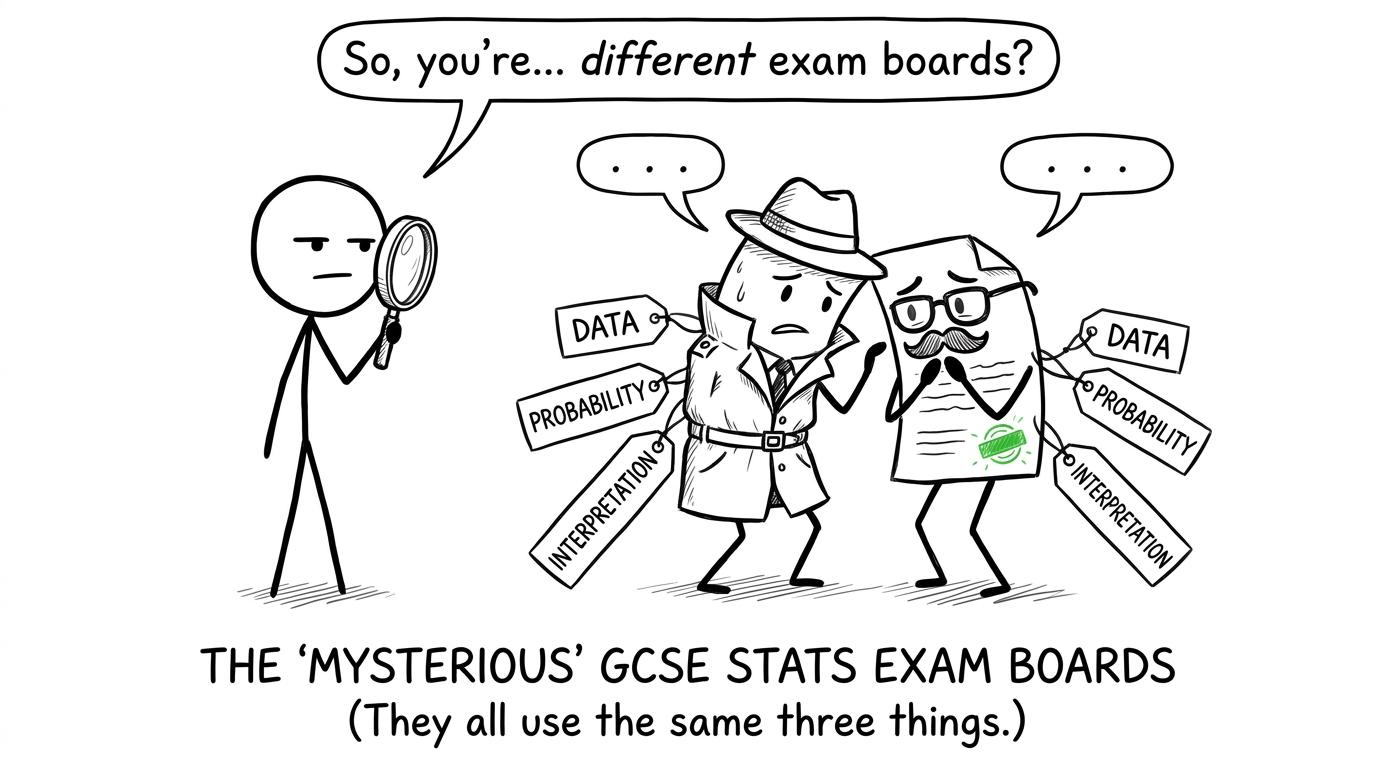 Two disguised exam papers carrying the same data, probability and interpretation luggage
What your school should arrange
The school should provide more than a brief announcement. A sound transition normally includes:
- confirmation of the receiving specification and tier;
- a comparison of old and new content;
- a plan for teaching specification gaps;
- new-board textbooks or digital resources where needed;
- appropriately matched mocks and past papers;
- correct examination entries before the relevant deadline;
- checks that existing access arrangements remain supported and reflect your normal way of working.
Entry deadlines and administrative rules can change between examination series, so the examinations officer should use current awarding-body and JCQ guidance rather than an old calendar.
If you are concerned, ask a precise question such as, “Which topics are new for our receiving specification?” That is easier for a teacher to answer usefully than, “Will we be all right?”
Common mistakes after changing exam board
Continuing with old-board papers exclusively. They may still help with shared content, but they cannot teach you the exact structure and wording of the final assessment.
Assuming every topic transfers perfectly. National subject content creates substantial overlap, not complete uniformity.
Throwing away previous notes. Keep useful explanations and examples, then label them against the new specification.
Using the wrong tier. Check the paper code and cover before beginning any mock or practice paper.
Comparing raw marks across boards. A mark from one specification does not automatically represent the same grade on another.
Revising only calculations. GCSE Statistics also rewards interpretation, reasoning, evaluation and conclusions in context.
Waiting for the school to organise every revision decision. The school controls the official change, but you can immediately organise your folder, identify your board and begin matched practice.
A change of route, not a lost year
An exam-board switch can feel larger than it is because the visible things change first: paper covers, topic codes and resource lists. Underneath them, much of your statistical understanding remains valuable.
Confirm the new specification, map the differences and practise its assessment style deliberately. Then let evidence guide your revision rather than anxiety.
Start with MathsGenie's free GCSE Statistics resources. Use the revision lessons and practice questions to close topic gaps, mark your work carefully, and progress to mini tests, past papers, video solutions and predicted papers where available. Add each task to your revision planner. A mid-course change is manageable when the next step is clear.