

Switch Exam Board GCSE Drama: Mid-Course Guide
Switch exam board GCSE Drama with less uncertainty. Learn what changes, what happens to assessed work and how to rebuild your revision plan effectively.
A course can feel settled until one announcement changes the map. The plays you have studied may still matter, but the component names, assessment rules and written-paper demands might not look the same.
If your school plans to switch exam board GCSE Drama partway through the course, the short answer is: it may be possible, but the school must manage it with the new awarding organisation, and completed work may not transfer automatically. Your exams officer and drama department need to check entry deadlines, non-exam assessment requirements, approved texts, evidence and moderation arrangements before confirming the change.
For you, the important task is not to master every administrative detail. It is to obtain a clear written account of what has changed, what previous work remains valid and what you must now complete.
Your immediate checklist
Ask your teacher for these details as soon as the change is confirmed:
- the full name and specification code of the new qualification;
- the components you will complete and the marks attached to each;
- which practical or written work already completed will still count;
- whether your set text, performance text or live theatre preparation has changed;
- what new portfolio, log, written record or performance evidence is required;
- when internal assessments and final examinations will take place;
- whether your access arrangements have been checked for the new entry;
- where to find the new specification, sample assessment materials and mark schemes.
Do not rely on a message passed between students. Exam-board changes involve precise rules, so the answer should come from the drama department, exams officer or senior leader responsible for curriculum decisions.
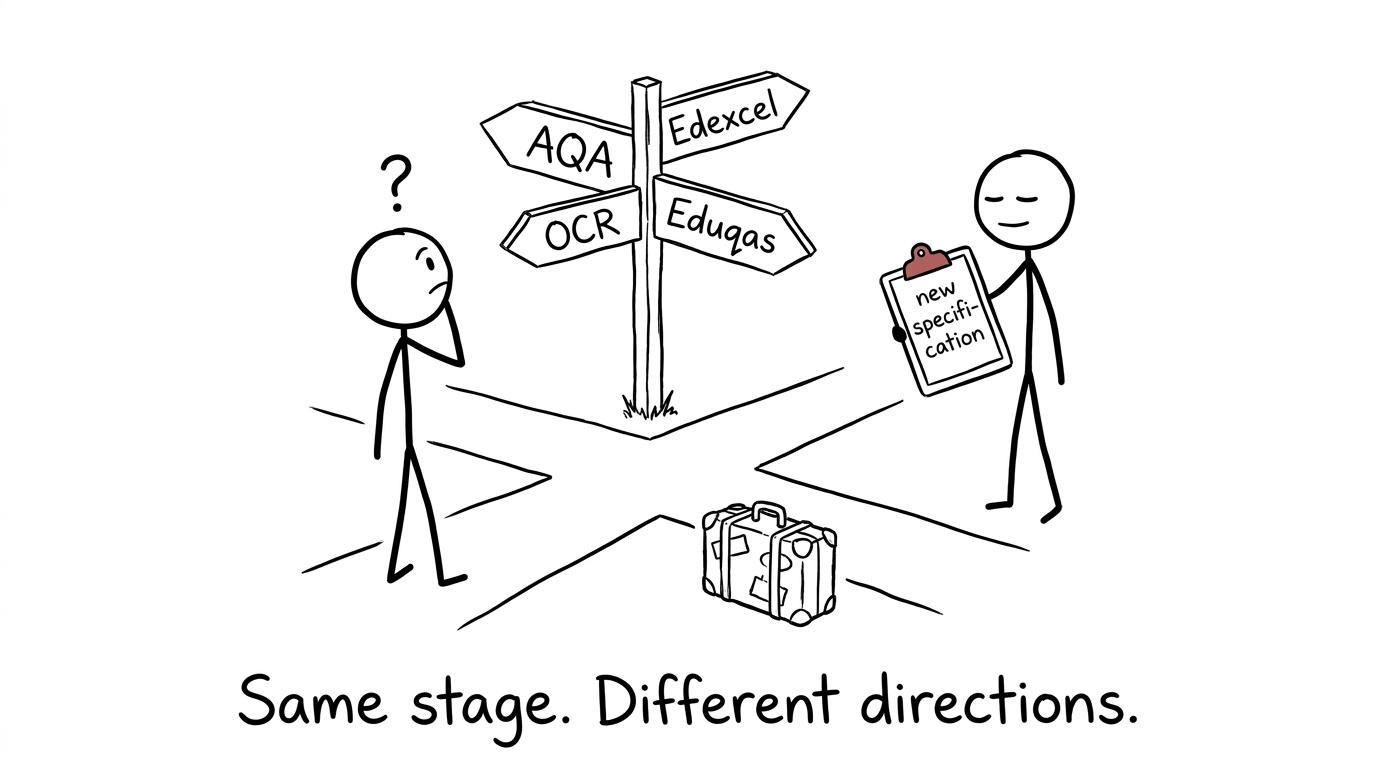 A student choosing between GCSE Drama exam-board signposts
Can a school switch GCSE Drama exam board mid-course?
Schools can change the awarding organisation they use, but feasibility depends heavily on timing. A change near the beginning of the course is usually easier to manage than one made after practical assessment, portfolio work or formal entries have begun.
GCSE Drama qualifications offered by AQA, Pearson Edexcel, OCR and Eduqas must follow national subject requirements. That creates broad common ground: students develop performance or design skills, create and interpret drama, and demonstrate knowledge and understanding through practical and written assessment.
Common ground does not make the specifications interchangeable. Exam boards can organise components differently, prescribe different texts or text-selection rules, request different supporting evidence and use distinct question formats. Teachers must therefore map the old course against the new one rather than simply replacing the logo on your revision folder.
The school, not an individual student, normally handles entries and communication with awarding organisations. If you are worried, ask for the name of the member of staff coordinating the transition. One informed answer is better than several guesses.
A board change is not the same as changing exam centre
This distinction matters. JCQ's transferred-candidate arrangements concern a student sitting a timetabled written examination at another approved centre while the original entry generally remains with the entering centre. They are not a simple method for changing awarding organisation.
Current JCQ guidance also excludes non-examined components, portfolios and practical assessments from ordinary transferred-candidate arrangements. Drama contains practical and non-exam assessment, so moving a written paper to another centre would not, by itself, solve the wider problem.
If your school is changing exam board, its exams officer may need to withdraw or amend entries and consult the relevant awarding organisations. If you are also moving school, both centres should discuss responsibility for entries, practical assessment, records, access arrangements and results. Never assume that changing school automatically changes your board, or that previous assessed work will follow you without formal approval.
What happens to work you have already completed?
This is often the most urgent question, and there is no safe universal answer.
Ordinary classwork can still be valuable even when it cannot be submitted. Rehearsal techniques, character interpretation, design decisions, evaluation and analysis are transferable skills. Formally assessed work is different. Whether it can count depends on the new specification, when and how it was completed, the evidence retained, authentication requirements and the awarding organisation's rules.
Your school should audit completed work under three headings:
| Status | What it means for you |
|---|---|
| Confirmed as usable | The school has checked that the work meets the new board's requirements and can explain how it will be assessed. |
| Useful but not transferable | The learning still helps, but you may need to produce new evidence or complete a different assessed task. |
| Awaiting confirmation | Do not discard notes, drafts, recordings or teacher feedback until the school receives a formal answer. |
AQA publishes a process for requesting a transfer of credit where a student has completed part of a qualification with another board. That does not mean credit will always be available or accepted in every GCSE Drama situation. The exams officer should ask the old and new awarding organisations about your precise components and retain their written response.
Keep every relevant document until the position is settled. Do not recreate controlled or assessed material independently at home unless your teacher explicitly instructs you to do so, because authentication and supervision conditions can matter.
What may change in your GCSE Drama course?
Component structure and weighting
The familiar labels on your course may disappear. Devising, performance from text and written examination content can be grouped, named and weighted differently. Begin with a one-page component map showing the task, deadline, available marks and assessment method for the new board.
Set texts and live theatre
Check whether your existing set-text preparation matches the new specification and current teaching choices. Even where the same play can be studied, the examination questions or expected analytical approach may differ.
Live theatre requirements also need checking. Keep accurate notes about the production, venue, date, performers, design choices and significant moments, following your teacher's instructions. Ask whether an earlier theatre visit remains suitable under the new specification.
Practical evidence and documentation
The required supporting material may change. One board's terminology should not automatically be copied into another board's task. Use the new board's current forms, guidance and assessment criteria supplied by your school.
Written examination technique
Subject knowledge is only part of an examination. You must also understand command words, question order, available marks and how much evidence a strong response needs. Use official specimen materials first, then board-specific past papers and mark schemes selected by your teacher.
How to adjust without letting maths revision slip
An unexpected Drama change creates extra work, but it should not consume every revision session. The danger is not merely having more to do. It is repeatedly deciding what to do next.
Start with two separate lists:
- Drama transition tasks: replacement notes, new terminology, practical deadlines and board-specific paper practice;
- normal GCSE revision: maths, English, science and your remaining subjects.
Give urgent assessed Drama work fixed slots, then protect shorter maths sessions around them. MathsGenie's 20-minute GCSE maths revision routine is useful on rehearsal-heavy days because it keeps revision active without requiring an entire evening.
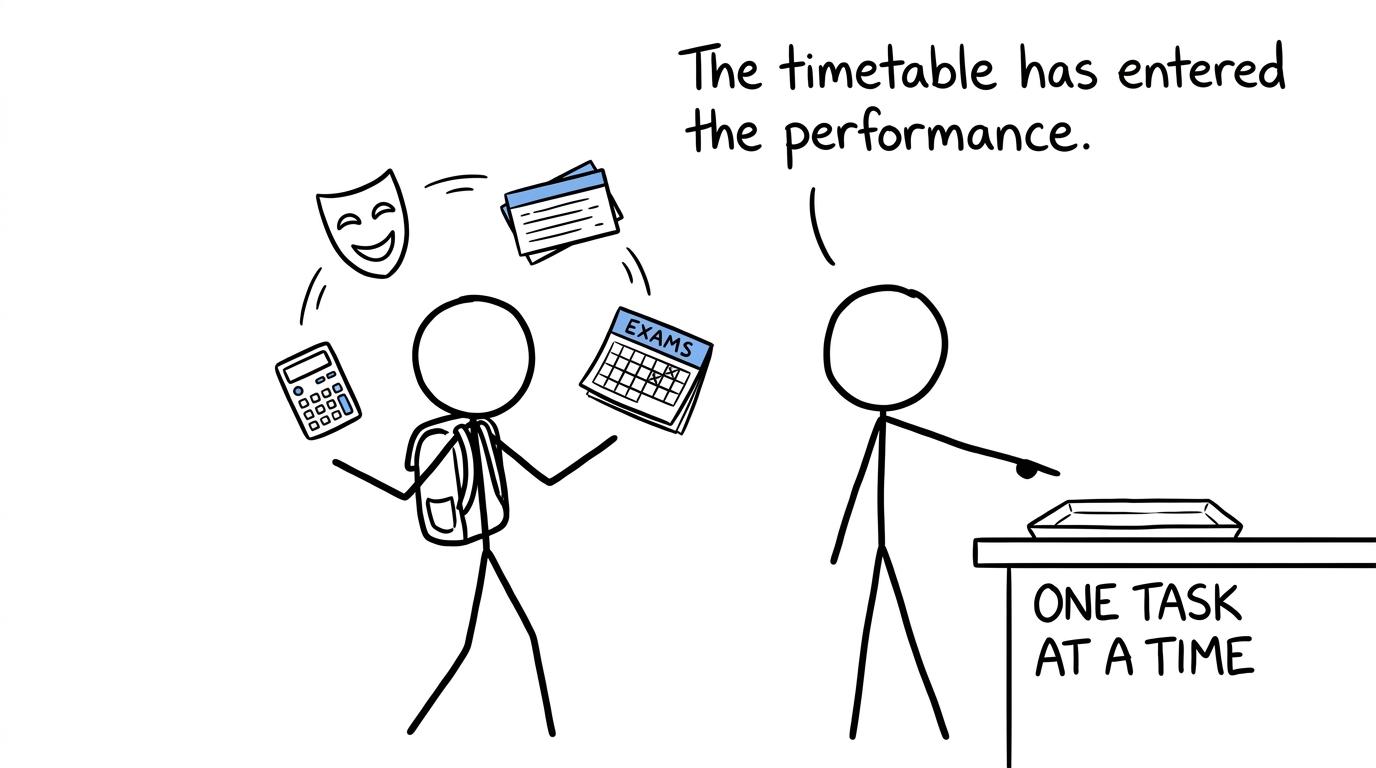 A student juggling Drama and maths revision tasks
Use evidence to decide what those maths sessions contain. The guide to finding your weakest GCSE topics explains how to turn lost marks into targeted practice rather than revising chapters at random. For a quick check, use Edexcel GCSE Maths mini tests, where appropriate for your board and tier.
When you have more time, follow the paper-to-practice cycle in how to use GCSE past papers properly: sit a suitable paper, mark it, diagnose errors, repair the weakest topics and retest. Edexcel students can also use the more detailed Edexcel past-paper method.
This approach matters because a disruption in one subject can encourage unfocused revision everywhere. A stable routine creates a boundary around the uncertainty.
A practical recovery plan
Build a specification gap list
Compare what you have already covered with what the new board expects. Your teacher should lead this process, but you can maintain your own list with four categories:
- secure and unchanged;
- familiar but assessed differently;
- new content or terminology;
- new evidence or performance task required.
This turns a vague fear into a finite set of actions.
Learn the new mark scheme early
Do not wait until the final weeks to discover how responses are rewarded. Annotate a sample paper with the relevant assessment criteria, command words and likely time allocation. Ask your teacher to show you an anonymised model or examiner-approved example where available.
Rehearse under the new conditions
Practical confidence should be tested against the new assessment criteria, not just whether a performance feels successful. Written confidence should be tested using the new question format, not old-board papers that happen to cover a similar play.
Review the plan each week
Keep a short meeting point with your teacher: what has been confirmed, what remains outstanding and what comes next? For maths, retain the same weekly discipline through MathsGenie's GCSE revision guidance and use GCSE predicted papers only after repairing topic gaps.
Common mistakes after an exam-board change
Assuming all GCSE Drama specifications are identical
They share national foundations, but their components, documentation and examinations are not automatically interchangeable. Work from the exact specification code confirmed by your school.
Throwing away earlier work
Old notes may remain academically useful, and records may help staff establish what you completed. Keep everything until your teacher confirms its status.
Using old-board past papers for final preparation
They may support general analysis, but they cannot teach the exact structure of your new examination. Prioritise current materials for the board you will actually sit.
Treating informal reassurance as formal approval
A teacher saying that work will “probably be fine” is not the same as confirmation that it satisfies assessment and authentication rules. Politely ask when the exams officer expects a definitive answer.
Abandoning other subjects while catching up
Drama deadlines may be urgent, but stopping maths revision creates a second problem. Use brief, repeatable sessions and consult the GCSE maths night-before plan when an assessment week becomes crowded.
Move from uncertainty to a written plan
A mid-course change can be disruptive, particularly when practical work has already begun. But the situation becomes manageable once three things are clear: which specification you are entering, what previous work remains valid and what gaps must now be closed.
Ask for those answers in writing. Preserve your work, use only the new board's approved assessment materials, and practise the revised format early. Then protect the rest of your GCSE timetable with routines that require fewer decisions.
For maths, make MathsGenie your free revision base. Use revision lessons and practice questions to repair individual topics, mini tests to check progress, past papers and mark schemes to build exam technique, and predicted papers and video solutions to sharpen your final preparation. One subject may have changed direction. Your wider revision plan does not have to lose its way.











