Study Playlists for GCSE Statistics Focus
Study playlists for GCSE statistics focus may feel useful, but do they improve results? Test music, reduce distractions and build a better revision routine.
A statistics question sits open on your desk. Before answering it, you choose headphones, find the right playlist, adjust the volume and skip a track that feels too energetic. Ten minutes have passed, but revision has not really begun.
If you are looking for study playlists for GCSE Statistics focus, the short answer is this: a playlist may help you start and make revision feel less unpleasant, but research does not show a reliable improvement in cognitive performance. Music with lyrics is particularly likely to interfere with reading and memory. Quiet instrumental music is less risky, yet silence may still be better for demanding questions.
The playlist can be useful. It just cannot do the learning for you.
The quick verdict
Use this checklist before pressing play:
- Choose silence for unfamiliar methods, written interpretations and timed papers.
- If silence feels uncomfortable, try quiet instrumental music without lyrics.
- Avoid favourite songs that encourage singing, track-skipping or phone use.
- Keep the same playlist rather than searching for a perfect one every session.
- Judge music by completed questions, accuracy and recall, not by how focused you felt.
- Practise some revision in silence because your examination room will not have a soundtrack.
The important distinction is between feeling ready to revise and revising effectively. A playlist can support the first. Your answers provide evidence about the second.
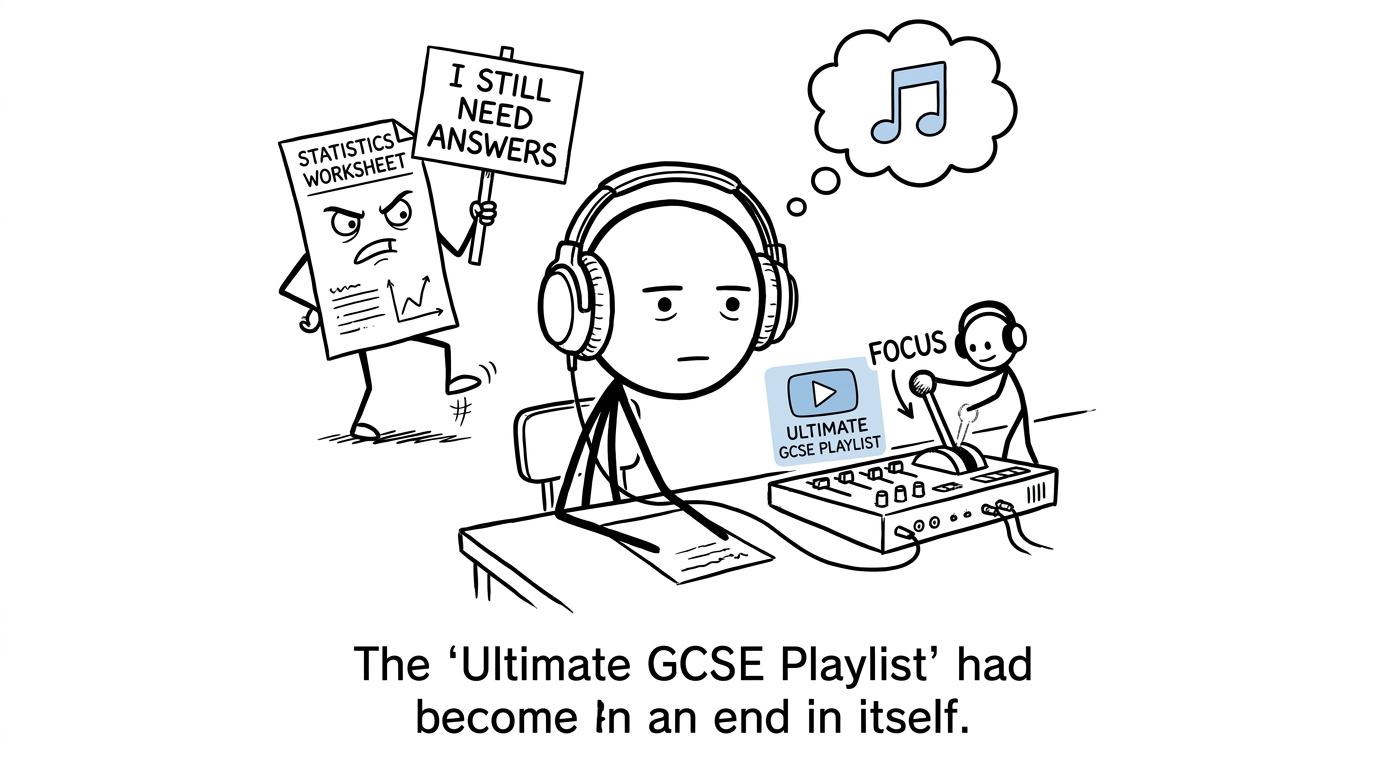 A playlist DJ promises focus while the statistics worksheet waits for answers
What research says about music and concentration
The evidence is more cautious than playlist titles such as “maximum concentration” suggest.
A systematic review published in 202220222022 examined 959595 articles containing 154154154 experiments across attention, memory, language, reasoning and other cognitive tasks. Most comparisons found no effect from background music. Where harmful effects appeared, they were more common in memory and language tasks, especially when the music contained lyrics.
A 202320232023 experiment with university students reached a similar conclusion. Music with lyrics reduced performance in verbal memory, visual memory and reading comprehension compared with silence. Instrumental lo-fi music did not produce a credible improvement or decline. Arithmetic performance was not clearly affected by either type.
Research published in 202420242024 also found poorer reading comprehension with lyrical pop music than with no music. Lyrics in the same language as the text were particularly distracting.
These studies mostly involved adults or university students rather than GCSE candidates, so they cannot prove exactly what will happen during your revision. However, the pattern is useful: music does not appear to offer a universal concentration advantage, while lyrics create an avoidable risk during language-heavy tasks.
That matters because GCSE Statistics is not simply calculation. Questions ask you to read scenarios, interpret graphs, compare distributions, evaluate sampling methods and communicate conclusions in context.
Why statistics can be vulnerable to musical distraction
Some statistics tasks appear mechanical. Finding an average or plotting a point may feel compatible with background music. But exam questions often combine several demands at once.
You might need to:
- identify the population and sample;
- decide whether data are discrete or continuous;
- interpret a frequency table;
- choose an appropriate diagram;
- calculate an average or measure of spread;
- explain whether a conclusion is justified.
The final bullet is where a catchy chorus can become expensive. You are processing mathematical information and constructing a precise written response at the same time.
For instance, the interquartile range is defined by
IQR=Q3−Q1.\text{IQR}=Q_3-Q_1.IQR=Q3−Q1.Remembering that relationship is only part of the task. You may also have to use it to compare consistency between two distributions. That interpretation requires language, attention and context.
The same is true for histograms. The key relationship is
frequency density=frequencyclass width.\text{frequency density}=\frac{\text{frequency}}{\text{class width}}.frequency density=class widthfrequency.Yet many lost marks come from reading the scale incorrectly or treating bar height as frequency. Music cannot protect you from that. Careful checking can. If this is a weak area, use the GCSE histogram revision guide before attempting exam questions.
A playlist may still be a useful ritual
Calling a playlist a ritual does not mean it is pointless.
Revision has a starting problem. Opening a book, confronting a weak topic and risking mistakes can feel harder than continuing once you are underway. A familiar instrumental playlist can become a simple cue: headphones on, phone away, first question started.
That is useful if the ritual is brief and repeatable. It becomes unhelpful when choosing music replaces the work.
A practical rule is to prepare one playlist in advance and make it longer than your normal session. Disable notifications, avoid tracks with dramatic changes and do not browse for alternatives once you begin. The aim is to remove decisions, not create another revision project.
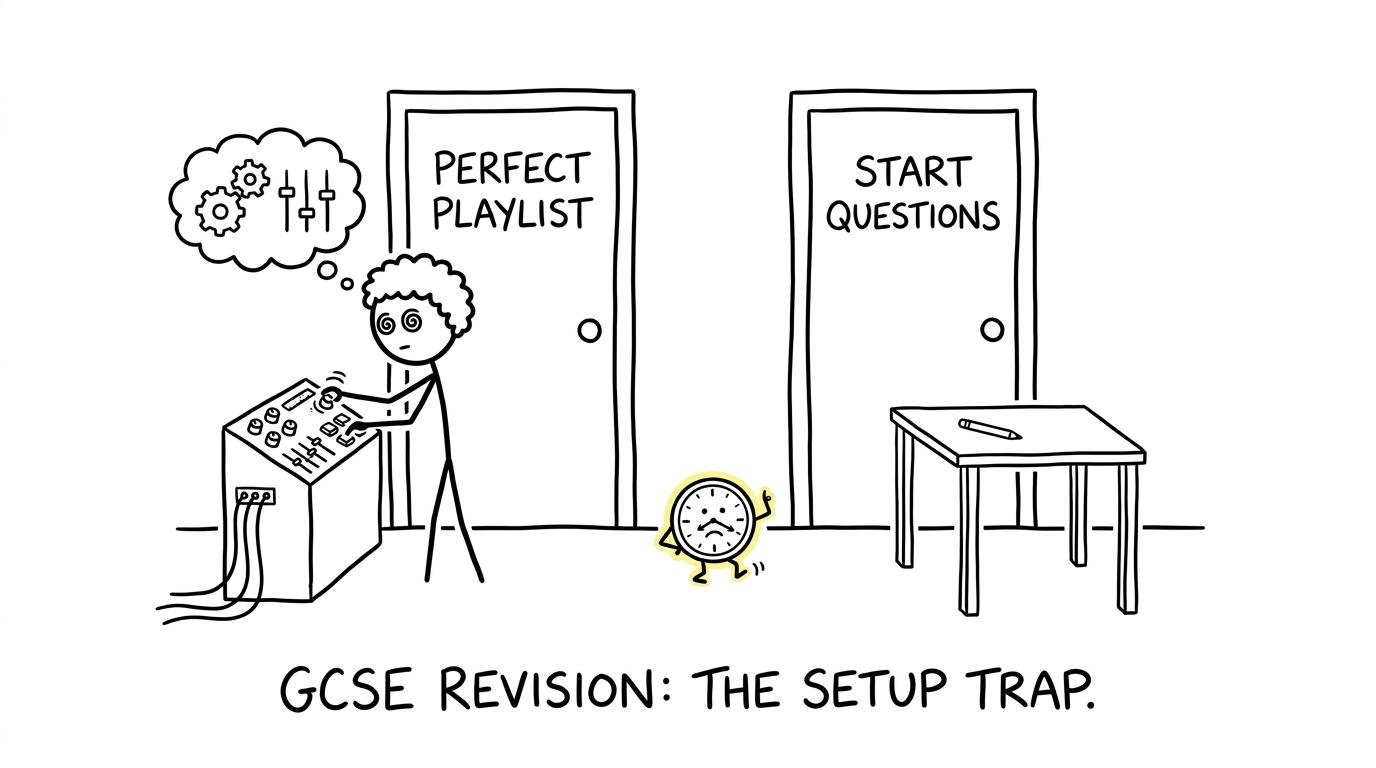 A student chooses between endlessly perfecting a playlist and starting questions
Match the sound to the statistics task
Different tasks place different demands on attention. Your music choice should reflect that.
Learning a method for the first time
Use silence where possible. Pause music while watching a revision video, reading an explanation or learning unfamiliar notation. You need enough attention to understand why the method works, not merely copy its steps.
MathsGenie's GCSE Maths revision hub lets you choose your exam board and move between lessons, worksheets, exam questions and revision guides. Students taking the separate qualification can use the Edexcel GCSE Statistics revision page.
Repeating a familiar skill
Quiet instrumental music is less likely to interfere when you are completing routine practice on a method you already understand. It may make repetition easier to tolerate, but check your answers. Enjoyment is not evidence of accuracy.
For targeted practice, resources such as averages from frequency tables and the cumulative frequency revision guide help you move from explanation to questions without wasting time searching.
Interpreting and evaluating data
Choose silence. Sampling, bias, correlation and comparison questions often depend on one word in the scenario. Lyrics compete most directly with precisely this kind of verbal processing.
Completing timed papers
Use examination conditions: silence, a timer and only the equipment allowed for that paper. This reveals whether you can sustain attention without the environmental support of music.
Past papers should expose weaknesses rather than flatter you. The guidance on when to start GCSE past papers explains how to move from short sections towards full timed practice.
Run your own fair test
You are revising statistics, so treat the playlist question statistically.
Choose several pairs of comparable question sets. Complete one set with your usual playlist and the other in silence. Alternate which condition comes first so tiredness does not always affect the same condition.
Record:
- marks earned;
- marks available;
- completion time;
- number of times you skip a track or touch your phone;
- errors caused by misreading;
- what you can recall the following day.
Calculate an accuracy percentage using
accuracy=marks earnedmarks available×100%.\text{accuracy}=\frac{\text{marks earned}}{\text{marks available}}\times 100\%.accuracy=marks availablemarks earned×100%.Do not draw a conclusion from one session. Question difficulty, sleep, topic confidence and interruptions are confounding variables. Repeated results across several comparable sessions are more informative, although a personal test still has a tiny sample and cannot establish a general rule for everyone.
Most importantly, decide what “helps” means before collecting data. If music improves your willingness to begin but slightly reduces accuracy, you face a trade-off. One sensible response is to use instrumental music for low-demand practice, then switch it off for interpretation and timed assessment.
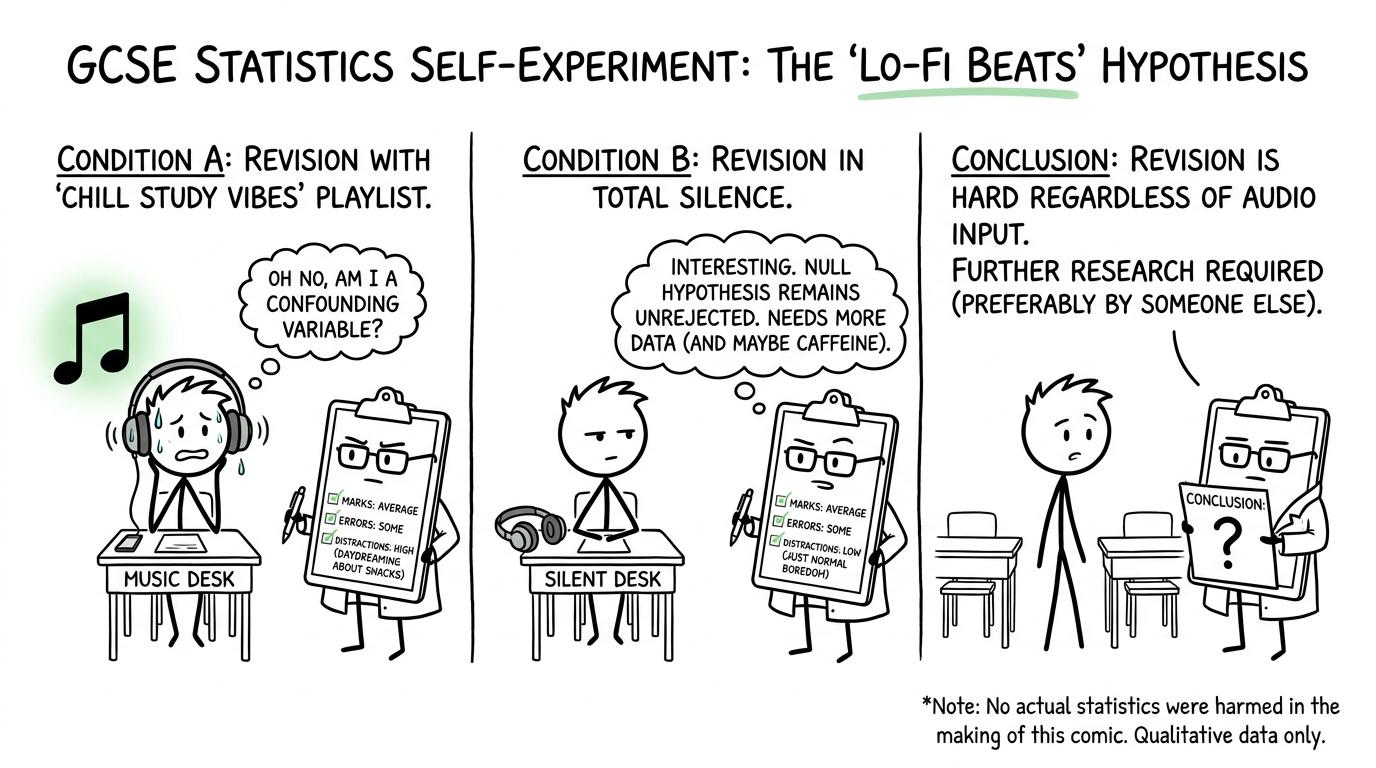 A student runs a serious fair test between music and silence
Build focus around actions, not atmosphere
A strong session needs a defined task. “Revise statistics” is too vague. “Complete a mini test, mark it and correct every sampling question” tells you what finishing looks like.
Try this sequence:
- select one statistics topic;
- retrieve the method from memory;
- use a revision lesson if there is a genuine gap;
- answer exam-style questions;
- mark them immediately;
- record why each mark was lost;
- retest the skill on another day.
Music sits outside this loop. It can make the room feel right, but improvement comes from retrieval, practice, feedback and correction. If planning is difficult, adapt the focused sessions in MathsGenie's one-week GCSE maths revision plan.
Common mistakes with study playlists
Measuring mood instead of performance
A productive session can feel difficult because you are retrieving knowledge and finding errors. A smooth session can feel excellent because the music is familiar. Use marks, corrections and later recall as evidence.
Revising only with music
Even if music helps at home, exclusive use can make silent paper practice feel unfamiliar. Include regular silent sessions before your GCSE exams.
Choosing lyrical favourites
Familiar lyrics are still language. They can pull attention towards singing, memories or anticipation of the next line. Instrumental tracks are the safer starting point.
Changing songs whenever work becomes difficult
Skipping a track may be disguised avoidance. When a question becomes uncomfortable, write down what you know, identify the topic and attempt a first step before touching the playlist.
Treating predicted papers as predictions of certainty
Predicted papers provide fresh exam-style practice, not guaranteed future questions. Use them alongside specification-matched lessons, official past papers and mark schemes.
Turn the ritual into real revision
Study playlists are neither a secret route to focus nor automatically harmful. For some students, a familiar instrumental soundtrack makes starting easier. The best available evidence does not show a dependable cognitive boost, however, and music with lyrics is more likely to disrupt memory and reading.
Keep the ritual if it gets you to the desk. Then demand evidence from it.
Open MathsGenie's free GCSE resources, choose your board and tier, and begin with one specific statistics weakness. Use revision lessons to rebuild the method, practice questions and mini tests to check it, then past papers, mark schemes and video solutions to expose what still needs attention. Nearer the exam, add predicted papers for fresh practice.
The playlist may begin the session. The questions, corrections and repeated practice are what move your grade.