

Stop Procrastinating on GCSE Engineering
Stop procrastinating GCSE Engineering revision with a practical plan for starting tasks, managing the NEA and strengthening calculation skills.
The hardest part of GCSE Engineering revision is often not understanding gears, materials or manufacturing. It is opening the work in the first place. A portfolio feels too large, calculations expose gaps in your maths, and practical tasks cannot always be completed at home.
If your search is “stop procrastinating GCSE Engineering”, the practical answer is this: make the next action smaller, clearer and easier to begin. Do not plan to “revise Engineering”. Decide to label one systems diagram, answer five retrieval questions or practise one calculation skill for five minutes.
That sounds modest. It is meant to. Procrastination is rarely defeated by creating a more intimidating plan.
Your anti-procrastination checklist
Use this whenever Engineering has slipped to the bottom of your revision list:
- Identify the exact task you have been avoiding.
- Reduce it to an action that can be started in five minutes.
- Separate work you can do at home from work requiring school equipment.
- Put your phone out of reach before the session begins.
- Use questions, diagrams and self-testing rather than rereading.
- Mark completed questions and record the reason for each lost mark.
- Schedule the next session before you stop.
- Ask your teacher promptly if an NEA decision or practical problem is blocking progress.
The aim is not to feel endlessly motivated. It is to build a system that still works when motivation is low.
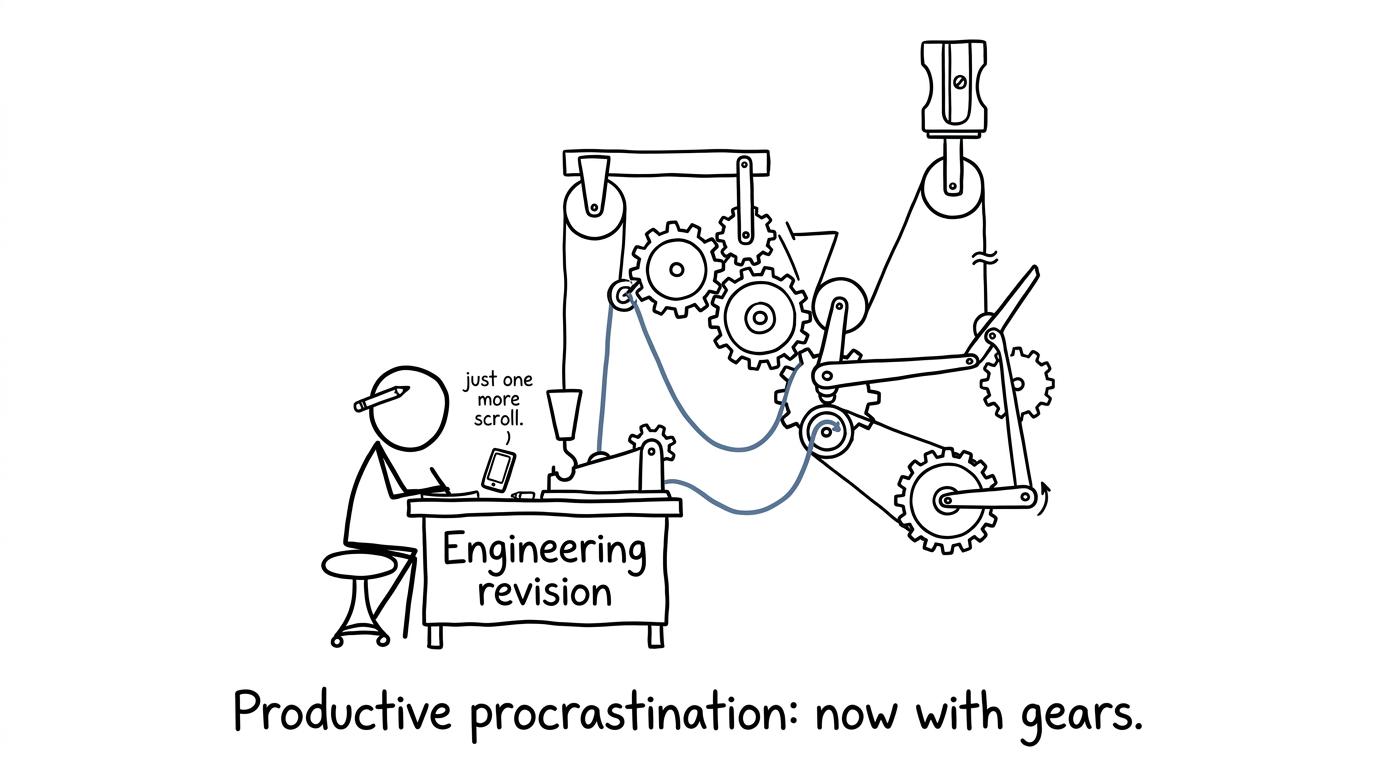 A student invents an elaborate machine to avoid opening an Engineering revision page
Why GCSE Engineering gets procrastinated on
Not every student avoids Engineering more than other subjects. For those who do, the structure of the course helps explain why.
One subject can contain several kinds of work
Engineering asks you to move between technical knowledge, calculations, drawings, manufacturing processes, systems, testing and evaluation. A task called “finish Engineering” therefore contains many hidden decisions.
Which section should you open? Do you need notes, CAD software, a calculator or workshop access? Are you recalling knowledge or improving a design? When the starting point is unclear, checking a message offers immediate certainty.
Make the task concrete instead:
- “Recall the properties of four materials without notes.”
- “Annotate one drawing with dimensions.”
- “Complete six density and pressure questions.”
- “Write three reasons why the prototype did not meet the specification.”
Clarity reduces the emotional cost of beginning.
Practical and written work create different barriers
Some Engineering tasks require machinery, materials, supervision or specialist software. You may postpone the entire subject because one part genuinely cannot be completed at home.
Split your list into three columns:
- Home: recall, calculations, process sequences and planning.
- School: manufacturing, measurements, testing and teacher feedback.
- Blocked: tasks awaiting equipment, information or a decision.
A blocked workshop task does not prevent you from revising material properties or practising calculations. It only means the next action must match the setting.
The finished product can feel uncomfortably visible
An answer in an exercise book can be crossed out. A prototype or portfolio feels more permanent. That visibility can encourage perfectionism: if the work cannot be excellent immediately, it seems safer not to start.
Engineering itself provides the better model. Designs are developed through testing, evidence and modification. Your first draft is not a verdict on your ability. It is a prototype that creates information for the next decision.
Maths gaps can become Engineering avoidance
Calculations may involve ratio, scale, units, area, volume, density, pressure, graphs and formulae. If these skills feel uncertain, “I need to revise Engineering” quietly becomes “I might discover that I cannot do the maths”.
That is useful diagnostic information, not failure. MathsGenie’s GCSE Maths topics by exam board and tier can help you identify the underlying skill instead of avoiding a whole subject.
For example, engineering relationships can include:
density=massvolume\text{density}=\frac{\text{mass}}{\text{volume}}density=volumemassand
pressure=forcearea.\text{pressure}=\frac{\text{force}}{\text{area}}.pressure=areaforce.If rearranging these relationships is the barrier, use the speed and density revision guide for focused practice. If drawings and models are causing hesitation, revisit scale drawings revision.
What actually breaks the procrastination pattern
Research on academic procrastination consistently links delay with task aversiveness: feelings such as boredom, frustration, uncertainty or anxiety. Avoidance improves your mood briefly, but the unfinished task becomes more threatening later.
The solution is not simply to “try harder”. Change the task and its environment so starting requires less negotiation.
Use a five-minute entry task
Choose an action so small that you can begin before your mind builds a case against it:
- open the correct document;
- write the date and section heading;
- list what the question gives you;
- retrieve five facts;
- mark yesterday’s questions.
After five minutes, you may continue or take a planned break. The important achievement is crossing the boundary between avoidance and action.
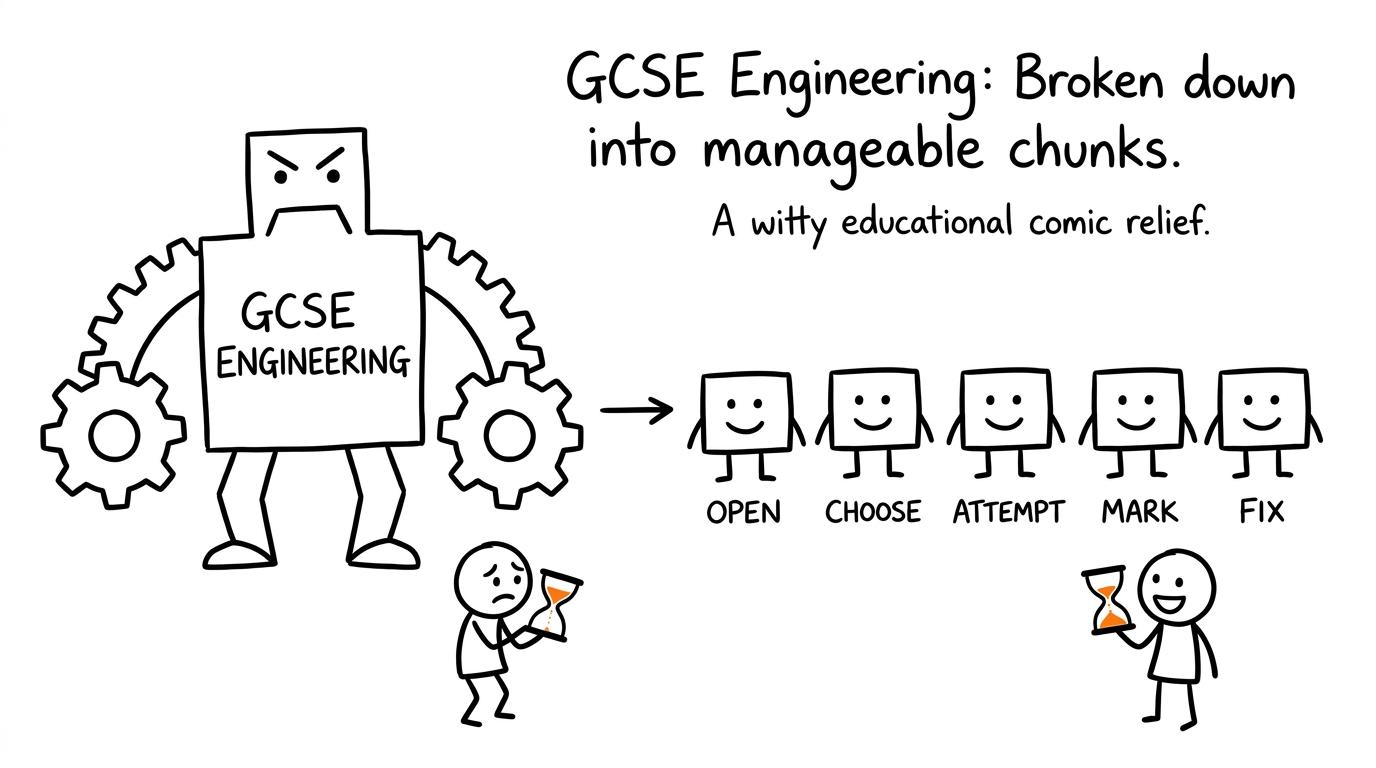 A large GCSE Engineering robot becomes five small manageable revision boxes
Replace vague intentions with an if-then plan
“Do Engineering tonight” leaves the time, place and action undecided. An implementation intention makes them explicit:
If I finish dinner, then I will sit at the kitchen table and answer one set of Engineering materials questions before opening social media.
Your plan should name a reliable trigger, a location and a visible action. It should not depend on suddenly feeling inspired.
Build a minimum viable session
A useful short session can have four parts:
- Start: retrieve facts from memory.
- Focus: complete one defined task.
- Check: compare your response with notes or a mark scheme.
- Close: record one error and choose the next action.
This is more effective than spending the entire session making attractive notes. For calculation practice, MathsGenie’s cycle is similarly direct: learn the method, practise questions, mark them and repair the error. The guide to finding your weakest GCSE topics shows how to turn lost marks into a focused revision list.
Make distraction physically inconvenient
A phone beside your calculator is not a neutral object. Notifications, visible icons and habitual checking continually reopen the decision between revision and immediate entertainment.
Put it in another room, leave it with someone you trust or use a blocker before sitting down. Open the worksheet and calculator first. Good revision environments reduce the number of decisions that require willpower.
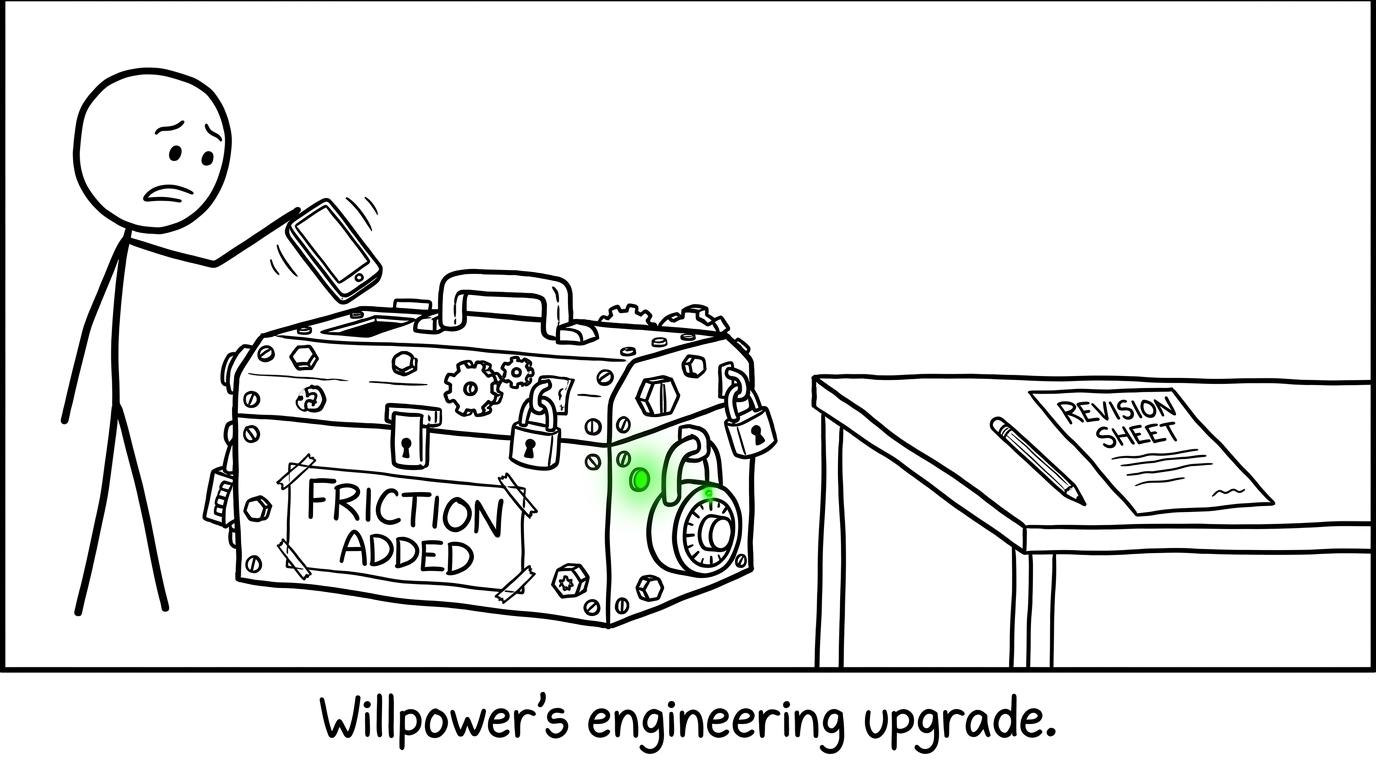 A student locks a phone inside an excessively engineered toolbox before revision
Use evidence rather than mood to choose topics
Students often revise whichever topic feels least uncomfortable. Instead, use a short test or recent assessment to identify where marks are being lost.
MathsGenie’s Edexcel GCSE Maths mini tests are useful when a full paper feels too large. You can also use the GCSE past papers collection to test the mathematical foundations that Engineering questions draw upon.
Record each mistake under one of these headings:
- knowledge;
- formula choice;
- rearranging;
- unit conversion;
- calculator accuracy;
- interpretation;
- time pressure.
“Bad at calculations” is difficult to act on. “I convert area units incorrectly” gives you a revision target.
A realistic weekly GCSE Engineering routine
Engineering benefits from frequent contact because it combines recall, application and project decisions. A workable week might include:
- Monday: materials and manufacturing retrieval.
- Tuesday: maths used in Engineering, such as ratio, units or formulae.
- Wednesday: portfolio planning or evaluation.
- Thursday: systems, diagrams and technical vocabulary.
- Friday: short mixed questions and error-log review.
- Weekend: a longer practical, drawing or timed assessment task where appropriate.
Keep weekday sessions short enough to repeat. If your wider maths revision also feels disorganised, adapt the structure in MathsGenie’s one-month GCSE maths revision plan.
Your exact Engineering assessment depends on the qualification your school enters. For example, the current AQA GCSE Engineering specification combines a written paper with non-exam assessment, and mathematical skills are assessed in an engineering context. Other technical qualifications may use different structures. Check your own specification and teacher guidance rather than assuming that every course follows the same format.
How to handle the NEA without waiting for panic
For students taking a course with non-exam assessment, the NEA can become the largest source of avoidance because it contains connected decisions. Break it into evidence-sized tasks:
- clarify the problem;
- identify user needs;
- record relevant research;
- generate and justify possible solutions;
- prepare drawings and plans;
- manufacture safely;
- test against measurable criteria;
- evaluate using evidence;
- identify justified improvements.
Do not invent test results, measurements or development work after the event. Record decisions while the evidence is available and follow your teacher’s instructions about permitted assistance and authentication.
When blocked, write one precise question for your teacher. “I do not understand my project” is hard to resolve. “Should this test measure maximum load or repeated use?” creates a useful conversation.
Common mistakes when trying to stop procrastinating
Making a timetable too ambitious to survive
A plan containing hours of Engineering every evening may feel serious, but it collapses after one difficult day. Set a small minimum and treat extra work as optional progress.
Starting with the most frightening task
There is value in tackling weak areas, but a task that feels impossible can restart avoidance. Begin with a brief entry action, then move into the demanding work once momentum exists.
Confusing organisation with revision
Colour coding folders, redesigning timetables and searching endlessly for resources can feel productive without strengthening recall or exam technique. Organisation should lead quickly to questions, testing or a concrete portfolio action.
Waiting to understand everything before practising
Questions reveal what you actually understand. Use a short lesson, attempt the task, check it and return to the exact gap. The best order for learning GCSE maths topics can help when several prerequisite skills need attention.
Treating one missed day as a ruined plan
A missed session is a scheduling problem, not proof that you are lazy. Restart with the next small action. Do not create a punishing catch-up session that makes tomorrow harder to begin.
Start smaller than your excuses
To stop procrastinating on GCSE Engineering, do not wait for the subject to feel simple. Make the next action obvious, reduce its size, remove nearby distractions and use completed questions as evidence of what to do next.
Begin now with one five-minute task. Then use MathsGenie to strengthen the calculations underneath your Engineering work: revision lessons for understanding, practice questions and mini tests for accuracy, and GCSE past papers for exam readiness. Closer to your maths exams, add predicted papers, mark schemes and video solutions so each mistake leads to a specific repair.
A large project becomes manageable in the same way any engineered system does: one functioning component at a time.










