Stop Procrastinating on GCSE Economics
Stop procrastinating GCSE Economics with a practical revision system for starting difficult topics, practising exam skills and building consistency.
Procrastination often begins with a sentence that sounds sensible: “I’ll revise economics when I have enough time to do it properly.” The problem is that “properly” quietly becomes an hour, then an entire evening, then some imaginary future day when you feel unusually focused.
If you want to stop procrastinating GCSE Economics, make the first task smaller and more specific. Do not plan to “revise the economy”. Choose one concept, one data skill or one exam question, and work on it for a short, fixed period. Starting is the immediate goal. Effective revision can grow from there.
This matters particularly when you are also preparing for GCSE maths. Economics draws on percentages, averages, graphs and data interpretation, so avoiding economics can leave quantitative weaknesses hidden until both subjects become urgent.
Your anti-procrastination checklist
Use this checklist whenever economics keeps slipping down your revision plan:
- Choose one specification point rather than a whole unit.
- Define an action you can finish in 151515 to 252525 minutes.
- Put your phone outside immediate reach.
- Retrieve knowledge before reopening your notes.
- Complete at least one relevant exam question.
- Mark the answer and record one correction.
- Decide exactly when you will return to the topic.
The order matters. It replaces the vague intention to revise with a visible beginning, an assessable result and a next step.
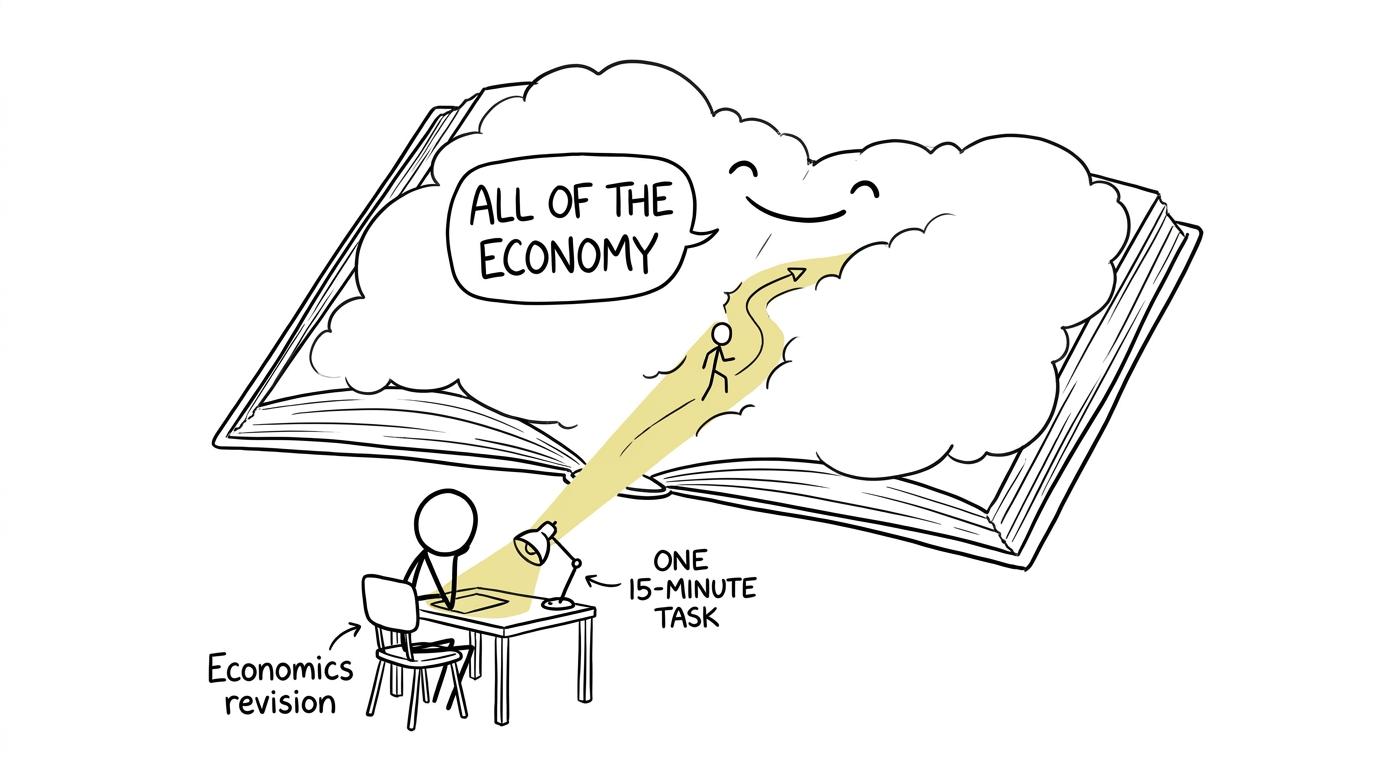 A student uses one small revision task to find a path through the fog of the entire economy
Why GCSE Economics gets procrastinated on
Economics is not necessarily harder than every other GCSE subject. It is, however, unusually easy to postpone because a single topic can require several kinds of thinking.
You may need to remember a definition, apply it to a case study, explain a chain of consequences, interpret numerical evidence and reach a justified judgement. “Revise inflation” therefore gives your brain no obvious first move. The task feels large before you have even opened the book.
There are several other reasons economics may be neglected.
The subject has fewer obvious finishing lines
A short calculation has a recognisable endpoint. An evaluative economics answer can always appear capable of improvement. You might add another consequence, stakeholder or qualification. Students who want to produce a perfect answer may consequently delay producing an imperfect first one.
Passive revision feels deceptively productive
Reading a page about market failure is comfortable because the ideas look familiar. Closing the book and explaining the same ideas is harder. That difficulty can be mistaken for failure, so students return to highlighting or reorganising notes.
Familiarity is not reliable evidence of recall. Economics revision becomes more useful when it produces something checkable: a definition from memory, a labelled diagram, an explanation chain or an answer compared with a mark scheme.
Economics competes badly with urgent subjects
Maths homework has questions to complete. English may have an essay deadline. Economics revision can remain open-ended, so it loses every competition for attention until an assessment is close.
The solution is not to declare economics more important than everything else. Give it a firm place and a small boundary: “At 17:0017{:}0017:00, I will spend 202020 minutes answering one market question at my desk.” Research on implementation intentions suggests that specific if-then plans can support task initiation, although no single planning technique works for every student. The useful principle is to remove the decision at the moment you are most tempted to delay.
What actually breaks the procrastination pattern
Procrastination is rarely defeated by waiting for motivation. A more dependable approach is to reduce the emotional and practical cost of beginning.
Shrink the entry task
Your first action should feel almost too small:
- write three definitions from memory;
- plan one extended response;
- interpret one chart;
- draw one supply-and-demand diagram;
- check one answer against a mark scheme.
This is not a plan to revise less. It is a way to cross the point where avoidance is strongest. A 202020-minute session completed today is more valuable than a two-hour session repeatedly moved to tomorrow.
Separate starting from finishing
Tell yourself that you only have to complete the agreed block. When the timer ends, you may stop. This gives the session a credible boundary and prevents revision from feeling like an unlimited claim on your evening.
If you continue, treat the extra time as optional. If you stop, write the next action before leaving. Tomorrow’s starting point should be “complete question 444 and mark it”, not “carry on with economics”.
Make distraction inconvenient
You do not need to prove that you can resist a phone sitting beside your paper. Put it in another room, leave it with someone at home or use a blocking setting during the session. Open the required document before the timer begins and keep only the necessary tabs available.
Environment beats repeated negotiation. Each distraction you remove is one less decision to make while your attention is already under pressure.
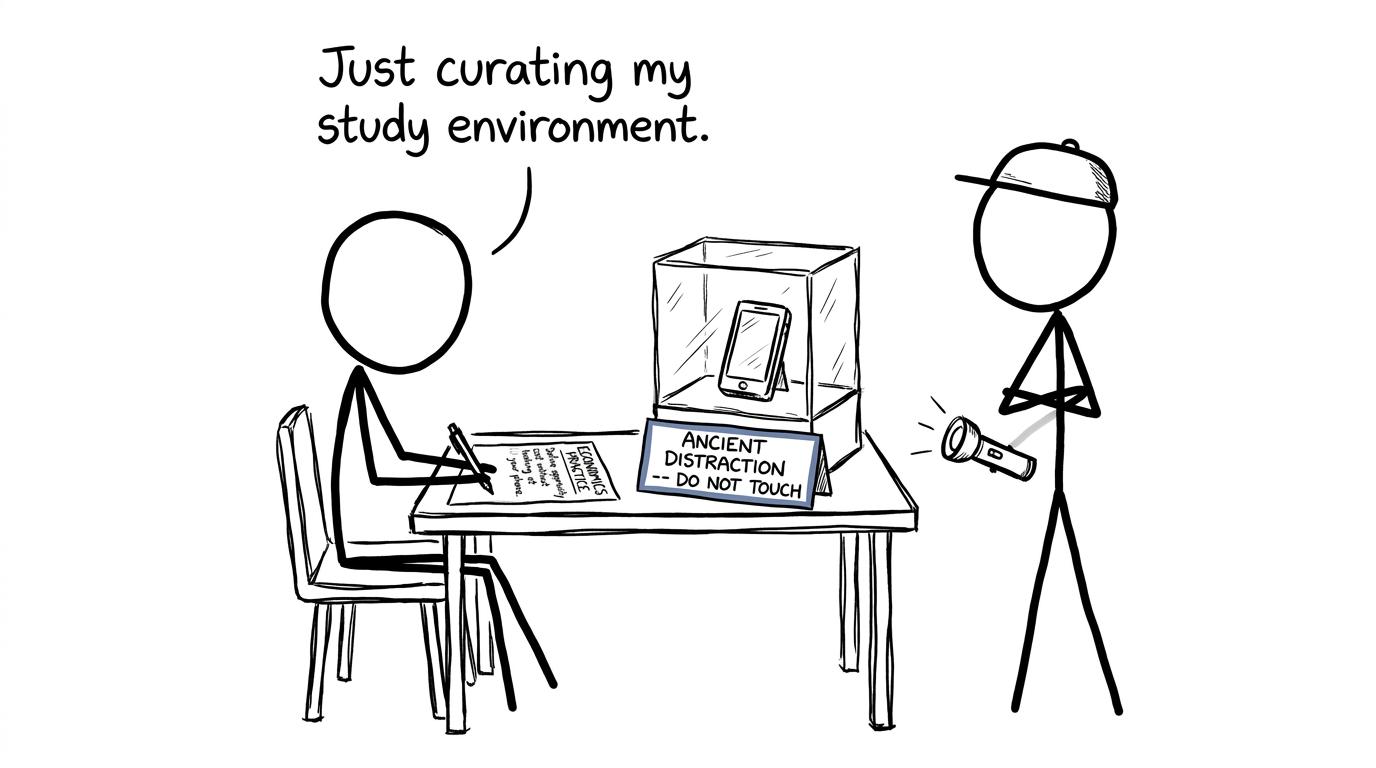 A student's phone becomes a carefully guarded museum exhibit during economics revision
Use a visible revision loop
Educational evidence on metacognition and self-regulation supports teaching students to plan, monitor and evaluate their learning within real curriculum content. For economics, that can become a simple loop:
- Plan: select one precise specification point and one output.
- Monitor: notice what you can recall or apply without help.
- Evaluate: mark the work and name the exact weakness.
- Adjust: choose the next question or resource from that weakness.
This is more useful than recording time alone. Forty minutes spent copying notes may tell you less than ten minutes spent attempting and checking a demanding question.
Build sessions around the economics assessment objectives
For AQA and OCR GCSE Economics, the assessment objectives broadly divide marks between knowledge and understanding, application, and analysis and evaluation. Their overall weightings are 35%35\%35%, 35%35\%35% and 30%30\%30% respectively.
That is a useful warning: memorising definitions is necessary, but it is not the whole subject. Build a revision session that moves through three modes:
- Recall: define or identify the concept without notes.
- Apply and analyse: connect it to the information in a case study and explain consequences.
- Evaluate: weigh relevant arguments and make a supported judgement.
Do not attempt every stage for every topic in one sitting. Instead, label the purpose of a session. “Recall labour-market terms” is clear. “Plan an evaluation of indirect taxation” is clear. “Do economics” is not.
Your own exam board’s specification and mark schemes should remain the final authority on content and question expectations. Do not assume another board uses identical paper structures or wording.
Connect economics revision to GCSE maths
Official GCSE Economics specifications require quantitative skills. These include percentages and percentage changes, averages, totals such as revenue, cost and profit, and the construction and interpretation of graphs and charts. At least 10%10\%10% of GCSE Economics marks are allocated to quantitative skills.
That makes maths revision a practical bridge into economics when the written content feels difficult to start. Useful relationships include:
percentage change=changeoriginal value×100\text{percentage change}=\frac{\text{change}}{\text{original value}}\times 100percentage change=original valuechange×100 revenue=price×quantity\text{revenue}=\text{price}\times\text{quantity}revenue=price×quantity profit=total revenue−total cost\text{profit}=\text{total revenue}-\text{total cost}profit=total revenue−total costYou can strengthen these foundations through MathsGenie’s percentage change revision resources and averages topic materials. Choose the version matching your maths exam board through the main GCSE maths revision hub.
However, do not let comfortable calculations become a hiding place from economics. After practising the maths skill, return to an economics question that requires you to interpret the result. A calculated change only earns its wider value when you can explain what it may mean for consumers, firms, workers or government.
Create a realistic weekly system
A revision plan should reduce decisions rather than create an attractive document you never use. Give economics two or three short appointments each week, with a different purpose for each.
A useful pattern is:
- one recall session for definitions, diagrams and connections;
- one exam-question session for application, analysis or evaluation;
- one data session combining calculations with written interpretation.
Keep a short error log containing the topic, what went wrong and the next action. “Weak on macroeconomics” is too broad. “I described inflation but did not connect it to falling real purchasing power” tells you what to repair.
If your whole GCSE timetable feels crowded, adapt the structure in MathsGenie’s one-week GCSE revision plan. The topics are mathematical, but the planning principle transfers: diagnose, select a small fix list, practise, mark and revisit.
Spacing also matters. Return to a topic after a gap rather than waiting until it feels completely forgotten. MathsGenie’s guide to stopping GCSE content from being forgotten explains how active recall, spaced practice and exam questions can form a repeatable routine.
Common mistakes when trying to stop procrastinating
Making the plan too ambitious
A timetable packed with long sessions looks committed but leaves no room for tiredness, homework or ordinary life. Miss one block and the entire plan can feel broken. Begin with sessions you can repeat consistently.
Revising only favourite topics
Completing familiar market calculations may feel reassuring, but it does not address a weakness in evaluation. Use teacher feedback, tests and marked questions to choose tasks rather than relying on mood.
Producing notes without testing recall
Notes can support learning, but copying is not proof that you can retrieve or apply an idea. Close the resource, attempt an output and then check it.
Completing questions without marking them
Unmarked practice leaves misconceptions intact. Compare your response with the mark scheme, annotate the missing step and return to the question later. Maths students can apply the same principle through GCSE predicted papers, but predicted papers should complement rather than replace official past papers.
Treating one missed day as failure
A disrupted session is a scheduling problem, not evidence about your ability. Do the smallest useful task at the next available opportunity. Consistency means returning repeatedly, not maintaining a perfect streak.
Start before you feel ready
The turning point is rarely a dramatic increase in motivation. It is the moment economics stops being one enormous obligation and becomes one defined action you can begin now.
Choose a topic from your specification. Set a short timer. Retrieve something before checking your notes, answer a question and mark it honestly. Then schedule the next encounter. That is how you stop procrastinating on GCSE Economics: not through one heroic evening, but through a system that makes beginning ordinary.
For the quantitative side of your preparation, use MathsGenie as your free revision base. Start with the GCSE maths revision hub, build confidence through revision lessons and practice questions, and then test your progress with mini tests, past papers, mark schemes, video solutions and GCSE predicted papers. One clear task is enough to begin.