

Staying Consistent With GCSE Further Maths Revision
Staying consistent with GCSE Further Maths revision gets easier with small routines, active practice, honest marking and a realistic plan for bad weeks.
Some revision plans are built for your most motivated day. They assume you will come home energised, ignore your phone and feel delighted to practise matrices. Then an ordinary Wednesday arrives. You are tired, another subject has a deadline, and the plan quietly collapses.
The answer to staying consistent GCSE Further Maths revision is not finding endless motivation. It is creating a routine that still works when motivation is low: set a small daily minimum, decide tasks in advance, answer questions actively, mark them immediately and return to mistakes later.
Consistency does not mean doing hours every day. It means making the next useful action easy enough to repeat.
Your consistency checklist
Use this as the short version of the whole strategy:
- Set a minimum session of 151515 to 202020 minutes.
- Choose the topic before the session begins.
- Start with questions rather than lengthy note-making.
- Mark every attempt and record the reason for lost marks.
- Revisit weak skills across several days.
- Keep one lighter session available for difficult weeks.
- Use timed papers only after enough targeted practice.
- Protect sleep, breaks and time away from revision.
If you study AQA Level 2 Further Mathematics, begin with the AQA GCSE Further Maths revision hub. If your school uses another additional maths qualification, check the exact specification and assessment arrangements with your teacher before building your plan.
Motivation starts things; systems keep them going
Motivation is useful, but unreliable. It rises after a good lesson, a strong mock result or a sudden burst of exam nerves. It can disappear just as quickly.
A system removes the daily question, “Do I feel like revising?” and replaces it with something more practical: “What is today’s task?”
For example, your routine might always begin at the same time, in the same place, with your phone outside the room. The resource is already open. The first question has already been selected. These details appear small, but each one removes a decision that could otherwise become an excuse to delay.
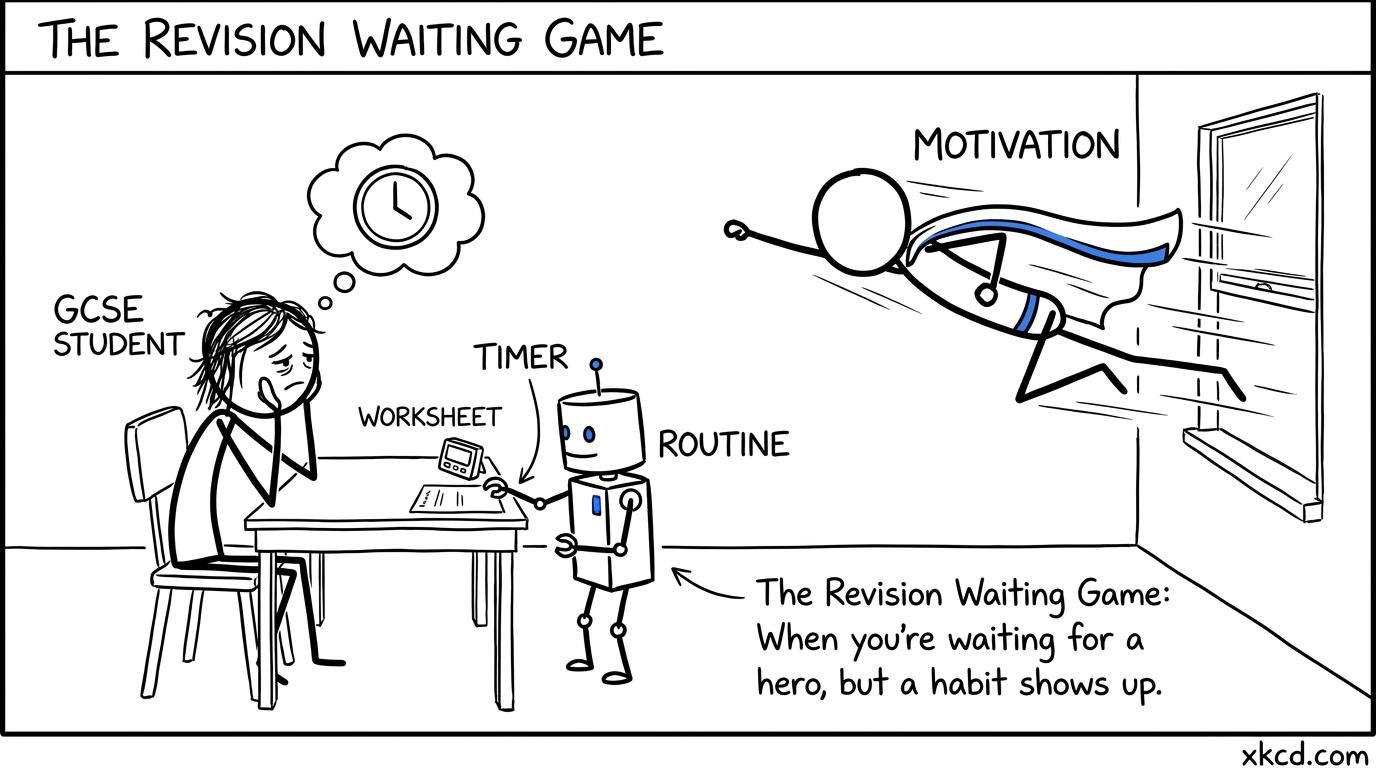 A routine robot starts revision while motivation is late
The best system is not the most ambitious one. It is the one you can repeat during a busy school week.
Create a minimum that survives bad days
Your minimum is the smallest revision session that still counts. It might be:
- 151515 minutes of algebra questions;
- one short Further Maths lesson followed by two questions;
- correcting three previous mistakes;
- one section of a mini test.
This is not your maximum. On a strong day, you can continue. On a difficult day, completing the minimum keeps the routine alive.
Make the task specific. “Revise Further Maths” is too vague because it forces you to decide what revision means at the moment when you are least willing to start. “Complete the first set of matrix questions and mark them” has a visible finish line.
If planning feels overwhelming, adapt the structure in the GCSE maths revision timetable guide. Further Maths is usually studied alongside GCSE Maths, so the two plans must fit together rather than compete for every available evening.
Use a revision loop, not a revision mood
A repeatable session should have four parts:
Recall
Begin without notes. Write down a rule, explain a method aloud or attempt a familiar question. The purpose is to discover what you can retrieve, not what looks familiar when a page is open.
Practise
Answer a small set of focused questions. Further Maths develops higher-order algebraic reasoning and may include functions, coordinate geometry, calculus, matrices and demanding geometry, depending on the qualification. These skills become secure through use, not recognition.
Mark
Check your work while your thinking is still fresh. Use the mark scheme and, where available, a video solution to see both what was rewarded and where your method changed direction.
Fix
Write one precise correction. Avoid entries such as “bad at algebra”. Record the actual problem: “forgot to check both roots”, “used the wrong gradient relationship” or “could not recall the matrix transformation”.
MathsGenie’s guide to finding your weakest GCSE topics explains how to turn lost marks into a useful priority list. The same principle applies to Further Maths: diagnose narrowly, practise deliberately and retest.
Space revision instead of repeatedly restarting
A long session can create the feeling that a topic is finished. Memory does not work quite so neatly.
Research on learning supports spacing practice across time rather than concentrating the same work into one sitting. Evidence also supports planning, monitoring and evaluating revision instead of relying on passive rereading. For maths, the practical conclusion is simple: return to a skill after some forgetting has occurred and see whether you can still use it.
A topic cycle could look like this:
- first session: learn or refresh the method;
- next session: complete focused questions;
- several days later: retrieve the method and answer new questions;
- later again: meet the skill inside mixed or timed practice.
You do not need a complicated tracking system. In your revision planner, record the topic, your confidence and the date you will revisit it. Keep no more than a few active priorities at once.
The GCSE one-month revision plan offers a useful model for balancing topic work, retrieval and paper practice. Adjust its workload to account for your separate Further Maths course and your other GCSE subjects.
Reduce the size of the starting line
When motivation dips, the course can appear as one enormous object: algebra, matrices, differentiation, graphs, geometry and every mistake you have ever made.
Do not start with the course. Start with the next action.
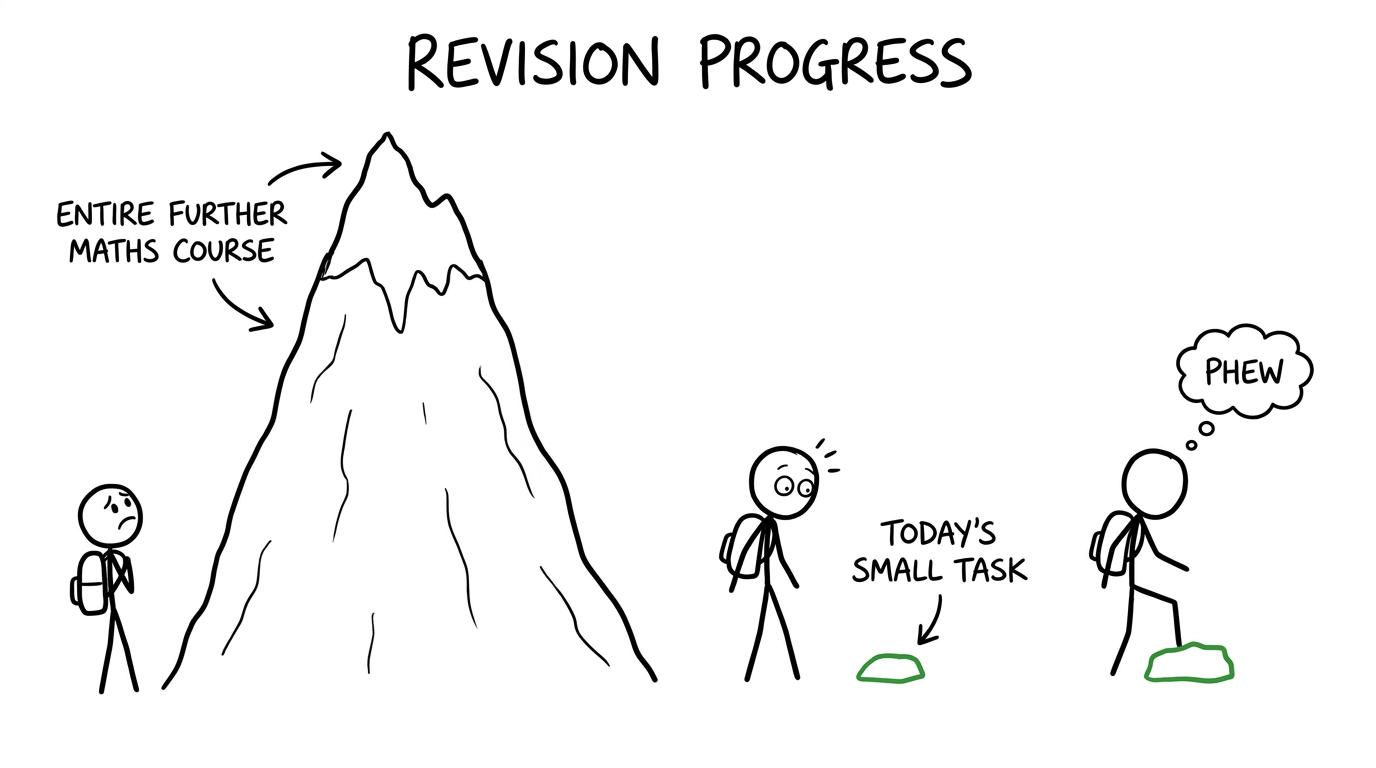 A student chooses one small revision step instead of the whole mountain
Prepare a short menu for different energy levels:
Low-energy task
Correct an old question, watch one short explanation or retrieve key facts for 101010 to 151515 minutes.
Normal task
Complete a focused question set, mark it and update your error log.
High-energy task
Attempt a mixed test or timed paper section, then review it carefully.
All three move revision forwards. The low-energy option prevents an imperfect week from becoming an abandoned month.
Match revision to the qualification you will sit
“GCSE Further Maths” is often used informally for different Level 2 qualifications, so confirm your board and specification with your school.
For example, AQA Level 2 Certificate in Further Mathematics is an additional, untiered qualification rather than a replacement for GCSE Mathematics. Its current specification assesses number, algebra, coordinate geometry, calculus, matrix transformations and geometry through a non-calculator paper and a calculator paper. Both can assess content from across the specification.
That matters for consistency. You cannot permanently leave one topic for “the other paper”. Your plan needs broad coverage, including non-calculator fluency.
Keep your underlying Higher GCSE skills secure too. Use the GCSE Maths revision hub to repair gaps in quadratics, surds, graphs, trigonometry or algebra before they slow down more advanced work. The GCSE topics by exam board and tier guide can help you distinguish core GCSE knowledge from extension content.
Make feedback visible
Students often measure consistency by hours completed. A better measure is whether yesterday’s weakness is becoming less costly.
Keep a compact fix list with three details:
- the exact skill;
- why the mark was lost;
- the next action.
A knowledge gap needs a revision lesson. A procedural mistake needs more focused questions. A misread instruction needs slower annotation. A timing problem needs short timed sets.
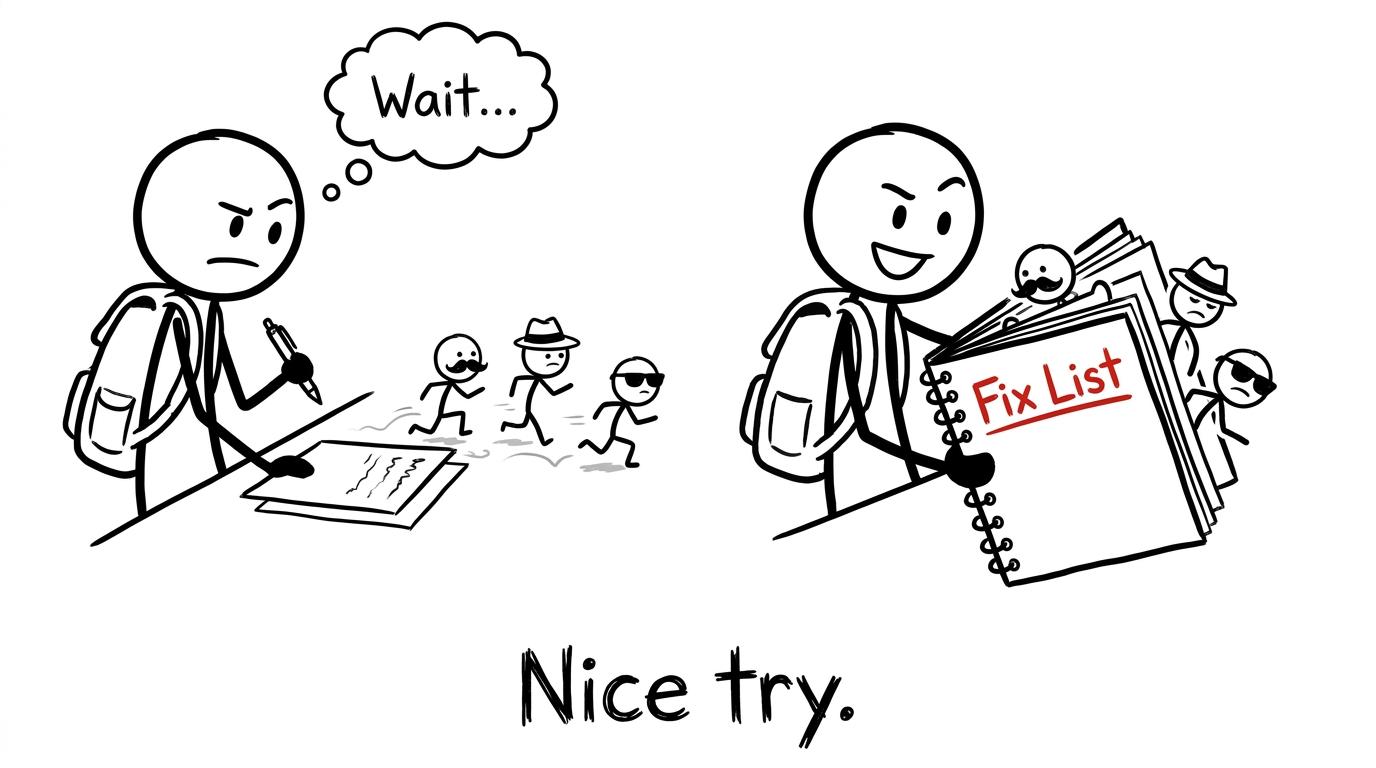 A student catches escaping mistakes in a fix list
Once topic questions become more secure, use GCSE mini tests for manageable mixed practice. As the exams approach, move towards the MathsGenie past-paper library, selecting papers that match your actual qualification.
Official past papers should be your main evidence of exam readiness. Predicted papers can provide fresh practice, but they supplement rather than replace official papers and mark schemes.
Common mistakes that break revision consistency
Making the plan too demanding
A timetable that requires perfect energy every evening will fail as soon as school becomes busy. Leave catch-up space and create a minimum version of each session.
Revising only favourite topics
Comfort can look like progress. Use mini tests, teacher feedback and marked papers to choose priorities rather than repeatedly practising what already feels safe.
Watching without practising
A video may make a method look clear, but understanding must survive when the explanation disappears. Follow revision lessons with questions completed independently.
Delaying the marking
Unmarked work cannot guide the next session. Mark promptly, identify the cause of each error and redo selected questions without copying the solution.
Treating one missed day as failure
Missing a session is a scheduling problem, not evidence that you lack discipline. Resume with the next small task. Do not attempt to punish yourself with an exhausting catch-up session.
Sacrificing sleep for extra hours
Teenagers need regular, sufficient sleep, and official exam-pressure guidance advises manageable targets, repeated testing and structured revision. A late-night marathon may reduce the quality of the following day’s work. Stop at a planned time and protect recovery.
Build a weekly reset
Once a week, spend 101010 minutes reviewing the system itself. Ask:
- Which sessions did I actually complete?
- Which topic is still costing marks?
- Did I practise actively or mostly consume explanations?
- What is the smallest useful target for next week?
- Do I need help from my teacher?
This is not a judgement. It is maintenance. Strong revision plans change when the evidence changes.
For fuller paper practice, follow the process in how to use GCSE past papers properly: attempt, mark, diagnose, relearn and retest. Avoid collecting paper scores without doing anything about the questions between them.
Consistency is returning, not being perfect
The students who stay consistent are not necessarily motivated every day. They simply have fewer decisions to make when motivation disappears. Their task is already chosen, the minimum is manageable, mistakes have somewhere to go, and a missed session does not become a reason to stop.
Start today with one small action. Open the AQA GCSE Further Maths revision hub, choose one relevant revision lesson and complete a short set of practice questions. Mark the work, add one correction to your fix list and schedule the skill again.
Then build gradually towards mini tests, official past papers and predicted papers. MathsGenie keeps the free revision lessons, practice questions, mark schemes, video solutions and paper practice together, so your energy can go into improving your maths rather than repeatedly deciding where to begin.










