

Staying Consistent With GCSE Bengali Revision
Staying consistent GCSE Bengali revision: build a low-motivation routine for language practice while protecting time for GCSE maths and other subjects.
Some weeks, revision feels almost automatic. On others, opening a Bengali vocabulary list seems unusually difficult, especially when maths homework, mocks and other GCSE subjects are competing for the same evening.
The real answer to staying consistent GCSE Bengali revision is not finding endless motivation. It is creating a routine small enough to survive when motivation disappears: choose a fixed cue, complete one short active task, check it and stop. On better days, you can do more. On difficult days, the minimum keeps the habit alive.
That matters because Bengali is not a subject you can revise effectively in one final burst. Vocabulary, script accuracy, listening, speaking and sentence construction improve through repeated contact. The same is true of maths. Consistency grows when both subjects have clear, manageable places in your week rather than fighting for whatever time remains.
Your low-motivation revision checklist
When energy is limited, use this stripped-back plan:
- Set a minimum session of 101010 minutes.
- Attach it to a reliable cue, such as arriving home or finishing dinner.
- Decide the exact task before the session begins.
- Retrieve from memory before looking at notes.
- Check your work immediately.
- Record the next action in one sentence.
- Keep Bengali and maths in separate, protected blocks.
- Never punish a missed session with an unrealistic catch-up marathon.
The aim is not to make every evening impressive. It is to make starting ordinary.
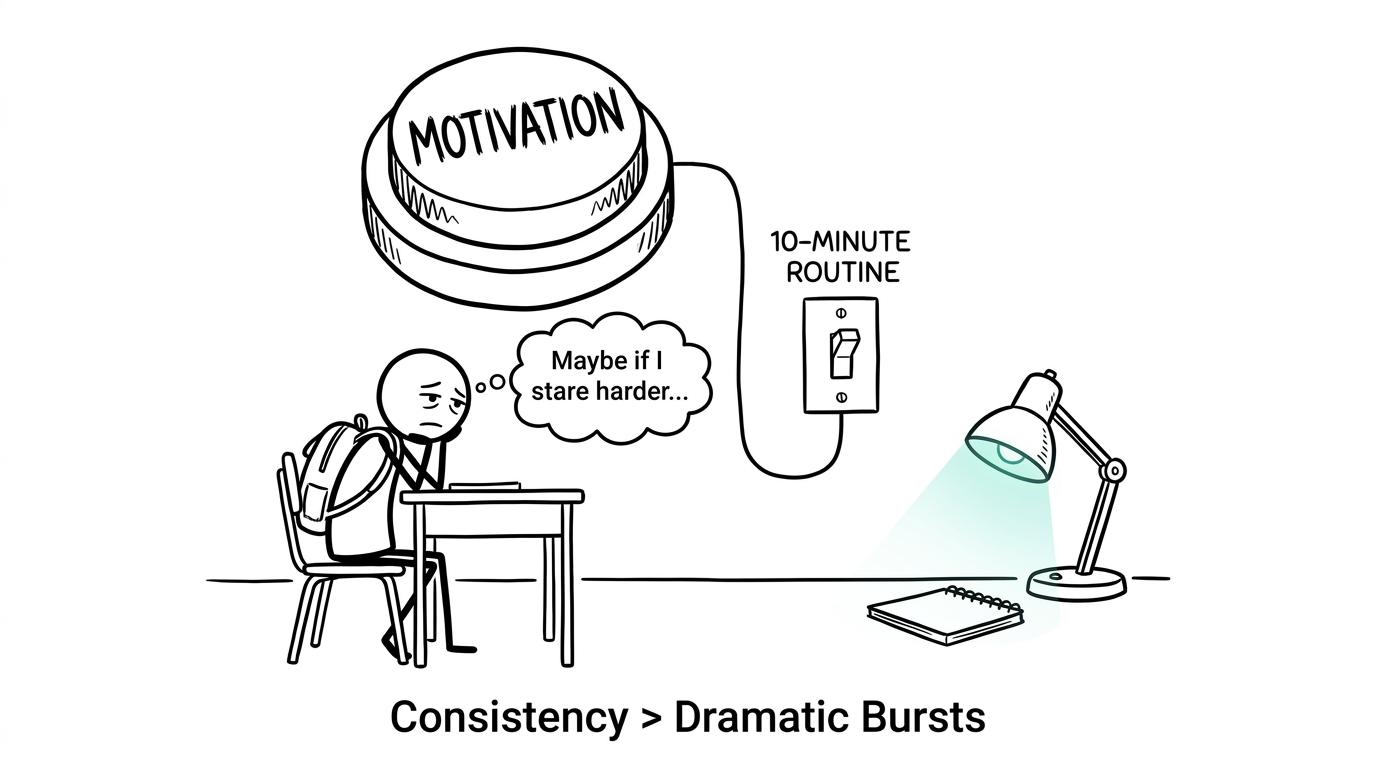 A student discovers that a small routine works when the motivation button does not
Build a routine that does not depend on mood
Motivation is useful, but it is unreliable. A routine removes the need to renegotiate with yourself each day.
Choose a cue that already happens. For example: after putting your school bag down, after a snack or immediately before your maths block. Then give the cue one precise response: open the Bengali folder and complete the task written on top.
“Revise Bengali” is too vague. It creates decisions at the exact moment when your energy is lowest. Better instructions include:
- recall vocabulary from one specification theme;
- listen to a short recording and note the main ideas;
- read one passage and identify unfamiliar language;
- record a spoken response to one prompt;
- plan one writing answer and check verb forms.
Prepare tomorrow's task at the end of today's session. This tiny decision makes the next start easier because you do not need to search through folders or wonder what counts as useful work.
Maths students can use the same principle. The GCSE maths revision hub organises free resources by exam board, making it easier to choose one lesson or question set before a session begins.
Set a minimum that still counts
A low-motivation routine needs a floor, not an ambitious ideal. Your minimum could be 101010 minutes or one clearly defined activity. It should feel almost too small on a good day and genuinely possible on a poor one.
A useful Bengali minimum might contain three actions:
- retrieve five items from memory;
- produce or understand one short response;
- check and correct the result.
This is not your maximum. If concentration returns, continue. If it does not, stop without guilt. You have still maintained contact with the language.
The same idea can protect maths revision. One short set from the Edexcel GCSE maths mini tests, followed by careful marking, is more useful than planning an enormous session that never starts. If your timetable repeatedly collapses under its own weight, use the principles in MathsGenie's realistic GCSE maths revision timetable to reduce it to something repeatable.
Match revision to the Bengali assessment
Consistency becomes easier when every task has a purpose. For the current AQA GCSE Bengali specification, students are assessed in listening, speaking, reading and writing. Each assessment objective contributes 25%25\%25% of the qualification. The course is linear, with assessments completed at the end of the course and at the same tier.
Foundation tier covers grades 111 to 555, while higher tier covers grades 444 to 999. Students take all four papers at the same tier. Always confirm your own entry and current specification with your school rather than assuming that a friend's arrangements apply to you.
A balanced week should therefore touch all four skills. That does not mean completing four long sessions. You might use short listening and vocabulary retrieval during the week, then complete a longer speaking or writing task at the weekend.
Keep the four skills visible
Use one page divided into listening, speaking, reading and writing. Record the date and one difficulty after each activity. If the speaking section has been untouched for two weeks, the page tells you what to do next.
This is more useful than tracking time alone. Spending an hour copying vocabulary may look productive, but it gives little evidence about whether you can retrieve that language or use it under assessment conditions.
Use retrieval and spacing rather than repeated rereading
Research reviews on learning support two especially useful approaches: retrieval practice and spaced practice. Retrieval means bringing information to mind without first looking at the answer. Spacing means returning to material on separate days instead of concentrating all exposure into one sitting.
For Bengali, close the vocabulary list before recalling words. Listen before reading a transcript. Attempt a sentence before checking your grammar notes. Say a response aloud before viewing your prepared version. The attempt may feel harder than rereading, but it also reveals what is genuinely available from memory.
Then revisit the material. A simple pattern is:
- first contact today;
- retrieval after 222 days;
- another check after 777 days;
- later use in a mixed task.
Treat mistakes as scheduling information. If a word, spelling or grammatical structure disappears from memory, it needs another retrieval opportunity. It does not need to become evidence that you are “bad at Bengali”.
Maths follows the same pattern. MathsGenie's guide to stopping maths content from being forgotten explains how spaced practice, questions and correction can replace passive rereading.
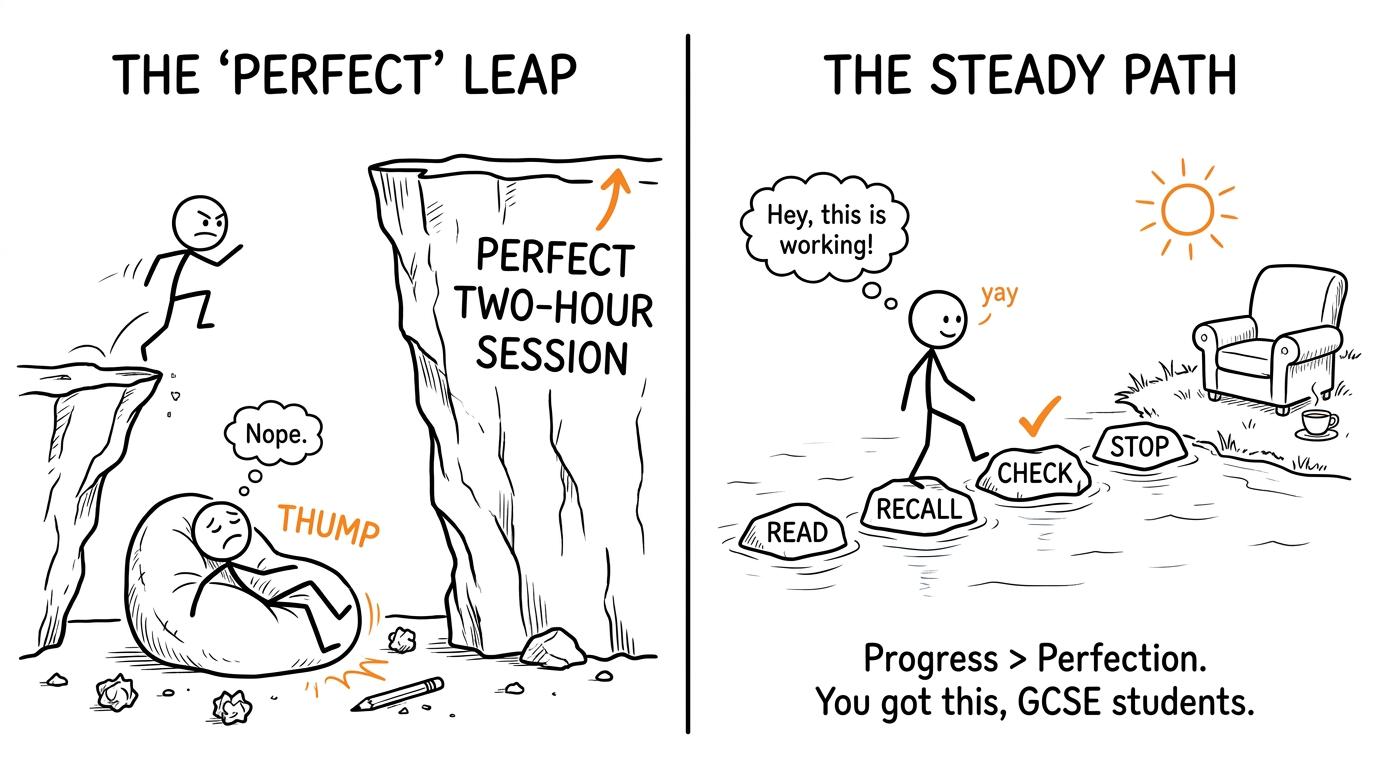 Small repeatable revision steps defeat the impossible perfect session
Create two versions of your weekly plan
A timetable often fails because it assumes every day will be calm. Create two versions instead.
The normal-week plan
This version can include several short Bengali sessions, a longer weekend task and scheduled GCSE maths practice. Give each block a clear outcome rather than writing only the subject name.
The difficult-week plan
This is your fallback when homework grows, sleep has been poor or motivation has dipped. Keep the same cues but reduce the size of each task. For example, replace a full writing task with planning its key ideas, or replace an extended listening activity with a short extract followed by recall.
Reducing a session is not the same as abandoning it. The difficult-week plan preserves the route back to normal work.
For maths, the one-week GCSE revision plan offers a structured approach when time is short. For a longer runway, the one-month maths revision plan shows how to combine retrieval, topic work and paper practice without treating every evening as an emergency.
Protect attention instead of testing willpower
A phone on the desk makes every quiet moment negotiable. Put it outside reach, use a timer and open only the material needed for the current task. This is not about becoming perfectly disciplined. It is about removing invitations to stop.
Keep Bengali and maths materials ready in separate folders or browser tabs. When one block finishes, take a short break before changing subject. A visible boundary helps prevent a difficult Bengali task from consuming the time reserved for maths, or vice versa.
You can also lower practical friction by keeping headphones, paper and your vocabulary list in one place. Consistency is often lost through small delays: finding a worksheet, locating a recording or deciding which topic to revise. Preparation removes those delays before tiredness can turn them into excuses.
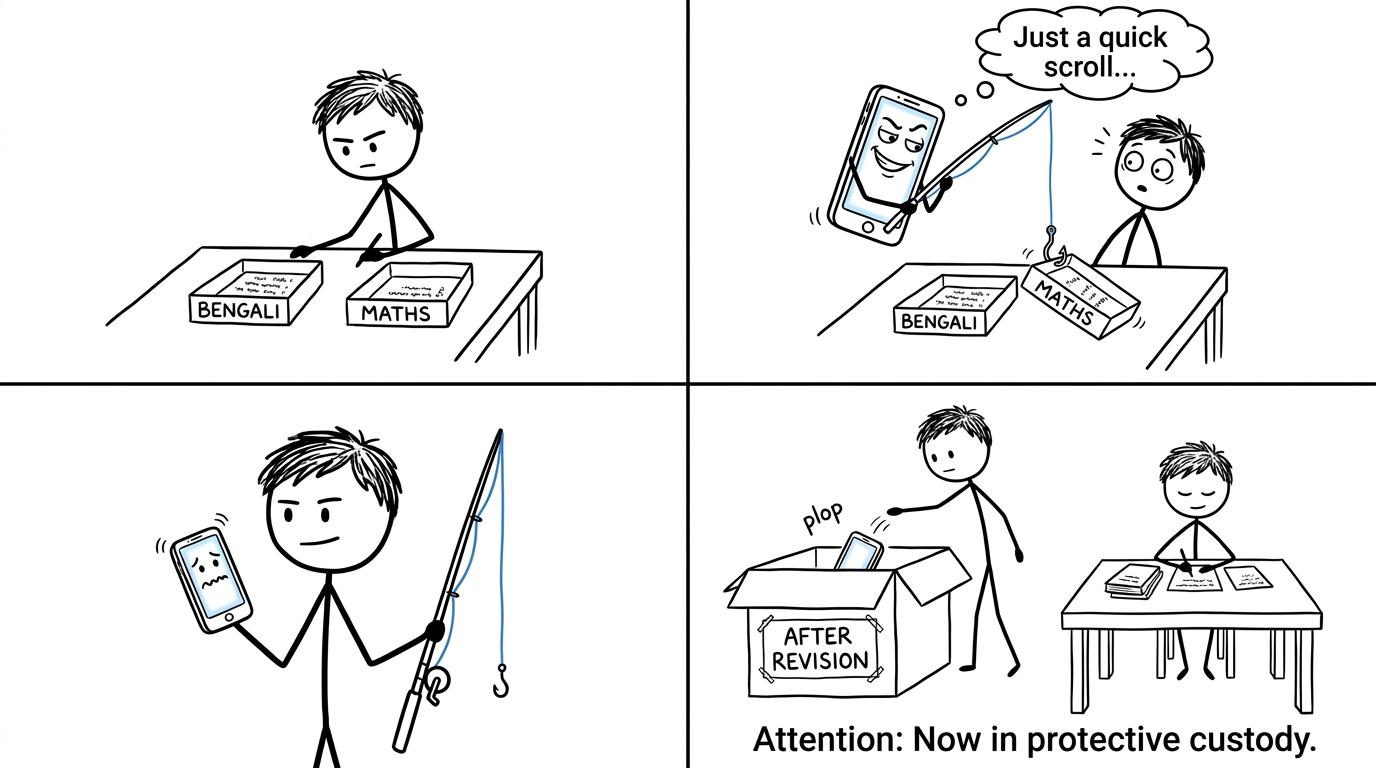 A student protects Bengali and maths revision from a phone with suspicious intentions
Let feedback choose the next session
A completed task is only useful if it changes what you do next. After Bengali practice, record one specific issue:
- vocabulary was not recalled;
- the main listening message was missed;
- an answer lacked tense variety;
- Bengali script was inaccurate;
- a speaking response stopped after one sentence;
- time was lost interpreting the question.
Then turn that issue into the next task. “Practise Bengali more” is not actionable. “Retrieve the missed travel vocabulary on Thursday” is.
Use the same feedback loop in maths: attempt, mark, diagnose, practise and retest. The guide to finding your weakest GCSE topics explains how evidence from questions can replace guesswork. When you are ready for longer maths assessment practice, use Edexcel GCSE maths past papers with the available mark schemes and worked solutions.
Common mistakes that break consistency
Waiting to feel motivated
Starting usually needs to come before enthusiasm. Use your cue and minimum task even when the session feels ordinary.
Making every session too large
If the plan only works on your best day, it is not yet a dependable plan. Keep a reduced version ready.
Revising only comfortable skills
Reading may feel easier than speaking, or vocabulary may feel safer than extended writing. Track all four assessment areas so neglected skills remain visible.
Copying instead of retrieving
Neat notes can hide weak recall. Close the resource, attempt the task, then check it.
Missing one day and abandoning the week
Do not convert one missed session into seven. Resume at the next planned cue. If you genuinely need to catch up, choose the most important task rather than stacking every missed activity into one evening.
Treating practice as proof of intelligence
An error is feedback about a particular word, skill or method. Correct it, schedule another attempt and move on.
Consistency is a system, not a feeling
On low-motivation weeks, the winning routine will probably look unimpressive: a short task, honest recall, immediate checking and a note for next time. That modest cycle is precisely why it survives.
Keep GCSE Bengali moving with balanced contact across listening, speaking, reading and writing. Protect maths with its own scheduled blocks, then let evidence decide what each session contains.
For free maths support, begin with the MathsGenie GCSE revision hub. Use revision lessons to rebuild weak methods, practice questions and mini tests for active recall, then progress to past papers and predicted papers. Mark everything carefully and use video solutions when a method remains unclear. You do not need a perfect week. You need a next session that is clear enough to begin.










