Spaced Repetition GCSE Art and Design: Simple Start
Spaced repetition GCSE art and design made simple: build a paper-based routine for artists, annotations and techniques while protecting maths revision time.
Revision feels straightforward when the subject has a list of facts. Art and Design is different. Your sketchbook contains experiments, decisions, artist research and half-formed ideas. Looking through it can feel productive without revealing what you can actually remember or apply.
Spaced repetition GCSE Art and Design revision offers a simple answer: revisit a small prompt after a gap, try to recall or perform it without looking, check what you missed, and schedule it again. You do not need a complicated app. A sheet of paper, a few prompt cards and roughly 101010 minutes can be enough.
This will not replace practical work or improve a portfolio by itself. Its value is narrower and more useful: it helps you retain artist connections, specialist vocabulary, process knowledge, annotation habits and your own creative intentions. For a student also preparing for maths exams, it creates a controlled routine rather than another endless revision task.
The simple checklist
Start with this stripped-back system:
- Choose five useful prompts from your current Art and Design project.
- Put each prompt on a small card or one-page tracker.
- Answer from memory before opening your sketchbook.
- Check your answer against your notes, teacher feedback or specification.
- Revisit the prompt after increasing gaps.
- Include short practical recalls, not only written questions.
- Stop after 101010 to 151515 minutes and return to making work or revising maths.
The important idea is not the exact timetable. It is the return. A memory becomes more dependable when you have to find it again after it has begun to fade.
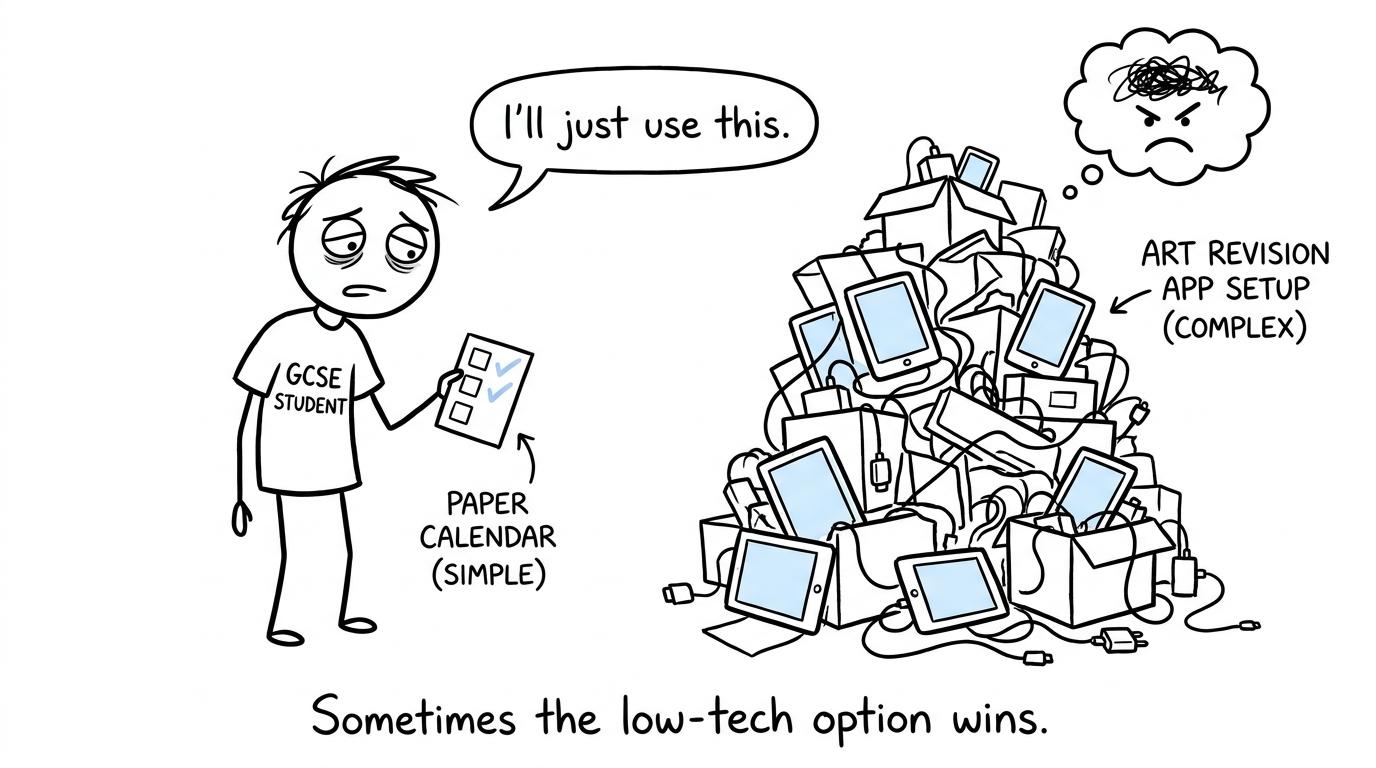 A student chooses a tiny paper revision calendar instead of a gigantic app setup
What spaced repetition means in Art and Design
Spaced repetition distributes encounters with the same material across time instead of compressing them into one long session. Retrieval practice adds another step: you attempt to bring the idea back without immediately rereading it.
Research reviews consistently support spacing as a useful way to strengthen long-term retention across many areas of learning. Retrieval practice also has strong general evidence, although its effect depends on what is being learnt and how the task is designed. Art should therefore not be treated like a vocabulary test. Remembering the definition of impasto is different from controlling thick paint purposefully.
Use spacing for the parts of art that benefit from memory and repeated attention:
- artist names, contexts and relevant features of their work;
- specialist terms for media, techniques and visual elements;
- safety requirements and process sequences;
- links between sources and your own intentions;
- teacher feedback that should influence your next decision;
- short technical routines that can be repeated practically;
- questions that make annotations more analytical.
Do not use it as a substitute for sustained investigation, experimentation or producing outcomes. The method should support your creative process, not reduce it to flashcards.
Build a paper system without an app
Take one sheet of paper and divide it into five columns:
- Prompt
- First attempt
- Next review
- What I missed
- Evidence in my sketchbook
Begin with five prompts. More cards can create the comforting appearance of organisation while quietly becoming another unfinished project.
Useful prompts might ask:
- What makes this source relevant to my intention?
- Which visual qualities have I borrowed, changed or rejected?
- What happened when I changed the material or scale?
- Which experiment should influence my next piece, and why?
- What does my teacher’s most recent feedback require me to do?
- Which specialist terms accurately describe this page?
On each review, cover the answer and respond aloud, in writing or through a tiny practical action. Then check. If the response is secure, move the card further ahead. If it is incomplete, correct it and bring it back sooner.
A perfectly optimised interval is unnecessary. A manageable starting rhythm is:
- first return: the following day;
- second return: around three days later;
- third return: roughly one week later;
- later returns: weekly until the idea is secure or no longer relevant.
Treat this as a flexible starting structure, not a scientific promise that one schedule suits every learner. Research does not establish one universally superior pattern of expanding intervals. Your project deadlines, teacher guidance and memory should shape the gaps.
Connect the routine to the assessment objectives
Across GCSE Art and Design specifications, the four national assessment objectives are equally weighted at 25%25\%25% each. The wording centres on developing ideas, refining work, recording observations and presenting a personal response. Exam boards such as AQA, Edexcel, OCR and Eduqas build their specifications around these common objectives, although component details and marking arrangements can differ.
Always follow your own board’s current specification and your teacher’s instructions. For revision purposes, you can organise prompts under the four objectives.
AO1: developing ideas
Recall connections rather than isolated biographies. Ask how a source informs your colours, composition, subject, process or meaning. A useful response explains influence and choice. Simply remembering an artist’s date of birth rarely moves a project forward.
AO2: refining work
Revisit techniques and experiments. Recall which materials you tested, what changed and why one route is more suitable. Some reviews can be practical: repeat a small mark-making, editing or construction exercise, then compare it with the earlier attempt.
AO3: recording ideas and observations
Use prompts that improve looking and annotation. Recall the vocabulary needed to discuss tone, texture, line, form, contrast, scale or composition. Then apply it to your own evidence rather than producing a memorised paragraph.
AO4: presenting a personal response
Return regularly to your intention. Can you state what you want the final response to communicate? Can you explain how earlier investigation, refinement and recording lead towards it? This prevents the final outcome from becoming detached from the journey documented in your portfolio.
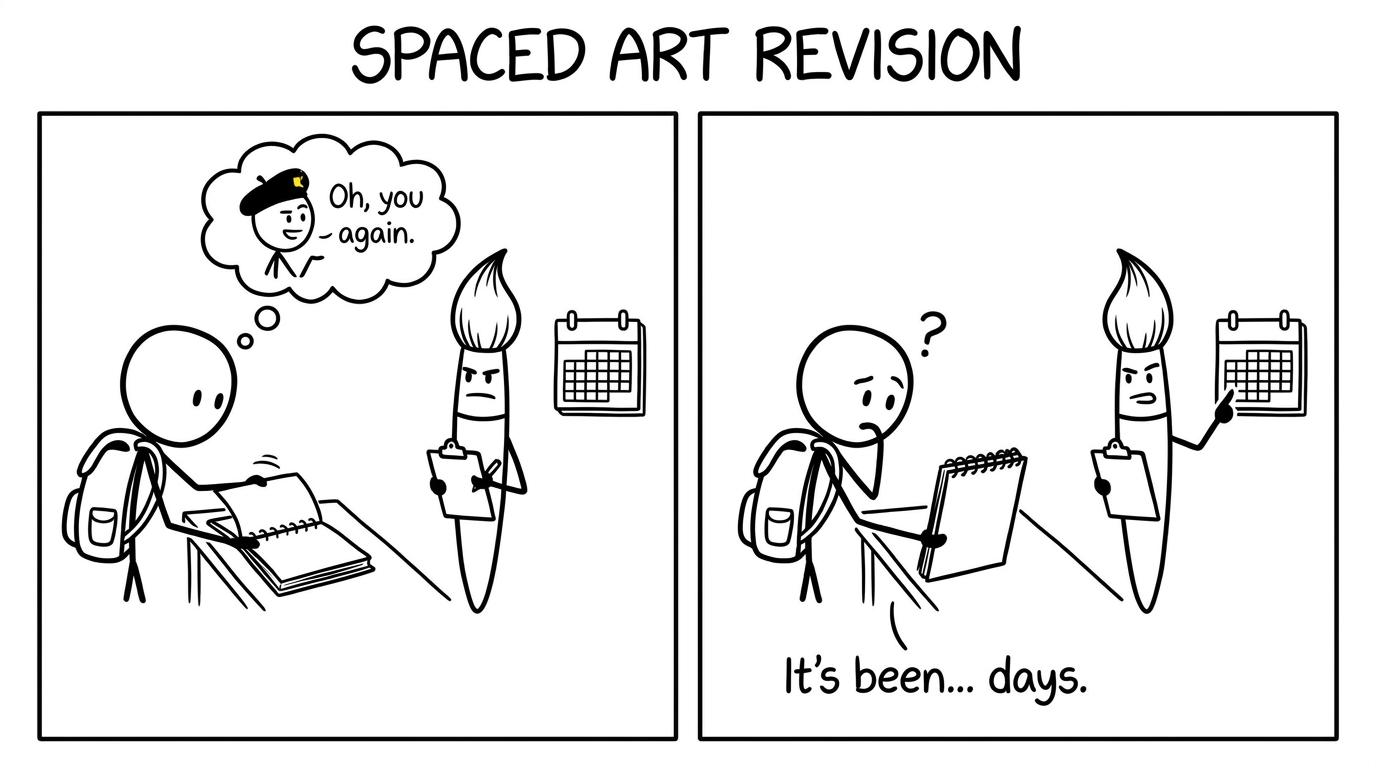 A tiny memory in a beret recognises a student reopening a sketchbook
Make retrieval visual and practical
A written question is only one form of retrieval. Art students can use several formats:
- Thumbnail recall: redraw the broad composition of your planned outcome without looking.
- Process recall: list the order of a technique, including preparation and safe working.
- Visual comparison: name three meaningful differences between two sources from memory.
- Intention recall: explain your project direction in two clear sentences.
- Vocabulary recall: choose an accurate term, then point to visible evidence of it.
- Feedback recall: close the sketchbook and state the next change your teacher requested.
After recalling, check the source. Feedback matters because confidently retrieving an inaccurate description merely strengthens the wrong idea. Correct the response immediately and try it again later.
Keep these tasks small. A thumbnail is not a replacement final piece, and a technical recall should not consume the time needed for sustained making.
Protect your GCSE maths revision time
Art coursework can expand to fill every available evening. Maths can do the same. A small spaced routine gives each subject a boundary.
One practical weekly pattern is to alternate brief Art and Design retrieval with focused maths practice. Start maths from the GCSE Maths revision hub, where you can choose resources for your board and tier. Use a revision lesson to rebuild one weak method, then answer questions without copying the solution.
The same learning principle applies: return to material rather than assuming one successful attempt means it is secure. The MathsGenie guide to turning notes into active recall explains how to convert passive notes into prompts, while the GCSE twenty-minute maths routine offers a compact structure for busy school days.
Use Edexcel GCSE Maths mini tests when you need short retrieval practice. If you are unsure which content belongs to your board or tier, check the GCSE maths topics by exam board and tier before building your plan.
The goal is not to make Art and Design behave like maths. It is to give both subjects a repeatable rhythm: recall, check, correct and return.
A low-effort weekly routine
Choose three fixed moments during the week. Keep each Art and Design review to around 101010 minutes.
At the first session, recall two artist or context connections and one current intention. At the second, retrieve a process and complete a tiny practical check. At the third, review teacher feedback and identify the next piece of portfolio evidence you need.
Follow this with maths practice on a clearly named topic. As examinations approach, use GCSE past-paper timing guidance to decide when to move from topic questions into longer papers. GCSE predicted papers are most useful later, after your core methods and weaker topics have been addressed.
If a week becomes crowded, reduce the number of prompts rather than abandoning the routine. A small system that survives is more valuable than an ambitious one used twice.
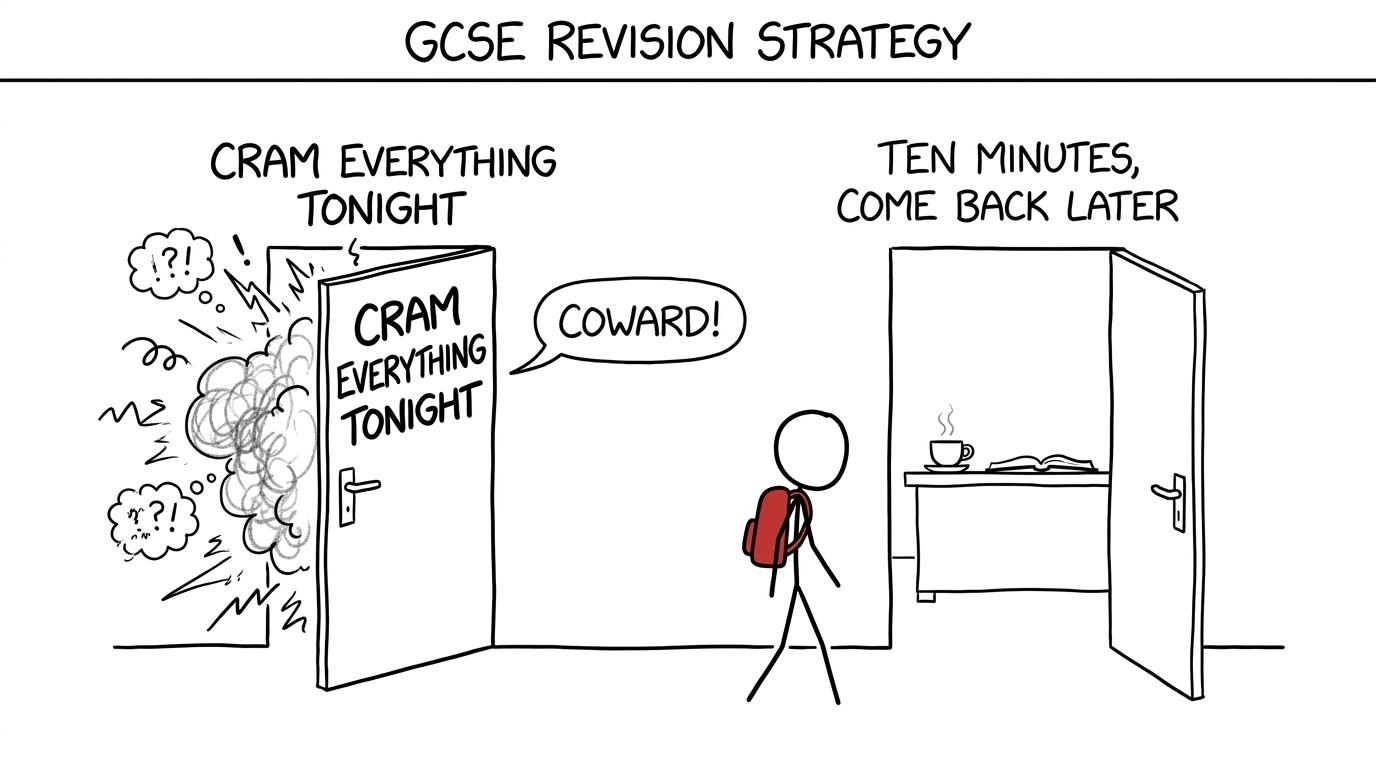 A student chooses calm ten-minute revision over a chaotic cramming room
Common mistakes with spaced Art and Design revision
Making too many cards
A card for every sentence in your sketchbook creates maintenance rather than learning. Select prompts that improve decisions, vocabulary, technical control or links between sources and intentions.
Rereading before attempting recall
Looking first removes the useful challenge. Cover the answer, make a genuine attempt, and only then check.
Memorising generic annotations
Examiners assess the evidence in your own project. Stock phrases can sound analytical while saying nothing specific. Recall a structure for analysis, but connect every response to visible choices and personal intentions.
Reviewing knowledge but avoiding practical work
Art and Design is practical and developmental. Use retrieval to prepare the next action, then make, test, photograph, annotate or refine something.
Ignoring feedback
A repeated answer is not automatically a correct one. Check prompts against trusted notes, current specification material and teacher feedback.
Letting Art consume every revision session
Portfolio work can always be adjusted once more. Set an endpoint, then switch subjects. In maths, mark practice carefully and revisit errors; the guide to using Edexcel past papers properly shows how corrections can become later retrieval tasks.
Start small and let the habit become useful
Spaced repetition for GCSE Art and Design should feel almost unimpressive at first: five prompts, one sheet of paper and a short return later in the week. That simplicity is its advantage. It keeps important ideas available without turning revision into an app-management project.
Choose prompts that support your assessment objectives, combine memory with practical action, and let teacher feedback guide what returns next. Then protect time for your other GCSEs.
For maths, make MathsGenie’s free GCSE revision resources your next stop. Begin with a revision lesson, strengthen the method with practice questions, check your work using mark schemes and video solutions, then revisit weaknesses through mini tests, past papers and predicted papers. Small returns add up, in a sketchbook and on an exam paper.