

Sleep Before GCSE English Language Exam: How Much?
Sleep before GCSE English Language exam: learn how many hours teenagers need, why rest supports memory and focus, and what to do the night before.
The temptation arrives late in the evening. One more practice question. One more page of notes. One more hour that feels productive because you are still awake.
But the best target for sleep before GCSE English Language exam day is usually eight to ten hours. That is the recommended regular range for teenagers aged thirteen to eighteen, although individual needs vary. If you know you function best with nine hours, aim for nine rather than treating eight as a challenge to beat.
Sleep cannot replace revision. It helps you use the revision you have already done by supporting memory, sustained attention and emotional control. Those abilities matter when you must read unfamiliar texts carefully, interpret language, select evidence and write clearly under time pressure.
The quick night-before checklist
If your exam is tomorrow, keep the plan simple:
- Work backwards from the time you need to wake up and allow eight to ten hours for sleep.
- Finish demanding revision at least an hour before bed where possible.
- Complete one short, focused review rather than a full paper.
- Check the paper, start time and equipment required by your school.
- Pack black pens, water and anything else you are permitted to take.
- Put your phone away and follow a familiar wind-down routine.
- If sleep does not come immediately, do not assume the exam is ruined.
The goal is not to manufacture a perfect night. It is to give your brain a fair chance to arrive rested.
How much sleep do GCSE students actually need?
Authoritative sleep guidance commonly recommends eight to ten hours per twenty-four hours for teenagers aged thirteen to eighteen. This is a regular-health recommendation rather than a special exam-night formula.
There is no evidence-based rule saying every student must have exactly nine hours before English Language. Sleep needs differ, and sleep quality matters alongside duration. The more useful question is: how much sleep normally leaves you alert without repeatedly needing to catch up at weekends?
Exam night is also a poor time to impose a dramatic new bedtime. Going to bed several hours earlier than usual may leave you staring at the ceiling and worrying about being awake. A steadier approach is to protect enough time for sleep and use a calm routine that your body recognises.
Revision habits across the whole exam season matter too. A realistic GCSE maths revision timetable leaves space for rest instead of treating sleep as whatever remains after every subject has taken its share.
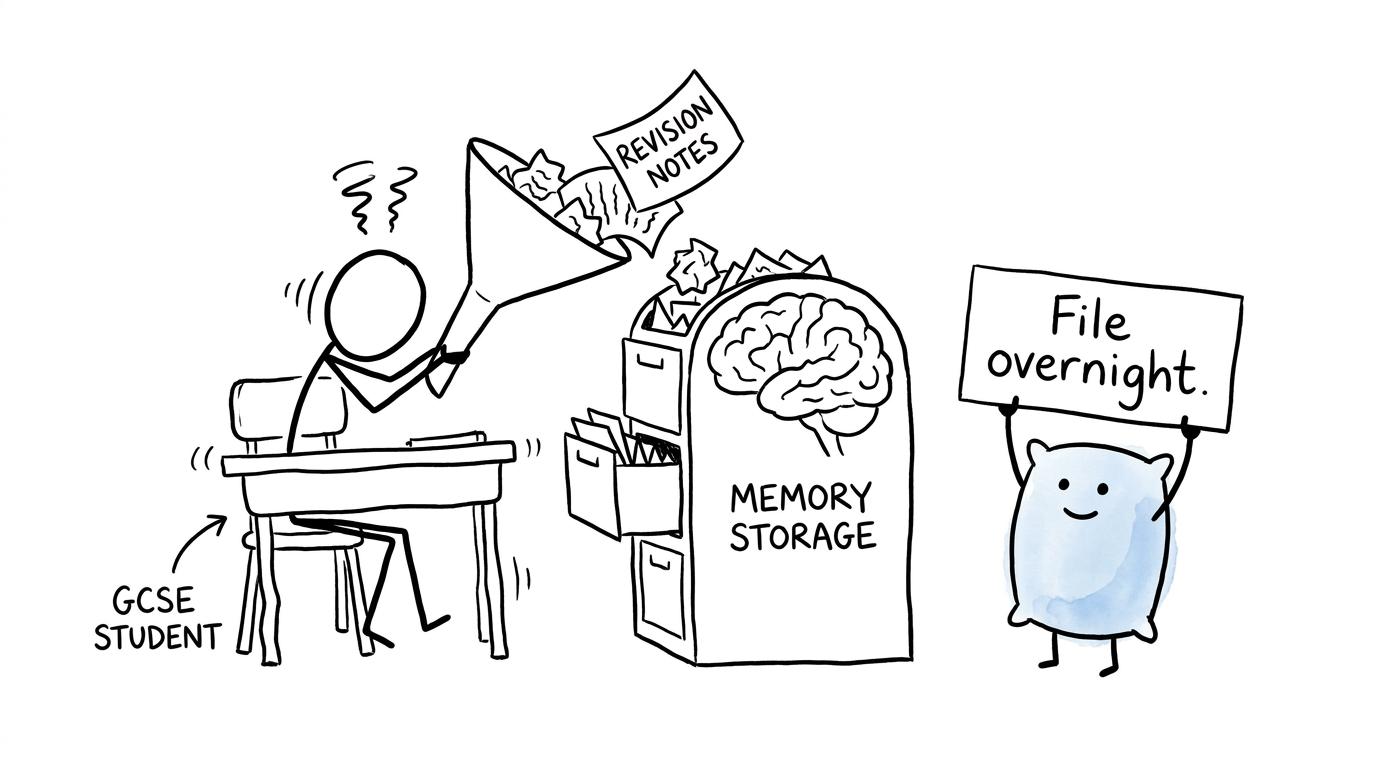 A tired student's brain files revision notes overnight
What sleep does for memory
Revision begins the learning process, but newly learned information is not instantly fixed in a permanent mental archive. During sleep, the brain continues processing and stabilising memories. Researchers call this memory consolidation.
For GCSE English Language, that does not mean sleep will secretly write an analytical paragraph for you. It means rest can support your ability to retain and retrieve things you have already practised, such as:
- the purpose of different reading questions;
- ways to analyse language and structure;
- how to compare writers’ ideas and perspectives;
- useful organisational patterns for extended writing;
- spelling, punctuation and vocabulary you have been developing;
- your planned approach to timing.
Research on sleep and learning generally finds that sleep supports memory consolidation. Evidence involving adolescents also links sleep after learning with stronger memory, although the size of the effect varies between tasks and individuals. Sleep should therefore be understood as part of learning, not as a guaranteed mark-boosting trick.
The night-before trade-off is important. An extra hour of rereading may expose you to more material, but reducing sleep can make it harder to retrieve and apply what you already know. English Language rewards application to unseen material. Alert reading is often more valuable than collecting one last page of notes.
Why sleep matters for focus in English Language
GCSE English Language specifications differ across AQA, Edexcel, OCR and Eduqas, so always follow your own exam board and teacher’s guidance. Across the qualifications, however, students need to read with understanding, interpret information, analyse writers’ choices and communicate effectively.
These are attention-heavy tasks.
Careful reading
A tired reader may reach the bottom of a paragraph without fully processing it. In an exam, that can lead to missed contrasts, overlooked evidence or an answer aimed at the wrong part of the text.
Working memory
Working memory holds information temporarily while you use it. In English Language, you rely on it when connecting a quotation to an interpretation, keeping the question in mind while planning a paragraph, or comparing details across sources. Sleep restriction and poor-quality sleep can make this mental juggling feel harder.
Sustained attention
The paper demands concentration over an extended period. You must repeatedly switch between reading, selecting, planning, writing and checking. Sleep deprivation has particularly consistent effects on vigilance, the ability to stay attentive and respond accurately over time.
Emotional control
Exam anxiety can make small difficulties feel enormous. Adequate sleep does not remove nerves, but sleep supports emotional regulation. A rested student may be better placed to pause, reread the question and continue rather than interpreting one difficult extract as proof that the whole paper has gone wrong.
This applies to maths as well. A missed instruction or premature calculation can cost marks even when you understand the method. MathsGenie’s GCSE Maths revision hub helps you prepare with revision lessons and practice questions before exam night, when attention is better spent winding down.
A sensible revision plan for the evening
The best night-before session has a finish line. Without one, revision expands until bedtime becomes negotiable.
Early evening: brief active review
Choose a small number of high-value tasks. You might review your exam structure, recall what each command word requires, plan one writing response without completing it, or check a short answer against a mark scheme.
Active recall is usually more revealing than passive rereading. Close the notes and explain the approach from memory. Then check the gap. This is the same principle behind MathsGenie’s twenty-minute revision routine: attempt, check, correct and stop.
One hour before bed: close the academic loop
Write down anything you are worried you will forget, then put the list away. Pack your bag, check your alarm and prepare what you need for the morning. These small actions reduce the number of unfinished decisions following you into bed.
Avoid beginning a complete timed paper late at night. Full papers are valuable earlier in revision, when you can mark them and repair weaknesses. Maths students can use Edexcel GCSE Maths past papers and GCSE predicted papers in planned sessions rather than sacrificing sleep to finish them.
At bedtime: make sleep easier, not compulsory
Keep the room quiet, dark and comfortably cool where possible. Reduce stimulating screen use and avoid caffeinated drinks late in the day. A calm non-screen activity, such as reading something undemanding or listening to quiet audio, can help create a transition.
Do not keep checking the clock. Trying to force sleep often increases frustration. If you remain awake for a while, rest calmly; one imperfect night does not erase months of learning.
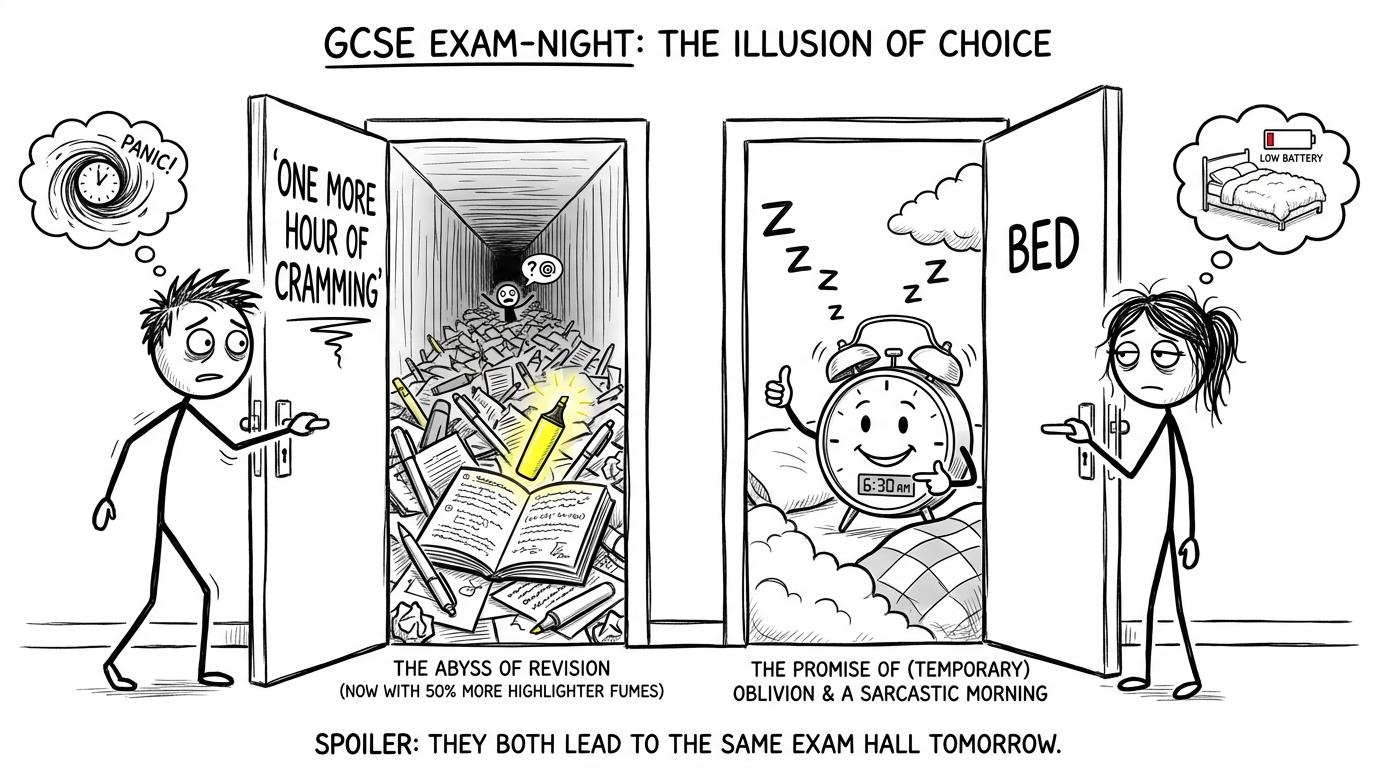 A student chooses between endless cramming and bedtime
What to do if you slept badly
Waking after a poor night can produce a second problem: panic about the consequences. Do not spend the morning predicting your grade from the number of hours you slept.
Instead:
- get up at the planned time;
- seek some morning daylight;
- eat a familiar breakfast if you normally do;
- drink water normally rather than excessively;
- keep any final review short and familiar;
- arrive with enough time to settle;
- read every question carefully before committing to an answer.
Avoid trying to compensate with an unusually large amount of caffeine, especially if it makes you shaky or anxious. During the paper, use deliberate checkpoints: return to the wording of the question, select evidence precisely and leave time to check your writing.
A single difficult night does not automatically determine performance. If poor sleep is frequent, lasts for weeks or affects daily life, speak to a parent, carer, GP or another appropriate health professional rather than trying to solve it only during exam season.
Common mistakes before an English Language exam
Trading several hours of sleep for cramming
Late revision feels visible; sleep does not. That makes cramming psychologically attractive. Yet English Language requires attention and flexible application, not simply the possession of more notes.
Attempting an entire paper too late
A full paper creates more work: marking, reviewing errors and deciding what to fix. Use complete papers earlier. On tired evenings, shorter tasks are more manageable. The principle is reflected in MathsGenie’s GCSE Maths mini tests, which provide focused practice without turning every session into a marathon.
Changing the routine dramatically
Going to bed extremely early, taking a long evening nap or sleeping far into the morning can disrupt a familiar rhythm. Consistency is generally more helpful than an exam-night experiment.
Using screens as a wind-down while continuing to revise
A video can quietly become messages, notifications and another hour awake. Decide when revision ends and move the phone away from the bed if possible.
Believing one bad night means failure
This thought adds anxiety without improving the situation. Return to controllable actions: breakfast, equipment, arrival time and careful reading.
 The exam-morning revision notes demand an unnecessary sequel
Protect sleep across the whole exam season
The larger lesson is not about one night. Memory, focus and confidence are built through repeated cycles of learning, practice, feedback and rest.
For maths, that means using revision lessons and exam questions, checking work with mark schemes and video solutions, then returning to mistakes on another day. The GCSE one-month revision plan can help distribute practice so that the final evening is a review rather than a rescue attempt.
Aim for eight to ten hours of sleep before your GCSE English Language exam, adjusted to what normally helps you feel rested. Stop intensive revision early enough to wind down, trust the preparation already completed and treat sleep as part of exam preparation.
Then apply the same calm structure to your next maths paper. Visit MathsGenie for free revision lessons, practice questions, mini tests, past papers, predicted papers, mark schemes and video solutions and build a plan that improves your grades without asking sleep to pay the bill.










