

A Six-Week GCSE Maths Revision Plan That Fits Your Life
A six-week GCSE maths revision plan with topic triage, weekly practice, past papers and rest days. Build a realistic schedule and adjust when you fall behind.

Six weeks can feel awkwardly short when your revision list still says “algebra”. A six-week GCSE maths revision plan makes that list manageable: identify your weakest topics, practise them in short sessions, then gradually spend more time on exam papers. Keep a rest day and a catch-up slot each week so the timetable survives ordinary life.
Imagine you are opening your exercise book after school, unsure where to begin. Your first job is to find the next useful task. This plan gives you that starting point, then shows how to adjust it as your confidence changes.
Start with topic triage
Before filling your GCSE maths revision timetable, check your exam board, foundation or higher tier, and exam dates. Choose resources that match your specification, whether you take Edexcel, AQA, OCR or Eduqas.
Use a recent marked assessment or attempt a selection of questions from GCSE past papers. Sort the topics into three groups:
- Secure: you can answer unfamiliar questions independently.
- Uncertain: you recognise the method but need prompts or make mistakes.
- Priority: you cannot yet start reliably.
Judge these groups through questions, rather than how familiar a video feels. Record specific gaps, such as “forming equations from word problems”, rather than broad labels such as “algebra”.
Choose a small number of priorities for the first week. Include skills that support other topics, such as fractions, negative numbers and rearranging equations. Ask your teacher which gaps are most useful to tackle for your current level and target grade.
Your six-week GCSE maths revision plan
The balance changes across the six weeks: targeted practice comes first, followed by more mixed questions and timed papers. Marking and revisiting mistakes belong in every week.
| Week | Main focus | What to put in your schedule |
|---|---|---|
| One | Diagnose and repair foundations | Review an assessment, identify gaps and practise a few priority skills. |
| Two | Strengthen weak topics | Continue targeted questions and revisit topics from the first week without notes. |
| Three | Connect your knowledge | Mix topics, attempt exam questions and complete a timed section or mini test. |
| Four | Practise complete papers | Attempt a full paper under its stated conditions, then use the marking to choose repair sessions. |
| Five | Refine exam performance | Practise another paper, review timing and revisit repeated errors. |
| Six | Consolidate before exams | Review your error log, practise selected questions and keep the final evening light. |
This is a flexible structure. If you already know most methods but struggle with timing, introduce timed work earlier. If a paper reveals several foundational gaps, protect time to repair them before attempting another.
Build your six-week schedule in the Revision Planner if you want somewhere to organise this structure around your available revision time.
Give each week a realistic rhythm
Suppose your week already includes homework, other GCSE subjects and an evening commitment. A timetable that ignores them will quickly become a source of guilt.
Start with four focused maths sessions, one flexible catch-up slot and one protected day without additional maths revision. Leave the remaining day available for other subjects or ordinary commitments. Sessions of around half an hour are a reasonable starting point; allow longer when completing a full paper, following the duration printed on it.
For a topic session, use this sequence:
- Attempt a few questions from a previous session without notes.
- Work on one specific weakness, using a revision lesson if needed.
- Answer fresh practice questions independently.
- Mark them and record the next action.
For example, “revisit percentage change on Thursday” is useful. “Do more revision” leaves you making the same decision again tomorrow.
Return to topics after a gap, then include them in mixed practice. This gives you opportunities to retrieve methods and decide which one a question needs. The broader GCSE maths revision timetable guide can help you fit that routine around the rest of your week.
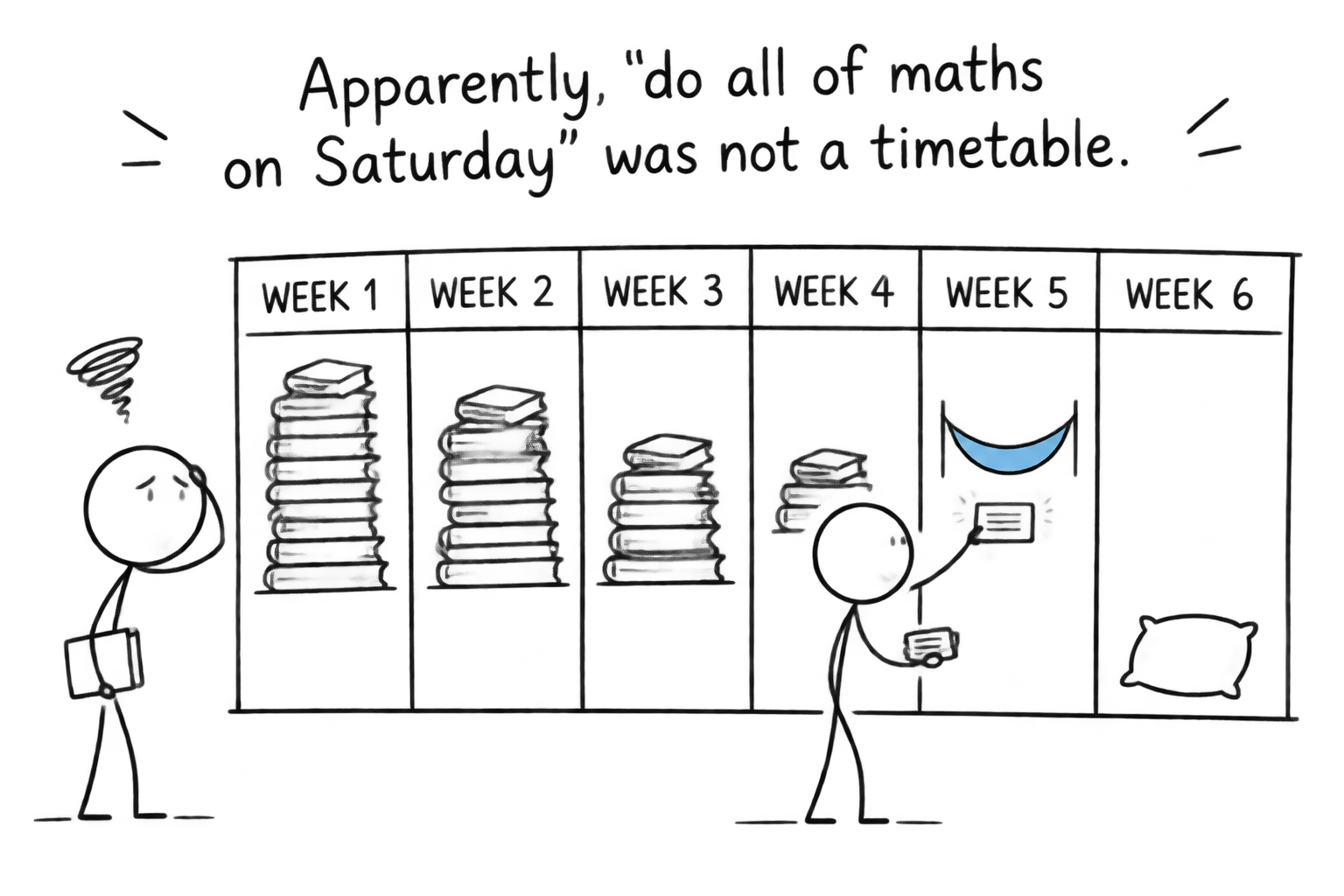 Stick figures discover that spreading revision across six weeks works better than putting everything on Saturday
Make past papers change your next session
Past papers provide evidence about what to practise next. You can use selected questions early, even before you feel ready for a complete paper. The guide to when to start GCSE past papers explores that progression.
For timed attempts, use your board and tier, follow the calculator instructions and keep notes out of reach. Afterwards, mark carefully using the mark scheme. Where MathsGenie provides video solutions, use them to understand a method you could not reconstruct yourself.
Keep a short error log with three details: the topic, what went wrong and your next action. Distinguish a missing method from an arithmetic slip or a misread instruction, because each needs a different response.
Then close the solution and retry the question independently. Later, attempt a different question testing the same skill. Reading a correction is only the beginning of checking whether you can use it.
MathsGenie’s topic mini tests offer shorter practice opportunities for Edexcel students. Predicted papers can provide additional practice when available, but cannot guarantee exam content. Keep your revision broad.
Adjust when you fall behind
Imagine Wednesday’s session disappears because another subject takes longer than expected. Move the most useful unfinished task into your catch-up slot. Keep the rest of the week intact.
If you repeatedly miss sessions, reduce the workload. Preserve the cycle of answering, marking and revisiting questions, even if you cover fewer topics. Cut repeated practice on secure skills before removing feedback or rest.
If a whole week slips, triage again using your latest work. Carry forward the highest-priority gaps and drop lower-value tasks. The one-month GCSE maths revision plan offers a shorter structure if your remaining time changes substantially.
Common mistakes to avoid
Planning every spare minute. Leave room for homework, tired evenings and marking. A full paper needs a separate review session.
Watching without attempting. Pause revision lessons and answer questions yourself. Understanding an explanation and producing a solution are different demands.
Chasing a paper score without reviewing it. A score shows performance on that paper; your errors tell you what to do next.
Sacrificing every rest day. A sustainable GCSE revision plan needs space to recover. Repeated overload is a reason to change the timetable.
Turn the next six weeks into a schedule
You now have a structure for choosing topics, practising exam papers and recovering when a session slips. The next step is giving those tasks a realistic place in your week, so each revision session has a clear starting point. Build your six-week GCSE maths revision schedule in the Revision Planner.















