Should I Take GCSE Geography? Honest Questions
Should I take GCSE Geography? Ask honest questions about content, fieldwork, writing, data skills, workload and whether the subject genuinely suits you.
Choosing GCSE options can feel strangely permanent. A timetable box looks small, yet you know you may spend two years inside it. Friends have opinions. Teachers see strengths you may not recognise. Meanwhile, every subject seems to promise useful skills and an interesting future.
So, should I take GCSE Geography? The short answer is yes if you are curious about places, people and physical environments, and you are willing to combine factual knowledge with data interpretation, fieldwork and extended writing. It may not suit you if you dislike explaining ideas with evidence or are choosing it only because friends say it is easy.
The best decision comes from asking better questions before the timetable is fixed.
A quick GCSE Geography decision checklist
Before choosing, ask yourself:
- Do physical processes and human issues genuinely interest me?
- Am I prepared to learn named examples and apply them to unfamiliar material?
- Can I interpret maps, photographs, graphs and numerical data?
- Am I willing to improve my longer written answers?
- How does my school organise fieldwork and assessment?
- Does Geography fit sensibly beside my other GCSE choices?
- Would I still choose it if none of my friends did?
You do not need to answer yes to everything. GCSE subjects are meant to develop skills, not merely confirm the ones you already have. But your answers should reveal whether Geography feels like a challenge worth accepting or simply the least uncomfortable option.
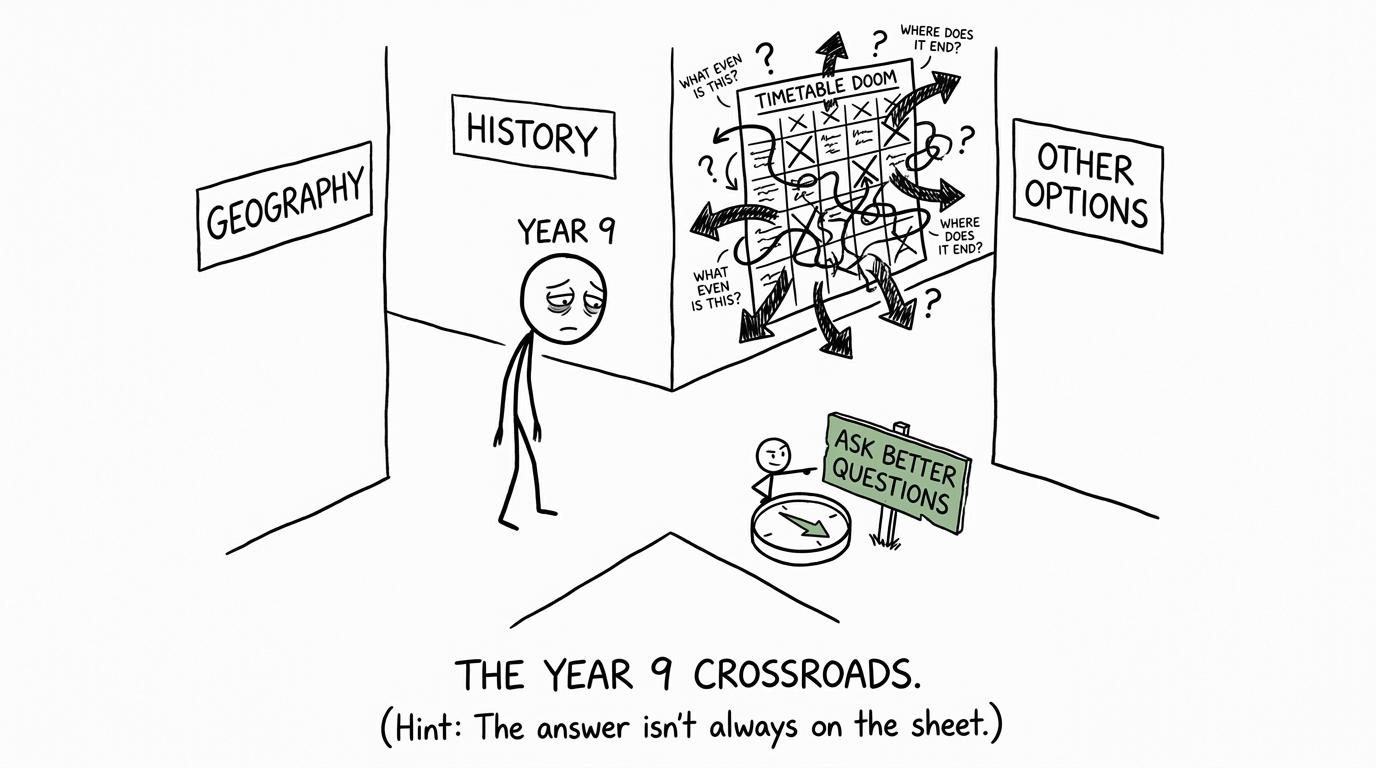 A student choosing between GCSE option corridors with a compass pointing towards better questions
Do you enjoy the real subject, not just the idea of it?
Geography is sometimes reduced to capitals, flags and colouring maps. That is not an accurate picture of the GCSE.
Current specifications cover physical and human geography, places, environmental interactions, geographical skills and fieldwork. Depending on your exam board and specification, you might examine hazards, landscapes, ecosystems, cities, economic change, resources and environmental challenges. You will also interpret maps, photographs, statistics and unfamiliar sources.
Edexcel, AQA, OCR and Eduqas organise their courses and papers differently. Even schools using the same exam board may select different optional topics or case studies. Ask your Geography teacher for the specification name, topics taught and recent assessment materials rather than relying on somebody else’s experience.
A useful test is to separate curiosity from preference. You do not have to enjoy every topic. Few students do. But do you often wonder why settlements grow, why coastlines change, why hazards affect places differently or how decisions create winners and losers? That curiosity matters because Geography regularly asks you to connect processes rather than repeat isolated facts.
Are you comfortable using evidence in different forms?
A Geography paper can move quickly between a map, a graph, a photograph, a short calculation and an extended response. That variety attracts some students and frustrates others.
The official subject content includes qualitative and quantitative data, maps, geographical information systems, numerical information and statistical techniques. You may need to identify a trend, quote evidence, recognise an anomaly and explain the geographical reason behind it.
This is where maths and Geography quietly overlap. Skills involving percentages, ratio, averages, scale, units, graphs and sampling can support both subjects. If map distance is a concern, MathsGenie’s scale drawings revision resources can strengthen the underlying proportional reasoning. If relationships between two variables feel uncertain, revisit the scatter graphs revision guide.
Maths confidence is useful, but Geography is not another maths GCSE. Numerical questions sit alongside interpretation and explanation. Being able to calculate something is only part of the task; you must often say what the result suggests and whether the evidence is reliable.
The GCSE Geography statistical skills guide shows the mixture clearly: averages, spread, percentage change, relationships, data presentation and evaluation all become tools for geographical reasoning.
Are you willing to write developed explanations?
Students sometimes choose Geography because they want a humanities subject with less writing than History. That comparison can be misleading.
GCSE Geography includes short responses, but it also requires extended writing. Strong answers explain processes, use evidence, apply knowledge to the question and reach justified conclusions. Depending on the command word, simply listing remembered facts may earn limited marks.
Ask yourself whether you are willing to practise writing paragraphs that do more than describe. A useful geographical answer often moves through four layers:
- identify the pattern, process or issue;
- support it with specific evidence;
- explain why it happens;
- judge its significance in the context of the question.
You do not need perfect essay skills before starting the course. You do need patience with feedback. If your teacher says that an answer needs more development, the solution is rarely to add unrelated facts. It is usually to make the chain of reasoning clearer.
How do you feel about fieldwork?
Fieldwork is not an optional extra added when the weather is pleasant. In England, GCSE Geography subject content requires fieldwork in contrasting environments, including work beyond the classroom and school grounds. Students engage with human and physical processes, collect primary data and evaluate their methods. Fieldwork knowledge and skills are assessed through written examinations rather than a separate coursework grade.
The precise trips depend on your school. They may involve a river, coast, urban area or another suitable environment, but you should ask rather than assume. Find out where students usually go, what data they collect, whether there are costs and how missed fieldwork is handled.
Fieldwork suits students who like testing ideas against reality. Measurements can be awkward. Samples can be imperfect. Results may not match the expected pattern. That is not failure; evaluation is part of geographical enquiry.
MathsGenie’s AQA fieldwork revision guide explains the enquiry cycle from questions and data collection through to analysis, conclusions and evaluation. The cartographic skills revision area also helps with maps, scale, direction, relief and spatial evidence.
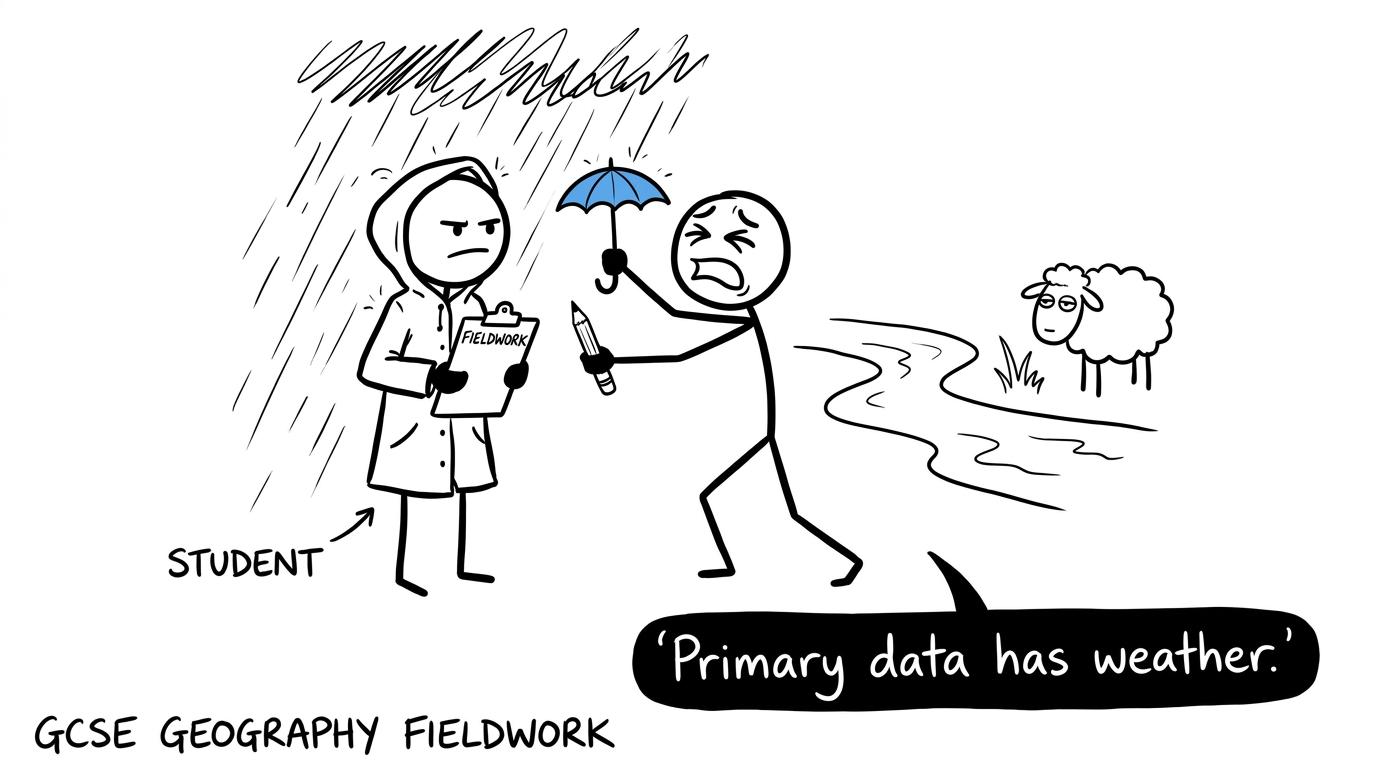 Students protecting a fieldwork pencil from the rain while collecting primary data
Does Geography fit your complete GCSE workload?
A subject should not be judged alone. The more useful question is what your whole timetable will demand from you.
Geography requires regular recall, application, data skills and extended responses. If several other options also involve substantial portfolios, performances or content-heavy examinations, consider how those demands will combine. This is not an argument against an ambitious set of choices. It is an argument for seeing the week rather than admiring each subject separately.
Look at your current habits honestly. Do you revise in short, repeated sessions, or leave factual content until the last moment? Geography rewards steady retrieval because case knowledge and processes become easier to apply when they are secure.
Maths deserves the same deliberate planning. The GCSE Maths revision hub lets you choose your exam board and move between lessons, practice questions, papers and solutions. The GCSE maths topics by board and tier guide can help you understand what foundation or higher tier maths will require alongside your options.
Are you choosing it for a sound reason?
Geography or History forms the humanities element of the English Baccalaureate in England. However, the EBacc is a group of subjects and a school performance measure, not a separate qualification. Your school may strongly encourage a particular pathway, so ask what applies to you.
Beyond that, avoid vague claims that one GCSE automatically unlocks a career. Geography can develop useful skills in analysing evidence, understanding systems, constructing arguments and evaluating decisions. It may also provide a natural foundation if you later consider A Level Geography. But future courses, apprenticeships and careers have their own entry requirements, which should be checked directly when the time comes.
A stronger reason sounds like this: “I am interested in the content, I understand the assessment, and I am prepared to build the required skills.” A weak reason sounds like: “My friend chose it,” “I heard it is easy,” or “I like the teacher I have now.” Teachers and classes can change. The subject remains.
How does Geography support GCSE maths?
Geography will not replace maths revision, but the subjects can reinforce useful habits.
Both ask you to read axes carefully, attach units, select relevant information and decide whether an answer is reasonable. Geography adds context to scale, percentages, averages and graphs. Maths gives you the precision to handle geographical data confidently.
This overlap is especially helpful if you treat weaknesses as specific skills. “I am bad at data” is too broad to act upon. “I confuse mean and median” or “I misread graph scales” gives you somewhere to begin. MathsGenie’s GCSE Statistics revision hub provides focused lessons, questions, worksheets and papers for developing those skills.
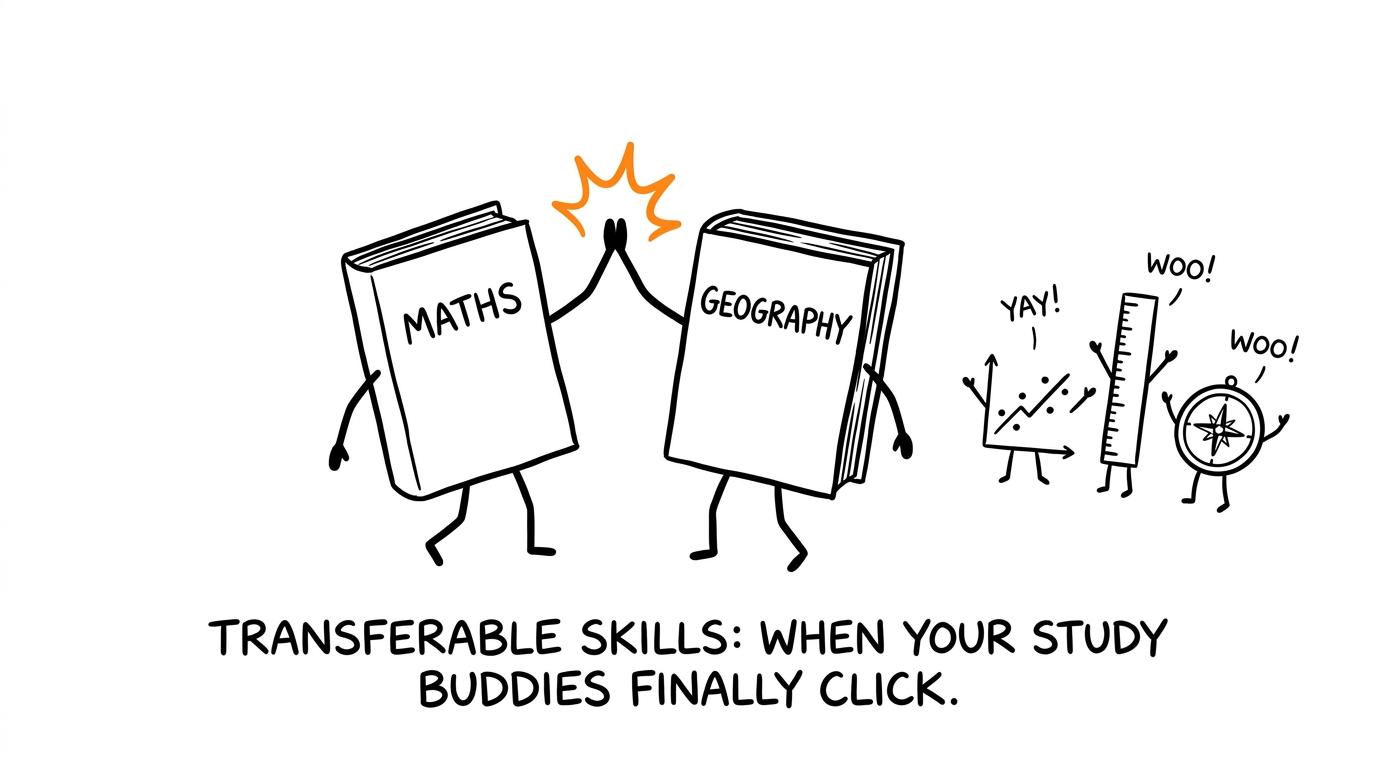 Maths and Geography books high-fiving while a ruler, map symbol and graph cheer
Common mistakes when choosing GCSE Geography
Assuming Geography is mostly memorisation
Knowledge matters, but examinations also test application, interpretation, analysis and evaluation. Learning a case study without understanding how to use it is not enough.
Choosing the teacher instead of the subject
A good teacher can make a subject enjoyable, but staffing and class arrangements may change. Base your decision on the course content and assessment as well.
Following friends into the same option
Friends can make lessons pleasant, but they cannot revise or sit the examination for you. Timetabling may place you in different classes anyway.
Ignoring fieldwork and data skills
Ask what fieldwork your school provides and look at actual exam questions. Geography involves more than written descriptions of places.
Believing there is a universally easy GCSE
Difficulty depends partly on your interests, skills and working habits. A subject that feels natural to one student may feel demanding to another. Look for a worthwhile fit, not a guaranteed shortcut.
Failing to check the exact specification
AQA, Edexcel, OCR and Eduqas do not arrange every topic or paper identically. Your school’s options booklet and Geography department should be your first sources for course-specific information.
Make the decision using evidence
Before submitting your options form, take three practical steps. Read your school’s course outline. Look at a recent paper for the correct exam board. Then ask the teacher what students commonly misunderstand about the course.
If the combination of physical environments, human questions, maps, evidence, fieldwork and writing still interests you, Geography is probably a sensible choice. If only one narrow topic appeals and the assessment style makes you miserable, another option may fit better.
Whatever you choose, protect the subjects already on your timetable. Use MathsGenie to organise free GCSE maths revision around short lessons, practice questions and mini tests, then build exam confidence with past papers, mark schemes, video solutions and predicted papers. The MathsGenie revision resources give you a practical place to start.
A good GCSE choice is not one you never find difficult. It is one whose difficulties you are willing to work through.