Should I Take GCSE English Language? Honest Questions
Should I take GCSE English Language? Ask honest questions about choice, workload, future plans and balancing English with focused GCSE maths revision calmly.
The timetable arrives, the option boxes appear, and suddenly a subject you have studied for years looks like a permanent decision. If you are asking should I take GCSE English Language, begin with one practical check: is it genuinely optional at your school?
In England, English is a compulsory core subject at Key Stage 4, and most students are entered for GCSE English Language as part of their school programme. Schools and qualifications differ across the UK, however, while alternative pathways, resits and individual arrangements can change what appears on a timetable. Ask your school before treating the decision as an ordinary option choice.
If you really do have a choice, the short answer is usually this: take it when it supports your next step and you can give it the necessary time. Do not choose it simply because someone says it is easy, and do not reject it because you see yourself as a “maths person”.
Your decision checklist
Before signing the form, find clear answers to these questions:
- Is GCSE English Language compulsory within your school programme?
- Which qualification and exam board would you follow?
- What do your likely sixth-form, college, apprenticeship or employment routes request?
- Are you prepared for both unseen reading and extended writing?
- How much independent practice will the course require?
- What support is available if English is currently difficult?
- Can you protect enough time for GCSE maths and your other subjects?
That first question matters most. A decision made with incomplete information can feel personal when it is really administrative.
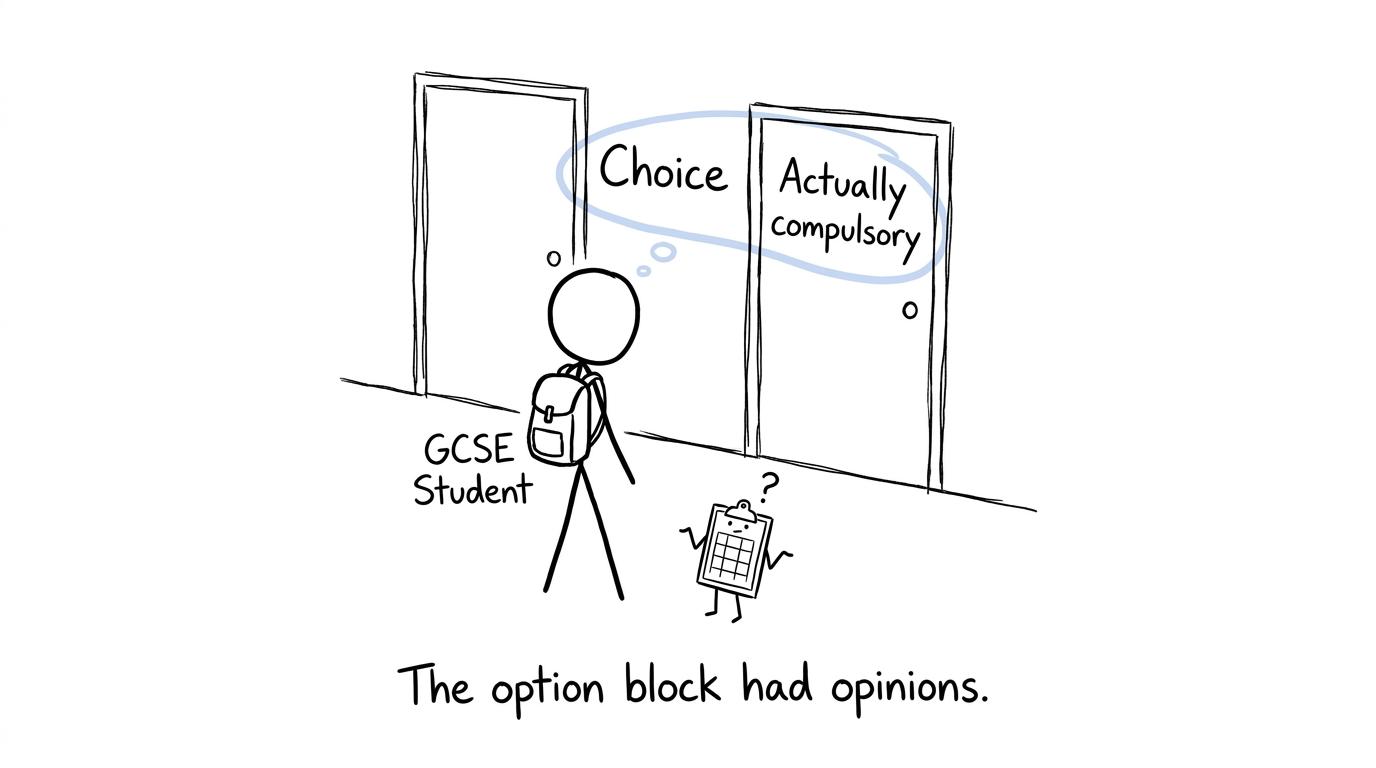 A student discovers that the option block has opinions
Is GCSE English Language actually an option for you?
In England, English, maths and science are core Key Stage 4 subjects. That does not mean every student in every setting follows an identical qualification route, but it does mean you should not assume English Language can be dropped in the same way as an optional subject.
Ask your head of year, English teacher or options lead:
- Am I expected to take GCSE English Language?
- Am I also taking English Literature?
- Is there an approved alternative pathway in my circumstances?
- Which exam board and specification will I follow?
- Will the course occupy an option block or part of the core timetable?
This conversation prevents a common misunderstanding. Sometimes students believe they are choosing English Language when the real choice concerns English Literature, an additional subject or the structure of a particular pathway.
If you are considering a resit, confirm the entry arrangements with your school or college instead. Post-16 institutions in England must support eligible students who have not yet achieved the required level in English, but the qualification, teaching programme and exam entry can depend on prior grades and current guidance. The GCSE English Language resit revision plan explains how to organise the next attempt once your entry is confirmed.
Do you understand what the course assesses?
GCSE English Language is not mainly a test of memorising novels or reciting terminology. Across specifications in England, the assessed content is divided equally between reading and writing, with each contributing 50%50\%50% of the qualification.
Reading tasks can require you to retrieve information, make inferences, analyse language and structure, compare perspectives and evaluate a text. Writing tasks assess how effectively you communicate for a particular audience, purpose and form. Accurate spelling, punctuation, grammar, vocabulary and sentence control matter too; the relevant assessment objective contributes 20%20\%20% of the qualification overall.
There is also a Spoken Language endorsement. It involves a prepared presentation and responses to questions, but it is reported separately and does not contribute to the numerical GCSE grade.
English Language is untiered. Unlike GCSE maths, there is no foundation or higher paper: students following the same specification sit the same assessment. Exam formats still vary between AQA, Pearson Edexcel, OCR and Eduqas, so revise from the correct specification rather than using whichever paper appears first in a search.
Start with the GCSE English Language revision hub, where you can choose your board. AQA students can go directly to the AQA GCSE English Language resources.
Are you willing to practise the uncomfortable parts?
Preference is useful information, but it is not the same as ability. You may enjoy creative writing yet dislike analysing unseen non-fiction. You may be a confident reader but find it difficult to finish extended responses under timed conditions.
Ask yourself which parts you are prepared to practise, not merely which parts you already enjoy.
A productive English Language revision cycle is simple:
- attempt one precise question under a time limit;
- compare the response with the mark scheme or teacher feedback;
- identify one missing feature;
- rewrite the weakest paragraph;
- return to the same question type later.
That rhythm should feel familiar to a maths student. In maths, a past paper reveals whether the weakness is knowledge, method, accuracy or communication. In English, a response can reveal weak evidence selection, undeveloped analysis, poor organisation or inaccurate writing.
The guide to GCSE English Language revision shows how to turn broad intentions into short, focused sessions. The aim is not to produce endless essays. It is to make each attempt tell you what to do next.
Will the qualification help with your next step?
Do not make this decision using a vague belief that English is either “essential everywhere” or “irrelevant if I want to do maths”. Entry requirements vary between courses, providers and employers. Check the actual requirements for routes you may realistically pursue.
Look at:
- sixth-form or college entry criteria;
- requirements for the subjects you hope to take;
- apprenticeship vacancy requirements;
- university course pages if you already have a direction;
- any English requirement attached to a professional pathway.
Ask your careers adviser to help if the wording is unclear. A requirement for English may refer to English Language, English Literature, either subject or an accepted equivalent. Never guess from the phrase “GCSE English”.
Even where it is not a formal gatekeeper, the underlying skills travel well. Reading a dense source, identifying what is actually being claimed and presenting a logical explanation are useful in science, humanities and maths. A mathematically correct idea can still lose clarity if the reasoning is not communicated precisely.
Can you balance English Language with GCSE maths?
The fear is often not English itself. It is what English might take away from maths revision.
That is a reasonable concern, but balance is not achieved by abandoning whichever subject feels less comfortable. It comes from giving different subjects the kind of practice they need. English benefits from timed reading, paragraph improvement and extended writing. Maths benefits from regular problem-solving, immediate marking and repeated practice of weak methods.
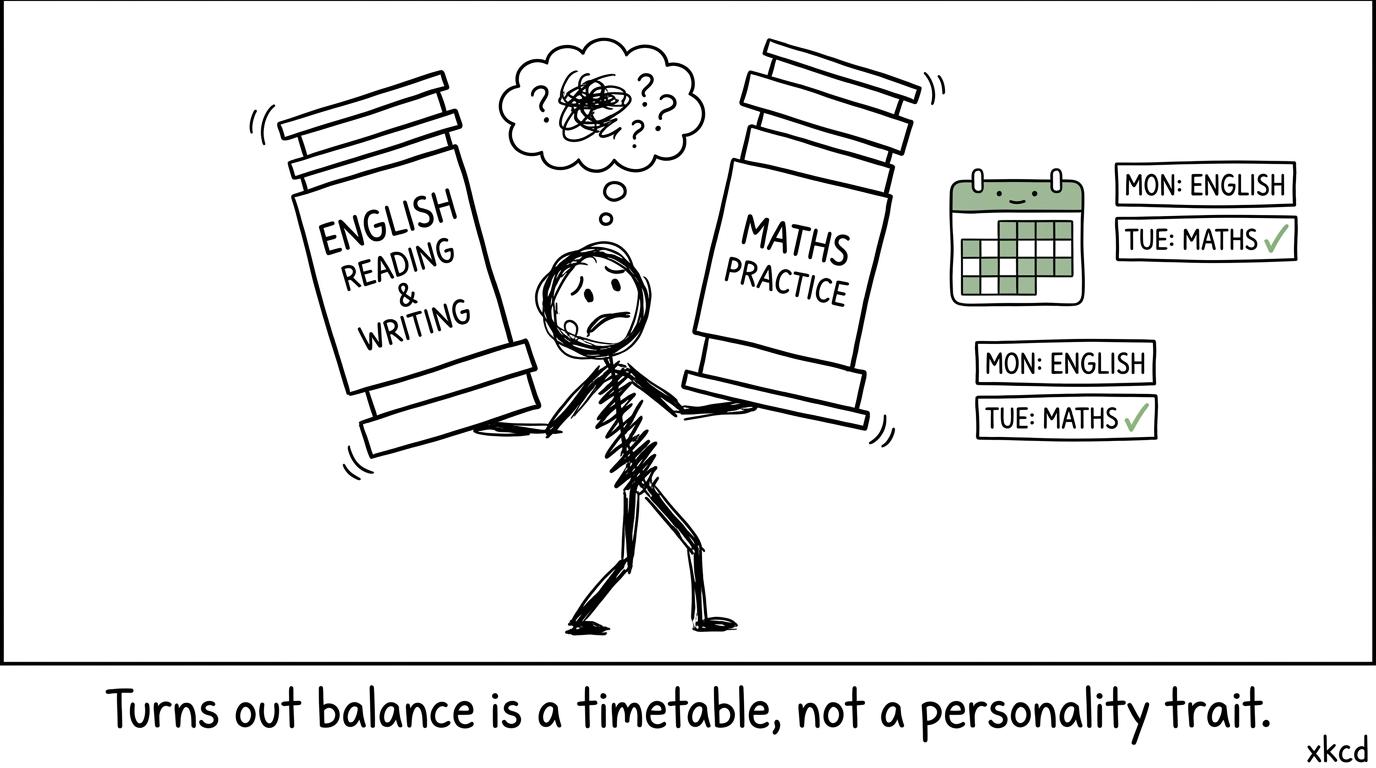 A student learns that balance is a timetable
Use separate, visible blocks. For example, place one English reading task and one writing task across the week, then protect several shorter maths sessions. If your maths plan currently consists of “revise everything on Sunday”, the problem is not English Language. The problem is the plan.
The GCSE maths revision hub lets you choose your exam board and move between revision lessons, worksheets, practice questions and papers. If time feels tight, use the GCSE one-month revision plan to build a realistic weekly structure rather than competing daily to-do lists.
What support will you receive?
A difficult subject becomes much more manageable when the feedback is specific. Before choosing, find out what support is included:
- Are practice responses marked regularly?
- Will you see annotated models at different levels?
- Are there intervention sessions or writing workshops?
- Can you access past papers and mark schemes?
- Will teachers explain your weakest assessment objectives?
- What access arrangements apply if you are eligible?
“Work harder” is not a revision strategy. “Select shorter evidence and analyse one word closely” is. The MathsGenie guide to using GCSE mark schemes explains how to turn assessment language into a practical improvement.
Are you choosing for the right reason?
Good decisions tend to survive honest questions. Weak decisions often depend on a slogan.
“English is easy” is not a plan. Neither is “I am bad at essays” or “I only need maths”. Instead, ask:
- What evidence do I have from recent classwork?
- Which part of the course is causing concern?
- Can that weakness improve through structured practice?
- What would I place on the timetable instead?
- Which choice keeps more future routes open?
If you are replacing English Language with another option, compare the complete trade-off: teaching time, assessment style, future requirements and personal workload. A subject should not be chosen merely because a friend is taking it or because one teacher made a lesson enjoyable.
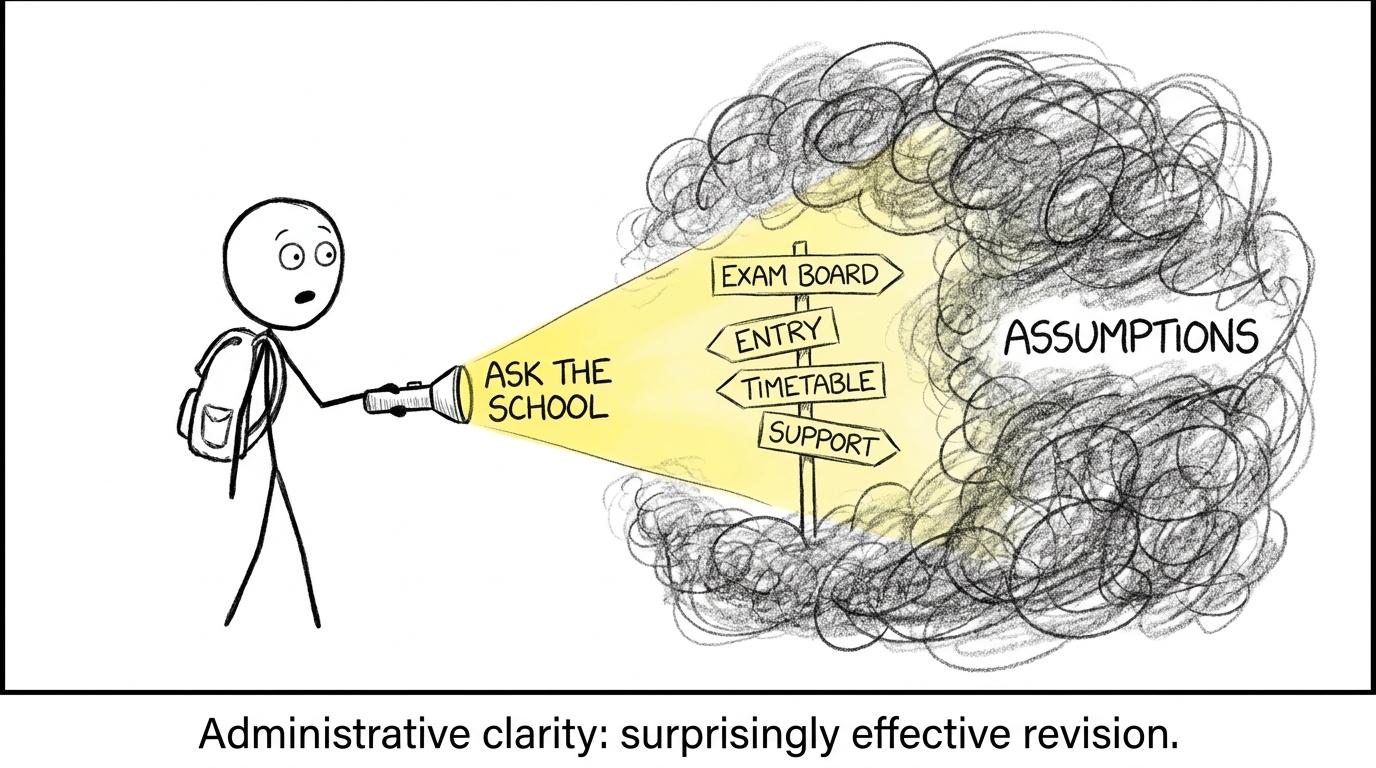 A student replaces assumptions with administrative clarity
Common mistakes when making the decision
Assuming the timetable proves it is optional
A subject appearing near an options form does not necessarily mean you can drop it. Confirm your school’s curriculum and your own entry route in writing if necessary.
Confusing English Language with English Literature
They are separate GCSEs with different content and assessment. Check exactly which qualification the conversation concerns.
Believing English Language has foundation and higher tiers
It is untiered. Do not apply GCSE maths tier rules to English or download a supposed foundation paper.
Choosing from a predicted grade alone
A predicted grade is one piece of evidence, not a complete forecast. Look at question-level strengths, teacher feedback, attendance, workload and your next-step requirements.
Ignoring the exact exam board
AQA, Edexcel, OCR and Eduqas papers do not have identical structures or timings. Use board-specific resources and practise the questions you will actually face.
Letting English consume all available revision time
Extended writing can expand indefinitely. Set a defined task and stopping time, then preserve regular maths practice. For realistic exam preparation, use Edexcel GCSE maths past papers or the appropriate board page, and add GCSE predicted papers after you have diagnosed and repaired topic gaps.
Make the decision, then build the system
So, should you take GCSE English Language? First establish whether the choice genuinely exists. If it does, check the requirements of your likely next steps, understand the assessment, examine your current evidence and decide whether you can support the course without neglecting maths.
The goal is not to create the perfect timetable. It is to avoid a preventable regret built on an assumption.
Once your subjects are confirmed, make improvement routine. Use MathsGenie for free English Language resources and keep your GCSE maths moving through revision lessons, practice questions, mini tests, past papers, mark schemes, video solutions and predicted papers. Choose one useful task today, mark it honestly, and let the next task be decided by what you learn.