

Short Breaks vs Long Break GCSE Drama Revision
Short breaks vs long break GCSE Drama: explore the evidence, choose practical timings and build a revision routine that protects focus and recall.
Revision can fail quietly. You sit down with a set text, rehearsal notes and good intentions. An hour later, you have read plenty but can recall very little. When comparing short breaks vs long break GCSE Drama revision, the most useful answer is not that one schedule always wins. Several planned short breaks are usually the better default for maintaining concentration and preventing revision from drifting. However, a longer break may be more restorative after an especially demanding task.
The evidence supports regular, deliberate breaks more confidently than it supports one perfect timetable. It also suggests something more important: the quality of the revision between breaks matters more than copying an exact timer from someone else.
For GCSE Drama, that means using focused blocks to retrieve theatrical vocabulary, explore a set text, plan analytical responses and recall details from live theatre. The same principles transfer directly to GCSE maths, where short blocks of questions, marking and correction can be built around the free GCSE Maths revision hub.
The answer at a glance
Use this checklist as your starting point:
- Prefer several planned short breaks during a long revision session.
- Begin with focused blocks of roughly 202020 to 303030 minutes and breaks of roughly 555 minutes.
- Take a longer break after several blocks or after a genuinely draining task.
- Decide when the break will end before it begins.
- Keep phones and social media out of short breaks where possible.
- Use active recall, planning and exam questions rather than relying on rereading.
- Revisit material on different days because spacing across days matters more for memory than break timing alone.
- Adjust the schedule using evidence from your own concentration and recall.
This is a framework, not an exam-board rule. AQA, Edexcel, OCR and Eduqas do not prescribe a revision-break schedule, and research has not established a uniquely optimal break length for every GCSE student or subject.
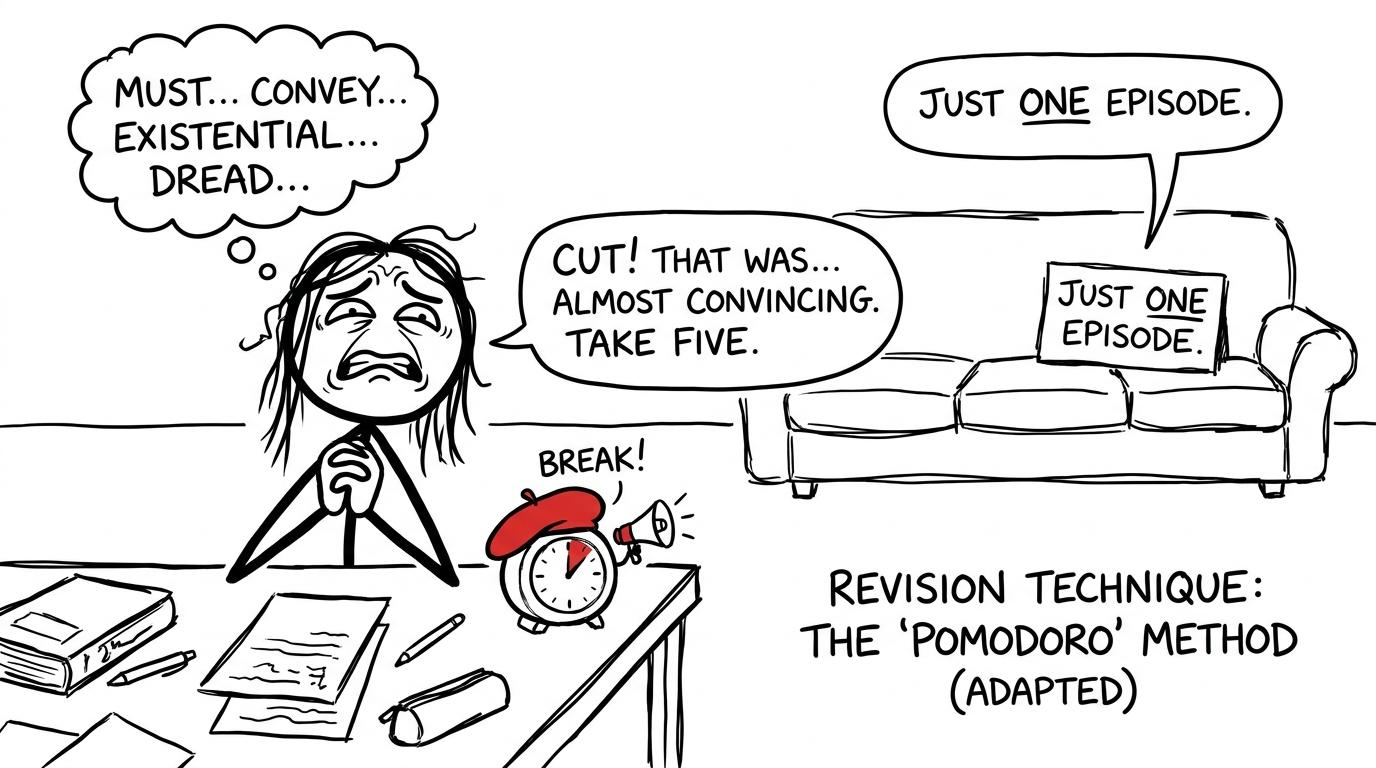 A timer acting as the director of a GCSE revision session
What the research actually suggests
Research into micro-breaks generally finds small but useful benefits for energy and reduced fatigue. Evidence for an automatic improvement in performance is less consistent, particularly when a task is cognitively demanding. In other words, a short pause may help you feel fresher without guaranteeing that your next Drama response will earn more marks.
A study of university students comparing predetermined break schedules found that systematic breaks were associated with less fatigue and distraction than breaks chosen entirely in the moment. Task completion did not differ clearly between the schedules. This matters because unplanned breaks often begin only after concentration has already collapsed.
More recent classroom research has reported promising results from frequent micro-breaks, but those participants were university students rather than GCSE Drama candidates. The finding is relevant, not definitive. It would be misleading to claim that a particular pattern has been proven specifically for revising set texts, theatre evaluation or devising portfolios.
A systematic review also found that micro-breaks of up to 101010 minutes tended to improve vigour and reduce fatigue, while their overall effect on performance was not statistically conclusive. Longer recovery within that micro-break range sometimes helped more, especially after demanding work.
The fairest conclusion is therefore balanced: short, scheduled breaks are a sensible default, but deeper mental fatigue can justify a longer pause.
Why GCSE Drama makes break planning important
GCSE Drama is dense in an unusual way. It combines factual recall with interpretation, practical imagination and evaluative writing. Depending on the specification, students may need to understand a set text, explain performance or design choices, analyse live theatre and reflect on devised work.
The written assessment is substantial across the main boards. For example, the written component is worth 40%40\%40% in the current AQA, Edexcel and Eduqas specifications. OCR's established J316 specification also assigns 40%40\%40% to its written performance-and-response component, although students should always check the specification and qualification route used by their school.
That mixture creates different types of tiredness. Learning terminology may feel repetitive. Planning an extended response demands sustained organisation. Visualising how an actor, director or designer would realise a moment requires creative attention. One break pattern does not have to govern all three.
Match the break to the task
For short recall activities, use shorter work blocks with brief resets. Suitable tasks include recalling stage configurations, defining theatrical vocabulary or listing precise moments from a production without notes.
For analytical planning, allow enough uninterrupted time to develop an argument. Stopping every few minutes can break the thread connecting an artistic choice, supporting detail and its effect on the audience.
For a full timed response, preserve exam realism. Complete the response under the timing conditions you intend to practise, then take a longer break before marking it. Maths students should use the same principle when sitting Edexcel GCSE Maths past papers: breaks belong between timed sections or papers, not wherever a difficult question appears.
A practical break schedule for Drama revision
Start with a flexible cycle rather than an inflexible productivity challenge.
Focus block
Choose one precise outcome for a block of approximately 202020 to 303030 minutes. “Revise Drama” is too vague. Better outcomes include retrieving quotations or moments from a set text, planning one response, annotating an extract from a performance perspective, or recalling evidence for a live theatre evaluation.
Work actively. Close the notes first, retrieve what you know, then check and correct. Research on learning consistently supports spacing and retrieval more strongly than passive rereading.
Short reset
Take approximately 555 minutes away from the task. Stand up, drink water, look into the distance or walk briefly. The aim is to reduce mental fatigue without beginning an activity that is difficult to stop.
A short break is not spare revision time. Nor is it an invitation to open several notifications. If the break fills your attention with new information, it may not feel restorative when you return.
Longer recovery
After several focused blocks, take a longer break of approximately 151515 to 303030 minutes. Eat, move around or change rooms. Longer recovery is particularly reasonable after a timed essay, an extended rehearsal reflection or a difficult sequence of analytical planning.
The crucial boundary is a decided return time. A long break with no endpoint can quietly become the end of the session.
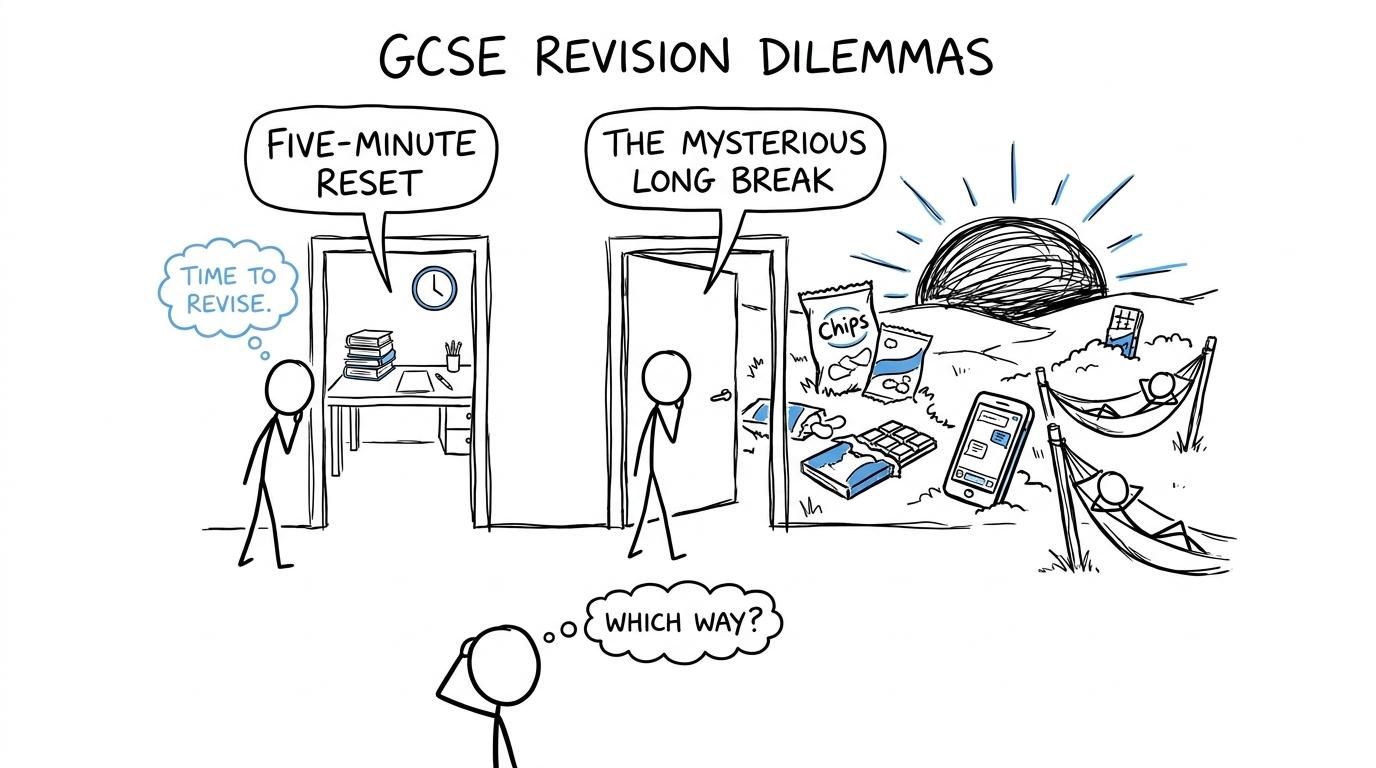 Two very different doors representing a short reset and an endless break
Break frequency is not the same as spaced practice
A five-minute pause inside an evening session creates rest, but it does not replace revisiting content across days. These ideas are related, yet distinct.
Spacing means returning to knowledge after a meaningful interval. You might retrieve a character's objectives today, plan a response later in the week and complete an exam-style question after another gap. Each return requires reconstruction rather than immediate repetition.
This is useful in maths too. MathsGenie's guide to stopping GCSE maths content from being forgotten uses a pattern of retrieval, marking and later review. If time is tight, the 20-minute GCSE maths revision routine shows how a small session can still contain active recall, questions and feedback.
A productive Drama plan therefore operates on two clocks:
- short breaks protect attention within today's session;
- spaced sessions protect memory over the coming days and weeks.
The second clock is usually more important for long-term retention.
Make each work block active
Breaks cannot rescue weak revision methods. Forty focused minutes of highlighting may feel orderly while producing little evidence that you could answer a question independently.
Try to make every block produce something checkable:
- a closed-book recall list;
- a response plan linked to the wording of a question;
- a paragraph completed under time pressure;
- a comparison between two performance choices;
- a list of precise live-theatre moments;
- corrections made after checking notes or teacher feedback.
A useful rhythm is retrieve, apply, check, record. Retrieve knowledge without notes. Apply it to a question or decision. Check accuracy. Record the next weakness to revisit.
MathsGenie builds the same rhythm into free revision. Students can learn through revision lessons, attempt practice questions, use mark schemes and video solutions, and then check progress through mini tests. The guide to finding weak GCSE topics quickly explains why recording the cause of an error is more valuable than merely recording a score.
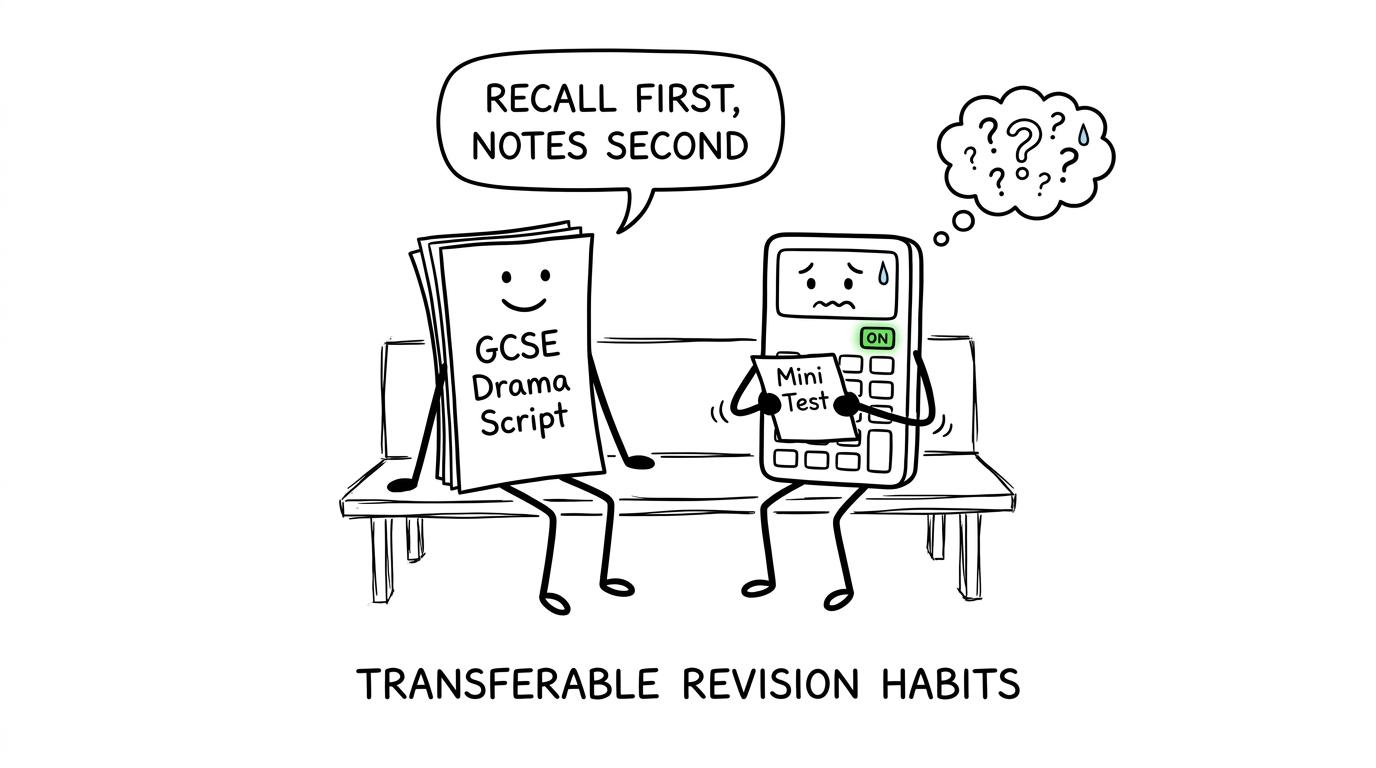 A Drama script and calculator exchanging active-recall advice
How to tell whether your break pattern works
Do not judge a timetable only by whether it feels comfortable. Judge it by what happens before and after each break.
At the end of a block, note whether you completed the intended task and whether concentration declined sharply. When you return, check how quickly you restart. At the end of the session, attempt a short closed-book recall. Recheck the material on another day.
If you regularly lose focus before the timer ends, shorten the block. If you are working carefully when the alarm interrupts you, extend it. If a 555-minute break repeatedly becomes 252525 minutes, change the break activity or move your phone away.
This is metacognition: planning, monitoring and evaluating how you learn. It is not about finding a flawless personality type. It is about responding to evidence.
For maths, short GCSE predicted papers, mini tests and selected past-paper questions can provide that evidence. Use them to test whether your recall and accuracy survive beyond the original revision block, rather than treating predicted papers as forecasts of an exact exam.
Common mistakes with revision breaks
Waiting until concentration has disappeared
A break taken only after prolonged distraction arrives too late. Schedule pauses in advance, while retaining the freedom to finish a coherent thought.
Treating every task identically
Vocabulary retrieval and a timed extended response place different demands on attention. Preserve uninterrupted exam practice, then recover afterwards.
Turning a short break into scrolling
Social media provides novelty rather than necessarily providing rest. Use a timer and choose a low-friction activity that is easy to stop.
Confusing rereading with progress
Familiarity can feel like knowledge. Test yourself before opening notes, then correct omissions precisely.
Copying a fashionable schedule rigidly
A predetermined structure can reduce distraction, but no single ratio has been proven optimal for every student. Monitor completion, concentration and later recall.
Taking breaks without spacing revision across days
Several pauses in one evening do not protect memory as effectively as returning to material later. Build a weekly plan, not just a timer.
Short breaks or a long break: the final judgement
For most GCSE Drama revision sessions, several planned short breaks are the stronger starting point. They can limit fatigue, make starting less intimidating and prevent you from waiting until attention has completely gone. A longer break still has a role after several blocks, after a demanding timed task or when a brief reset has not restored useful concentration.
The deeper lesson is that breaks organise revision; they do not create learning by themselves. Learning comes from retrieving, applying, checking and returning later.
Use that approach across your GCSE subjects. Begin with MathsGenie's free GCSE Maths revision resources, choose a focused lesson or set of practice questions, pause deliberately, then mark your work. As exams approach, add past papers, predicted papers, mini tests, mark schemes and video solutions. The aim is not to remain at your desk for the longest time. It is to make each return to the desk count.










