Self Study GCSE Food and Nutrition: A Realistic Plan
Self study GCSE Food and Nutrition with a realistic 24-week plan. Learn what you can do alone, how NEA works and where maths revision fits in.
The theory may look manageable. The recipes can be practised at home. Then three letters change the whole plan: NEA.
If you want to self study GCSE Food and Nutrition, the honest answer is that you can learn much of the course independently, but you cannot usually complete the qualification entirely alone. GCSE Food Preparation and Nutrition includes practical non-exam assessment that must be supervised, authenticated, marked and submitted through an approved centre.
Your first task is therefore not buying a textbook or choosing recipes. It is finding a school, college, distance-learning provider or examination centre willing to handle the complete assessment process.
The short answer: is self-study actually possible?
Yes, with an important distinction.
You can independently learn nutrition, food science, food safety, food choice and food provenance. You can also develop practical cooking skills in your own kitchen. However, earning the GCSE requires more than sitting a written paper.
Current specifications from major exam boards divide assessment between a written examination and non-exam assessment. For AQA, for example, the written paper is worth 50%50\%50% and the two NEA tasks together are worth 50%50\%50%. OCR also allocates 50%50\%50% to its written examination and 50%50\%50% across its food investigation and food preparation tasks. Exact timings, task structures and administrative rules differ by board.
That creates a simple checklist:
- choose the exact exam board and specification;
- find an approved centre before beginning assessed work;
- confirm that the centre accepts private or distance-learning candidates;
- ask how it will supervise, authenticate and mark your NEA;
- check which kitchen facilities and ingredients you must provide;
- obtain the current specification and assessment guidance;
- build enough time for theory, practical skills and exam practice.
Do not assume that a centre offering the written examination will automatically accept your NEA. Ask specifically about GCSE Food Preparation and Nutrition, including both practical tasks.
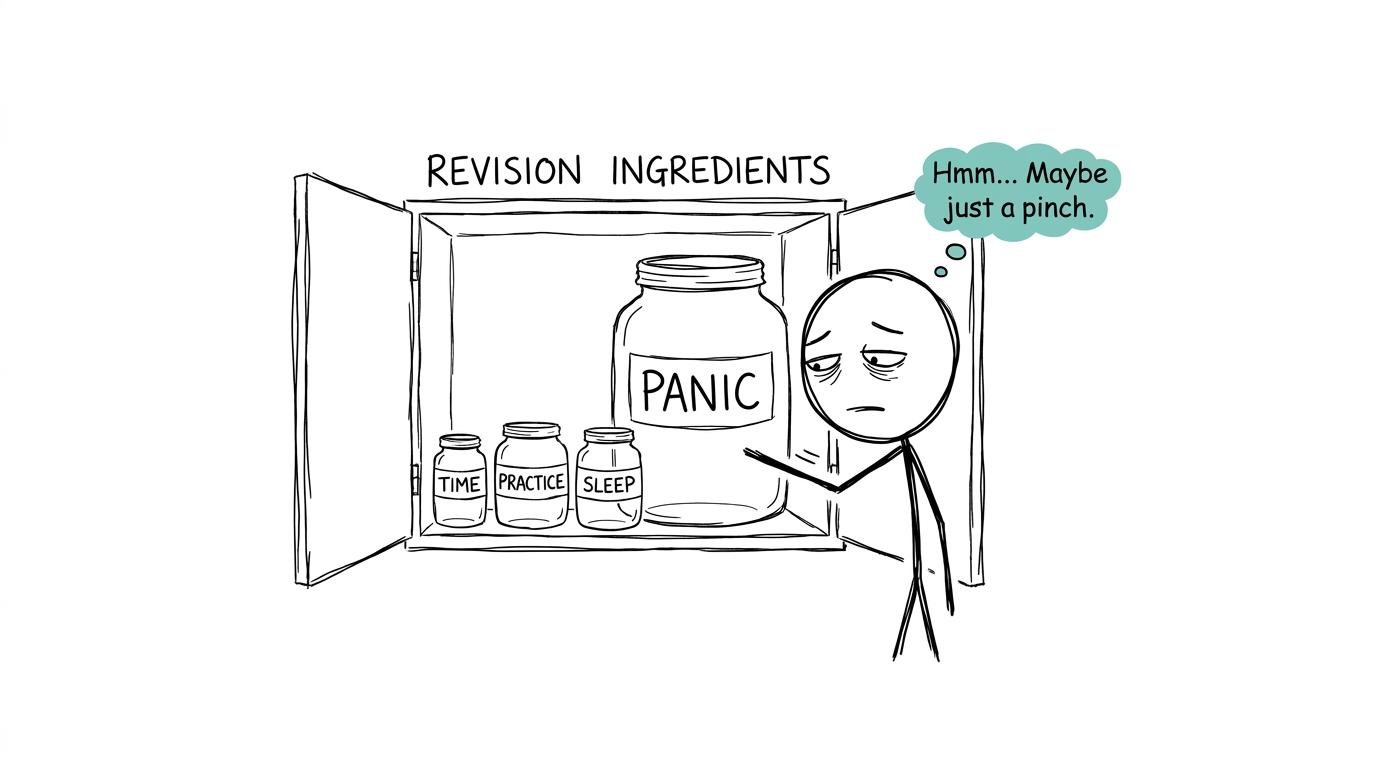 A student wisely puts the enormous jar of revision panic away
Why the NEA changes everything
Non-exam assessment is not ordinary homework. The entering centre must follow the relevant exam board and JCQ requirements, provide sufficient supervision, authenticate your work and arrange marking and moderation.
For a distance-learning candidate, current JCQ guidance says that arrangements with an approved centre must be made before assessed work begins. The entering centre is responsible for administering the NEA process. Your final submission must be your own work, and both candidate and teacher authentication may be required.
This means that photographs taken casually at home, an investigation completed before joining a centre or a portfolio assembled without supervision may not be acceptable. Only your centre can tell you what conditions apply to your specification.
Private-candidate availability can also change, and documents published at different times may not always say the same thing. Treat the exam board's latest entry information as a starting point, then obtain written confirmation from the board and your intended centre before paying for a course.
Questions to ask a prospective centre
Contact centres with precise questions rather than simply asking whether they offer the GCSE:
- Which exam board and specification code do you use?
- Will you enter a private candidate for every component?
- Who supervises, authenticates and marks the NEA?
- Where will practical assessments take place?
- How many compulsory centre sessions are required?
- What are the internal deadlines and total fees?
- Are ingredients, equipment and protective clothing included?
- Can you support access arrangements where appropriate?
Keep the answers in writing. A clear administrative plan is just as important as a revision timetable.
What you need to learn
Although terminology varies slightly, the course normally combines five broad areas.
Nutrition and health
You need to understand nutrients, their functions and sources, dietary needs through life, energy balance and relationships between diet and health. Learning isolated definitions is not enough; examination questions often require you to apply knowledge to a person, menu or dietary requirement.
Food science
This includes the functional and chemical properties of ingredients and the changes that occur during preparation and cooking. You should be able to explain observations using accurate scientific vocabulary rather than merely describing what happened.
Food safety
You need secure knowledge of contamination, food poisoning, storage, preparation, cooking temperatures and personal hygiene. Practical routines should match your written explanations.
Food choice and provenance
Expect to consider cost, culture, religion, ethics, seasonality, environmental concerns, food labelling and where ingredients come from. Strong answers connect several influences instead of listing disconnected facts.
Practical food preparation
Specifications require a range of preparation and cooking techniques. Repeating a few familiar meals will not create enough breadth. Keep a skills record showing what you practised, what went wrong and what you will change next time, but do not confuse informal practice with authenticated NEA evidence.
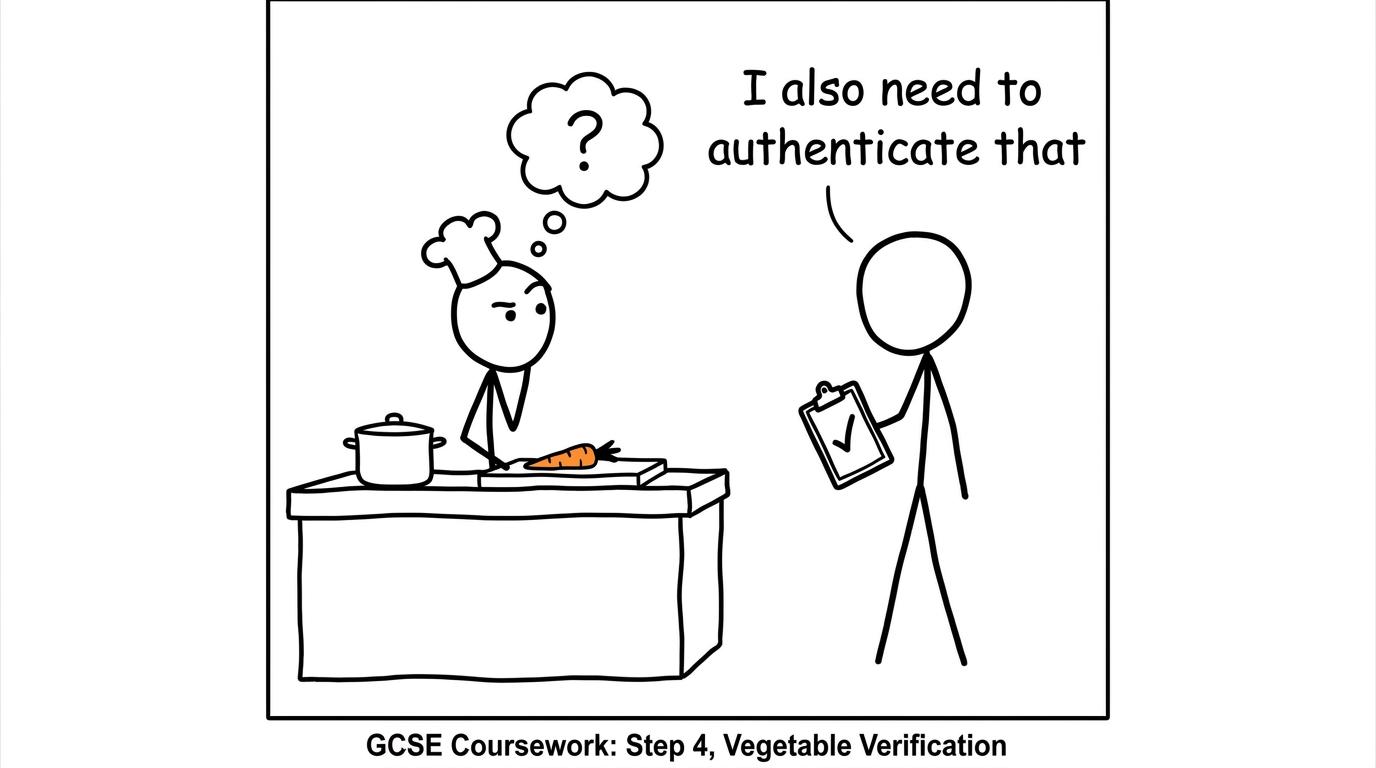 A candidate discovers that even a carrot may need authenticating
A realistic 24-week self-study plan
A short plan can create urgency, but it cannot create kitchen experience. OCR publishes a total guided learning expectation of roughly 120120120 to 140140140 hours for its course. A sensible independent schedule is therefore about 555 to 777 hours each week over 242424 weeks, adjusted around your centre's compulsory sessions and NEA dates.
Never begin live NEA work from a timetable found online. Your centre must issue and manage the current tasks.
| Week | Main focus |
|---|---|
| 111 | Confirm the exam board, approved centre, entry arrangements, costs and NEA conditions. Download the current specification. |
| 222 | Audit your theory knowledge and practical skills. Create folders for notes, informal cooking records and centre instructions. |
| 333 | Study macronutrients, their functions and food sources. Practise one relevant cooking skill. |
| 444 | Study vitamins, minerals, water and fibre. Review safe knife use and weighing. |
| 555 | Cover energy needs, energy balance and healthy dietary guidance. Practise adapting a familiar dish. |
| 666 | Learn dietary needs across life stages and for different activity levels. Complete short-answer questions. |
| 777 | Study special diets, allergies and intolerances carefully, distinguishing medical requirements from preferences. |
| 888 | Cover food spoilage, contamination, microorganisms, storage and hygiene. Audit your kitchen routine. |
| 999 | Study carbohydrates in food science, including gelatinisation, dextrinisation and caramelisation where required. |
| 101010 | Study proteins and fats, including denaturation, coagulation, aeration and emulsification. |
| 111111 | Investigate raising agents and heat transfer through unassessed practical trials. Record controlled observations. |
| 121212 | Review sensory testing, variables, fair comparisons and ways to present results clearly. |
| 131313 | Study food provenance, seasonality and primary and secondary food processing. |
| 141414 | Cover environmental, ethical, economic, cultural and religious influences on food choice. |
| 151515 | Study food labelling, marketing and consumer choice. Practise interpreting numerical information. |
| 161616 | Build practical breadth with doughs, sauces, protein foods, vegetables and different cooking methods. |
| 171717 | Practise planning a sequence of dishes, including safe storage, timing and efficient use of equipment. |
| 181818 | Follow the centre's instructions for preparation leading towards NEA work. Do not use unofficial task materials. |
| 191919 | Complete only the NEA stages authorised by your centre under its required conditions. |
| 202020 | Continue centre-managed NEA activity and preserve evidence exactly as instructed. |
| 212121 | Return to the written specification. Identify weak topics revealed by question practice. |
| 222222 | Complete a timed paper or substantial paper section, then mark it using the official mark scheme. |
| 232323 | Repair weaknesses using focused recall, command-word practice and another practical skills session. |
| 242424 | Complete final timed practice, review errors and prepare equipment and routines for the written examination. |
The maths hidden inside food and nutrition
Food Preparation and Nutrition is not a substitute for GCSE Maths revision, but mathematical fluency makes several parts easier. You may need to interpret proportions, scale ingredient quantities, compare nutritional data, calculate percentages, read graphs or manage time.
A percentage is calculated using:
percentage=partwhole×100\text{percentage}=\frac{\text{part}}{\text{whole}}\times 100percentage=wholepart×100For extra support, use MathsGenie's fractions, decimals and percentages revision and percentage lessons. Recipe scaling also depends on proportional reasoning, so revisit the AQA ratio revision guide or the Edexcel writing and simplifying ratio guide for your board.
Keep units consistent. Convert masses and volumes before comparing values, label graph axes and avoid rounding too early. These are small habits, but small habits protect marks.
How to revise without a classroom teacher
Use a repeatable cycle: learn, retrieve, apply, mark and repair.
Read one specification section, close your notes and write what you remember. Then answer questions and compare your response with the mark scheme. Record missing knowledge, vague explanations and misunderstood command words. Revisit those points within a few days.
For practical work, choose a skill rather than merely a recipe. Decide whether the session is developing knife control, sauce-making, dough handling, heat control, presentation or time management. Afterwards, evaluate specific evidence instead of writing that the result was simply “good”.
Balance this subject with your maths workload. MathsGenie's guide to the best order for learning GCSE Maths topics can help you organise revision lessons, topic questions, mini tests and timed papers without jumping randomly between topics.
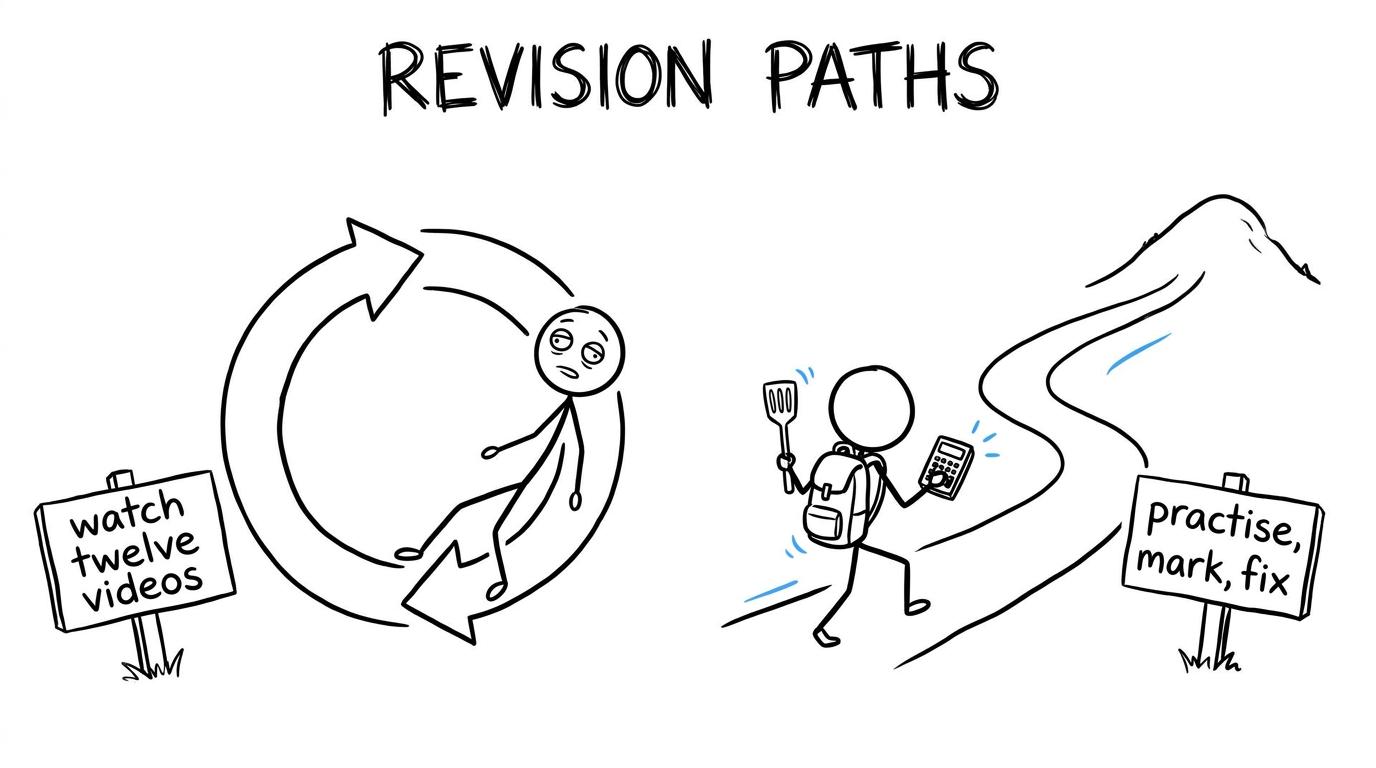 The useful revision path runs through practice, marking and fixing
Common mistakes when studying independently
Finding a centre too late
This is the most serious mistake. The NEA requires arrangements that cannot safely be improvised after you have completed the work.
Revising only the written examination
A strong theory score cannot replace missing NEA marks when the assessment is split between the examination and practical components.
Treating cooking practice as evidence automatically
Home practice is valuable, but it does not become assessable evidence unless it was produced under the conditions specified by your centre and exam board.
Learning facts without applying them
Knowing nutrient definitions is only the first layer. Practise selecting and explaining knowledge for particular people, dishes and contexts.
Ignoring command words and mark schemes
“State”, “describe”, “explain”, “analyse” and “evaluate” demand different kinds of responses. Mark schemes reveal the precision expected.
Letting Food and Nutrition displace core GCSE revision
Plan across all your subjects. Use separate blocks for Food and Nutrition theory, practical work and GCSE Maths. Consistency usually beats an occasional exhausting weekend.
Build the plan before you build the portfolio
Self-studying GCSE Food and Nutrition is doable, but only when independence is paired with proper assessment support. Secure an approved centre first, work from the exact specification and allow enough time to develop genuine practical competence. Then follow a steady cycle of theory, retrieval, practical rehearsal and marked exam practice.
For the numerical skills running alongside the course, make MathsGenie your free revision base. Use its revision lessons and practice questions to strengthen weak topics, then progress to mini tests, past papers, predicted papers, mark schemes and video solutions. A clear plan will not make every week easy. It will make the next step obvious; and that is often what keeps revision moving.