Self Study GCSE Biology: A Realistic 12-Week Plan
Self study GCSE Biology with a realistic 12-week plan for choosing a board, covering practical work, learning content and preparing for the final exams.
A biology textbook can create a misleading impression. It begins with cells, moves through organs and eventually reaches entire ecosystems. Read from front to back, the course can feel endless.
But if you want to self study GCSE Biology, the honest answer is yes: it is achievable outside school. You need the correct specification, access to required practical work, regular exam-question practice and an exam centre if you are entering as a private candidate. The challenge is not finding information. It is building a system that reveals what you understand, what you have forgotten and what must happen next.
This guide gives you that system, including a realistic twelve-week plan you can adapt around your maths revision and other GCSE subjects.
Your self-study checklist
Before beginning, confirm these essentials:
- Choose one qualification: GCSE Biology or Combined Science.
- Confirm your exam board: AQA, Pearson Edexcel, OCR or Eduqas.
- Download the current specification and assessment information.
- Check whether you will sit foundation or higher tier.
- Arrange an approved exam centre if you are a private candidate.
- Ask the centre how it will provide or verify the required practical experience.
- Collect official past papers, mark schemes and examiner guidance.
- Reserve four or five repeatable revision sessions each week.
- Keep a topic tracker and an error log.
- Continue practising the mathematical skills used in biology.
Do not postpone the exam-centre and practical arrangements. They can be harder to organise than the learning itself.
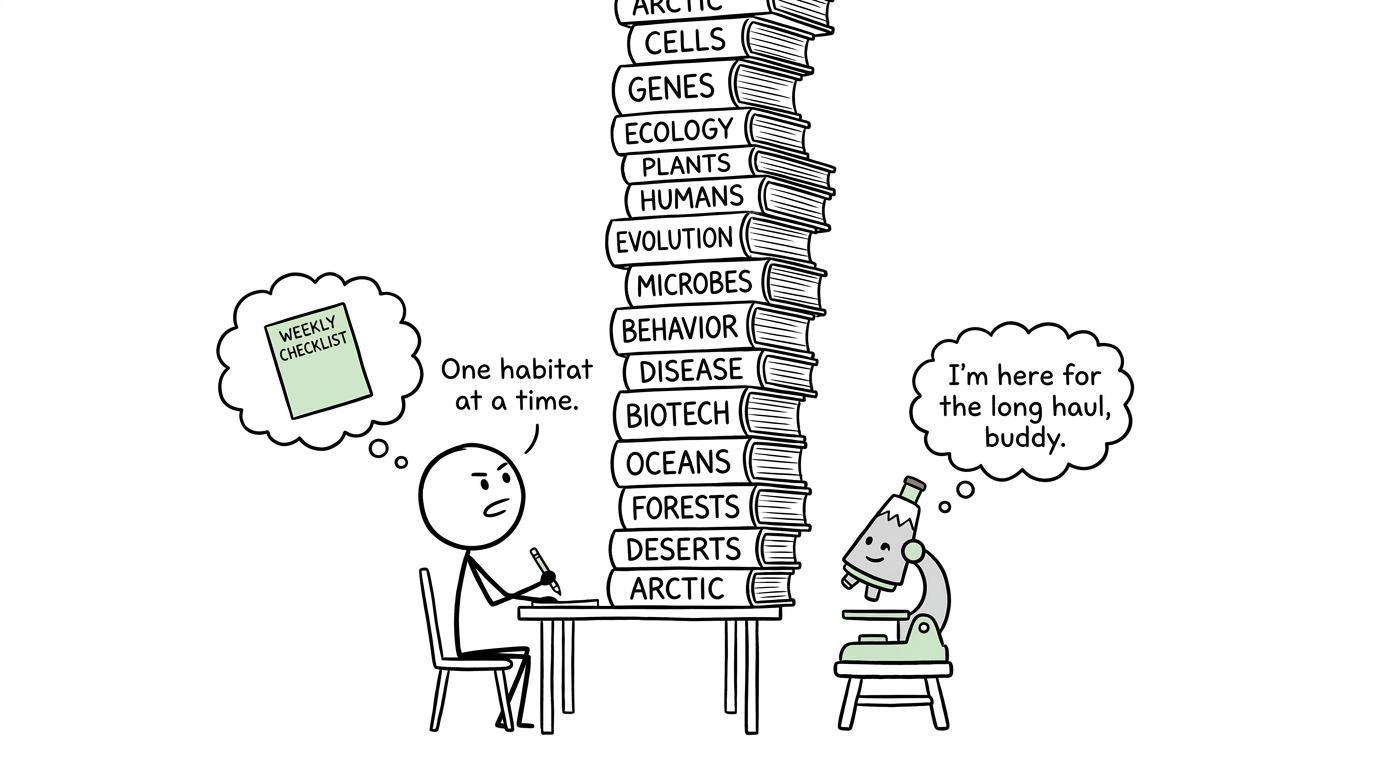 A student calmly turns a mountain of biology revision into one manageable weekly checklist
Is self-studying GCSE Biology actually doable?
It is doable when you treat the specification as the boundary of the course. Without that boundary, independent revision easily expands into interesting but unexamined detail.
GCSE Biology requires more than recalling definitions. In the regulated single-science qualifications used in England, assessment objectives broadly divide marks between knowledge, application, and analysis or evaluation. That is why reading alone is insufficient. You must learn facts, apply them in unfamiliar situations and interpret evidence.
You also need to understand the practical requirements. Practical skills are assessed through written examination questions, and at least 15%15\%15% of the marks in GCSE single science relate to practical work. At least 10%10\%10% of Biology marks assess mathematical skills at an appropriate level.
Requirements differ by board. For example, AQA GCSE Biology specifies ten required practical activities, Pearson Edexcel identifies eight mandatory core practicals, and OCR requires practical activities covering its specified apparatus and techniques. Eduqas organises its requirements differently again. Always use the current specification for your board rather than borrowing another student's checklist.
Self-study becomes less realistic if you avoid practical arrangements, change resources constantly or never complete questions without notes. It becomes much more realistic when every week contains learning, retrieval, questions and correction.
Sort out the qualification before revising
Separate Biology or Combined Science?
GCSE Biology is a separate science qualification. Combined Science includes biology, chemistry and physics and normally produces a double award. They overlap, but their specifications and practical requirements are not identical.
Check your entry code with your school or exam centre. Do not assume that a Biology textbook automatically matches your qualification.
Foundation or higher tier?
For GCSE qualifications in England, foundation tier makes grades 111 to 555 available, while higher tier makes grades 444 to 999 available, with a limited grade 333 safety net under the relevant awarding rules. Choose the tier with your school, tutor or exam centre after looking at actual papers. Higher tier contains additional and more demanding content; it is not simply the same paper with harsher grade boundaries.
Private-candidate arrangements
A private candidate must enter through an approved school, college or examination centre. Awarding organisations do not normally accept entries directly from individual candidates.
Contact centres early and ask:
- whether they accept your chosen board and qualification;
- whether they can meet the practical requirements;
- what evidence or attendance they require;
- which fees and internal deadlines apply;
- how access arrangements will be handled, if relevant.
For AQA science, for example, a centre accepting a private candidate must make provision for the specified practical activities. Watching demonstrations online can support understanding, but it should not be assumed to replace the centre's formal requirements.
A realistic twelve-week GCSE Biology plan
This plan assumes that you already have some Key Stage Three science knowledge and can manage roughly four to six focused hours each week. If you are starting from scratch, spread the same sequence across more weeks rather than rushing.
Use one short session for retrieval, two for learning and questions, and one longer session for practical skills or mixed assessment. Keep separate time for maths using the GCSE Maths revision hub.
| Weeks | Main focus | Evidence that the work is complete |
|---|---|---|
| One and two | Set-up, baseline paper and cell biology | Specification checklist, marked baseline and completed cell questions |
| Three and four | Organisation and transport systems | Retrieval quiz, practical notes and corrected exam questions |
| Five and six | Infection, response and bioenergetics | Mixed topic test and updated error log |
| Seven and eight | Homeostasis, coordination and inheritance | Timed questions covering recall, application and data |
| Nine and ten | Variation, evolution and ecology | Completed practical summaries and mixed paper sections |
| Eleven and twelve | Full papers, repair and final review | Timed papers, marked corrections and a short priority list |
Weeks one and two: build the map
Print or save the current specification. Turn every content statement into a tracker marked not started, developing or secure.
Complete part of an official paper before revising. This is a diagnosis, not a judgement. Separate each lost mark into one of four categories: missing knowledge, weak application, mathematical error or misunderstood command word.
Then learn cell structure, microscopy, cell division and transport across membranes according to your board. Practise retrieval without notes and include the relevant practical methods.
Weeks three and four: connect structure to function
Cover organisation, enzymes, digestion, circulation, plant tissues and transport systems as required by your specification. Biology becomes easier when facts form a chain: structure affects function, function affects process, and the process produces evidence you can measure.
Complete short exam-question sets after each topic. For supporting numeracy, revisit ratio and proportion within the GCSE maths learning order, particularly when dealing with scale, magnification and rates.
Weeks five and six: practise applying knowledge
Study infection and response, disease, photosynthesis and respiration. Exact groupings vary between boards, so follow your specification rather than this article's order where they differ.
At the end of week six, complete a mixed test without notes. Mark it immediately. Copying the correct answer is not enough; write why your original thinking failed and what clue should guide you next time.
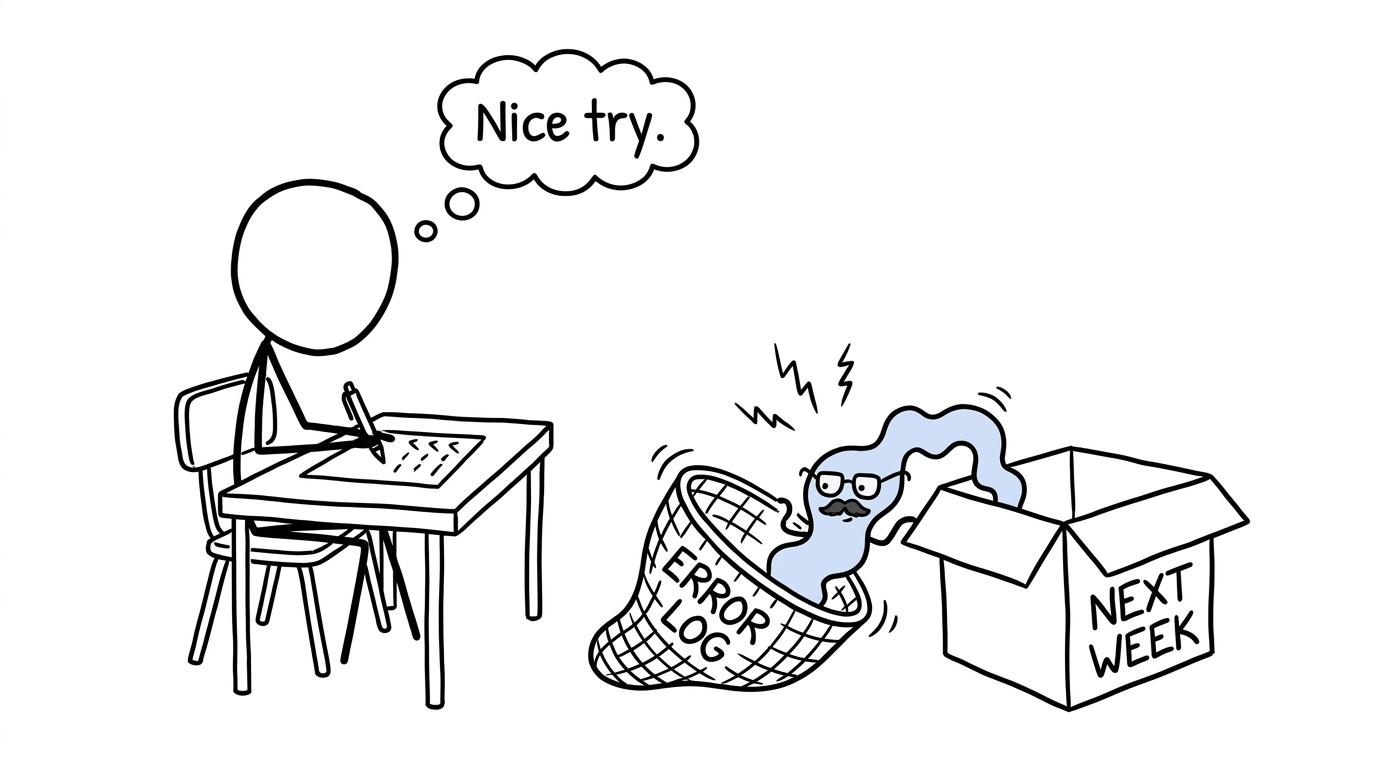 A disguised mistake is caught before it can sneak into next week's revision
Weeks seven and eight: handle processes and data
Move to homeostasis, hormonal and nervous coordination, reproduction, genetics and inheritance as appropriate for your course. These topics often combine precise vocabulary with unfamiliar diagrams or datasets.
Maintain your maths alongside the science. You may need to calculate percentage change,
percentage change=changeoriginal value×100,\text{percentage change}=\frac{\text{change}}{\text{original value}}\times 100,percentage change=original valuechange×100,rearrange equations, interpret rates and compare distributions. MathsGenie's GCSE Statistics revision resources can strengthen your work with averages, sampling and data displays, while the scatter graphs revision guide supports correlation and lines of best fit.
Weeks nine and ten: finish the content and revisit practicals
Cover variation, evolution, genetic technologies and ecology in the form required by your board. Then audit every required or core practical.
For each practical, explain from memory:
- the purpose and scientific principle;
- the independent, dependent and control variables;
- the apparatus and method;
- risks and sensible precautions;
- how results should be recorded or displayed;
- limitations, improvements and possible conclusions.
Practical questions can alter the context while testing the same reasoning. Memorising one scripted method is less useful than understanding why each step exists.
Weeks eleven and twelve: turn knowledge into exam performance
Complete full papers under the correct conditions for your board and tier. Use the same calculator rules and timings that apply to the real assessment.
Mark each paper carefully. Convert the result into a repair list containing no more than five priorities. Then relearn, practise and retest those priorities before attempting another paper.
This is the same feedback loop described in MathsGenie's guide to using GCSE past papers properly. The subject changes, but the principle remains:
paper, mark, repair, retest.
Do not use unofficial predicted papers as substitutes for the specification and official past papers. For maths preparation, however, MathsGenie's Edexcel GCSE Maths predicted papers provide fresh timed practice once you have covered the course.
What each self-study session should contain
A focused session can follow this pattern:
- Five minutes: retrieve older facts without notes.
- Twenty minutes: learn one small specification section.
- Twenty minutes: answer questions independently.
- Ten minutes: mark, correct and update your tracker.
- Five minutes: schedule the next retrieval attempt.
The exact duration matters less than the sequence. Passive input feels smooth because it hides mistakes. Questions feel harder because they expose them. Exposure is useful.
If you are balancing Biology with maths and other subjects, use a sustainable timetable rather than planning heroic daily sessions. The GCSE revision timetable guide explains how to combine short weekday blocks with longer weekend assessment.
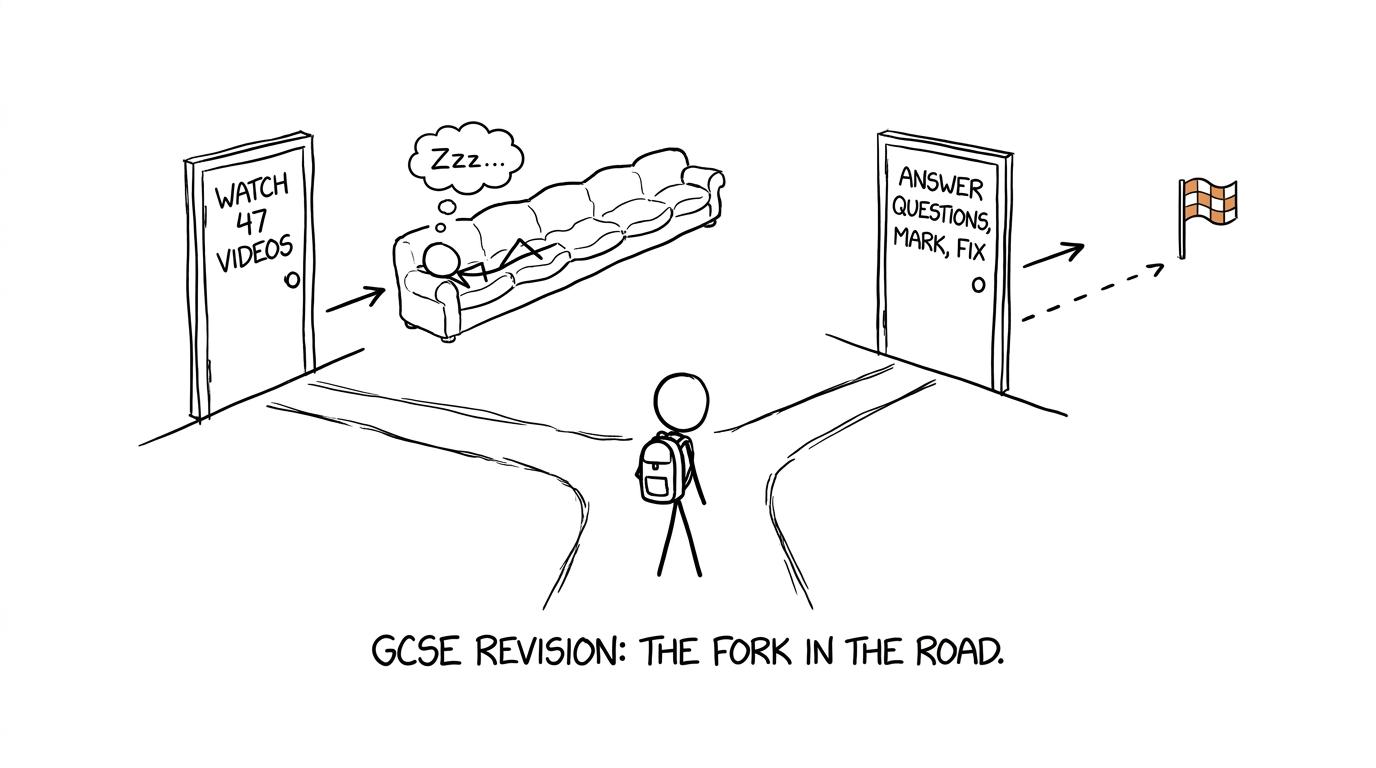 A student chooses active question practice over an endless corridor of revision videos
Common self-study mistakes
Using the wrong specification
AQA, Edexcel, OCR and Eduqas share broad national content, but their wording, practical structures and papers differ. Put your board and qualification code on the front of your revision folder.
Treating videos as completed revision
A clear explanation can create familiarity without recall. Close the resource and write what you remember. Then answer a question.
Ignoring practical work until the end
Practical understanding is part of the assessment, not an optional appendix. Organise centre requirements early and revisit practical reasoning throughout the course.
Avoiding biology calculations
Marks can be lost through incorrect units, scale, standard form, percentage change, rates and graph interpretation. Use the GCSE Maths topics by board and tier guide to locate gaps in the mathematical foundation supporting your science.
Completing papers without repairing mistakes
A score tells you where you are. Corrections change where you are going. After every paper, choose the smallest useful next action: relearn one idea, answer a fresh set and check that the error no longer repeats.
Begin with the next manageable action
You can self-study GCSE Biology, but independence does not mean improvisation. Secure the correct specification and exam arrangements, organise the practical requirements, then work through a repeated cycle of learning, retrieval, questions and correction.
Your biology plan also depends on confident numeracy. Use MathsGenie as your free maths revision base: choose your board and tier, strengthen calculations through revision lessons and practice questions, then test yourself with mini tests, past papers, predicted papers, mark schemes and video solutions. If twelve weeks feels too distant, adapt the structure in the one-month GCSE revision plan and start with one specification statement today.