

Self Study GCSE Astronomy: A Realistic Plan
Self study GCSE Astronomy with a realistic 24-week plan covering exam content, observations, maths skills, resources and private exam entry.
The hardest part of learning astronomy alone is not understanding why stars shine. It is knowing whether you are following a course that can actually lead to a qualification.
The short answer is yes: you can self study GCSE Astronomy, but you cannot manage every requirement entirely by yourself. You must arrange examination entry through an approved centre, complete the required observations and ensure that the centre can confirm their completion. Sort out those practical details before spending months revising.
Academically, the course is manageable with steady independent work. It combines scientific knowledge, observation, extended writing, data interpretation and a meaningful amount of GCSE maths. The realistic route is to allow about 242424 weeks, study for three to five hours each week and begin past-paper practice well before the final month.
Your self-study checklist
Before starting, make sure you can answer yes to these questions:
- Do you have the current Pearson Edexcel GCSE Astronomy specification, code 1AS01AS01AS0?
- Have you found a centre willing to enter a private candidate?
- Has the centre explained how it will handle the observation requirement?
- Can you complete at least one unaided and one aided observation safely?
- Can you sustain three short revision sessions each week?
- Do you have access to specification-matched questions and official past papers?
- Are your standard form, graphs, ratios and formula skills secure enough for scientific calculations?
That first administrative conversation matters more than it appears. A student can understand cosmology beautifully and still face a problem if no centre has agreed to make the entry or confirm the observations.
What GCSE Astronomy currently involves
Pearson Edexcel GCSE Astronomy is a grades 9-1 qualification assessed through two externally examined papers. It is not divided into foundation and higher tiers.
Paper 1, Naked-eye Astronomy, covers Topics 111 to 888. These include Planet Earth, the lunar disc, the Earth-Moon-Sun system, time cycles, Solar System observation, celestial observation, early models and planetary motion.
Paper 2, Telescopic Astronomy, covers Topics 999 to 161616. It moves through lunar and solar exploration, planetary systems, starlight, stellar evolution, galaxies and cosmology.
Each paper lasts 111 hour 454545 minutes, is worth 100100100 marks and contributes 50%50\%50% of the qualification. The papers include multiple-choice, short-answer, calculation, graphical and extended-response questions.
The current specification requires mathematical skills to account for at least 20%20\%20% of written-examination marks. Observational skills account for at least 15%15\%15%. This is why astronomy revision cannot be reduced to memorising impressive facts about black holes.
You must also undertake at least one unaided and one aided observation from the permitted tasks. The observations do not contribute a separate coursework mark, but knowledge of planning, recording, analysing and evaluating observations is assessed in the written papers. Keep a detailed record because the entering centre must confirm completion under Pearson's current arrangements.
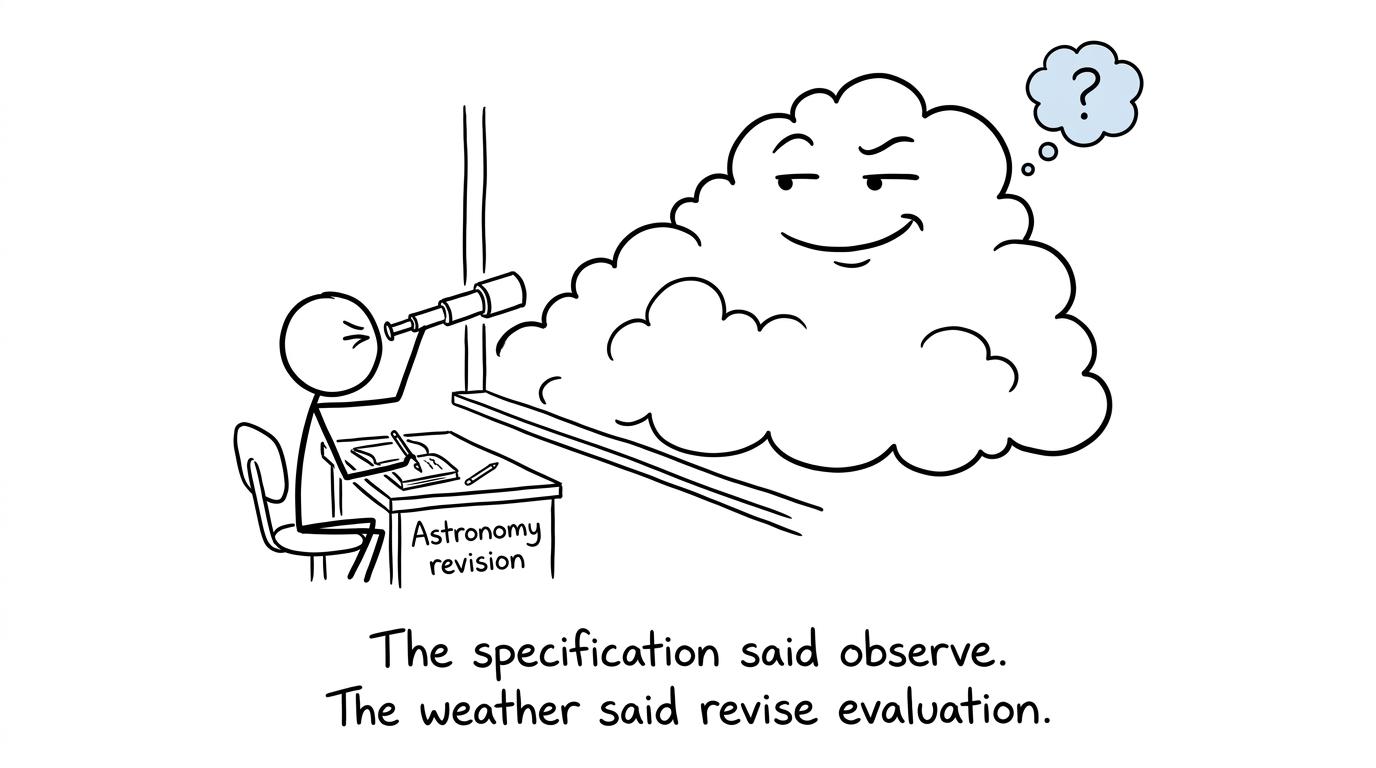 A student negotiates astronomy revision with cloudy weather
Is self study GCSE Astronomy genuinely doable?
It is doable if you treat it as a structured GCSE rather than an open-ended interest in space.
The subject suits independent learners because the specification provides a clear sequence. Many ideas can be learnt through diagrams, simulations, reading, retrieval and examination questions. You do not need to own an observatory. Depending on the approved task, aided work may use equipment such as binoculars, a telescope, a camera or suitable astronomical images. Your centre should approve the arrangement before you begin.
Three difficulties deserve honesty.
First, the course is broad. Lunar phases and coordinate systems eventually give way to spectroscopy, stellar evolution and cosmology. Watching unrelated astronomy videos can create knowledge without specification coverage.
Second, the British weather does not respect revision timetables. Observations may require several possible dates, suitable visibility and careful records. They should begin early, not in the week before a centre deadline.
Third, private entry takes organisation. Centres set their own availability, fees and internal deadlines, and not every centre accepts Astronomy candidates. Ask specifically about qualification code 1AS01AS01AS0, the observation statement, evidence requirements and the summer examination series. Never assume that accepting private candidates for GCSE Maths means accepting them for Astronomy.
A realistic 24-week GCSE Astronomy plan
Use three sessions each week: one to learn content, one for active recall and one for questions or observation work. A useful baseline is two sessions of 454545 minutes and one session of 606060 to 909090 minutes.
| Weeks | Main focus | Evidence of progress |
|---|---|---|
| 111: 222 | Download the current specification, arrange a centre, map all 161616 topics and audit your maths | Confirmed entry route and a dated revision plan |
| 333: 444 | Planet Earth and the lunar disc | Closed-book recall plus labelled diagrams |
| 555: 666 | Earth-Moon-Sun system and time cycles | Accurate explanations of phases, eclipses and time concepts |
| 777: 888 | Solar System and celestial observation | Questions on coordinates, sky motion and visibility |
| 999: 101010 | Early Solar System models and planetary motion | Comparison of models supported by evidence |
| 111111: 121212 | Review Paper 1 and complete a timed section | Marked answers and a short mistake log |
| 131313: 141414 | Exploring the Moon and solar astronomy | Retrieval cards and examination questions |
| 151515: 161616 | Solar System exploration and planetary formation | Clear links between observations, evidence and conclusions |
| 171717: 181818 | Starlight and stellar evolution | Secure vocabulary, graphs and calculation methods |
| 191919: 202020 | The Milky Way, galaxies and cosmology | Structured answers using precise scientific language |
| 212121: 222222 | Mixed practice across both papers | Two marked timed sections and targeted repairs |
| 232323: 242424 | Full papers, weak topics and final retrieval | Completed papers, mark-scheme review and reattempted questions |
Run the observations alongside this sequence. During the first two weeks, agree suitable tasks and evidence with your centre. Plan possible dates early, allowing alternatives for cloud or equipment problems. Record the date, time, location, conditions, equipment, method and results required by the task. Then analyse limitations and sensible improvements.
Never look directly at the Sun through binoculars, a telescope or an unapproved filter. Solar work requires an explicitly safe method and appropriate supervision or guidance.
Build a repeatable weekly routine
A plan works when it reduces decisions. Use the same rhythm each week:
- Session A: learn: read one specification section and produce a short summary from memory.
- Session B: retrieve: answer questions without notes, redraw key diagrams and define technical vocabulary.
- Session C: apply: complete calculation, data, observational or extended-response questions; mark them immediately.
- Weekly review: record one knowledge gap, one maths weakness and one examination-technique issue.
This is slower than collecting notes but much better at exposing what you cannot yet recall. A revision folder can look complete while the knowledge inside it remains difficult to retrieve.
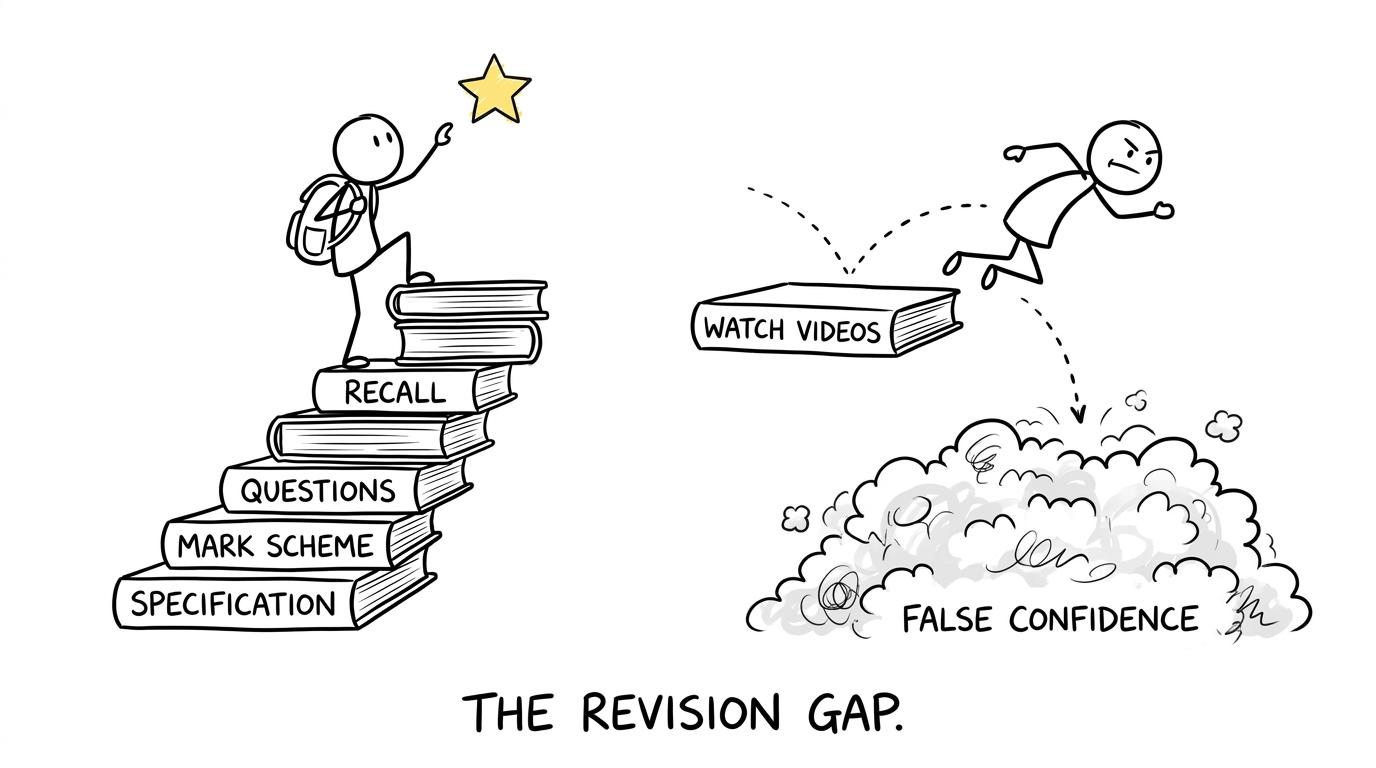 A student builds a staircase from the specification to a star
Strengthen the maths used in astronomy
GCSE Astronomy repeatedly draws on numerical and graphical reasoning. Relevant skills include rearranging formulae, substituting values, proportional reasoning, angles, units, interpreting gradients and working with very large distances.
Standard form is especially important when quantities span enormous scales:
a×10n,1≤a<10 a \times 10^n, \qquad 1 \leq a < 10 a×10n,1≤a<10You should also be comfortable with relationships such as inverse-square behaviour:
I∝1d2 I \propto \frac{1}{d^2} I∝d21and with converting angles using:
1∘=60′and1′=60′′ 1^\circ = 60' \qquad \text{and} \qquad 1' = 60'' 1∘=60′and1′=60′′These are not worked examples to copy. They are signals for your maths audit: can you interpret the notation, rearrange an equation, retain units and judge whether an answer is sensible?
Use the MathsGenie GCSE Maths revision hub to diagnose gaps. The standard form revision lesson is directly useful when handling astronomical scales.
For wider skills, choose the hub matching your maths examination board: Edexcel GCSE Maths revision, AQA GCSE Maths revision, OCR GCSE Maths revision or Eduqas GCSE Maths revision. Your Astronomy qualification is Pearson Edexcel, but your separate GCSE Maths course may use another board.
How to revise for the two papers
Begin topic questions as soon as you finish each section. At the halfway point, attempt a timed Paper 1 section rather than waiting until all 161616 topics feel finished.
Marking should produce a next action. Classify each lost mark as:
- missing knowledge;
- incorrect scientific vocabulary;
- weak maths or units;
- failure to interpret data;
- an incomplete observational evaluation; or
- an extended answer without enough linked reasoning.
Then repair the precise weakness and reattempt the question later. The method described in MathsGenie's guide to using past papers properly transfers well to Astronomy: attempt, mark, diagnose, practise and retest.
Official Astronomy papers should remain your main source for authentic question style. MathsGenie's GCSE revision timetable guide can help you fit Astronomy around Maths and other subjects without allowing one course to consume every evening.
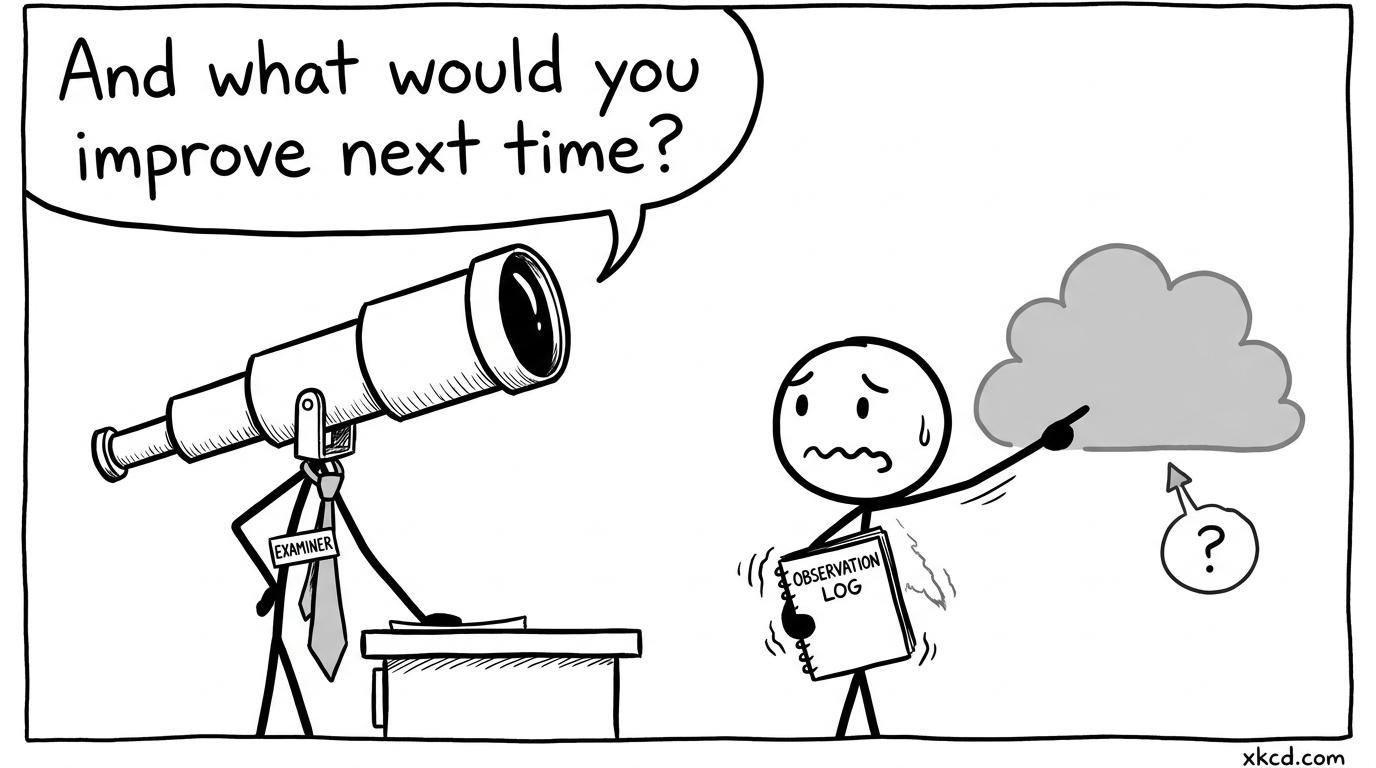 A telescope asks a student how an observation could be improved
Common mistakes when learning GCSE Astronomy alone
Delaying the exam-centre search
Finding a centre is not a final-week task. Confirm entry, evidence expectations, costs and deadlines before committing to the course.
Treating observations as optional coursework
They are not separately marked coursework, but the required aided and unaided observations must still be completed and confirmed. Their underlying skills are examined.
Revising interesting topics instead of the specification
Cosmology can absorb hours while time zones, lunar details or observational procedures receive none. Track every specification statement.
Producing notes without retrieval
Highlighting and copying feel productive because they leave visible evidence. Closed-book recall and questions reveal whether learning has actually happened.
Ignoring maths until a past paper
Calculation skills need regular practice. Use MathsGenie's one-month GCSE Maths plan to organise short, active sessions alongside Astronomy.
Buying equipment before choosing an observation
A telescope is not automatically necessary, and unsuitable equipment may not help with an approved task. Agree the task and method first.
Your next step
Self-studying GCSE Astronomy is realistic, but the successful version is less romantic than simply staring at the night sky. It begins with a specification, a willing examination centre and an early observation plan. Then it becomes a steady cycle: learn, retrieve, apply, mark and revisit.
Start today by contacting possible centres and mapping the 161616 topics across 242424 weeks. Alongside your Astronomy materials, use MathsGenie as your free maths revision base. Its revision lessons, practice questions, mini tests, past papers, predicted papers, mark schemes and video solutions can strengthen the numerical skills that Astronomy expects while keeping your main GCSE Maths preparation moving forward.
The sky is vast. Your plan should not be.











