Revision Order GCSE Statistics: Does It Matter?
Revision order GCSE Statistics advice: learn what to tackle first, when order matters, and how to build a balanced timetable that targets lost marks.
Revision timetables often look wonderfully organised. Every subject has a colour. Every hour has a purpose. Then Monday arrives, the first statistics question feels unfamiliar, and the whole plan starts to wobble.
So, does revision order GCSE Statistics planning genuinely matter? Yes, but not because there is one perfect sequence that every student should follow. Order matters when it helps you diagnose weaknesses, build connected knowledge, revisit topics after a gap and practise under exam conditions. It matters far less whether statistics appears before history on Tuesday evening.
The best order is personal and flexible: diagnose first, repair the weakest high-value skills, space your returns, then use mixed questions and papers to check whether the learning survives.
The short answer: what should you do first?
Use this checklist to organise your GCSE Statistics revision:
- Confirm whether you are taking a separate GCSE Statistics qualification or revising the statistics content within GCSE Maths.
- Check your exam board, specification and tier where applicable.
- Begin with a short diagnostic test or past-paper section.
- Rank topics by lost marks and confidence, not preference.
- Learn prerequisite skills before topics that depend on them.
- Revisit each topic after a gap rather than completing it once.
- Move from focused questions to mixed, timed practice.
- Adjust the order whenever marking reveals a more important weakness.
You can begin with the GCSE Statistics revision hub, which brings together board-specific papers and revision resources. If statistics is part of your GCSE Maths course, choose your board and tier through the wider GCSE Maths revision hub.
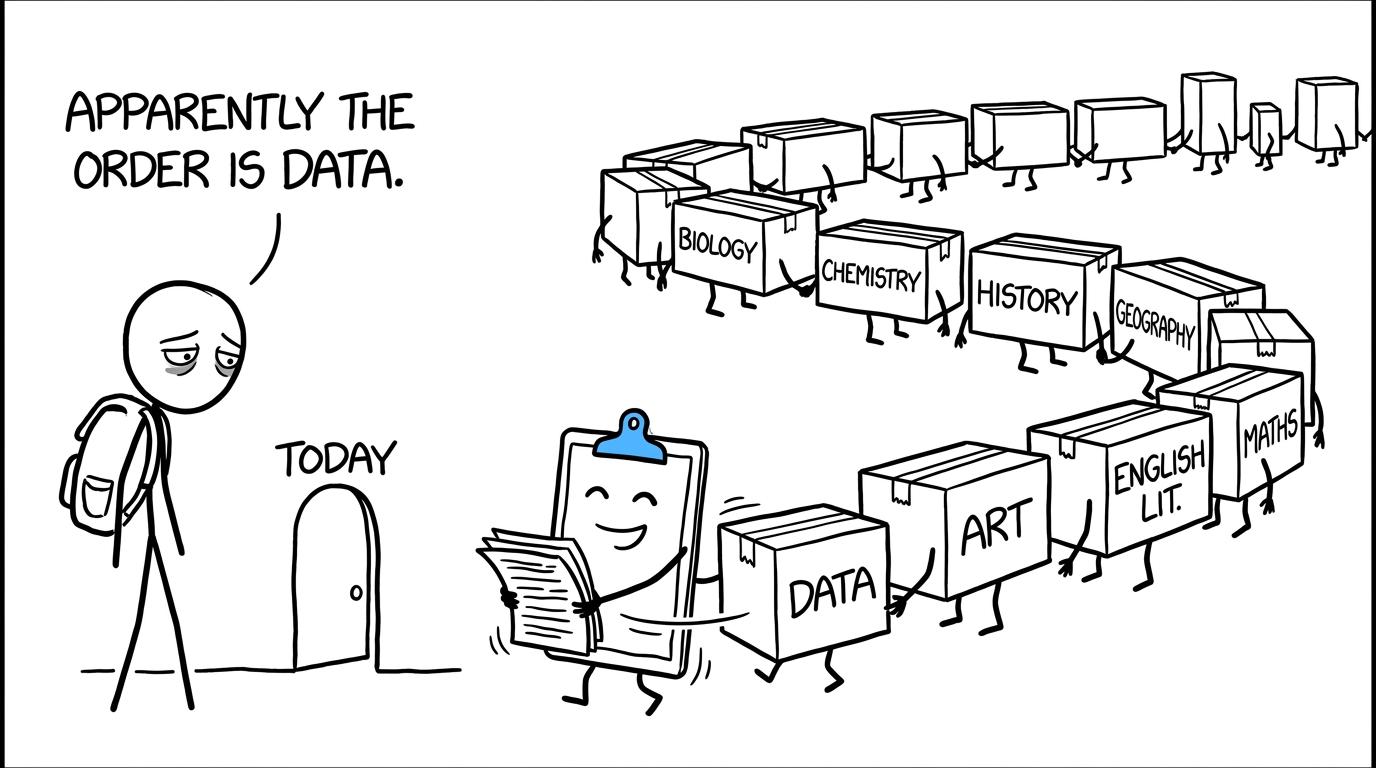 A student and clipboard rearranging a queue of revision topics
When revision order really does matter
A timetable is useful when it reflects how knowledge fits together. It is less useful when it is simply a neat list of chapter titles.
Put prerequisite knowledge before dependent topics
Some statistical ideas rely on earlier skills. Averages from a list are usually more accessible before estimating averages from grouped data. Understanding frequency, class intervals and graph scales helps before cumulative frequency or histograms. Comparing distributions becomes more meaningful once you can identify measures of centre and spread.
This does not require a rigid national sequence. Edexcel, AQA, OCR and Eduqas organise GCSE Maths content differently, while a separate GCSE Statistics course has its own specification. Use the GCSE topics by exam board and tier guide to identify what belongs to your course rather than relying on somebody else's checklist.
A sensible conceptual route might move through:
- data types, sampling and questionnaires;
- tables, charts and interpreting data;
- mean, median, mode and measures of spread;
- scatter graphs and relationships;
- grouped data and frequency diagrams;
- cumulative frequency, box plots and histograms where required;
- statistical reasoning and comparison.
That is a map, not a command. If your diagnostic work shows that scatter graphs are secure but sampling is weak, start with sampling.
Tackle fragile topics while your attention is strongest
The first part of a revision session often receives your clearest attention. Use it for a topic that requires thought, not automatically for the easiest item on the list.
This does not mean beginning every evening with the hardest question available. A brief familiar warm-up can help you settle. After that, move to the weakness you have chosen. Saving every difficult topic until the end creates a predictable problem: the work needing the most concentration receives whatever energy remains.
Leave time for topics to return
A topic reviewed once can feel fluent because the notes are still visible and the method is still fresh. That feeling is not the same as being able to retrieve the method later.
Research on learning consistently supports retrieval practice and spacing: recalling knowledge and returning to it after a delay are generally more useful for durable learning than repeated passive rereading. The precise gap need not become another source of anxiety. What matters is that a topic comes back.
For example, your timetable could include an initial learning session, a short independent check a few days later, and mixed exam questions the following week. The sequence is:
diagnose→learn→practise→mark→return\text{diagnose} \rightarrow \text{learn} \rightarrow \text{practise} \rightarrow \text{mark} \rightarrow \text{return}diagnose→learn→practise→mark→returnMathsGenie's revision planner can help you make those returns visible rather than trusting yourself to remember them.
When subject order is mostly irrelevant
Students sometimes spend more time designing the order than doing the revision. Should statistics come before biology? Should it always be revised in the morning? Is Wednesday somehow better for graphs?
There is no universal subject sequence that answers those questions. Statistics does not become less learnable because geography came first. What matters more is whether the session is focused, active and followed by feedback.
Subject order is usually secondary when:
- you can concentrate adequately in either position;
- the sessions are short enough to remain purposeful;
- you are practising rather than only reading;
- every important subject receives repeated attention;
- your plan includes recovery time and realistic breaks.
Personal patterns still count. If calculation-heavy work is consistently poor late at night, move it earlier. If starting with a manageable task helps you overcome avoidance, use a short confidence-building warm-up. Treat these as observations about your attention, not universal rules about the brain.
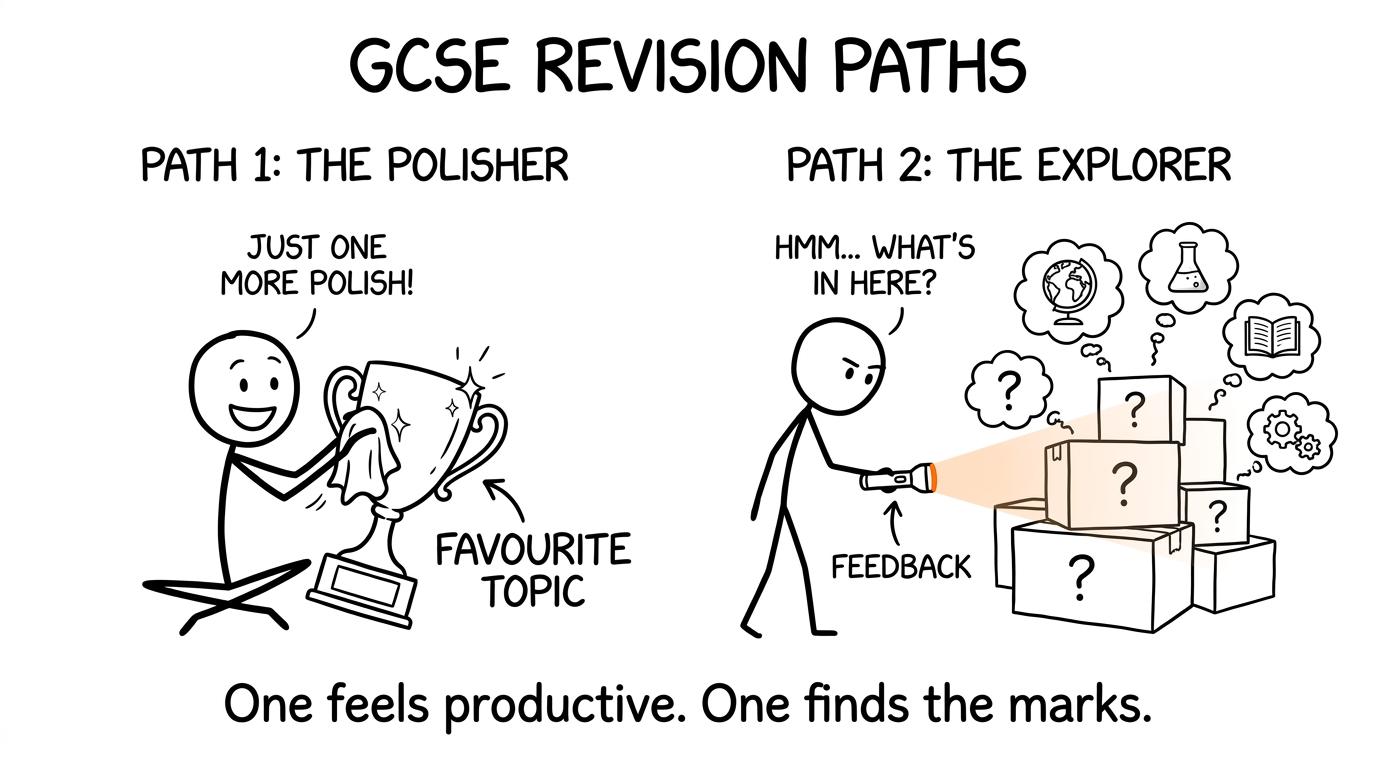 One student polishing a favourite-topic trophy while another follows feedback
Build your order from evidence, not comfort
The most useful timetable begins with information. Complete a mini test, a selection of mixed questions or part of a paper without revising immediately beforehand. Mark it carefully and classify each lost mark.
Useful categories include:
- knowledge: you did not know the fact or method;
- selection: you knew several methods but chose the wrong one;
- interpretation: you misread a table, graph or context;
- accuracy: the approach was sound but the calculation or scale was wrong;
- communication: the conclusion lacked comparison, context or sufficient working.
This classification changes revision order. A missing method calls for a revision lesson and focused questions. Repeated interpretation errors call for varied exam questions. Accuracy problems may require slower checking rather than another hour of notes.
For students taking the separate Edexcel qualification, the Edexcel GCSE Statistics revision page provides topic practice, worksheets and past papers with mark schemes. Always match resources to your actual specification.
How to sequence a statistics revision session
A practical session needs only four parts.
Recall something previously revised
Begin with a short, closed-book check from an older topic. This is not the main lesson. Its purpose is to make previous learning return before it disappears from the timetable.
Repair one defined weakness
Choose a target narrow enough to finish. “Revise statistics” is too broad. “Interpret cumulative frequency graphs” or “identify bias in sampling methods” gives the session a visible destination.
If cumulative frequency is on your course, the cumulative frequency revision guide explains the link between running totals, quartiles and box plots. Higher-tier students who need support with frequency density can use the histograms revision resources, provided these match their board and specification.
Practise without copying
Move from the lesson to questions while the method is clear, but close the notes where possible. Productive struggle is useful because it reveals whether you can select and carry out the method independently.
Mark, correct and schedule the return
A mark scheme is not merely a device for producing a score. It shows what the question required and where your response stopped earning marks. Record one precise correction, then put the topic back into your timetable.
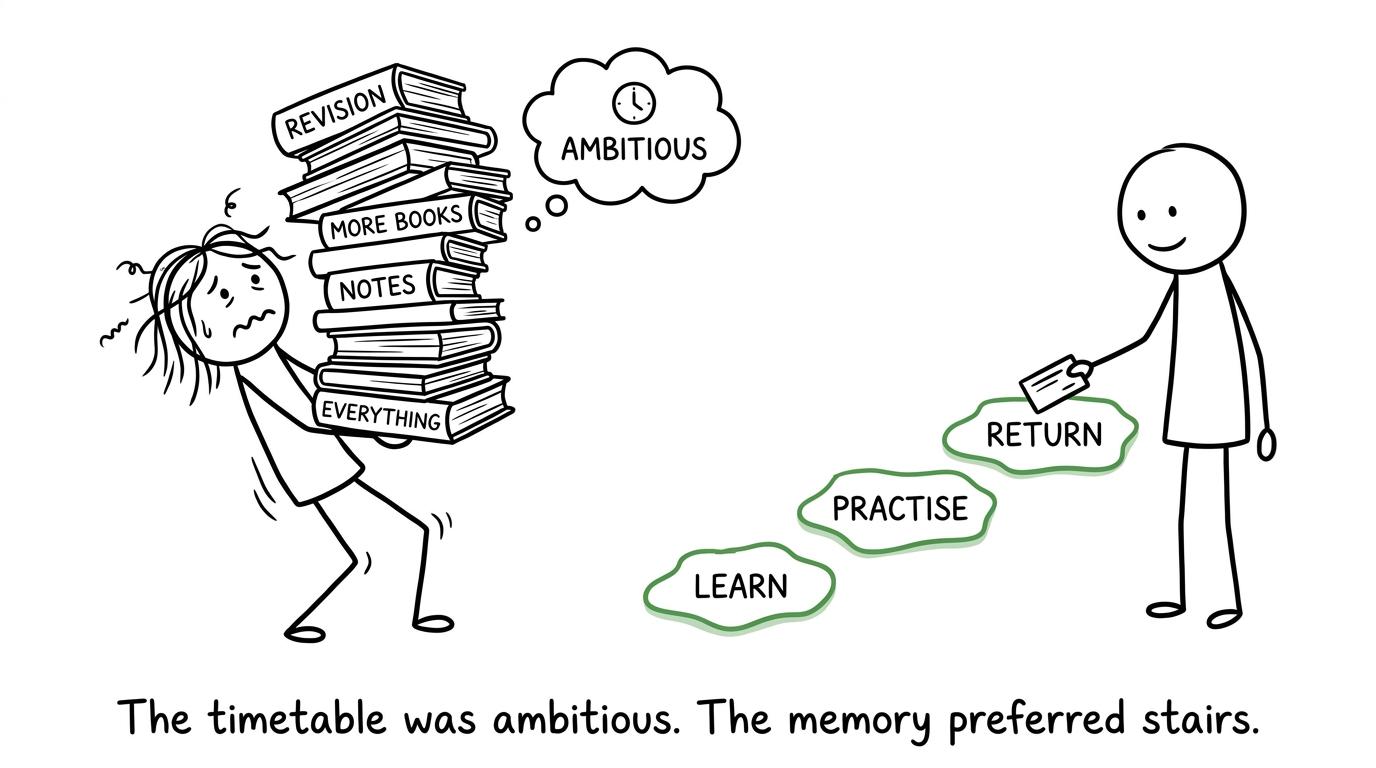 A student choosing small revision stepping stones instead of carrying every book
Change the order as the exam approaches
Early revision should be diagnostic and topic-focused. At this stage, it is reasonable to spend longer rebuilding weak foundations.
Later, increase the amount of mixed and timed work. Real papers do not announce which technique comes next. You must recognise the structure of a question, select relevant information and decide what statistical idea applies. Mixed practice prepares you for that switching.
Near the exam, your order might become:
- a brief recall task;
- a timed paper or paper section;
- careful marking with the mark scheme;
- focused repair of the two topics responsible for the most avoidable lost marks;
- a scheduled retest.
The guide to starting GCSE past papers explains how to progress from diagnostic sections to full timed practice. Predicted papers can provide fresh questions later, but they should supplement official past papers rather than replace broad specification coverage.
Common revision-order mistakes
Revising only in textbook order
Textbook order is designed to teach a course coherently. It is not automatically the best priority order for an individual student who has already covered the material. Let assessment identify where you begin.
Always starting with favourite topics
Familiar work feels smooth, and smooth work feels productive. But confidence is not the same as need. Use a favourite topic as a short warm-up if it helps, then move on.
Putting every weak topic into one exhausting block
Difficulty is not improved by overload. Divide a large area into smaller skills, practise one carefully and return later. A plan you can repeat is stronger than a heroic session you avoid repeating.
Finishing a topic and never revisiting it
Ticking a box records activity, not retention. Every important topic needs at least one later retrieval opportunity, ideally followed by mixed questions.
Refusing to alter the timetable
A timetable is a forecast. Marking supplies new data. If a paper reveals that data interpretation is costing more marks than averages, change the next session. Flexibility is not failure; it is evidence-led revision.
Make your next revision decision simple
The order of subjects in a GCSE timetable is not magic. Statistics does not have to occupy a particular day or always come before another subject. But the order within the learning process matters: diagnose before prioritising, build foundations before dependent ideas, practise before assuming mastery, and return before the knowledge fades.
Start today with one honest diagnostic task. Mark it, choose the clearest weakness and schedule its return. MathsGenie gives you the free structure to continue: revision lessons for understanding, practice questions and mini tests for retrieval, mark schemes and video solutions for feedback, and past papers and predicted papers for exam preparation.
Open the GCSE Maths revision hub, confirm your board and course, and let your next lost mark decide what comes next.