Revision Order GCSE Sociology: Does It Matter?
Revision order GCSE Sociology: learn when sequence matters, how to prioritise weak topics, and how to balance Sociology with GCSE Maths revision.
Revision timetables often look reassuring before they begin. Every subject has a colour, every evening has a purpose, and Sociology sits neatly between Maths and Science. Then Monday arrives, one task takes longer than expected, and the perfect plan starts to bend.
So, does revision order GCSE Sociology planning actually matter? Yes, but not because Sociology must always come before or after another subject. Order matters when it helps you revisit content over time, tackle genuine weaknesses, prepare for the next exam and use your concentration wisely. There is no universal subject sequence that guarantees better grades.
The better question is not, “Should Sociology come before Maths?” It is, “What needs my best attention today, and when will I return to it?”
The short answer: use priorities, not a fixed order
A strong revision order should:
- prioritise weak or forgotten material rather than favourite topics;
- reflect the dates and demands of your actual papers;
- revisit Sociology across several days instead of completing it in one block;
- include retrieval, exam questions and feedback;
- protect regular Maths practice, because mathematical fluency also fades without use;
- change when your evidence changes.
Start by confirming your specification through the GCSE Sociology revision hub. AQA and Eduqas organise their content and papers differently, so a timetable copied from another student may put topics in an unhelpful sequence.
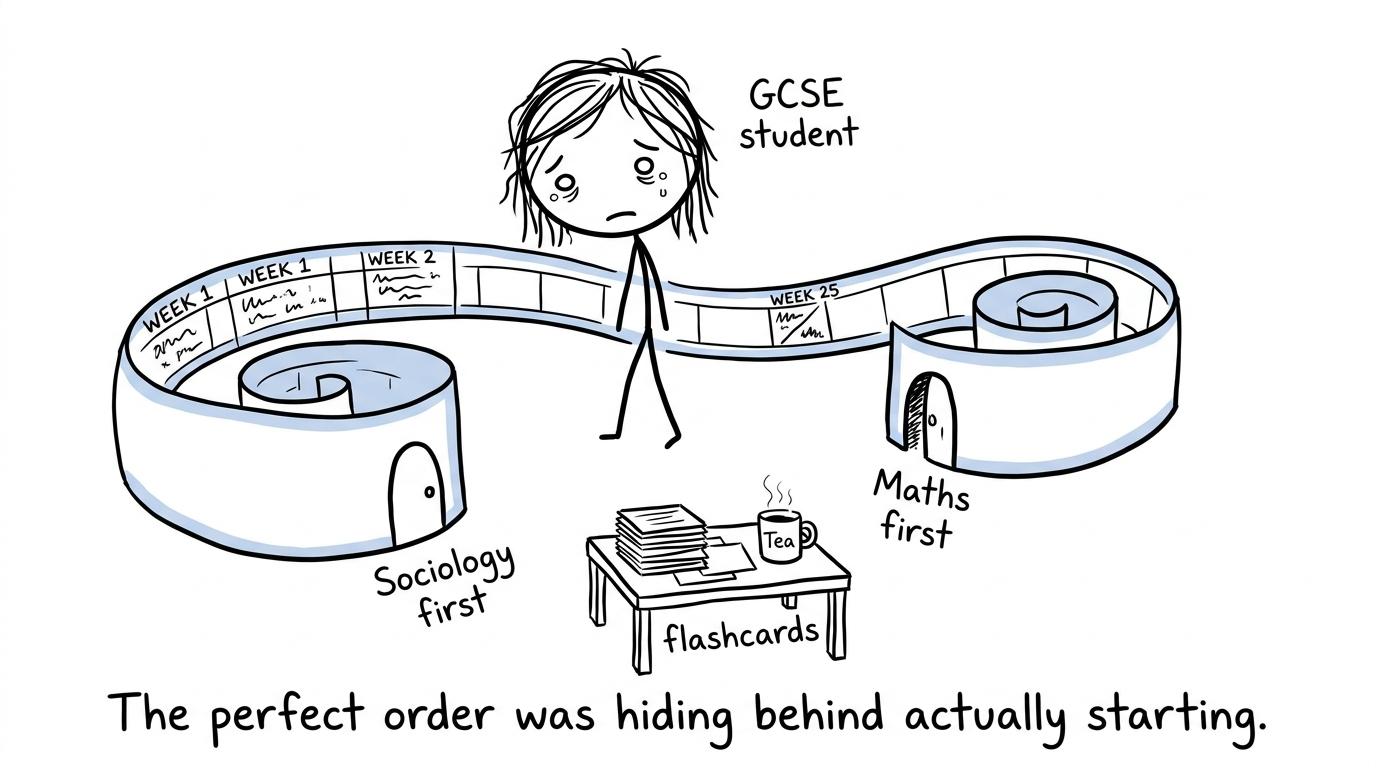 A student discovers that starting matters more than finding a perfect revision order
When revision order genuinely matters
Order matters most at three levels: across the exam season, across a week and within an individual session.
Across the exam season
The nearest exam deserves attention, but it should not consume every available hour. If Sociology is first, increase Sociology practice while keeping short Maths sessions alive. If Maths is first, reverse the emphasis without abandoning Sociology completely.
This is where spacing matters. Research on learning consistently supports returning to material after gaps and retrieving it from memory. A single long Sociology weekend may feel productive, but several shorter encounters create more opportunities to forget slightly, retrieve and strengthen recall.
Use the MathsGenie revision planner to place all your exam dates first. Work backwards from them, leaving room for repeated reviews rather than one final encounter with each topic.
Across the week
Do not assign one subject permanently to the beginning or end of every evening. Your energy changes, and so do your priorities.
If you concentrate best immediately after a break, use that period for whichever task requires the most reasoning. That could be planning a Sociology extended response, comparing perspectives or completing demanding higher-tier Maths questions. Later, when your concentration is lower, use shorter retrieval tasks, corrections or flashcards.
The first subject should usually be the task you are most likely to avoid, provided you are alert enough to do it properly. Starting with an easy favourite can create motion, but it can also become sophisticated procrastination.
Within a revision session
A useful session order is:
- retrieve earlier knowledge without notes;
- work on one weak area;
- complete an exam-style task;
- check it against a mark scheme or teacher guidance;
- record one precise next step.
The sequence matters because feedback should influence what happens next. Completing question after question without checking them simply gives mistakes more rehearsal.
The best order for GCSE Sociology topics
There is no single compulsory order for revision, but your specification provides the safest structure.
For AQA, Paper 1 focuses on families and education, while Paper 2 focuses on crime and deviance and social stratification. Relevant theory and research methods also run through the course. Both papers carry 50%50\%50% of the qualification, so revising only the topic you enjoy is a costly gamble. The AQA GCSE Sociology revision page brings the relevant lessons, questions and papers together.
Eduqas divides the qualification into Understanding Social Processes and Understanding Social Structures. Its content also includes families, education, crime and deviance, social differentiation and stratification, with research methods applied across topics. Use the Eduqas GCSE Sociology revision page rather than assuming an AQA topic order fits your papers.
A sensible sequence has three phases.
Build the foundations first
Begin with essential concepts, perspectives, evidence and research methods that support several areas of the course. Weak understanding here makes later evaluation harder because you lack the language needed to compare explanations.
This does not mean spending weeks copying definitions. Test whether you can explain each concept from memory, place it within the correct perspective and connect it to a relevant topic.
Repair weak topics next
Use marked classwork, teacher feedback and past-paper answers to identify where marks disappear. Separate the problem into:
- knowledge: missing or inaccurate concepts, studies or evidence;
- application: failing to connect material to the question or source;
- analysis: explaining links too briefly;
- evaluation: asserting that an argument is weak without explaining why;
- timing: leaving extended responses unfinished.
This produces a useful revision order. “Crime and deviance” is too broad; “evaluating explanations of crime” is actionable.
Mix topics once the basics are secure
After establishing a topic, stop keeping it isolated. Alternate families with education, or crime with stratification and methods. This is interleaving: practising different but related material rather than finishing one enormous block before touching anything else.
Mixing can feel harder because the correct idea is not already sitting in short-term memory. That difficulty is often useful. It forces you to recognise what a question requires, which is closer to the experience of an exam.
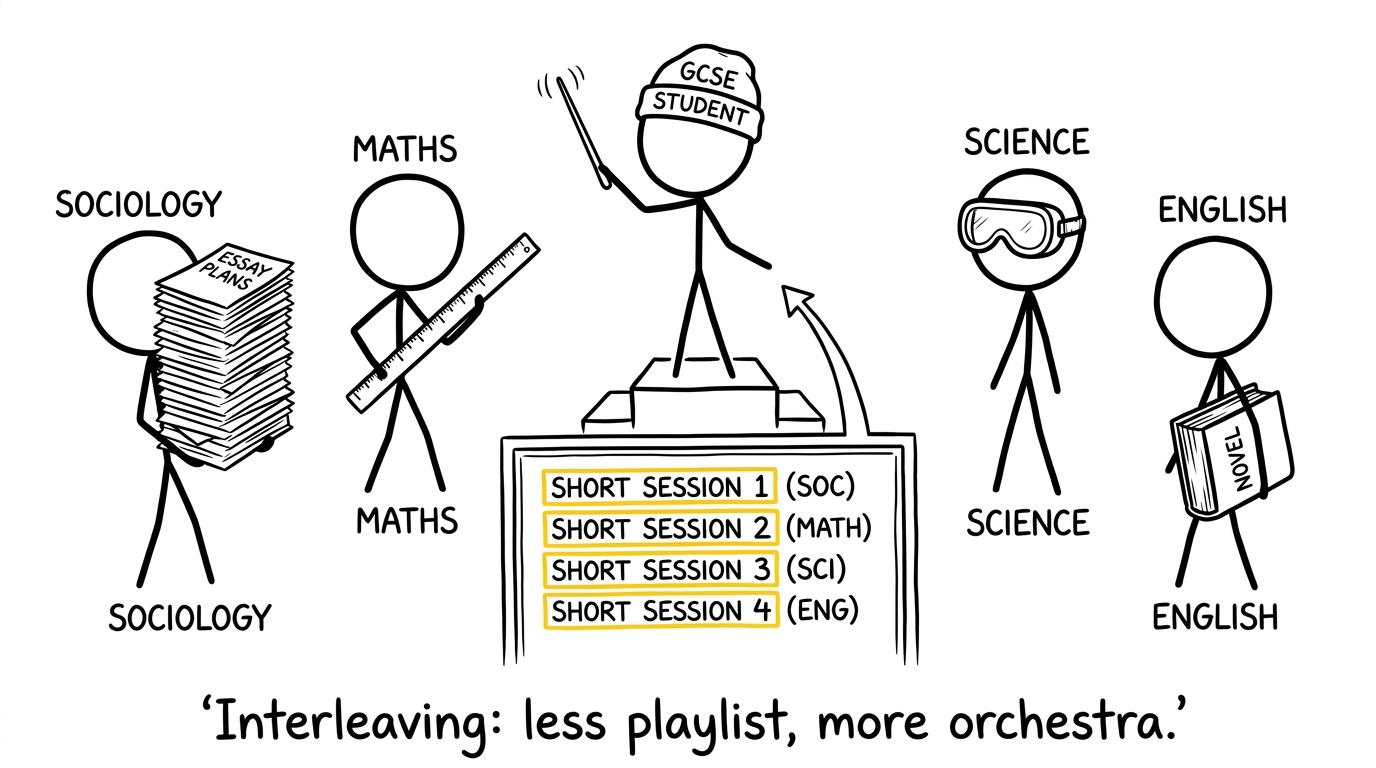 Revision subjects perform as an interleaved orchestra
Should Sociology come before or after Maths?
Neither order is automatically better. Sociology and Maths ask for different kinds of thinking, so the right sequence depends on the task rather than the subject label.
Put Sociology first when:
- you need fresh concentration for an essay plan or extended response;
- you have repeatedly postponed a weak topic;
- its examination is closer;
- teacher feedback shows a significant knowledge or evaluation gap.
Put Maths first when:
- you need uninterrupted time for difficult problem-solving;
- a Maths paper is closer;
- recent questions reveal a weak method;
- delaying Maths usually leads to skipping it.
Alternating can be particularly effective. A focused Sociology block followed by a break and a short Maths set creates variety without constant task-switching. Avoid changing subjects every few minutes, because resetting your materials and attention can consume the time you intended to save.
Students preparing for foundation or higher tier Maths can choose board-specific lessons, question banks and papers from the GCSE Maths revision hub. Sociology is not divided into foundation and higher tiers in the same way, so do not transfer your Maths assumptions to its assessment structure.
Build an order from evidence, not confidence
Confidence is useful, but it is a poor diagnostic tool. Familiar notes can make a topic feel secure even when you cannot retrieve it unaided.
Begin with a short knowledge check or selected past-paper questions. Mark the work carefully, then place topics into three groups:
- cannot recall or begin;
- partly secure but inaccurate;
- secure enough to maintain through spaced practice.
Revise the first group while your concentration is strongest. Keep the second group in regular rotation. Revisit the third group occasionally so it does not decay.
The same principle works for Maths. The guide to finding your weakest GCSE topics explains how to turn lost marks into a specific priority list. If you need a manageable weekday habit, the twenty-minute Maths revision routine can sit beside longer Sociology sessions.
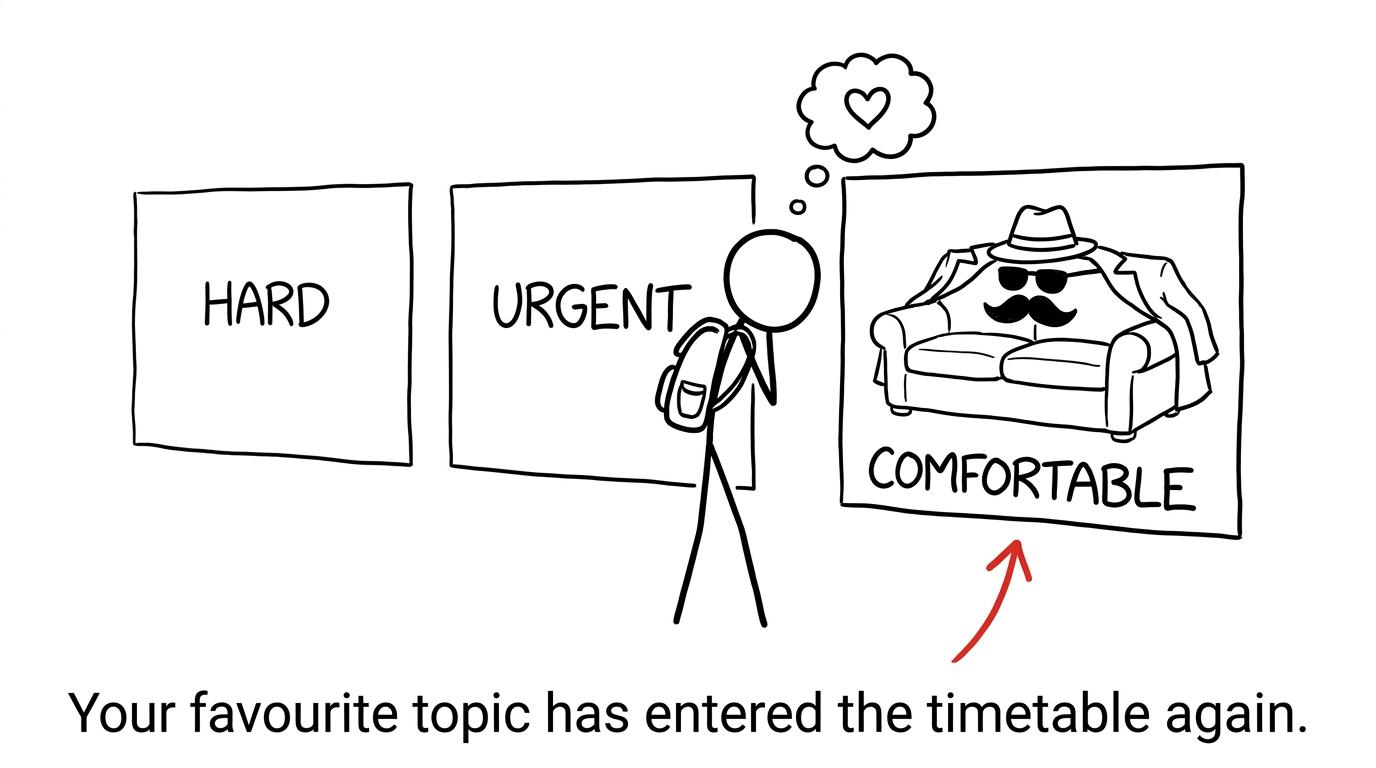 A comfortable favourite topic attempts to sneak back into the timetable
How to change the order near the exams
Early revision should be topic-led. Learn the content, retrieve it, answer focused questions and correct misunderstandings.
As the exams approach, become increasingly paper-led. Practise selecting relevant knowledge, adapting it to the wording and managing time. Keep some unseen material for realistic final practice rather than consuming every paper immediately.
For Maths, move from topic questions towards timed GCSE past papers, using the mark schemes and video solutions to diagnose lost marks. Edexcel GCSE predicted papers can provide additional exam-style rehearsal, but they should complement full specification revision rather than encourage topic guessing.
Your timetable should therefore evolve. An order that was sensible six weeks before an exam may be inefficient during the final week.
Common revision-order mistakes
Finishing one subject before starting another
GCSE courses are too broad for a “complete and forget” strategy. By the time you finish every Sociology topic, the first may already feel distant. Keep several subjects and topics in rotation.
Always beginning with the easiest task
An easy start can reduce resistance, but it should be brief. If comfortable tasks repeatedly occupy your best concentration, difficult work is pushed into tired periods and eventually disappears.
Following the textbook order without diagnosis
Textbook order is designed to teach a course coherently. Revision order should respond to your current knowledge, feedback and exam schedule.
Confusing rereading with retrieval
Reading notes before every attempt hides what you can actually remember. Close the notes first. Retrieve, check, correct and retrieve again later.
Letting the nearest exam erase every other subject
Prioritising an imminent paper is rational. Abandoning all later subjects is not. Maintain them through short recall or practice sessions so restarting does not feel like learning from the beginning.
Refusing to change the timetable
A revision plan is a decision tool, not a contract. Move a topic forwards when a past paper exposes a gap. Reduce its frequency when repeated checks show secure understanding.
A better order begins with one honest decision
The order you revise subjects in matters, but there is no magical position for GCSE Sociology. What matters is whether the sequence gives difficult work your best attention, revisits knowledge over time and changes in response to real evidence.
Start with your specification. Diagnose one weakness. Schedule the next return before closing your books.
MathsGenie can provide the structure: use the free Sociology revision hubs for board-specific lessons, questions and papers, then balance them with GCSE Maths revision lessons, practice questions, mini tests, past papers, predicted papers, mark schemes and video solutions. Open the revision planner today and build an order that serves your next mark rather than merely making the timetable look complete.