Revision Order GCSE Latin: Does It Matter?
Revision order GCSE Latin: learn when subject order matters and how spacing, retrieval and energy should shape a balanced Latin and maths plan each week.

The timetable looks sensible until you try to use it. Latin is sitting beside maths, both feel demanding, and a surprisingly awkward question appears: which should come first?
The short answer is that revision order GCSE Latin planning matters a little, but not because Latin has one perfect position in every timetable. Order matters when it affects your concentration, whether you revisit material, and whether weaker subjects receive enough attention. It matters far less than the quality and regularity of the revision itself.
For a student preparing for maths exams alongside Latin, the most reliable approach is to place the hardest task in a high-energy slot, alternate demanding activities, and revisit both subjects across the week. Do not automatically put Latin first or last every day. Let the task, your current weaknesses and the exam calendar decide.
The quick answer: how to order Latin and maths revision
Use this checklist when planning your week:
- Put a demanding Latin translation or timed maths paper in a slot when you are usually alert.
- Use lower-energy periods for short vocabulary retrieval, correcting work or reviewing an error log.
- Revisit Latin and maths on several days rather than completing one enormous block of each.
- Start with the subject you are most likely to avoid when procrastination is the main risk.
- Prioritise the nearer exam as the examination period approaches, without abandoning the later one.
- Alternate task types so that two heavily demanding sessions do not drain the same kind of attention.
- Use completed questions and mark schemes to decide what comes next.
The GCSE maths revision timetable guide can help you build this into a realistic week rather than an optimistic timetable you stop following after two days.
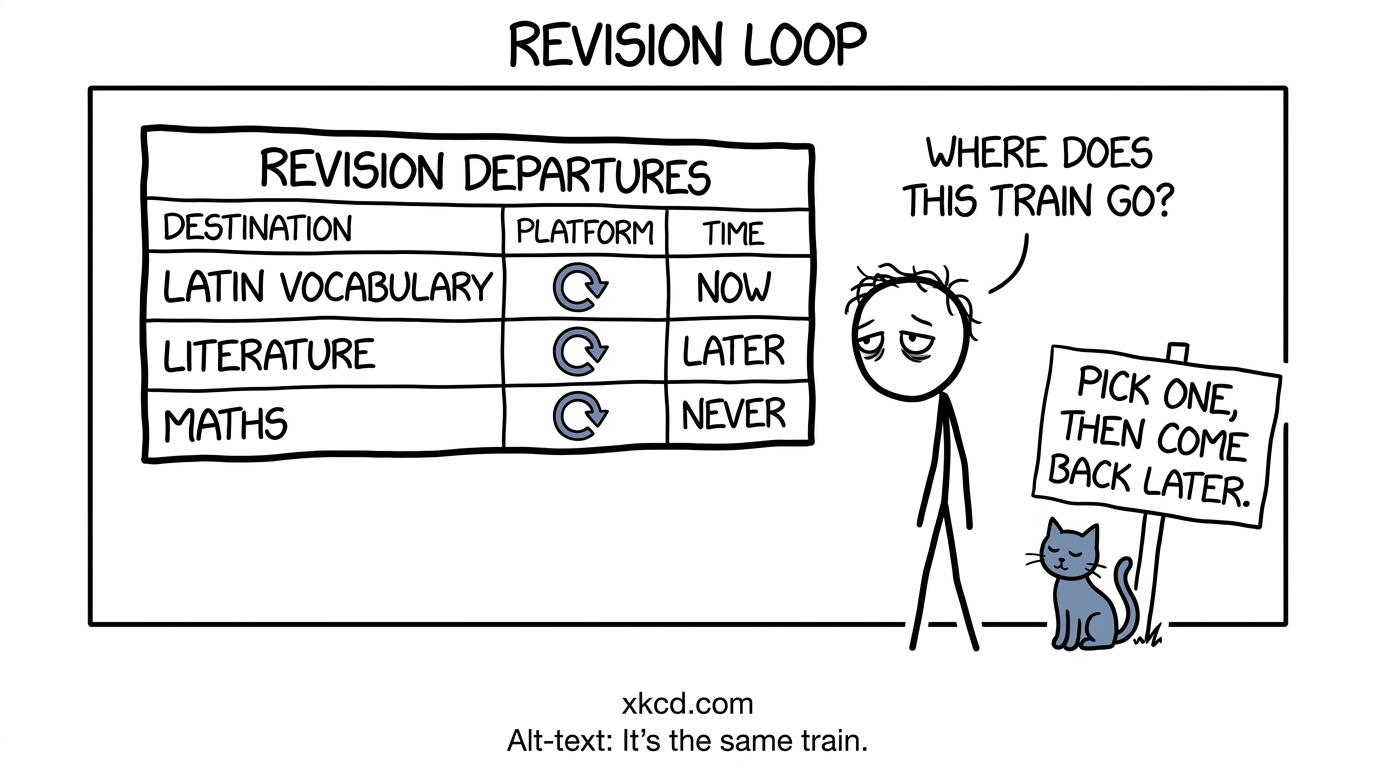 A confused student choosing between Latin and maths on a circular revision departures board
Why revision order matters less than students think
There is no universal evidence-based rule saying that Latin must come before maths, or that any particular GCSE subject should always occupy the first evening slot. Students differ in when they concentrate best, what they find difficult and which examination is approaching.
What learning research supports more clearly is spacing and retrieval practice. Spacing means returning to material on different days rather than cramming it into one sitting. Retrieval means trying to recall or apply knowledge before looking at the answer.
Both principles fit Latin. Vocabulary needs to be recalled, not merely recognised on a page. Grammar and translation choices need repeated application. Depending on your qualification and specification, prescribed literature or cultural material may also require accurate knowledge and thoughtful analysis.
They fit maths too. Remembering a method while looking at a completed solution can feel reassuring, but the examination asks you to select and apply that method independently. MathsGenie's guide to stopping maths content from being forgotten explains how spaced practice, mixed questions and marking can turn temporary familiarity into more durable recall.
So the order of Monday evening's subjects is not irrelevant. It is simply not the biggest lever. A beautifully ordered timetable filled with passive rereading is weaker than a slightly untidy plan built around retrieval, practice and correction.
When should GCSE Latin come first?
Latin should usually take the first slot when it contains the most mentally demanding task of the session.
When you need to translate independently
Translation asks you to hold several possibilities in mind: vocabulary, endings, syntax and the meaning of the sentence as a whole. If this is currently a weak area, doing it when tired may lead to guessing rather than careful analysis.
Place independent translation earlier, then follow it with a more contained maths task, such as targeted practice on one known weakness. The change of task can refresh attention without turning the second session into an easy escape.
When Latin is the subject you keep postponing
A timetable is partly an academic plan and partly a plan for managing your own behaviour. If you regularly begin with maths because it feels more familiar, then quietly run out of time for Latin, Latin should come first on selected days.
This is sometimes called tackling the avoided task first. It is not a claim that Latin is intrinsically harder. It simply closes a predictable loophole in your routine.
When the Latin examination is nearer
During the examination period, proximity matters. If Latin is tomorrow and maths is next week, the final Latin session deserves priority. That should be focused preparation rather than panicked cramming: short retrieval, familiar question types, corrections and a clear stopping time.
When should maths come first?
Maths should take the first slot when you need sustained problem-solving, a timed paper or careful work on an unfamiliar method.
When you are completing timed practice
A full paper or demanding paper section needs uninterrupted attention. Begin with maths while you are fresh, mark it after a short break, and use the result to choose a later topic session.
MathsGenie provides a central GCSE maths revision hub with free revision lessons, exam questions, past papers and solutions for boards including Edexcel, AQA, OCR and Eduqas. Choose the correct exam board and foundation or higher tier rather than mixing resources indiscriminately.
When maths has the larger evidence-based weakness
Do not judge weakness by anxiety alone. Use actual work. A marked paper may show that algebra, ratio or geometry is repeatedly costing marks, even if Latin feels more uncomfortable.
The MathsGenie weakest-topics diagnostic shows how to turn lost marks into a focused revision list. If maths contains the clearest and most expensive gap, give that gap your best concentration slot.
When the session must build examination stamina
Latin vocabulary retrieval can be effective in a short period. A maths paper cannot always be compressed in the same way. If your purpose is to practise sustained concentration under timed conditions, schedule maths first and keep the later Latin task short and precise.
Use task order, not just subject order
The more useful question is often not “Latin or maths first?” but “Which kind of thinking should come first?”
A subject label hides important differences. Latin vocabulary cards and an unseen translation are both Latin, yet they place very different demands on you. Watching a maths revision lesson and completing a timed higher-tier paper are equally different.
A balanced sequence might contain:
- a demanding task while concentration is high;
- a short break away from the desk;
- a different kind of active task;
- immediate checking and one written correction;
- a note showing what must be revisited.
Avoid placing two passive tasks together. Reading Latin notes followed by watching maths videos may feel smooth because neither forces you to reveal what you cannot yet do. If you watch a revision lesson, move promptly into questions.
For busy days, the twenty-minute maths revision routine offers a repeatable learn, practise and check structure. A similar principle can guide a short Latin session: retrieve vocabulary, attempt a small task, check it, and record the gap.
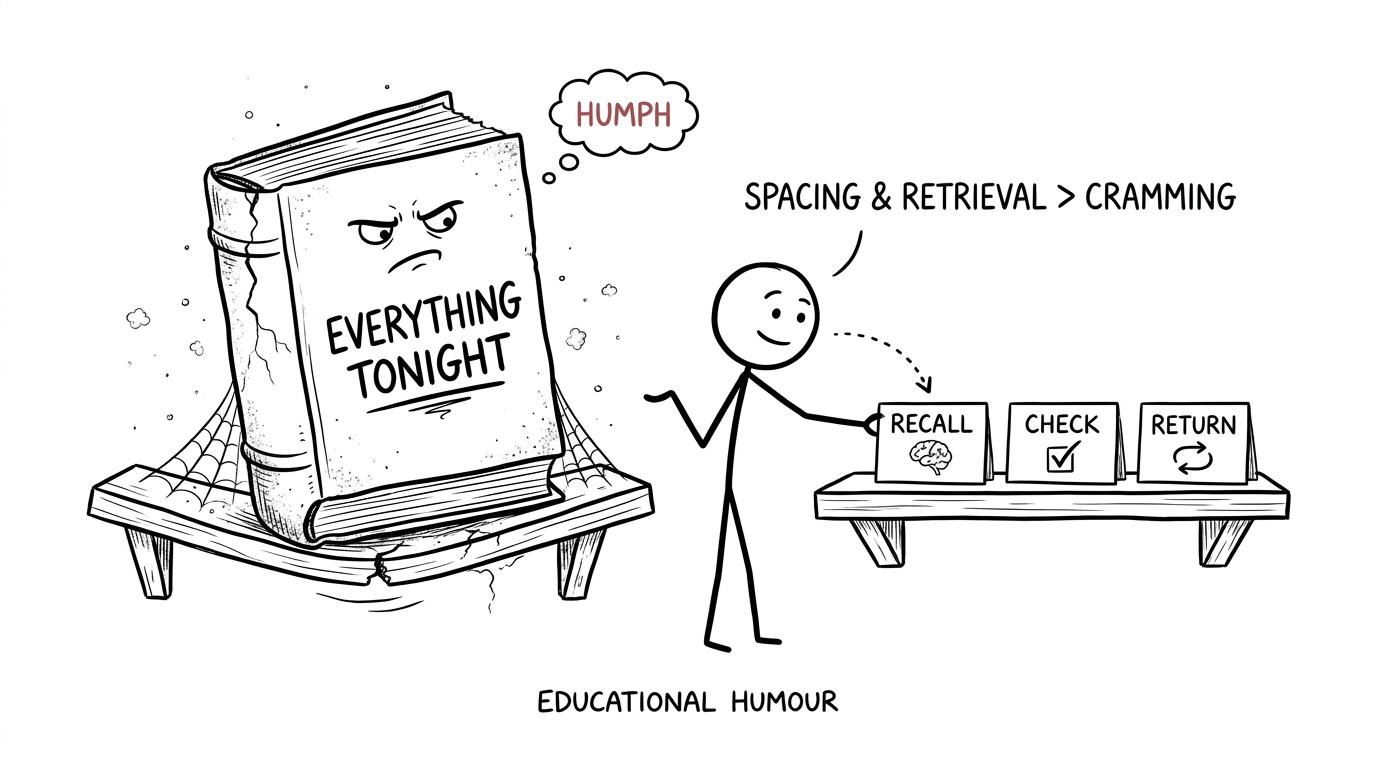 A student choosing small recall and checking cards instead of an enormous revision book
A flexible revision order for the week
A fixed daily order is simple, but flexibility usually produces a stronger plan. Give each session a purpose.
Early in the revision period
Concentrate on diagnosis and coverage. Alternate which subject goes first, and notice when the quality of your work is highest. Use teacher feedback, specification checklists and marked questions to identify gaps.
At this stage, spacing matters more than urgency. Returning to Latin vocabulary and maths topics throughout the week is preferable to declaring one day “Latin day” and another “maths day”, then leaving a long gap before either subject appears again.
If the full timetable feels overwhelming, use the one-month GCSE maths revision plan to organise maths around diagnosis, topic repair and increasingly timed practice.
In the final weeks
Move towards examination conditions. Latin sessions should increasingly reflect the tasks required by your own specification, while maths sessions should include material matching your board and tier.
Shorter timed sets can sit beside Latin without consuming an entire evening. For Edexcel students, the GCSE maths mini tests offer focused timed practice with mark schemes and worked solutions where available.
Between examinations
Let the next paper lead. Check the exact dates on your official school timetable, because subjects and components may be separated differently. Prioritise the nearest examination, then reserve a brief maintenance slot for the subject that comes later.
Maintenance prevents the later subject from becoming a cold start. A small vocabulary retrieval or a few mixed maths questions can preserve continuity without competing with tomorrow's paper.
Common mistakes with revision order GCSE Latin planning
Always starting with your favourite subject
Enjoyment is useful, but it can become camouflage. If the same subject always receives your freshest attention, the other gradually inherits the tired end of every evening. Rotate the first slot or deliberately protect time for the avoided subject.
Treating the timetable as more important than feedback
A timetable is a hypothesis. Marked work tests it. If a maths mini test uncovers a repeated weakness, or a Latin task reveals insecure vocabulary, change the next session accordingly.
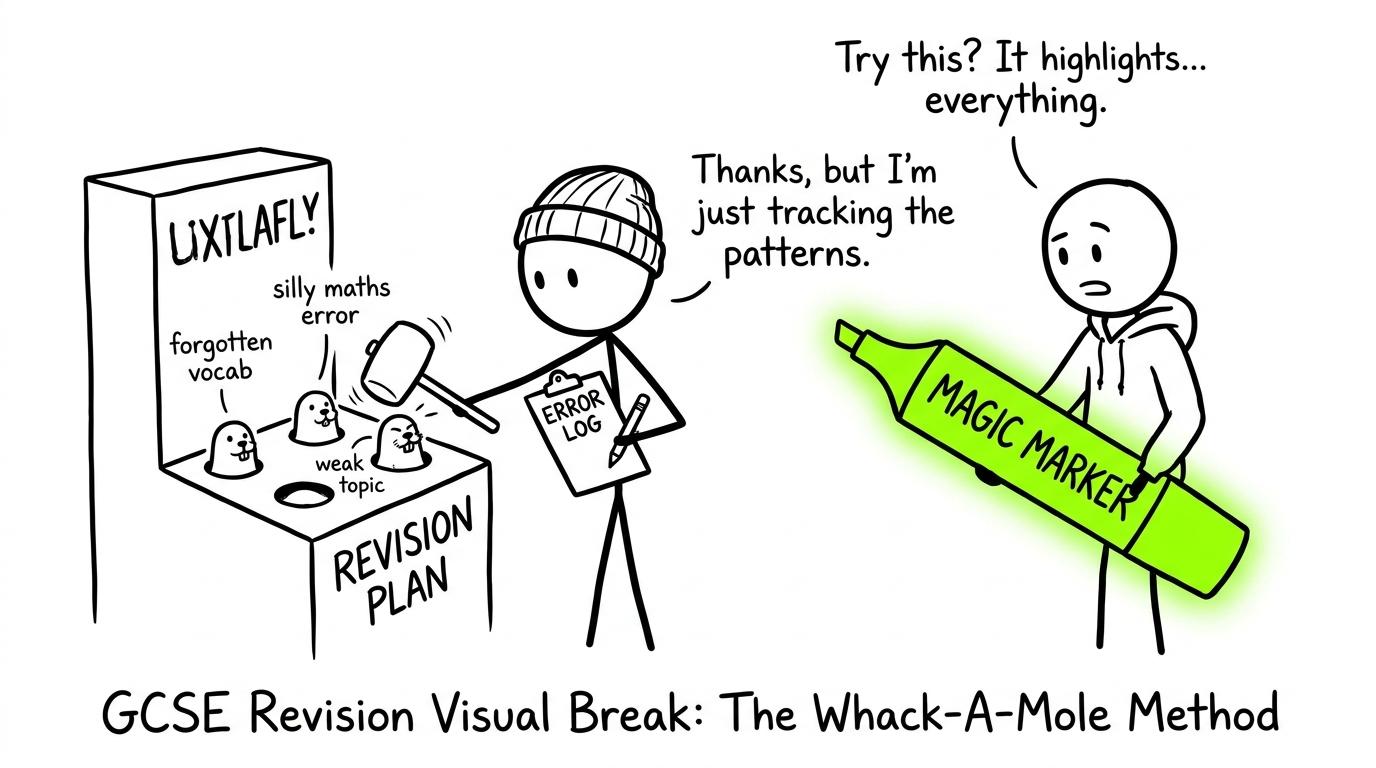 A calm student using an error log at a revision whack-a-mole machine
Scheduling two exhausting tasks back to back
A difficult translation followed immediately by a full maths paper may look impressively rigorous. It can also produce two poor-quality attempts. Separate demanding tasks or place one on another day.
Confusing rereading with retrieval
Highlighting vocabulary or reading a maths solution creates recognition. It does not prove that you can produce the answer independently. Close the book, attempt the task, then check.
Ignoring exam board, tier or specification
For Latin, use the content and assessment structure specified for your qualification. For maths, practise with the correct Edexcel, AQA, OCR or Eduqas materials and confirm whether you are sitting foundation or higher tier. Generic revision cannot replace knowing what your papers require.
The best order is the one that produces useful evidence
Revision order matters when it protects concentration, prevents avoidance and keeps both Latin and maths returning across the week. It does not matter enough to justify searching for one perfect sequence.
Begin with the task requiring your best attention. Follow it with a different form of active practice. Mark what you complete, record the specific gap, and allow that evidence to shape the next session. That rhythm is more valuable than always putting Latin first or always saving it until last.
For maths, make MathsGenie your free revision base. Use revision lessons to rebuild understanding, practice questions and mini tests to expose gaps, then past papers and predicted papers to develop examination readiness. Check your work with mark schemes and video solutions, update your revision planner, and return to the mistakes that matter most.
The order begins the session. The feedback decides where you go next.