Revising GCSE Astronomy With Music: Does It Help?
Revising GCSE astronomy with music can aid routine, but lyrics often distract. Learn when to use silence, instrumentals and timed self-tests.
There is a familiar revision moment: the astronomy notes are open, the headphones are on, and ten minutes later you remember every lyric but very little about stellar evolution. So, is revising GCSE astronomy with music a good idea?
The short answer is: sometimes, but not for every task. Quiet instrumental music may help you settle into a session without noticeably harming performance. Music with lyrics is riskier, particularly while reading, memorising facts or writing explanations. Silence remains the safest choice for demanding work and realistic exam practice.
The important question is not simply whether music is playing. It is whether the music helps you complete the task in front of you.
A quick music and revision checklist
Use this as your starting rule:
- Choose silence for past papers, unfamiliar calculations and extended written answers.
- Try quiet instrumental music for routine practice or organising notes.
- Avoid lyrics while reading, retrieving facts or learning terminology.
- Keep the volume low enough that it fades into the background.
- Use a familiar playlist rather than searching for new songs mid-session.
- Test your recall afterwards without music or notes.
- Practise regularly in the quiet conditions you expect in the examination.
Music is a setting, not a revision method. The learning still comes from retrieval, practice questions, marking and correction.
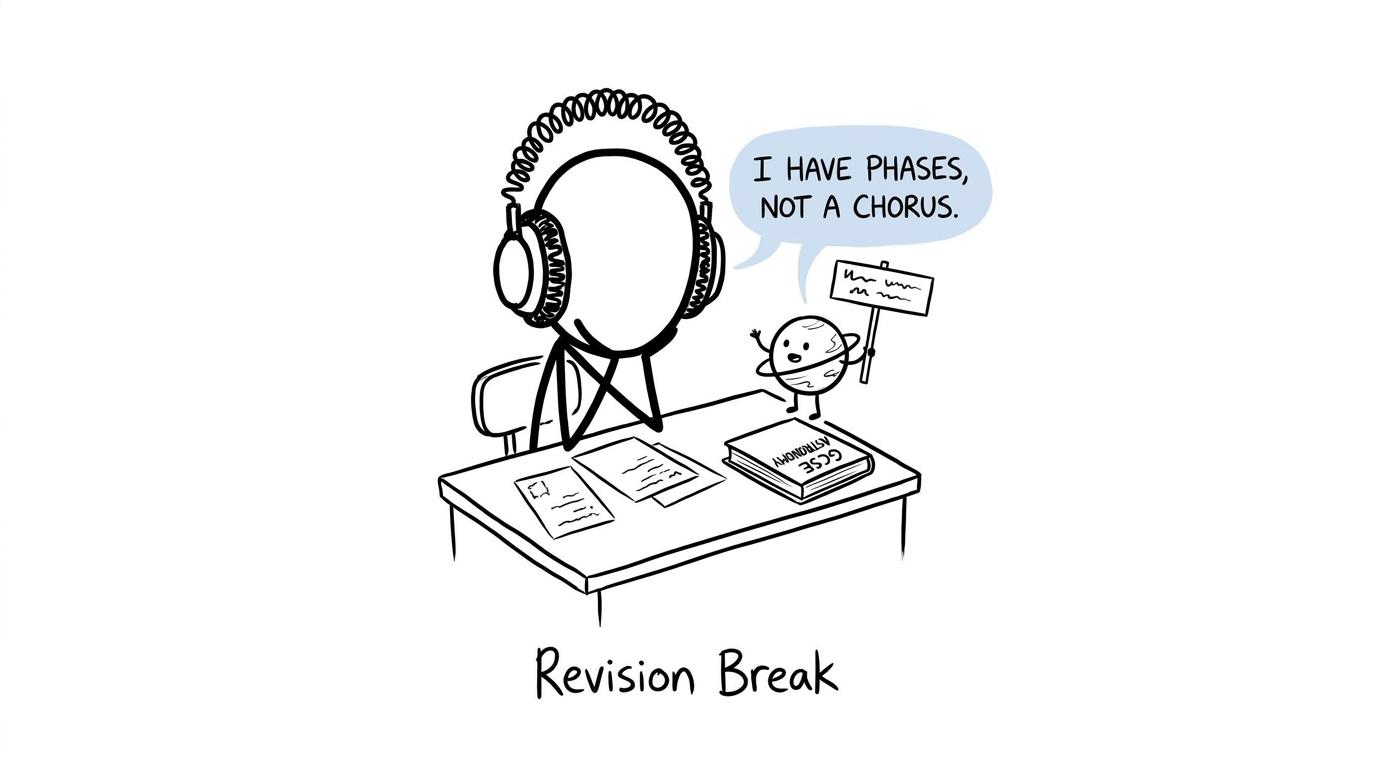 A planet reminds a student that it has phases, not a chorus
What research says about music and concentration
Research does not support a simple claim that music always improves concentration. Nor does it show that every form of background music is automatically harmful.
A systematic review covering a wide range of cognitive experiments found that results varied by task, music and individual. The clearest pattern was that music containing lyrics tended to be more disruptive than instrumental music, especially for memory and reading comprehension. A controlled study published in 2023 similarly found poorer verbal memory, visual memory and reading performance with lyrical music, while instrumental lo-fi music neither clearly improved nor damaged performance.
Another 2023 meta-analysis reported a small positive overall association between background music and learning, with effects depending on factors such as timing, age and the material being learned. Taken together, these findings suggest caution rather than a universal rule.
There is no convincing reason to assume that instrumental music makes everyone learn better. It may be neutral for many students. Lyrics, however, introduce competing language when the brain is already trying to process words.
That distinction matters in astronomy. Remembering the sequence of stellar evolution, interpreting a paragraph about redshift and constructing an extended explanation all rely heavily on verbal processing. A song is not merely sound in those moments. It is another stream of language asking for attention.
Match the sound to the astronomy task
GCSE Astronomy combines factual knowledge, mathematical reasoning, diagrams, observations and written evaluation. One soundtrack will not suit all of those demands.
Learning definitions and scientific explanations
Silence is usually the better option when learning terms, reading about astronomical models or recalling a sequence. Lyrics may compete with the words you are trying to encode and retrieve.
Do more than reread. Close the book and write what you can remember about a topic. Then check the specification or your notes and correct the gaps. A perfectly remembered playlist cannot compensate for passive revision.
Completing familiar calculations
Instrumental music may be less disruptive during familiar calculations, although it should not be treated as a performance enhancer. Pearson Edexcel GCSE Astronomy includes mathematical skills such as standard form, ratios, unit conversion, graphs and rearranging equations. Relationships may include forms such as:
I∝1d2 I \propto \frac{1}{d^2} I∝d21and
T2∝r3. T^2 \propto r^3. T2∝r3.If you already understand the method, quiet background music might make repetitive practice feel easier to begin. If you are learning the method for the first time, silence leaves more attention available for deciding what each quantity means and checking the units.
Astronomy students can strengthen these supporting skills through the GCSE Maths revision hub. The GCSE maths topics by exam board and tier guide also helps you identify relevant areas such as standard form, proportion, graphs and rearranging formulae.
Interpreting diagrams, graphs and observations
Graphical questions require you to notice scale, units, trends and anomalies. Observational work requires equally deliberate attention. Music that constantly changes pace, becomes louder or attracts emotional attention can pull you away from those details.
Instrumental sound may be acceptable when producing a neat summary diagram from knowledge you already understand. Turn it off when analysing unfamiliar data or evaluating the limitations of an observation.
Answering exam questions
Past papers should increasingly be completed in silence. The goal is not to make revision unpleasant. It is to make the real examination feel familiar.
Start with short sets if a full paper feels too demanding. The guidance on when to start GCSE past papers explains how to move from topic questions to timed sections and complete papers. Although MathsGenie specialises in maths, the same progression works well for astronomy calculations and data questions.
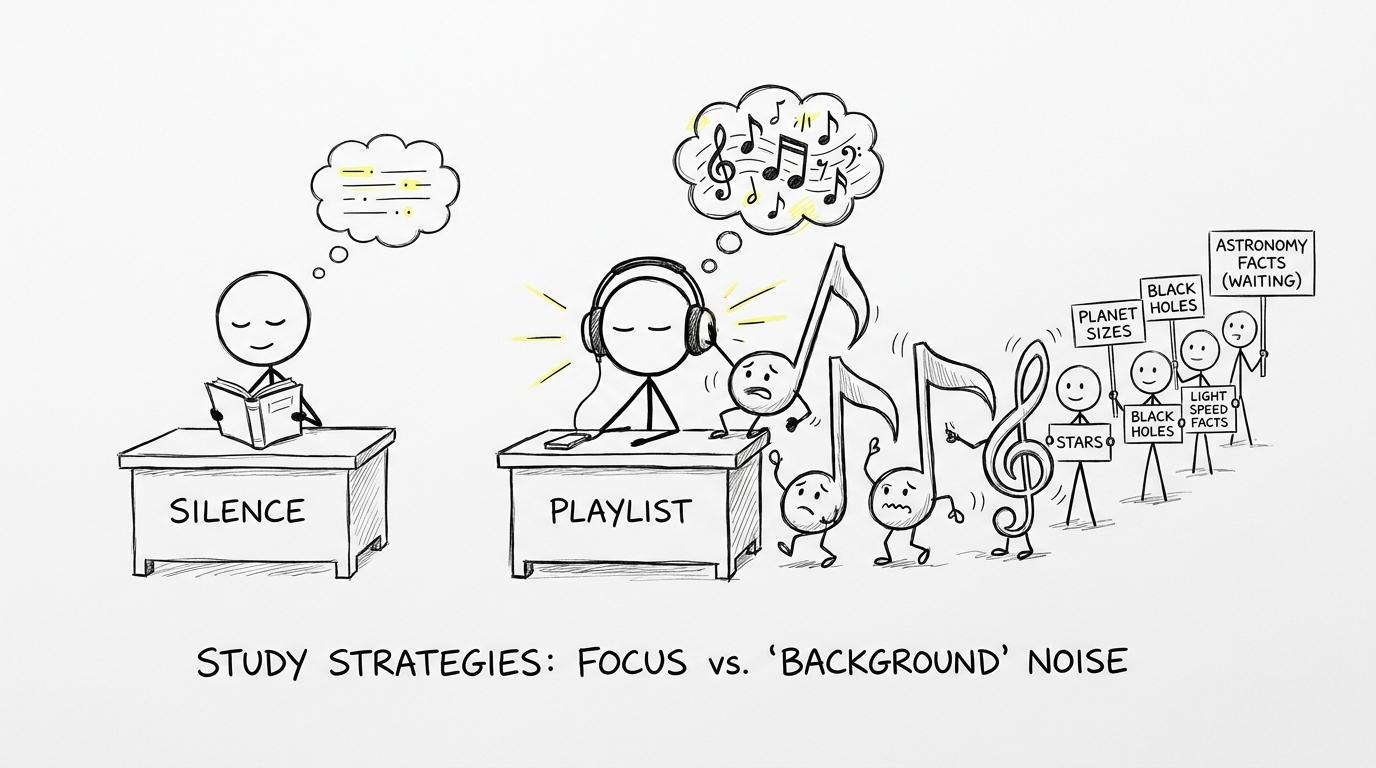 Musical notes queue behind astronomy facts trying to enter a student's brain
When background music may still be useful
Revision has two separate problems. One is learning effectively. The other is beginning at all.
A familiar instrumental playlist can act as a starting cue. You press play, put your phone out of reach and begin the planned task. In this case, the value may come from the routine rather than from any direct improvement in memory.
Music may also mask unpredictable household noise. A steady, quiet instrumental track can feel less intrusive than conversations, doors or a television in another room. If possible, use downloaded audio or a fixed playlist so that notifications and song searches do not become the real distraction.
The key is honesty. If music helps you sit down but then encourages daydreaming, it has solved one problem by creating another. Use it for the first few minutes, then switch it off when the work becomes demanding.
A structured plan reduces the need to rely on mood. The GCSE one-month revision plan shows how to combine focused topic work, retrieval and paper practice. For a broader sequence of skills, see the best order to learn GCSE maths topics.
Run your own fair revision test
Individual differences matter, so test the effect instead of trusting how productive a playlist feels.
Choose two astronomy topics of similar difficulty. Revise one in silence and the other with quiet instrumental music for the same length of time. Use the same revision method in both sessions. On the following day, complete comparable recall questions without notes and without music.
Record:
- how quickly you started;
- how often your attention wandered;
- how much you recalled later;
- how accurately you answered questions;
- how long corrections took.
Do not judge the session only by enjoyment. A playlist can make time pass quickly while reducing what remains in memory. Delayed recall is a better test.
Repeat the comparison more than once before deciding. A single session may be affected by tiredness, topic difficulty or interruptions. This is not a formal scientific experiment, but it is more informative than assuming that personal preference and learning effectiveness are identical.
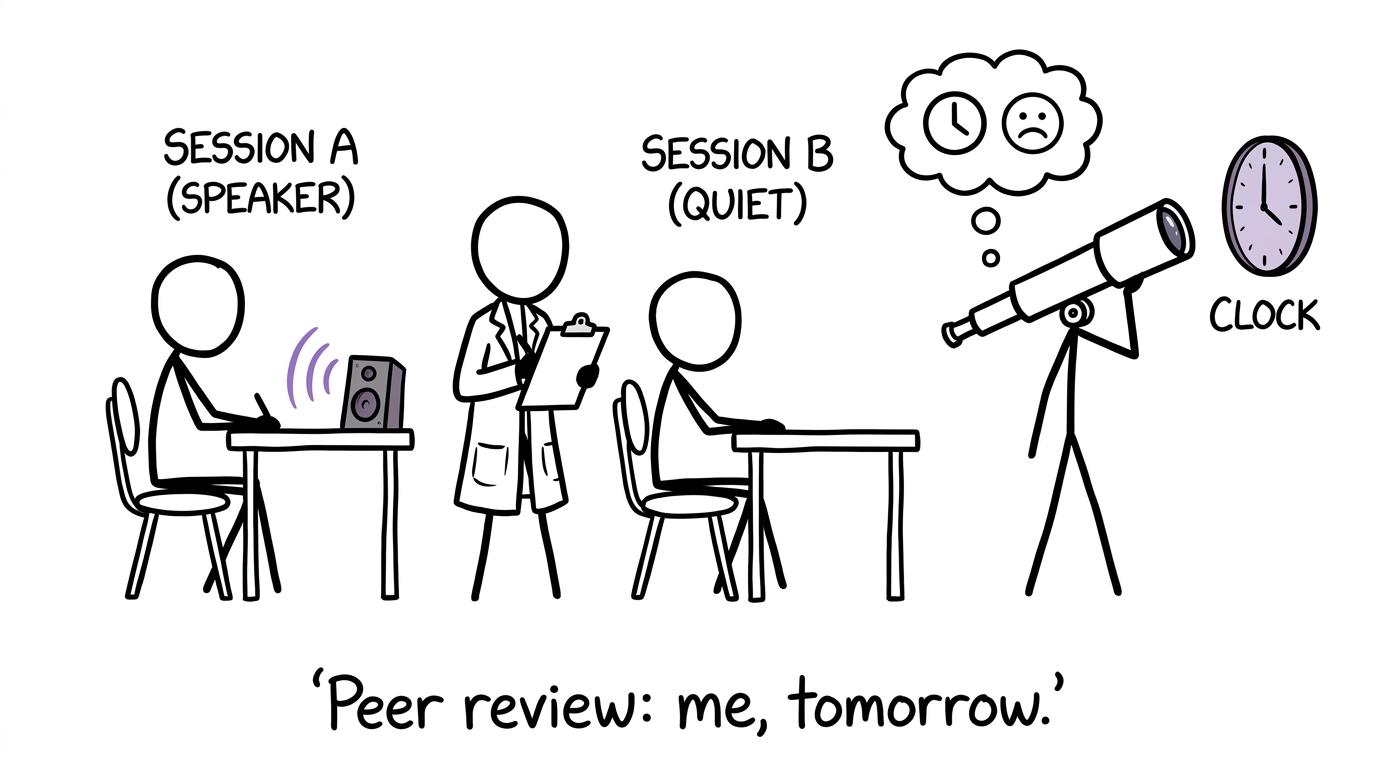 A student conducts a serious silence-versus-speaker revision experiment
Build a revision routine that survives without music
A strong astronomy session can follow a simple cycle:
- Select one precise topic.
- Retrieve what you know before opening your notes.
- Review the missing knowledge.
- Complete relevant questions.
- Mark the work carefully.
- Record one specific correction.
- Return to the topic on another day.
For mathematical content, MathsGenie's staged approach combines videos, exam questions and solutions. The MathsGenie staged revision scheme demonstrates how testing can identify the skills that need more attention.
Keep at least some sessions silent from the beginning. If you always work with headphones, silence itself can feel strange in an exam. Gradually practise removing the music for longer sections, especially as the examination approaches.
The same principle applies to GCSE Maths across Edexcel, AQA, OCR and Eduqas. Use music selectively while rebuilding a familiar skill, but remove it for timed questions requiring sustained reasoning. MathsGenie's guide to GCSE maths topics that regularly matter can help you choose purposeful practice rather than revising whatever feels easiest.
Common mistakes when revising with music
Choosing favourite songs rather than background sound
Favourite tracks invite anticipation, singing and changing songs. Familiar instrumental music is generally less demanding.
Making the volume too high
Background music should remain in the background. If you notice every transition or beat, it is probably claiming attention needed by the task.
Using music during every session
Even if music feels comfortable, complete regular silent practice. Exam performance depends partly on being accustomed to quiet, timed concentration.
Confusing longer revision with better revision
Music may make a session feel shorter, but time at a desk is not the same as learning. Check recall and question accuracy afterwards.
Letting the phone control the session
Choosing playlists, skipping tracks and reading notifications can be more disruptive than the music itself. Prepare the audio before starting and place the device out of reach.
Revising passively
Copying colourful notes while listening to music can feel productive without exposing weak knowledge. Retrieval, practice questions and corrections provide much stronger evidence of understanding.
The best answer is a flexible one
Revising GCSE astronomy with music is not automatically good or bad. For reading, memorisation, unfamiliar mathematics and exam practice, silence is the safer choice. For routine tasks, a quiet instrumental playlist may be neutral and may help some students begin. Music with lyrics carries the clearest risk of distraction.
Treat your playlist as part of the environment, not as the engine of progress. The engine is active recall, accurate practice and careful review.
Use MathsGenie's free GCSE Maths resources to strengthen the standard form, ratio, algebra, graphs and geometry that support astronomy. Build understanding with revision lessons and video solutions, then use practice questions, mini tests, mark schemes, past papers and predicted papers to make your knowledge reliable under pressure. Headphones are optional. Purposeful practice is not.