

Revising Before Bed GCSE Bengali: Help or Harm?
Revising before bed GCSE Bengali can support recall if it stays brief and protects sleep. Learn what to review, when to stop, and how to plan maths.
The question behind revising before bed GCSE Bengali is simple: will those final vocabulary cards settle into your memory overnight, or will late-night revision leave you too tired to perform tomorrow?
The short answer is that a brief, calm review before bed may support memory consolidation, particularly for material you have already learnt. But it stops helping when revision delays sleep, increases anxiety or turns into an attempt to learn an entire topic at midnight. Sleep is not time stolen from revision. It is part of the process that helps learning stick.
This matters even more when Bengali is only one subject competing with GCSE maths, English and science. A sensible evening should protect tomorrow's concentration as well as review today's knowledge.
The quick bedtime revision checklist
Before opening your Bengali notes late in the evening, ask:
- Am I reviewing familiar material rather than beginning a difficult new topic?
- Can I finish within about fifteen to twenty minutes?
- Will I still have enough time for a full night's sleep?
- Am I testing myself rather than simply rereading?
- Can I work away from my bed and put my phone aside afterwards?
- Have I decided exactly when I will stop?
If the answer to most of these questions is yes, a short session may be useful. If revision will push your bedtime back, sleep is usually the better investment.
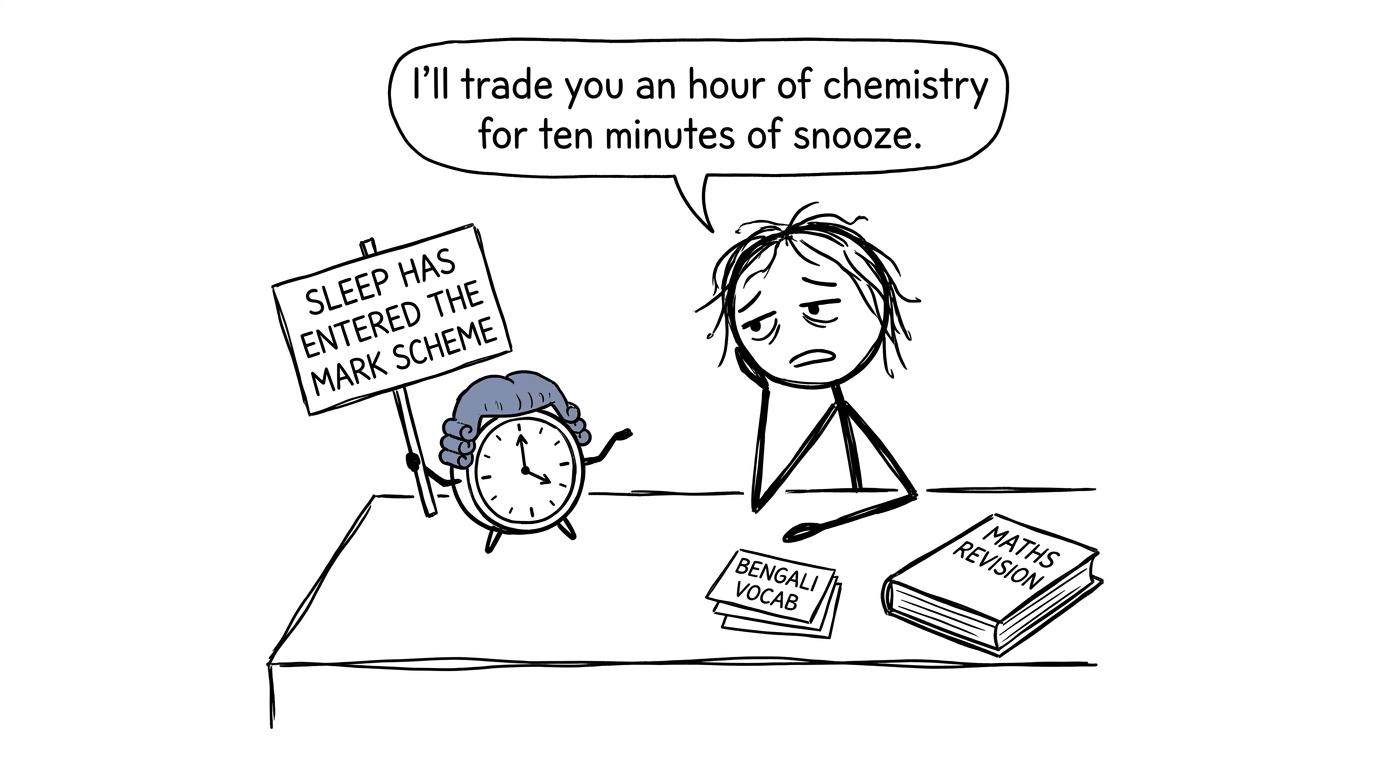 A GCSE student and an alarm clock debate whether sleep belongs in the mark scheme
Why sleep matters after GCSE Bengali revision
Learning does not finish when you close a book. During sleep, the brain continues processing and stabilising recently encountered information. This is commonly called memory consolidation.
Research generally supports the idea that sleep after learning can reduce forgetting. A recent study of adolescent English vocabulary learning also found stronger memory consolidation after sleep. However, evidence about the perfect time to learn is more mixed. Earlier adolescent research found that evening learning benefited a procedural task, while word-pair recall sometimes benefited more from afternoon learning.
That distinction matters. Bengali vocabulary, spellings, translations and grammatical patterns are forms of declarative knowledge. The research does not justify a rule that says every student should memorise vocabulary immediately before sleeping. It suggests something more modest: sleep supports memory, but the timing, difficulty of the task and quality of the sleep all matter.
The useful principle is therefore not "revise as late as possible". It is "review briefly, then sleep properly".
Sleep supports recall but cannot replace learning
A bedtime review can reactivate a memory. It cannot create a secure memory from nothing.
If you have already met a set of Bengali words several times, retrieving them before bed may strengthen the learning process. If you are encountering forty unfamiliar words for the first time while exhausted, you may struggle to encode them accurately in the first place. There is less useful material for sleep to consolidate.
The same is true in maths. Looking over a method you practised earlier may refresh it. Trying to understand an unfamiliar Higher tier topic while barely awake is unlikely to be efficient. The GCSE Maths Revision hub is better used earlier in the day, when you can watch a lesson, answer practice questions and think carefully about errors.
When revising before bed helps GCSE Bengali
A late review is most useful when the task is small, active and familiar.
Good options include:
- recalling a short set of previously learnt vocabulary;
- checking commonly confused Bengali spellings;
- saying several prepared speaking responses aloud;
- mentally retrieving useful sentence structures;
- reviewing corrections from an earlier writing task;
- testing recognition of words from a known topic.
For AQA GCSE Bengali, listening, speaking, reading and writing each contribute approximately 25%25\%25% of the qualification. A balanced revision plan should therefore develop all four skills rather than allowing vocabulary lists to consume every evening.
A short bedtime session is naturally better suited to retrieval than to full exam practice. Listening work, extended writing and timed reading normally deserve an earlier slot when your attention is stronger.
Use retrieval, not passive rereading
Rereading can feel smooth because the answer is visible. That feeling is not the same as being able to recall the answer independently.
For a stronger bedtime routine:
- cover the Bengali word and retrieve it from the English prompt;
- reverse the direction and retrieve the English meaning;
- say an answer before checking it;
- separate secure words from uncertain ones;
- leave difficult errors for tomorrow's focused session.
Keep the test short enough that it remains calm. Bedtime revision should close a loop, not open five new ones.
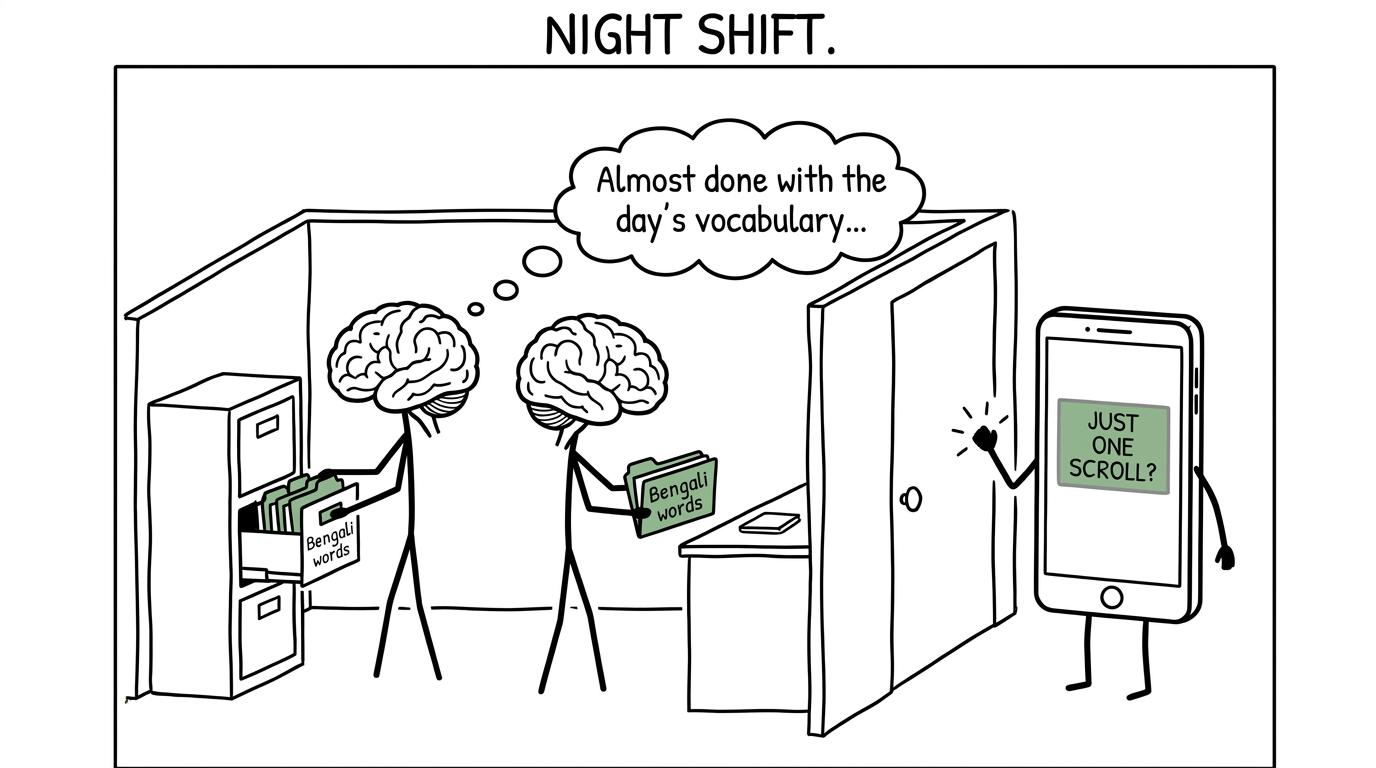 Tiny brain workers file Bengali vocabulary while a phone asks for one more scroll
When late-night Bengali revision starts to hurt
The clearest danger is not the subject. It is lost sleep.
Teenagers commonly need around eight to ten hours of sleep, although individual needs vary. NHS sleep guidance also emphasises regular routines, reduced caffeine later in the day and a calm, screen-free wind-down. If a twenty-minute review quietly becomes two hours of cramming, any possible memory benefit is being bought with poorer alertness the next day.
Insufficient sleep can make concentration, emotional regulation and careful decision-making harder. Those are exactly the abilities required for listening closely, constructing accurate written answers and avoiding preventable mistakes in maths.
Late revision is likely to be counterproductive when:
- you repeatedly miss your planned bedtime;
- you are too tired to check answers accurately;
- mistakes make you anxious rather than informative;
- revision takes place in bed and makes it harder to switch off;
- phone notifications keep interrupting the session;
- caffeine is being used to extend the evening;
- you are attempting a full paper shortly before sleep.
If you have a maths exam the following morning, use a controlled GCSE maths night-before plan rather than sacrificing sleep to one more paper.
A better evening routine for Bengali and maths
The strongest routine gives demanding work the best part of your attention and reserves bedtime for light retrieval.
Earlier in the evening
Complete the work that requires sustained thought. This might include a Bengali listening task, a timed writing response or a focused maths topic. For maths, first identify the skills actually costing you marks. The guide to finding your weakest GCSE topics explains how to use marked work as evidence rather than revising whatever feels most comfortable.
Use this earlier period to:
- learn or repair one specific skill;
- complete practice questions without notes;
- check the relevant mark scheme;
- record errors precisely;
- decide what needs revisiting later.
Maths students should also confirm that resources match their board and tier. The GCSE maths topics by exam board and tier guide covers Edexcel, AQA, OCR and Eduqas and helps prevent unfocused revision.
Shortly before your wind-down
Choose one small Bengali retrieval task. Set a firm endpoint and stop when it arrives, even if a few words remain uncertain. Those words become tomorrow's starting list.
Then put the materials away. Dim the lights, leave the phone outside the sleeping area if possible and follow a consistent routine. The goal is not to fall asleep while revising. It is to finish revision early enough that sleep remains easy.
The following morning
Spend a few minutes testing the same material without looking at your answers. This tells you more than the confident feeling you had while reading the night before.
Items recalled correctly can be scheduled for a later review. Items missed should return sooner. This creates spacing across evenings rather than one exhausting block.
Protect maths revision across a crowded GCSE timetable
A Bengali exam can easily dominate your attention when it is close, but maths performance develops through repeated practice. Letting maths disappear for a week often creates a larger restart than expected.
On busy language-revision days, keep a small maths minimum:
- one short set of practice questions;
- a mini test;
- corrections from a previously marked paper;
- one revision lesson followed by independent questions.
A structured one-month GCSE maths revision plan can help distribute this work before the exam season becomes crowded. Past papers should also be introduced deliberately rather than saved for a midnight emergency. The guide to when to start GCSE past papers explains how to move from diagnosis to timed practice.
The principle is the same in both subjects: short retrieval has a place, but substantial learning needs time, feedback and alertness.
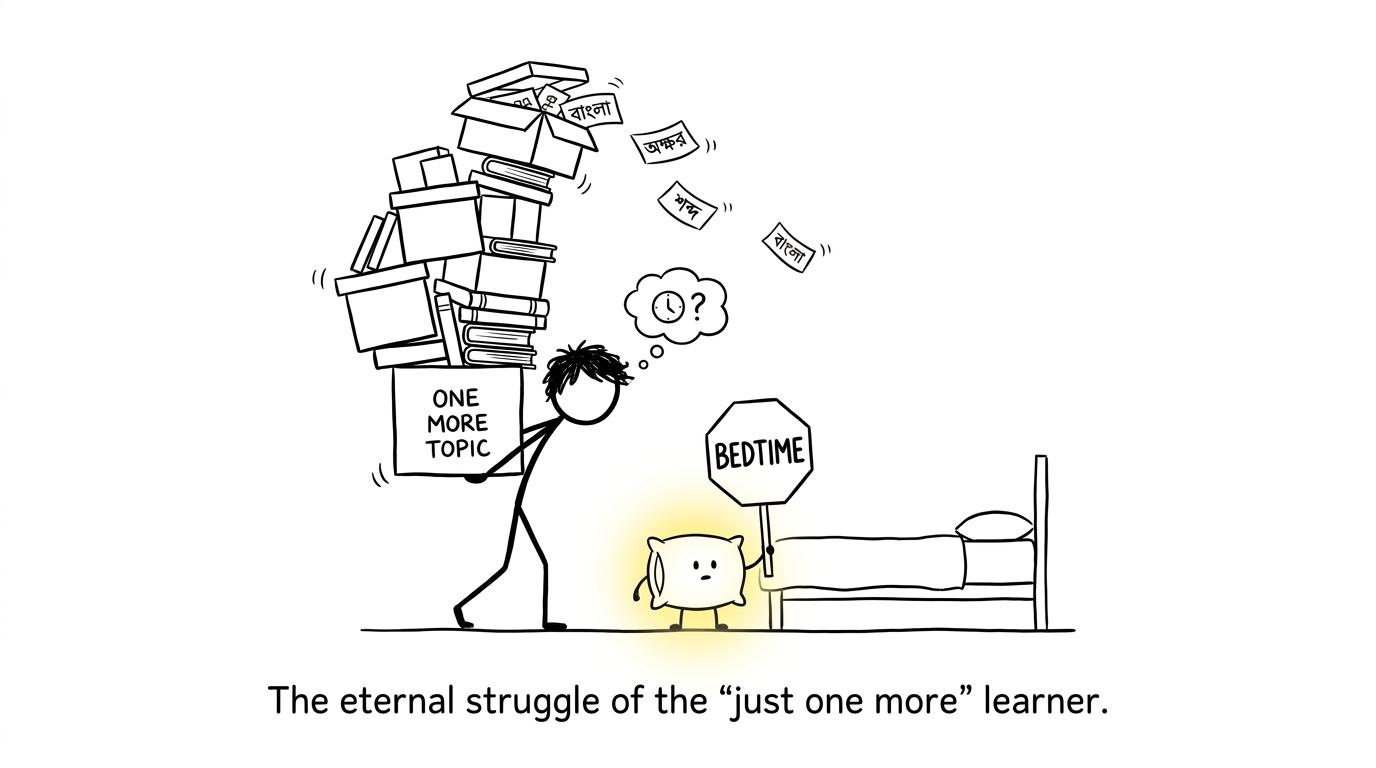 A student carries a tower of extra topics towards bed while a pillow holds up a bedtime stop sign
Common mistakes with bedtime revision
Turning a review into a new lesson
The final part of the evening is not the ideal time to begin a large grammar unit or unfamiliar maths topic. Review what you already partly know and schedule new learning earlier.
Measuring effort by how late you stay awake
A late finish feels serious because it is uncomfortable. Discomfort, however, is not proof of effective revision. Judge the session by what you can retrieve later, not by the bedtime you sacrificed.
Revising on a phone without boundaries
Digital flashcards can be useful, but the same device contains messages, videos and notifications. If a phone keeps extending the session, use paper cards or a written recall list instead.
Ignoring errors because bedtime is close
Do not repeatedly rehearse an uncertain spelling or method. Mark it as uncertain, check the accurate version and return to it when alert. Repetition only helps when what you repeat is correct.
Attempting full papers too late
A full Bengali or maths paper requires attention, timing and careful review. Use daytime or early-evening sessions for this work. If your tier is still being discussed, read the guidance on GCSE Foundation and Higher maths and speak to your teacher before selecting practice papers.
The verdict: revision should protect sleep
Revising GCSE Bengali immediately before bed can help when it is a brief retrieval session built on earlier learning. It hurts when it becomes cramming, creates anxiety or reduces sleep. There is no memory trick powerful enough to make chronic tiredness a sensible revision strategy.
Finish the demanding Bengali and maths work earlier. Use the final review to retrieve a small amount, note what needs attention tomorrow and stop at the planned time.
For your maths preparation, make MathsGenie's free GCSE revision resources your starting point. Use revision lessons to understand methods, practice questions and mini tests to build recall, then past papers and predicted papers to develop exam technique. Check your work with mark schemes and video solutions, and close the laptop early enough for sleep to do its share of the work.










