

Revising Before Bed GCSE Astronomy: Help or Hurt?
Revising before bed GCSE Astronomy can aid recall if sleep stays protected. Use this calm plan to revise effectively without late-night cramming.
The clock says bedtime. Your notes say stellar evolution. A worried part of your brain says that another hour might rescue tomorrow's test.
So, does revising before bed GCSE Astronomy help? A short, focused review can support memory, particularly when sleep follows soon afterwards. But the benefit disappears quickly if revision delays or disrupts that sleep. You cannot consolidate information during sleep you have traded away.
The practical answer is simple: use the final part of the evening for calm retrieval, not heavy learning. Stop at a fixed time, protect enough sleep and return to difficult calculations when you are alert.
The short answer: revise briefly, then sleep
Late-evening revision is most useful when it meets four conditions:
- You review material you have already learnt.
- You actively retrieve facts rather than rereading pages.
- The session is short and has a firm stopping time.
- You still leave enough time for a full night's sleep.
It is likely to hurt when you attempt an entire topic, complete a full paper, drink caffeine to stay awake or continue until you are too anxious to settle.
A sensible bedtime review might last around 151515 to 252525 minutes. It should feel like closing open tabs in your mind, not opening sixteen new ones.
For a wider evening structure, MathsGenie's GCSE Maths Night-Before Plan applies the same principle: choose a small target, mark honestly and protect your stopping time.
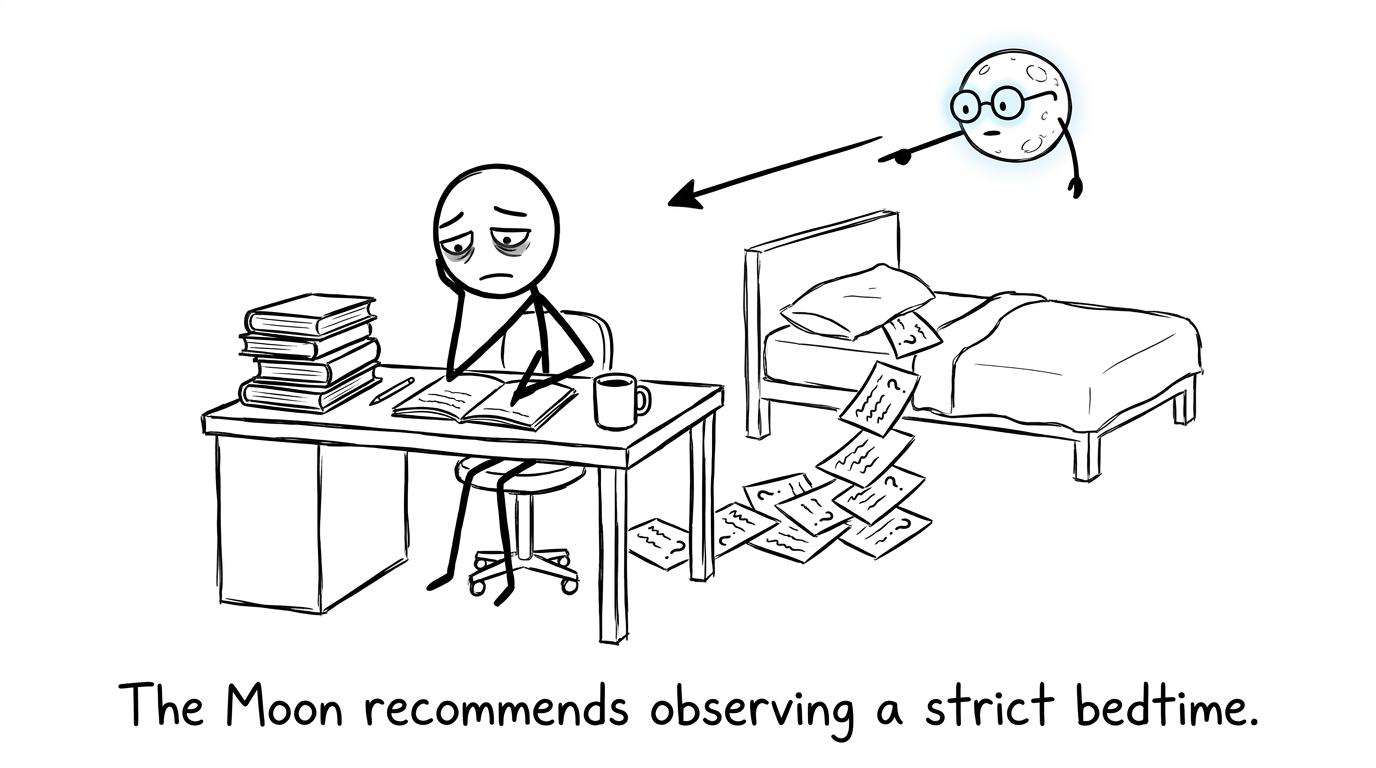 A cartoon Moon firmly recommends bedtime while revision cards try to hide under a pillow
Why sleep matters after astronomy revision
Learning does not finish when you close the book. Newly encoded information remains vulnerable. During sleep, the brain supports processes involved in stabilising and reorganising memories, usually described as memory consolidation.
Research reviews consistently support a role for sleep in retaining newly learnt information. However, they do not prove that studying immediately before sleep is always better than studying earlier. Timing effects can vary with the material, the learner and the type of memory being tested.
That distinction matters for Astronomy. The subject combines several kinds of learning:
- factual recall, such as features of the lunar surface;
- linked explanations, such as stages of stellar evolution;
- visual interpretation of diagrams and graphs;
- procedural skills, including calculations and data handling;
- evaluation of observational methods.
Sleep may help preserve what you have successfully encoded. It cannot repair a concept that was never understood, and it cannot replace repeated retrieval over several days.
There is also a direct cost to cutting sleep. Teenagers generally need substantial sleep, with authoritative health guidance commonly placing the recommended range around 888 to 101010 hours per night. Insufficient sleep is associated with weaker attention, concentration and academic performance. Those are precisely the abilities required to interpret an unfamiliar graph or keep track of units in a calculation.
The best question is therefore not, "Can I fit in another hour?" It is, "Will this hour improve tomorrow's performance more than the sleep it removes?" Late at night, the answer is often no.
What to revise before bed
The final session should involve low-friction retrieval. Select one narrow area rather than browsing the whole specification.
Good bedtime tasks
Try one or two of these:
- recall key definitions without looking;
- label a familiar diagram from memory;
- list the stages in a process, then check the order;
- review a small set of equations and units;
- explain one concept aloud in plain language;
- inspect mistakes you corrected earlier that day;
- write three questions to answer the next morning.
For calculations, recall the structure rather than beginning a difficult set. You might check that you can recognise relationships such as:
speed=distancetime\text{speed} = \frac{\text{distance}}{\text{time}}speed=timedistanceor express astronomical quantities in standard form as:
a×10nwhere1≤a<10.a \times 10^n \quad \text{where} \quad 1 \leq a < 10.a×10nwhere1≤a<10.If standard form causes lost marks, use MathsGenie's Standard Form GCSE Maths Revision during an earlier, more alert session. Astronomy calculations frequently depend on confident numerical handling, so repairing the underlying maths is more useful than repeatedly copying an equation.
Tasks to leave until tomorrow
Avoid starting these immediately before sleep:
- a full timed examination paper;
- a completely new topic;
- complex multi-stage calculations;
- extended answers that require detailed marking;
- a large stack of flashcards;
- anything likely to push beyond your stopping time.
These tasks need attention and feedback. Schedule them earlier using a realistic GCSE revision timetable, then reserve bedtime for a small review.
A calm pre-sleep astronomy routine
A good routine removes decisions. You do not want to spend half the session choosing a topic.
About an hour before bed
Finish demanding work. Put away the full paper and mark scheme. Reduce stimulating screen use and avoid caffeine late in the day, following NHS sleep guidance for teenagers.
Choose tomorrow's first task now. This prevents bedtime revision from expanding because you feel that everything must be finished tonight.
A short recall block
Set a timer for around 151515 minutes. Choose one previously studied topic and retrieve information with your notes closed.
Useful prompts include:
- What causes the phases of the Moon?
- How does redshift provide evidence about an expanding universe?
- Which variables belong on each graph axis?
- What makes an astronomical observation reliable?
- Which units and conversions appear in this topic?
Check your responses for approximately 555 minutes. Correct only clear gaps. Do not turn every gap into a new revision project.
The final few minutes
Write a brief morning list:
- one fact to test again;
- one calculation skill to practise;
- one question to ask your teacher or investigate.
Then stop. A boundary is part of the revision method, not evidence that you have given up.
Maths students can practise the same short retrieval habit through Edexcel GCSE Maths Mini Tests. Use them earlier in the evening, mark the answers and carry only the two most important corrections into your final review.
Match the method to the GCSE Astronomy assessment
The current Pearson Edexcel GCSE Astronomy specification is an untiered qualification graded 999-111. It has two externally examined papers: Naked-eye Astronomy and Telescopic Astronomy. Each lasts 111 hour 454545 minutes, carries 100100100 marks and contributes 50%50\%50% of the qualification.
The papers include multiple-choice, short-answer, calculation, graphical and extended open-response questions. This means memory matters, but recall alone is insufficient. You must also apply ideas, analyse information and evaluate observations.
Your revision should therefore operate at three levels:
- Recall: definitions, features, sequences, equations and units.
- Application: selecting knowledge for an unfamiliar situation.
- Analysis: interpreting data, graphs and observational evidence.
Bedtime is suitable mainly for the first level and for a light review of earlier mistakes. Application and analysis need fresher attention, exam questions and proper feedback.
MathsGenie's guide to using GCSE past papers properly explains the wider cycle: attempt, mark, diagnose, repair and retest. Apply that cycle to official Astronomy material from your school or exam board. For the mathematical foundations, MathsGenie's free revision lessons and question banks let you repair the exact skill behind an error.
Why active recall beats bedtime rereading
Rereading feels smooth because the page supplies the information. Recognition can then masquerade as memory. In the examination, however, the page is gone.
Active recall reverses the direction. You begin with a question and produce the answer from memory before checking it. That effort reveals whether knowledge is actually available.
A useful pattern is:
- close the notes;
- answer a narrow prompt;
- check against reliable material;
- record one correction;
- retrieve it again the next day.
Bedtime review should be one contact in a spaced sequence, not the entire sequence. MathsGenie's active recall guide for GCSE students shows how to turn notes into prompts and revisit them over time.
The same approach works for maths-heavy astronomy topics. Recall the required relationship, identify the units and describe the shape or trend you expect. Complete the harder calculations earlier, when you can check your reasoning carefully.
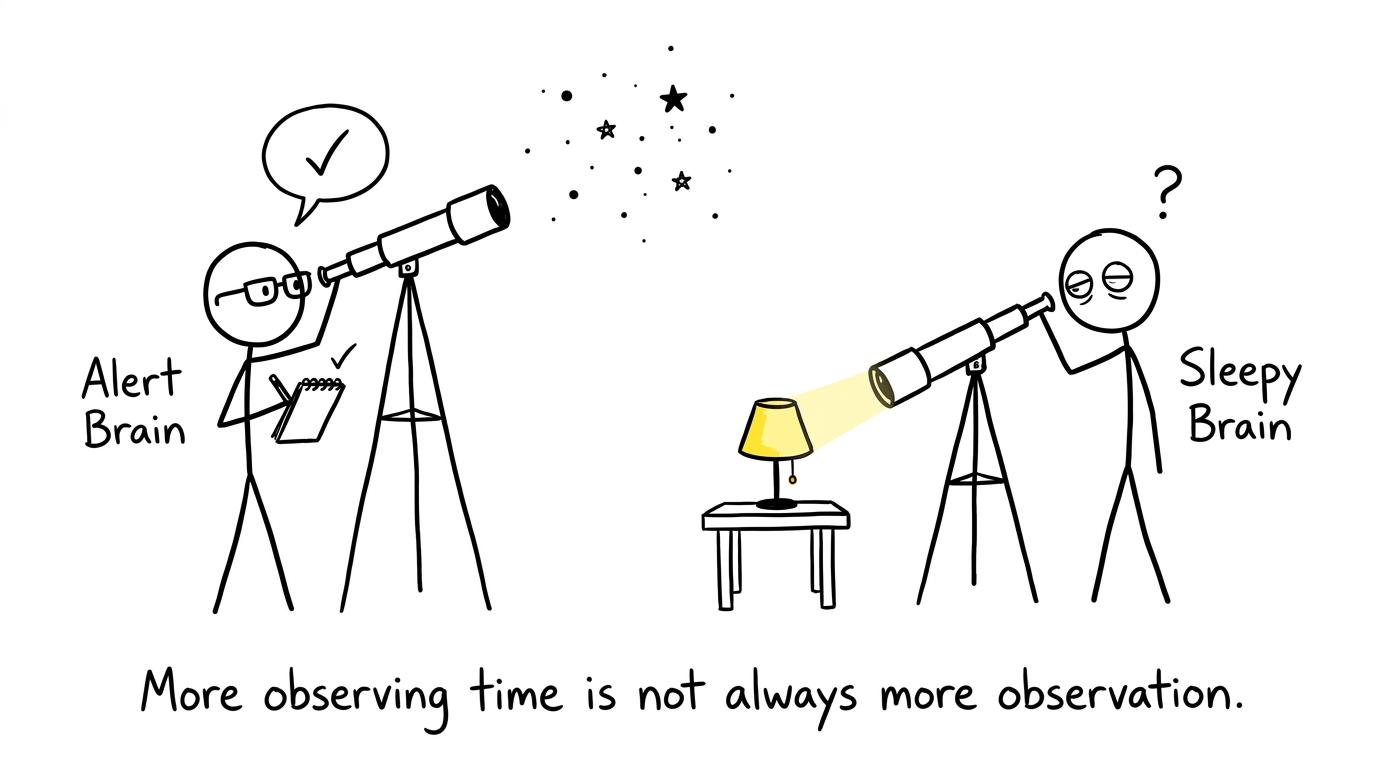 Two telescope operators show the difference between alert and sleepy observation
Common mistakes when revising Astronomy at night
Trading sleep for one more chapter
An extra chapter can feel productive because its cost is delayed until morning. Set bedtime from your required wake time, not from the amount of unfinished revision.
Learning new material in bed
This can make both revision and sleep less effective. Use a desk or another suitable space, and keep the bed associated with winding down and sleeping.
Using a phone as both notes and entertainment
One notification can turn a short review into a much later bedtime. If possible, use paper prompts or download what you need before the wind-down period.
Confusing familiarity with recall
Recognising a diagram is not the same as labelling it independently. Close the source before testing yourself.
Doing calculations without checking units
Astronomy involves large distances, time scales, angles and graphical data. Make units part of every daytime calculation routine. MathsGenie's guide to finding your weakest GCSE topics can help you distinguish a subject-knowledge gap from an underlying maths error.
Treating predicted material as a guarantee
No predicted paper can tell you exactly what will appear. Use predicted resources to rehearse unseen questions, not to eliminate sections of a specification. MathsGenie's GCSE predicted topics guidance explains how to use predictions without gambling your revision.
The best evening revision protects tomorrow
Revising GCSE Astronomy before bed can help when it is brief, active and followed by sufficient sleep. It hurts when the session becomes a late-night attempt to compensate for weeks of missed practice.
Think of sleep as part of revision rather than time taken away from it. Review one small topic, retrieve it without notes, correct a few gaps and stop when planned. Tomorrow, use questions and mark schemes to find out what survived.
For the maths skills beneath Astronomy calculations, make MathsGenie your free revision base. Use revision lessons to understand methods, practice questions and mini tests to strengthen recall, then past papers, predicted papers, mark schemes and video solutions to build examination confidence. Start small tonight, and let sleep do its share of the work.










