

GCSE Active Recall: Turn OCR Maths Notes into Marks
GCSE active recall for OCR Maths: turn notes into flashcards, mini tests and past-paper practice with worked examples, mistakes and FAQs.
If you’re an OCR student, you probably know the feeling: your notebook looks immaculate, your highlights are museum-quality, and yet a GCSE exam question lands and your mind goes oddly quiet. That’s not because you’re “bad at maths”. It’s because notes are proof you saw the method, not proof you can do it. The bridge from tidy pages to confident marks is active recall, and the good news is you can build it directly from the notes you already have for GCSE Maths.
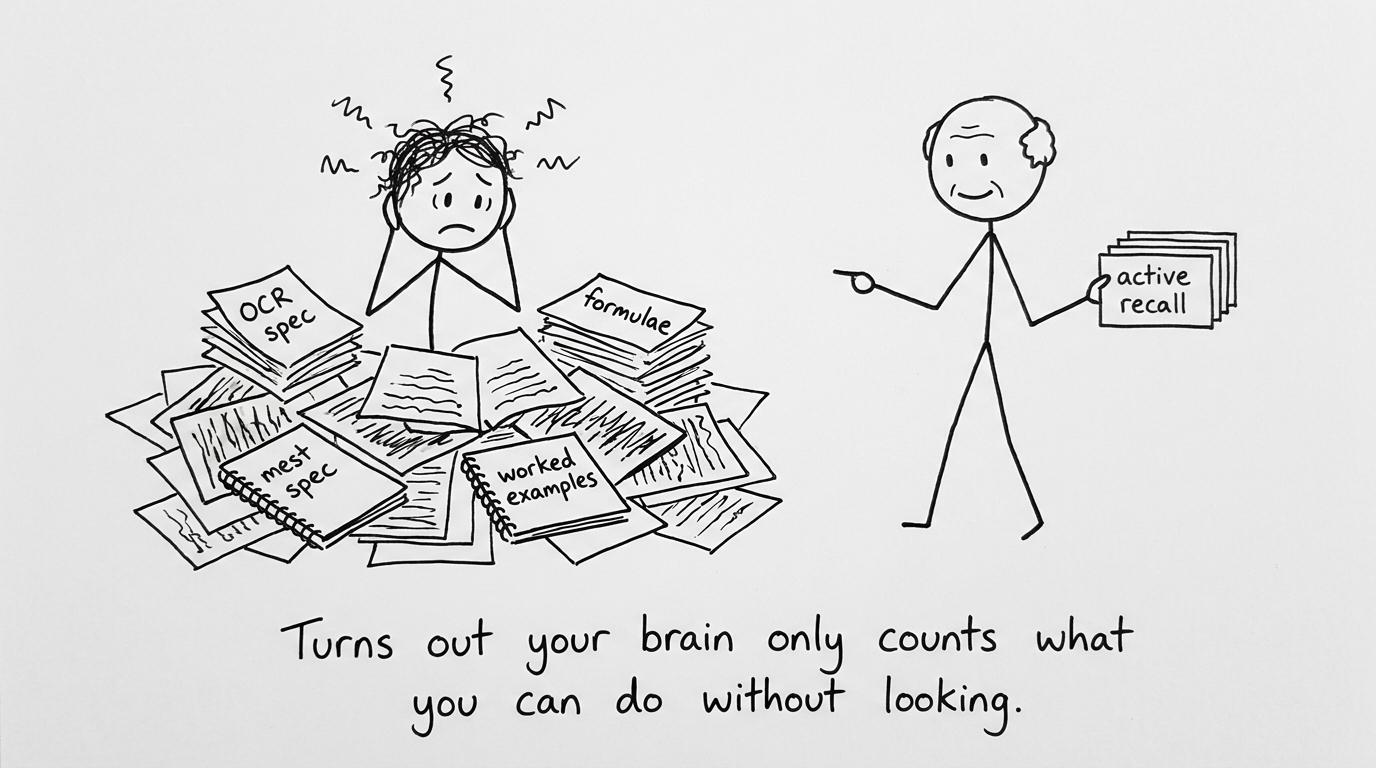 A student realises notes aren't the same as recall
On YesGenie (Maths Genie), OCR students can turn passive revision into repeatable exam performance by pairing small chunks of recall with exam-style practice, then using mark schemes and video solutions to tighten the method. Your notes don’t need rewriting. They need converting.
A quick GCSE active recall checklist (OCR-friendly)
Use this as your default loop for every OCR GCSE Maths topic:
- Shrink a page of notes into 5-10 “can I do it?” prompts.
- Hide the method and try from memory (no peeking for the first attempt).
- Check with a worked example or a mark scheme.
- Fix the exact step you missed (one sentence, one line, one example).
- Space it: revisit after 1 day, 3 days, 7 days.
- Mix topics (because OCR papers mix topics).
Good places to practise this on YesGenie:
- OCR GCSE Maths Hub
- GCSE Past papers (all boards)
- Resources (mini tests, predicted papers and more)
- Starters (quick warm-ups)
Why notes don’t “stick” in GCSE Maths (and what active recall changes)
Most GCSE Maths mistakes aren’t because you never learned the topic. They’re because, under time pressure, your brain can’t retrieve the method cleanly. Reading notes feels reassuring because it creates familiarity. Familiarity is quiet. Exams are loud.
Active recall flips the pressure earlier. It asks: can you produce the method without looking? It’s a small discomfort now to avoid a big one later.
For OCR students, that matters because OCR papers often reward method marks: even if the final answer slips, correct structure can still earn marks. Active recall trains you to start correctly; it’s the part many students freeze on.
How to convert OCR GCSE notes into active recall prompts
Your notes already contain three ingredients: facts, methods, and examples. Active recall turns each ingredient into a prompt.
Turn facts into “definition” prompts
Facts are things like angle rules, fraction conversions, or circle formulae. Convert them into short prompts:
- “Write the formula for the area of a circle.”
- “What does standard form look like?”
- “What is the sum of angles in a triangle?”
Then answer in one line from memory. If you miss it, don’t rewrite a paragraph; write the one-line fix.
Turn methods into “recipe” prompts
Methods are multi-step, like solving equations or rearranging formulae. Convert them into a simple instruction:
- “Solve a linear equation with brackets.”
- “Rearrange to make xxx the subject.”
- “Find the gradient and equation of a line.”
Your goal is not to memorise words. Your goal is to reproduce the steps.
Turn examples into “blanked” examples
Take an example in your notes and cover key steps. Then redo it from scratch.
If you’re using YesGenie topic pages, you can do the same using revision guides and worked solutions to create your own blanked method cards.
A strong place to pull examples from is a revision guide page like:
Even if you’re OCR, the GCSE maths content overlaps heavily across boards. The key is practising the method the way GCSE questions ask for it.
Build a simple active recall system using YesGenie
You don’t need a complicated app. You need a rhythm.
Use lessons and revision guides to compress the topic
Start with a short chunk, not the whole chapter. Open a single topic, learn it cleanly, then convert it.
For example, if algebra is shaky, use a focused page like:
Read once, then immediately test yourself by writing the key rules and doing one example without looking.
Use question banks to prove you can retrieve it
Once you can recall the steps, you need to apply them in varied formats. That’s where question banks help: same skill, different wording.
Your notes might show one neat example. OCR might ask it sideways.
Use past papers to simulate OCR timing and topic-mixing
OCR GCSE Maths success is as much about switching gears as it is about knowing content. After 2-3 topics are in your recall cycle, start mixing.
Use:
Then mark ruthlessly. Not to judge yourself, but to update your prompts.
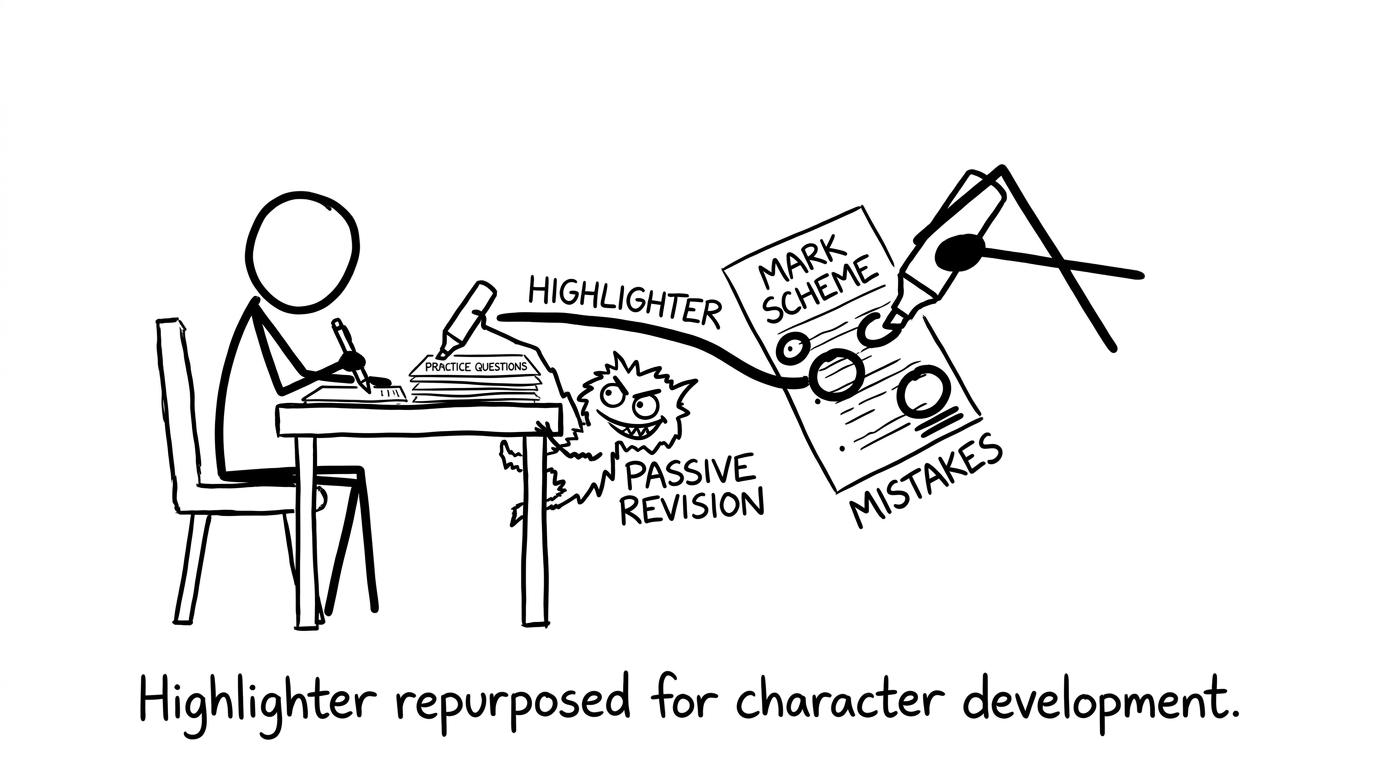 Gremlin tries to hand over a highlighter
Worked examples (turning notes into active recall)
Below are three GCSE-style examples, shown in a way you can directly turn into recall prompts.
Example 1: Rearranging a formula (OCR loves clear algebra)
Prompt you create from notes: “Make xxx the subject: y=3x−5y = 3x - 5y=3x−5.”
Method from memory (then check):
y=3x−5y+5=3xx=y+53\begin{aligned} y &= 3x - 5 \\ y + 5 &= 3x \\ x &= \frac{y+5}{3} \end{aligned}yy+5x=3x−5=3x=3y+5Active recall upgrade: do it again tomorrow, but swap letters: “Make ttt the subject: p=3t−5p = 3t - 5p=3t−5.” Same method, less familiarity.
Example 2: Percentages (turn a note page into 5 prompts)
Prompt: “A price is £80 and increases by 15%15\%15%. Find the new price.”
Increase by 15%15\%15% means multiply by 1.151.151.15:
80×1.15=9280 \times 1.15 = 9280×1.15=92So the new price is £92.
Prompts you can extract from this one example:
- “What multiplier is a 15%15\%15% increase?”
- “What multiplier is a 15%15\%15% decrease?”
- “Why is 15%15\%15% increase not ×15\times 15×15?”
- “Write the method for percentage change in one line.”
- “When do you use ×1.15\times 1.15×1.15 vs ×0.85\times 0.85×0.85?”
Example 3: Solving a linear equation (method marks matter)
Prompt: “Solve: 4(2x−3)=3x+114(2x-3)=3x+114(2x−3)=3x+11.”
Expand and solve:
4(2x−3)=3x+118x−12=3x+118x−3x=11+125x=23x=235\begin{aligned} 4(2x-3) &= 3x+11 \\ 8x-12 &= 3x+11 \\ 8x-3x &= 11+12 \\ 5x &= 23 \\ x &= \frac{23}{5} \end{aligned}4(2x−3)8x−128x−3x5xx=3x+11=3x+11=11+12=23=523So x=235x=\frac{23}{5}x=523.
Active recall habit: if you made one mistake (say, −12-12−12 became +12+12+12), your fix card is not “be careful with signs”. It’s: “When moving −12-12−12 across, add 121212 to both sides: 11+1211+1211+12.” Specific beats motivational.
Make OCR GCSE active recall feel realistic (not robotic)
Active recall works best when it matches the exam’s reality: mixed topics, incomplete memory, and the need to keep going.
Practise “start lines”
A lot of GCSE marks are earned in the first two lines. So create prompts that force a correct start:
- “Write the first line after expanding 3(2x+5)3(2x+5)3(2x+5).”
- “Write the first line when finding the mean from a table.”
- “Write the first line when using Pythagoras.”
Even if you can’t finish, you’re training the bit that unlocks method marks.
Use mini tests and starters to reduce friction
On tired days, don’t pretend you’ll do a full paper. Do a 10-minute warm-up and keep the streak alive:
Consistency beats hero sessions.
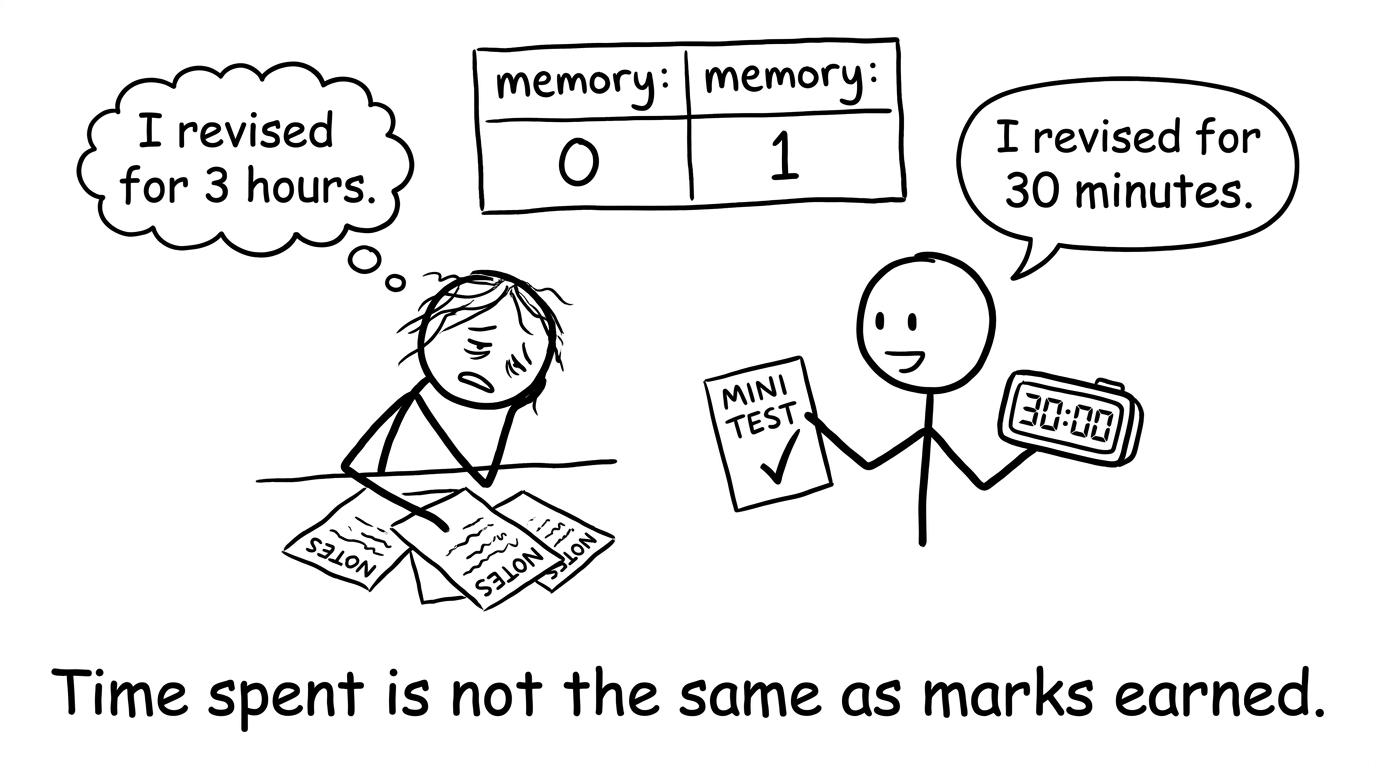 Two students compare time spent vs memory
Common mistakes when turning GCSE notes into active recall
- Rewriting notes instead of converting them. If your revision produces more pages, you’re often building comfort, not recall.
- Making flashcards too vague. “Explain fractions” is not a prompt. “Convert 0.3750.3750.375 to a fraction” is a prompt.
- Checking too quickly. Struggling for 20-30 seconds is where learning happens. Peeking instantly trains dependence.
- Not using mark schemes. OCR GCSE Maths rewards method marks; mark schemes show what counts.
- Only doing topics you like. Your weakest topics usually offer the fastest grade gains.
- Never mixing topics. OCR papers won’t keep algebra in one corner and geometry in another.
Turning GCSE notes into active recall: the calm, repeatable plan
The student who improves fastest isn’t the one with the nicest notebook. It’s the one who makes revision measurable: “Can I do this without looking?” That’s what active recall gives OCR GCSE students an honest feedback loop, early.
Start on the OCR GCSE Maths Hub, pick one topic, and convert just one page of notes into prompts today. Then prove it with exam-style questions, and finish by checking against mark schemes or video solutions. When you’re ready, step up to full GCSE Past papers and use Resources for mini tests and predicted-paper practice.
Your notes don’t need to be perfect. Your retrieval does. Build that on YesGenie, and the GCSE marks follow.










