

Revising Before Bed: GCSE Art and Design Guide
Revising before bed GCSE Art and Design may aid memory, but not if it delays sleep. Discover a calm routine that also protects your maths revision.
The sketchbook is still open. One annotation needs rewriting, an artist reference feels uncertain, and tomorrow’s maths practice has not happened. At that point, stopping can feel irresponsible.
But revising before bed GCSE Art and Design is helpful only when it is short, purposeful and followed by enough sleep. A calm review may support memory consolidation. A late, stressful session that reduces sleep is more likely to leave you tired, distracted and less ready to learn the next day.
The practical answer is simple: use the final part of the evening to retrieve or organise what you already know, not to begin a major artwork, rescue an entire project or sacrifice sleep.
The bedtime revision checklist
Before opening your sketchbook, ask:
- Do I have one specific task that can be completed in about 101010 to 252525 minutes?
- Am I reviewing existing learning rather than starting a complicated new idea?
- Can I finish without reducing the sleep I need?
- Is the activity calm enough to help me wind down?
- Have I protected time for tomorrow’s GCSE maths revision too?
If the answer to the first three questions is no, sleep is usually the better investment.
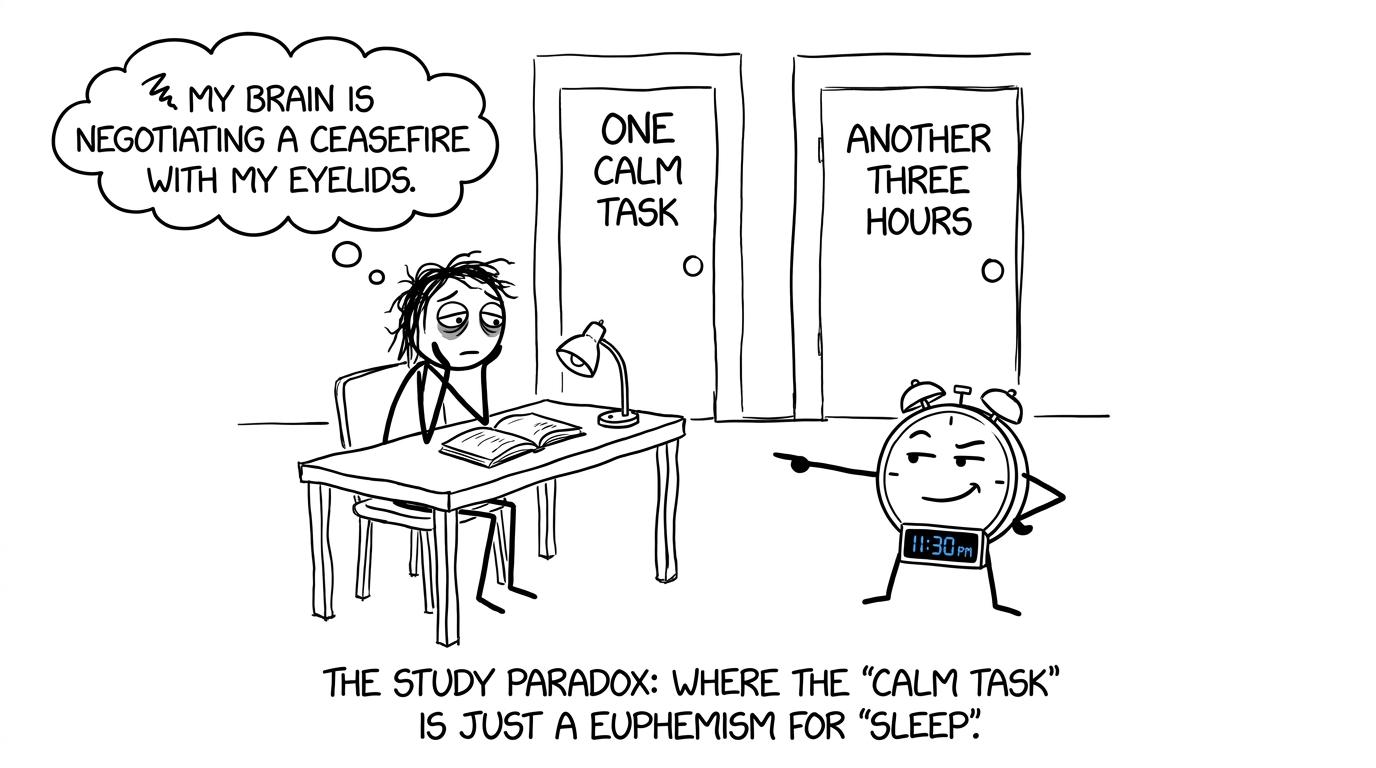 A tired student chooses between one calm revision task and another three hours
Does revising GCSE Art and Design before bed help memory?
Sleep plays an important role in memory consolidation, the process through which recently learned information becomes more stable. Research involving adolescents and adults generally finds that sleep after learning can support retention. However, the effect depends on the material, the learner and the quality of sleep.
There is no strong evidence that revising GCSE Art and Design immediately before bed has a unique, guaranteed benefit. The sensible conclusion is narrower: a brief review followed by proper sleep may help you retain some of what you have already learned.
That could include:
- recalling an artist’s methods and influences;
- remembering specialist vocabulary;
- reviewing the purpose behind your experiments;
- mentally sequencing a familiar practical process;
- identifying how a page demonstrates an assessment objective;
- deciding the first manageable task for the next day.
Art and Design contains both declarative knowledge, such as terminology and contextual information, and procedural knowledge, such as controlling materials or following a practical process. Some research suggests that sleep may support these forms of memory differently. That does not mean you should attempt detailed practical work at midnight. It means a calm recall task may be more useful than passive rereading.
Sleep is not a shortcut around practice. It can help stabilise learning, but it cannot consolidate a technique that has never been understood or attempted.
When late-night art revision starts to hurt
The benefit disappears quickly if revision delays sleep. UK health guidance commonly indicates that teenagers aged 131313 to 181818 generally need around 888 to 101010 hours of sleep, although individual needs vary.
Insufficient sleep can affect attention, mood and the ability to concentrate. Those are not minor concerns during exam season. They matter when you are evaluating a composition, following a multi-stage process or interpreting a higher-tier maths question accurately.
The trade-off can be expressed simply:
useful evening revision=focused review+protected sleep\text{useful evening revision} = \text{focused review} + \text{protected sleep}useful evening revision=focused review+protected sleepIf the review takes sleep away, the calculation changes. An extra hour spent staring at an unfinished page may produce less value than arriving at school rested enough to make sound decisions.
Watch for these warning signs:
- you keep changing the task rather than completing one objective;
- you are making careless practical mistakes;
- anxiety is rising as bedtime moves later;
- your phone repeatedly interrupts the session;
- you are trying to finish a large piece in one sitting;
- you expect sleep to compensate for unfocused revision.
Stopping is not giving up. Sometimes it is the most disciplined revision decision available.
Why GCSE Art revision is different from cramming facts
Across AQA, Pearson Edexcel, OCR and Eduqas, GCSE Art and Design is built around sustained practical development. Specifications use a portfolio component and an externally set component, although schools and exam boards may use slightly different terminology and administrative arrangements.
Students are expected to develop, refine, record and present ideas. Evidence can include research, experimentation, annotation, observation, practical control and a personal response. This is why an all-night cram is especially poorly matched to the subject. A portfolio records a journey; it cannot be recreated honestly through one exhausted burst.
Before bed, the best tasks are therefore small and reflective rather than expansive. You might close your notes and recall three reasons for choosing a material, check that sources have been acknowledged, or write tomorrow’s first action on a card.
Avoid beginning a new final outcome or using hazardous, messy or highly stimulating materials late at night. Follow your teacher’s instructions and your school’s rules about where practical work may be completed.
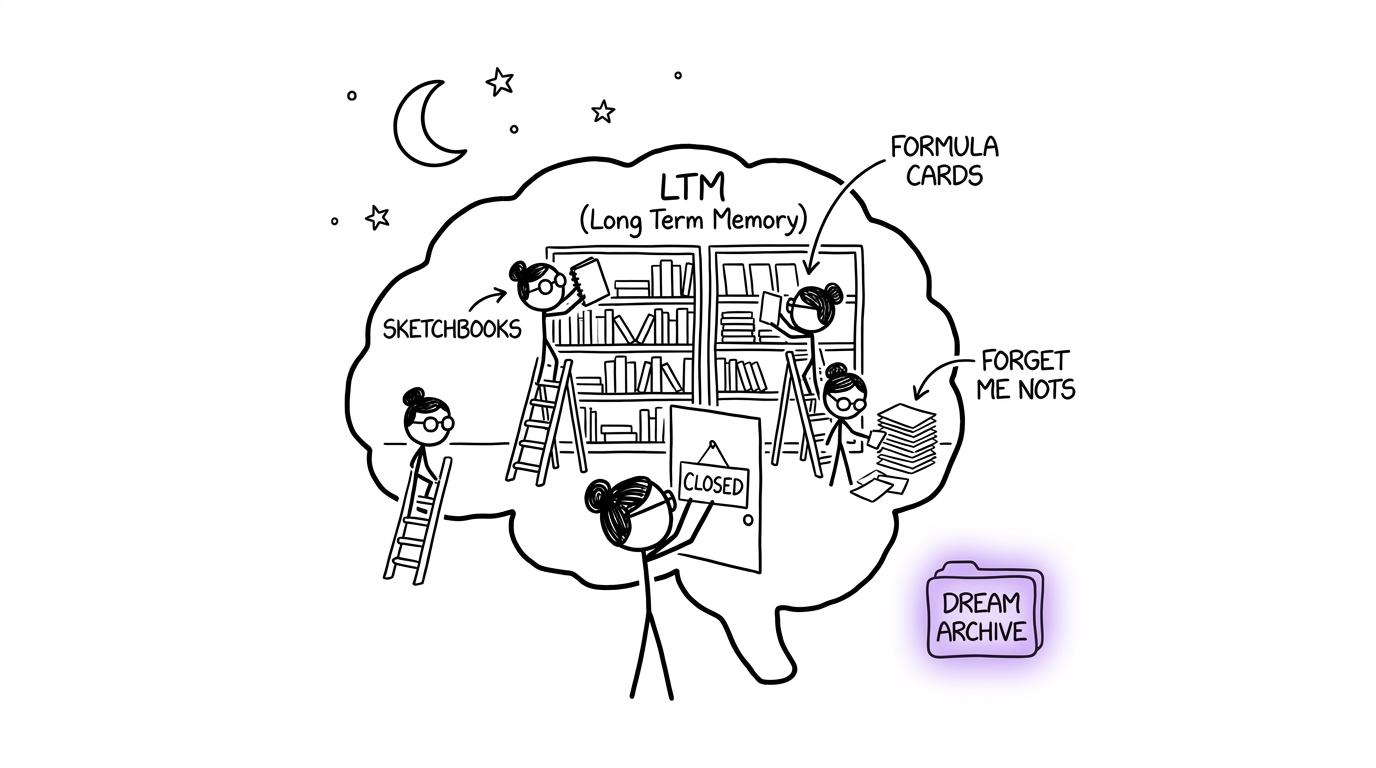 Tiny librarians inside a sleeping brain organise sketchbooks and revision cards
A better pre-sleep routine for Art and Design
Choose one closed task
A closed task has a visible finish. “Revise art” is open-ended. “Recall four features of an artist’s approach, then check my notes” has a boundary.
Useful choices include:
- retrieving key terminology without looking;
- explaining the intention behind one experiment;
- reviewing teacher feedback and selecting one action;
- checking tomorrow’s materials;
- writing a short plan for the next studio session.
Keep the task away from your bed if possible. The aim is to preserve a clear association between bed and sleep.
Retrieve before you reread
Looking at a page can create the feeling of familiarity without proving that you can remember it. Instead, close the notes and say or write what you know. Then check the original and correct only what was missing.
This same principle is valuable in maths. Watching a solution is not the same as producing the method independently. MathsGenie’s guide to stopping GCSE maths content from fading explains how retrieval, spacing and exam-style questions work together.
End with a clear restart point
Write down the first action for tomorrow. It might be to photograph a development page, test one colour combination or ask your teacher about a piece of feedback. This reduces the need to keep rehearsing unfinished tasks in your head.
Then close the sketchbook. Put materials away, dim the lights and move into a calm routine. NHS sleep guidance commonly recommends regular sleep times, reducing stimulating screen use and allowing time to wind down.
Protecting maths revision during an art deadline
Art can expand to fill every free evening because there is nearly always something that could be refined. Maths has a different danger: when it is postponed, methods become less fluent and weak topics remain hidden until the next paper.
Do not try to solve that problem with a full maths paper at bedtime. Instead, plan maths earlier and use a small maintenance task when Art and Design is demanding most of your attention.
The GCSE maths revision hub lets you choose resources for Edexcel, AQA, OCR and Eduqas, then work at the appropriate foundation or higher tier. A sustainable pattern might include:
- an earlier session using a revision lesson and practice questions;
- immediate checking with solutions or a mark scheme;
- one recorded mistake to revisit;
- a short retrieval prompt later, without opening a large new task.
If time is tight, an Edexcel GCSE mini test is more manageable than an entire paper. When you have a longer, alert session available, use Edexcel GCSE Maths past papers or OCR GCSE Maths past papers under suitable conditions.
The principle is balance, not equal time every night. An art deadline may need priority today. Maths still needs a place in the week.
Plan revision before tiredness makes the decision
Evening judgement is often weakest when the workload feels largest. Decide your stopping time earlier in the day, while you are calmer. Then work backwards.
A useful sequence is:
- complete demanding practical work earlier;
- do focused maths practice while concentration is still strong;
- mark the work and record the next target;
- use a brief art recall or planning task near bedtime;
- stop at the planned time.
MathsGenie’s one-month GCSE maths revision plan can help you distribute lessons, mini tests and paper practice across the week. If an exam is imminent, use the GCSE maths night-before plan rather than improvising a late marathon.
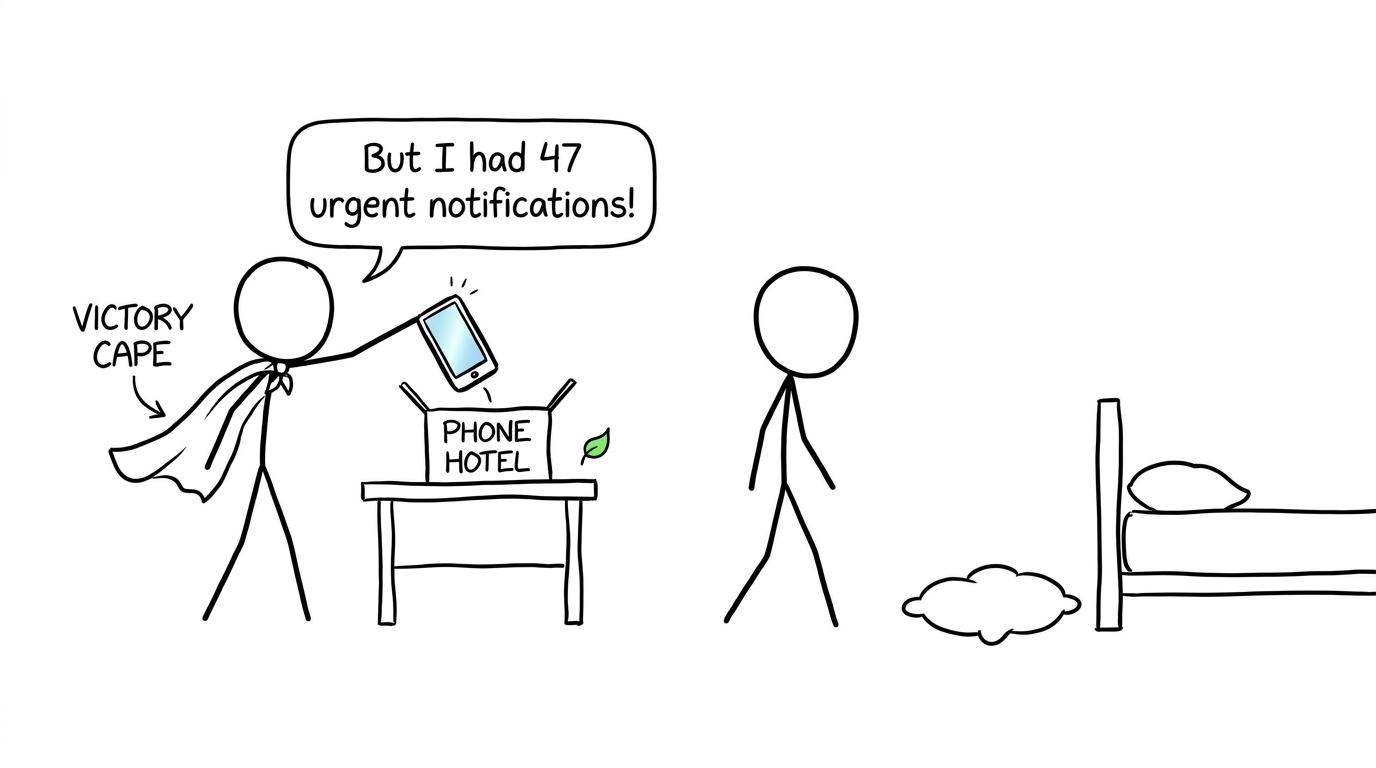 A student checks a phone into a tiny phone hotel before going to sleep
Common mistakes when revising before bed
Confusing time spent with learning gained
Two tired hours are not automatically better than 202020 focused minutes. Judge a session by what you can retrieve, explain or do afterwards.
Starting work with no finishing condition
“Improve my sketchbook” has no natural endpoint. Choose one page, one piece of feedback or one recall target.
Using a phone as both a resource and a distraction
Notifications fragment attention and can extend the session. Download or prepare what you need, then place the phone out of reach before winding down.
Sacrificing sleep to reduce guilt
Late revision can feel productive because it is uncomfortable. Discomfort is not evidence of progress. Protecting sleep may do more for tomorrow’s concentration than another unfocused task.
Letting art remove maths from the timetable
Art deadlines are visible; lost maths fluency is quieter. Use the Edexcel GCSE Maths revision pathway for short topic sessions, then build towards timed questions and papers when you have more energy.
Treating predicted papers as predictions of certainty
Predicted papers are useful for realistic practice, not for guaranteeing content. Use them alongside specification-wide revision, past papers, mark schemes and topic repair.
The best decision is usually the repeatable one
Revising GCSE Art and Design before bed can help when it is a brief act of retrieval, reflection or organisation followed by sufficient sleep. It hurts when it becomes an open-ended attempt to defeat a deadline by staying awake.
Choose one calm task. Retrieve rather than reread. Record tomorrow’s first step. Then stop.
For the maths part of your exam preparation, make MathsGenie’s free GCSE maths resources your starting point. Use revision lessons and practice questions to repair individual methods, mini tests to check recall, and past papers or predicted papers with mark schemes and video solutions to develop exam readiness. A good revision plan does not ask you to be awake forever. It helps each session have a purpose.










