

Should You Revise Weakest Topic First GCSE Biblical Hebrew?
Revise weakest topic first GCSE Biblical Hebrew? Learn when to tackle hard language or literature, how to retest it, and when leaving it last can work.
Revision creates a peculiar temptation: we want to begin with the work that proves we are already good at something. Familiar vocabulary feels productive. A comfortable passage feels reassuring. The weakest topic remains safely at the bottom of the list.
If your question is “revise weakest topic first GCSE Biblical Hebrew, or leave it until last?”, the short answer is this: usually tackle it near the beginning of the session, after a brief warm-up, then return to it at the end for a short retest. Starting early gives the topic your better attention; revisiting it later turns the session into spaced retrieval rather than one long encounter.
There are exceptions. If the topic is so unfamiliar that you cannot begin independently, or if the examination is tomorrow and another area offers a more realistic mark gain, a different order may be sensible. The important decision is not simply first or last. It is whether your weak area receives focused, active and repeated practice.
The quick decision checklist
Use this plan before each revision session:
- Confirm that the topic is genuinely weak using a question, translation task or teacher feedback.
- Complete a short, familiar warm-up to settle your attention.
- Put the weakest manageable topic early in the session.
- Retrieve before rereading: attempt vocabulary, grammar or textual recall without notes.
- Check your response against reliable course materials or a mark scheme.
- Record the precise gap rather than writing “bad at Hebrew”.
- Finish with a brief, closed-book retest.
- Schedule another attempt on a later day.
The same process works for maths. A mixed paper reveals the gap; targeted practice repairs it; another question checks whether the repair held. MathsGenie’s GCSE maths revision hub is built around that learn, practise and check rhythm.
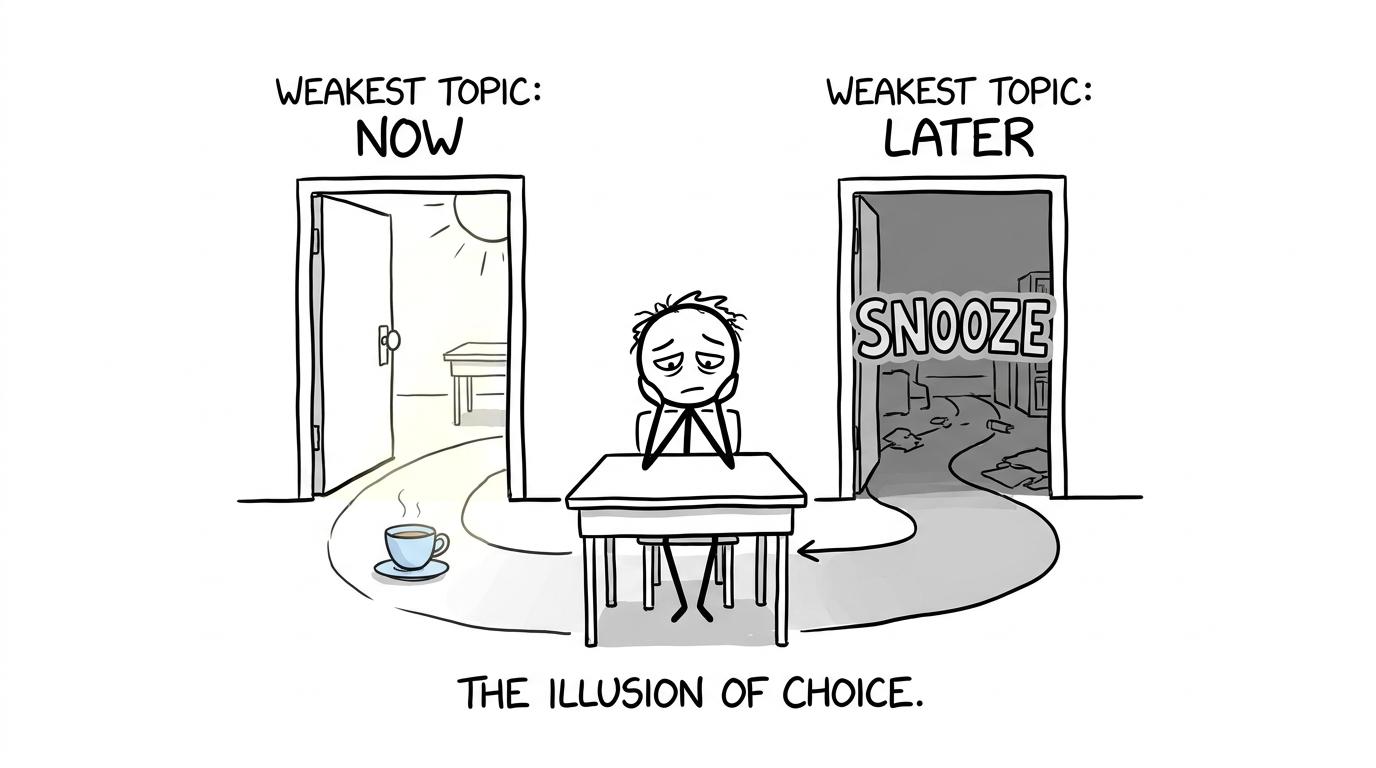 A student discovers that both revision routes lead back to the same desk
Why your weakest Biblical Hebrew topic usually belongs near the start
A weak topic demands more than recognition. You may need to distinguish similar forms, recall vocabulary without prompts, apply grammatical knowledge or explain a set-text detail accurately. That work benefits from attention that has not yet been spent on easier tasks.
Starting early also prevents avoidance from making the timetable. If difficult material is always saved until the final few minutes, tiredness and time pressure repeatedly push it into tomorrow. The problem is not a lack of good intentions. It is that the schedule gives the weakest area the easiest escape route.
This does not mean opening every session with the most intimidating page in your folder. A short warm-up can be useful: recall familiar vocabulary, identify a few secure forms or summarise what you revised previously. Then move to the weak area while the session still has momentum.
For students balancing Biblical Hebrew with GCSE maths, this principle matters because revision time is shared. The GCSE one-month revision plan shows how diagnosis, targeted practice and later review can create a manageable weekly rhythm instead of a collection of last-minute decisions.
Why finishing with the weak topic can still help
“Do it first” should not become another rigid rule. There are circumstances in which placing difficult material later is reasonable.
You might need to begin with prerequisite knowledge. If your weakness in translation comes from insecure vocabulary or grammar, attempting a demanding passage immediately may produce little useful information. Review the missing foundation first, then apply it.
You might also use the end of a session as a test rather than the first teaching encounter. After studying the weak area earlier, put the notes away, work on something else and return for a short retrieval task. The gap between attempts makes the final check more meaningful than repeatedly looking at the same page.
Finally, consider your own concentration pattern. Some students focus best immediately; others need several minutes to settle. Metacognitive revision means planning, monitoring and evaluating your approach rather than copying a timetable mechanically. The question is: when can you give the difficult task your best honest attempt?
First for learning, last for testing
The strongest compromise is simple: meet the weakness twice.
Begin with diagnosis
Before reviewing notes, try to recall or apply what you know. For Biblical Hebrew, that might mean testing vocabulary, identifying a grammatical feature, translating a short unseen section or recalling the context and significance of part of a prescribed text.
The purpose is not to produce a flattering mark. It is to discover the smallest repairable gap. “I confuse these two forms” creates an action. “I am terrible at language” does not.
Repair one specific gap
Use your textbook, class materials, specification and teacher guidance to correct that gap. Keep the focus narrow enough to finish. GCSE Biblical Hebrew covers distinct demands across language and literature, so “revise Paper 111” is not a useful task description.
For the current Pearson Edexcel qualification, Language and Literature are separate externally examined components, each worth 50%50\%50% of the GCSE. Set texts also change by examination period. Students sitting in 202620262026 to 202820282028 should therefore use the prescribed texts and specification for those years rather than inheriting an older revision list. Confirm your entry and materials with your school.
End with retrieval
Close the book and repeat a short version of the original task. If you can only answer while the explanation remains visible, the material is not yet secure. Check immediately, note the remaining error and schedule another retrieval attempt.
This is also how a maths topic moves from familiar-looking to usable. MathsGenie’s guide to revising GCSE maths without wasting time uses the same loop: learn, practise, mark, fix and retest.
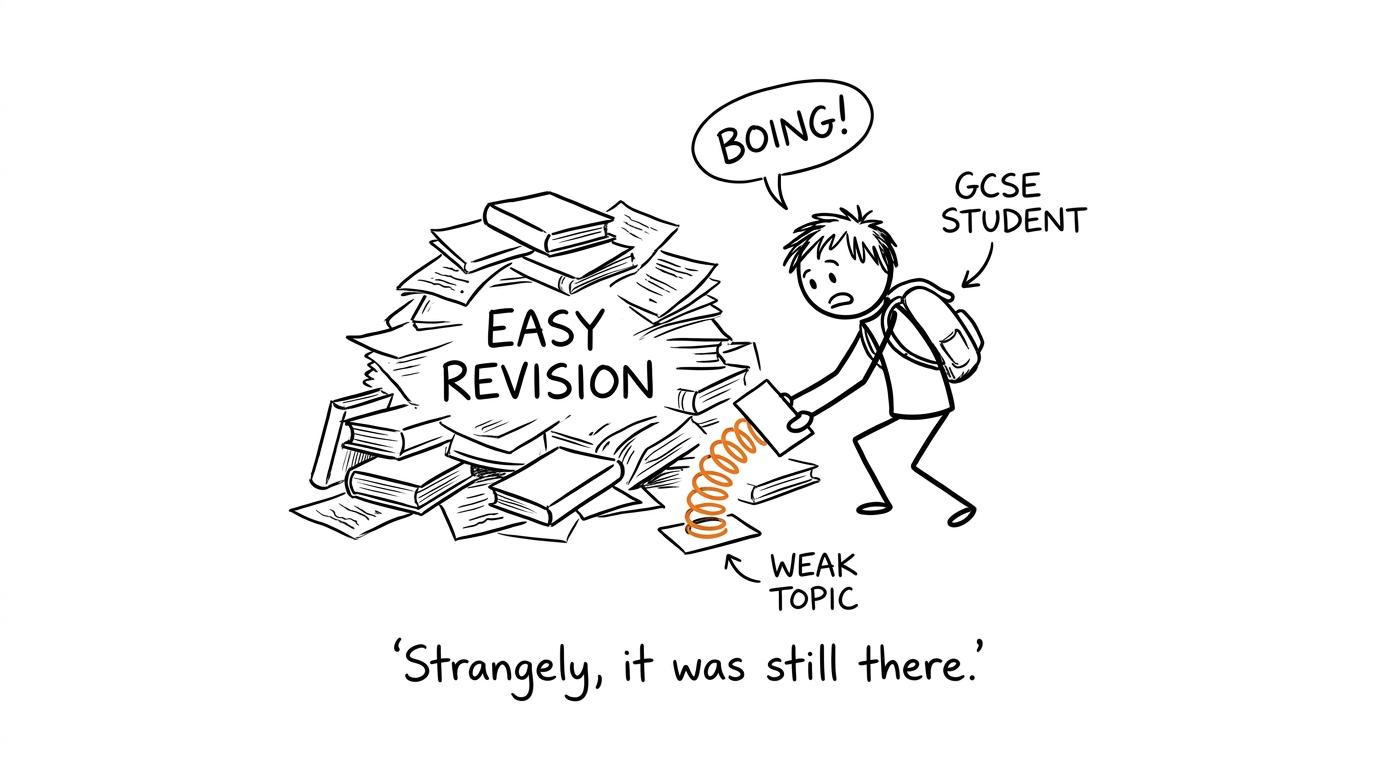 A weak topic refuses to stay hidden beneath easy revision
How to decide what “weakest” really means
The topic you dislike most is not automatically the topic costing the most marks. Confidence is useful evidence, but it is unreliable on its own.
Use three sources:
- Performance: Which question types produce errors or blank responses?
- Feedback: Which misconceptions has your teacher identified?
- Specification coverage: Is the topic required for your examination and current set-text cycle?
Then classify the weakness. Is it missing knowledge, faulty recall, weak application, slow performance or misunderstanding of the question? Each problem needs a different response. More rereading will not necessarily improve recall; more untimed practice will not automatically solve a timing problem.
In maths, a marked paper performs the same diagnostic job. MathsGenie explains how to turn errors into a targeted repair list in How to Use Edexcel GCSE Maths Past Papers Properly. Students taking AQA, OCR or Eduqas can use the same analysis while choosing material matched to their own board and tier.
Build a session around energy, not guilt
A productive session needs a structure that is demanding but repeatable. One sensible pattern is:
- a brief retrieval warm-up from an older topic;
- a focused block on the weakest current area;
- a different task to create some separation;
- a short closed-book retest of the weak area;
- a written next step for another day.
Avoid turning the weak-topic block into the entire evening. Long sessions can create the feeling of familiarity without proving independent recall. Research on learning broadly supports active retrieval and returning to material after a gap over passive rereading, although it does not establish one perfect session order for every GCSE Biblical Hebrew student.
Spacing matters beyond a single evening. Revisit the topic across several days rather than declaring it complete after one successful attempt. The GCSE one-week revision plan offers a useful model for balancing diagnosis, focused repair and mixed assessment when several subjects are competing for time.
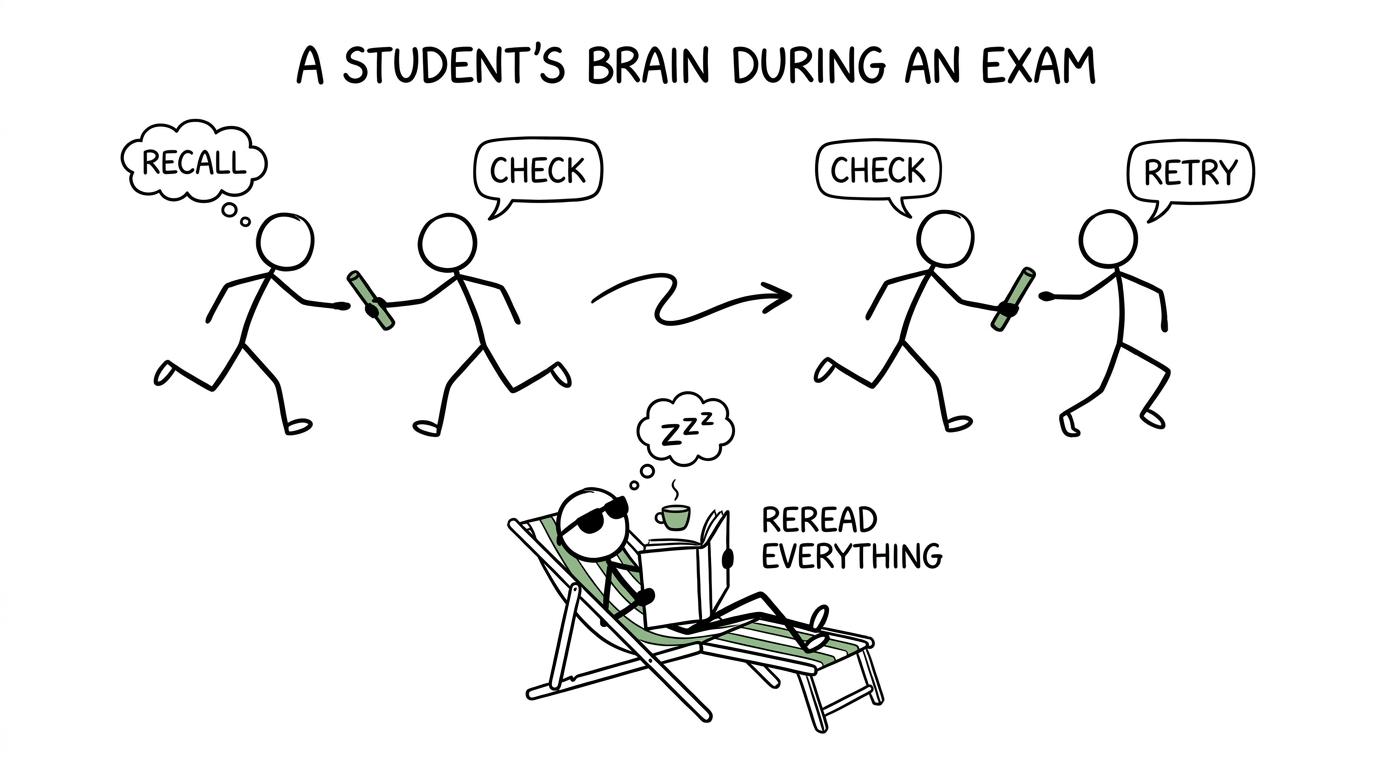 Inside the revision relay, recall passes the baton to checking and retrying
When the examination is close
As the examination approaches, priority should reflect likely return as well as weakness. A large, examinable gap that can be improved deserves attention. An obscure detail requiring hours for uncertain benefit may not.
Do not abandon strong topics completely. Secure knowledge can fade, and examination performance requires switching between different demands. Keep some mixed retrieval in the plan while allocating a larger share of focused time to repeated weaknesses.
This is why past papers should become more prominent without replacing topic repair. They reveal whether knowledge transfers under time pressure. Maths students can read when to start GCSE past papers and use the GCSE maths topics by exam board and tier guide to keep practice aligned with Edexcel, AQA, OCR or Eduqas requirements.
Common mistakes when prioritising weak topics
Saving every difficult task until the end
This makes the weakest topic dependent on leftover time and energy. Put a defined attempt in the diary earlier, even if it is short.
Starting cold with something impossibly broad
“Learn Biblical Hebrew grammar” is not a revision task. Choose a specific form, vocabulary group, translation skill or section of the prescribed literature.
Rereading instead of retrieving
Recognition can feel like knowledge. Close the notes before answering, translating or recalling. Then check and correct.
Spending the whole session on one weakness
A single long block can be tiring and misleading. Break the work up and return after a delay.
Treating one correct answer as mastery
Success immediately after reviewing may reflect short-term familiarity. Retest on another day and in a mixed context.
Using outdated or mismatched materials
Check the current specification, examination year and prescribed texts. For maths, also confirm your board and foundation or higher tier before choosing papers.
Make the weak topic smaller, then begin
Your weakest topic should not control the emotional weather of the entire revision season. It is information: a signal showing where the next useful piece of work may be.
Begin with a short warm-up. Tackle one precise weakness while your attention is available. Check it. Leave it briefly. Test it again. That approach is usually better than placing the topic permanently first or permanently last, because lasting improvement comes from repeated encounters rather than one heroic session.
MathsGenie does not teach GCSE Biblical Hebrew, but it can organise the maths side of your revision so that both subjects receive deliberate attention. Start with the free GCSE maths revision resources, then combine revision lessons and practice questions with mini tests, mark schemes, video solutions, past papers and predicted papers. Diagnose the gap, repair it and return to prove that it has become smaller.











