Revise GCSE Sociology With Sibling Help: What Works
Revise GCSE Sociology with sibling support effectively. Learn what their exam experience can teach you, what may be outdated, and how to check advice.
Revision advice from an older sibling can feel unusually convincing. They have sat the exam, survived the long answers and probably remember which topics caused trouble. But should you revise GCSE Sociology with sibling support when their course may have been different from yours?
Yes, if you use them as a quiz partner, explanation listener and source of practical perspective. No, if you treat their old notes, remembered question formats or predictions as more reliable than your current specification, teacher and mark schemes.
The best arrangement is simple: your sibling provides the conversation; current official materials provide the facts.
A quick sibling revision checklist
Before opening a folder of inherited notes, agree on these rules:
- Check that you studied the same exam board and specification.
- Use the current specification as your content checklist.
- Ask your sibling to test you before showing you an answer.
- Practise short answers and extended responses, not recall alone.
- Compare written work with current mark schemes.
- Keep sociology support separate from your planned maths revision.
- Ask your teacher whenever old and current guidance conflict.
That final point matters. A confident memory is still a memory, not an official document.
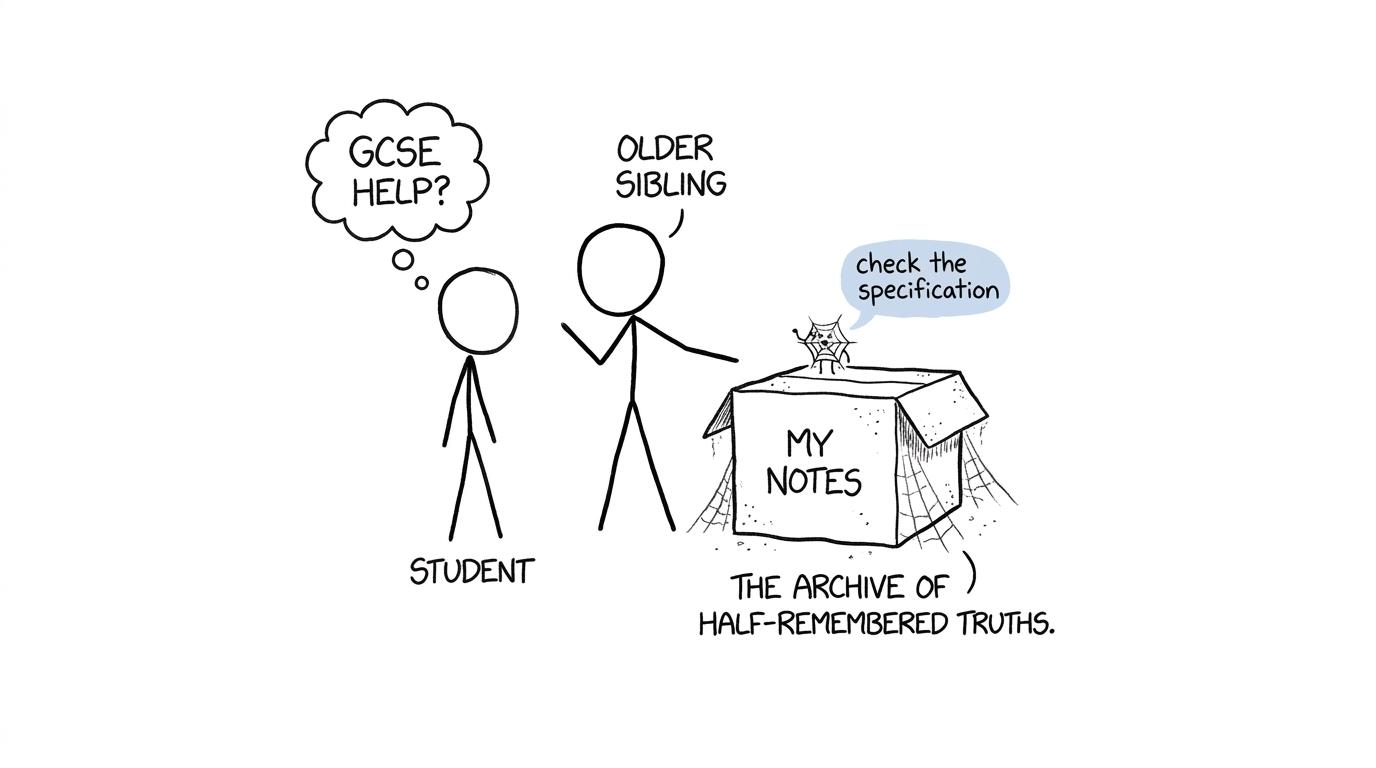 An older sibling discovers that inherited revision notes need a specification check
What is genuinely useful about an experienced sibling?
A sibling who has already completed GCSE Sociology possesses something a revision guide cannot: experience of turning knowledge into an answer under timed conditions. That experience can help, provided you separate enduring habits from changing assessment details.
They can run proper retrieval practice
Retrieval practice means trying to recall knowledge before returning to notes. Research reviews in school and classroom settings generally find that retrieval can improve learning, although its effectiveness depends on the quality and difficulty of the questions, the feedback provided and the material being learned.
Your sibling can therefore:
- give you a concept and ask for a definition;
- name a topic and ask for contrasting perspectives;
- ask you to identify strengths and limitations of a research method;
- provide a scenario to which you apply sociological knowledge;
- return to missed material several days later.
They should leave enough silence for you to think. Instant hints turn retrieval into recognition, which feels easier but tells you less about what you can produce independently.
This principle transfers directly to maths. The MathsGenie GCSE Maths revision hub lets you attempt questions before checking solutions, while topic resources help you repair whatever your first attempt exposes.
They can listen to explanations
Explaining a theory, concept or method aloud forces you to organise it. Your sibling does not need to remember every sociological detail to notice when an explanation is vague, repetitive or missing a logical link.
Ask them to use neutral prompts:
- “What does that term mean?”
- “How does that evidence support the argument?”
- “What would an opposing view say?”
- “Have you answered the question that was asked?”
Research into learning by explaining suggests possible benefits, but the evidence does not establish that teaching another person is automatically better than well-designed retrieval. The useful part is the mental work: recalling, organising and clarifying knowledge. A relaxed conversation in which your sibling supplies every missing idea does not create the same effort.
They can make practice feel accountable
Revision often fails quietly. A student intends to write an answer, reads a page instead and finishes with no evidence of what they can do. Agreeing that your sibling will return in 252525 minutes to collect an answer creates a clear endpoint without turning them into a second teacher.
They can also help you maintain a simple error log:
- topic or question;
- what was missing;
- whether the problem was knowledge, application, evaluation or timing;
- the action needed next;
- the date for a second attempt.
The same diagnostic habit is valuable across your timetable. MathsGenie's guide to finding your weakest GCSE topics explains how to turn lost marks into focused revision rather than vaguely repeating an entire subject.
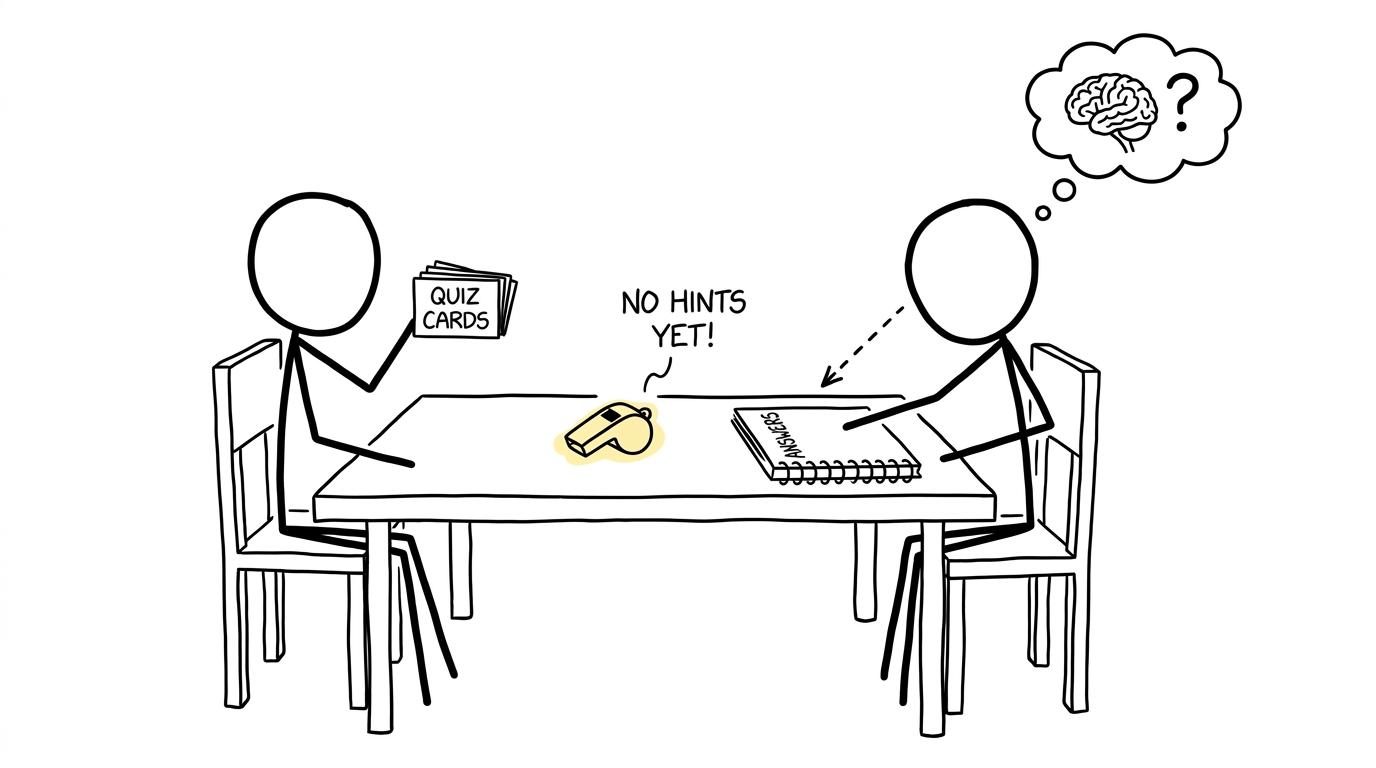 Two siblings conduct a no-hints-yet recall quiz
What may be outdated in your sibling's advice?
The older the notes, the more carefully you should inspect them. Even when a qualification title looks familiar, teaching content, terminology, assessment guidance and available support materials can change.
Their exam board may not match yours
GCSE Sociology specifications are built within national subject-content requirements, but exam boards can organise and assess that content differently. Current official materials show, for example, that Eduqas uses two equally weighted written components covering sociological processes and social structures, with research methods assessed across the qualification. Another board's paper structure and question sequence should not be assumed to match.
Write your exam board and specification code at the front of your revision folder. Then verify:
- the topics you must learn;
- how papers are divided;
- the current question types;
- assessment objectives;
- the command words used;
- the latest sample materials and mark schemes.
If your sibling sat a different board, their general revision habits may remain useful. Their detailed paper advice may not.
Old question formats can create false confidence
A sibling may remember a particular essay length, mark allocation or section order perfectly, for the paper they sat. That does not prove it applies to yours.
Use current past papers and specimen materials to establish what your exam actually requires. Look at several papers rather than treating one paper as a promise about the next. Sociology requires knowledge, application, analysis and evaluation; memorising a rigid paragraph count is not a substitute for responding to the precise command word and available marks.
This is also why reliable maths preparation begins with the correct board and tier. The MathsGenie guide to GCSE maths topics by exam board and tier helps students distinguish shared subject content from board-specific organisation.
Their case studies and statistics may have aged
Sociology examines a changing social world. An older example may still illustrate an idea, but statistics, policies and contemporary contexts can become dated. Named studies may also be absent from your current course requirements or taught differently by your school.
Do not discard an old example merely because it is old. Ask a better question: is it accurate, relevant to the current specification and suitable for this answer? Check factual claims against your teacher's current resources. Never improve an essay by adding a half-remembered statistic with no dependable source.
Their remembered mark-scheme advice is not the mark scheme
A sibling can comment on clarity, balance and whether your conclusion follows from your argument. They should not invent a mark or promise that a particular phrase “always gets credit”. Mark your work against current assessment materials and ask your teacher about uncertain judgements.
In maths, this discipline is equally important. Using GCSE past papers properly means marking, diagnosing, repairing and retesting, not simply collecting scores.
How to structure a useful sibling revision session
A good session has boundaries. It is short enough to repeat and specific enough to reveal something useful.
Begin with a current source
Choose one section of your present specification or a topic list supplied by your teacher. Do not let your sibling choose topics solely from memory.
Set one outcome, such as recalling key concepts, comparing perspectives, evaluating a research method or planning an extended response. “Revise families” is too broad to guide a focused session.
Retrieve before reviewing
Spend the first part answering oral or written questions without notes. Your sibling records gaps but does not interrupt every hesitation. Afterwards, open your current materials, correct errors and add only what is required.
Then switch from recall to application and evaluation. Knowing a definition is necessary, but GCSE Sociology also requires students to use knowledge in context and construct reasoned arguments. Research-method questions deserve regular attention too; official subject requirements ensure that research methods form a meaningful part of assessment.
Finish with independent evidence
End by producing something your sibling cannot complete for you: a timed answer, an essay plan from memory or a concise comparison of perspectives. Check it against current guidance and record one improvement for the next session.
Schedule a later retest. The first correction shows that you understood the feedback; delayed retrieval shows whether the learning lasted.
Keep sociology support from crowding out maths
The most helpful sibling can accidentally become a timetable. One conversation expands, an old folder appears and the planned maths session disappears.
Protect both subjects by giving each a visible task. You might complete one focused sociology session, then move to a maths mini test or paper section. MathsGenie's GCSE 45-minute tests are useful when you want exam-style practice without committing to a full paper.
Your maths work should still match your board: Edexcel, AQA, OCR or Eduqas, and your foundation or higher tier. If the exam is close, a structured one-week GCSE maths revision plan can prevent another subject from consuming all the available time.
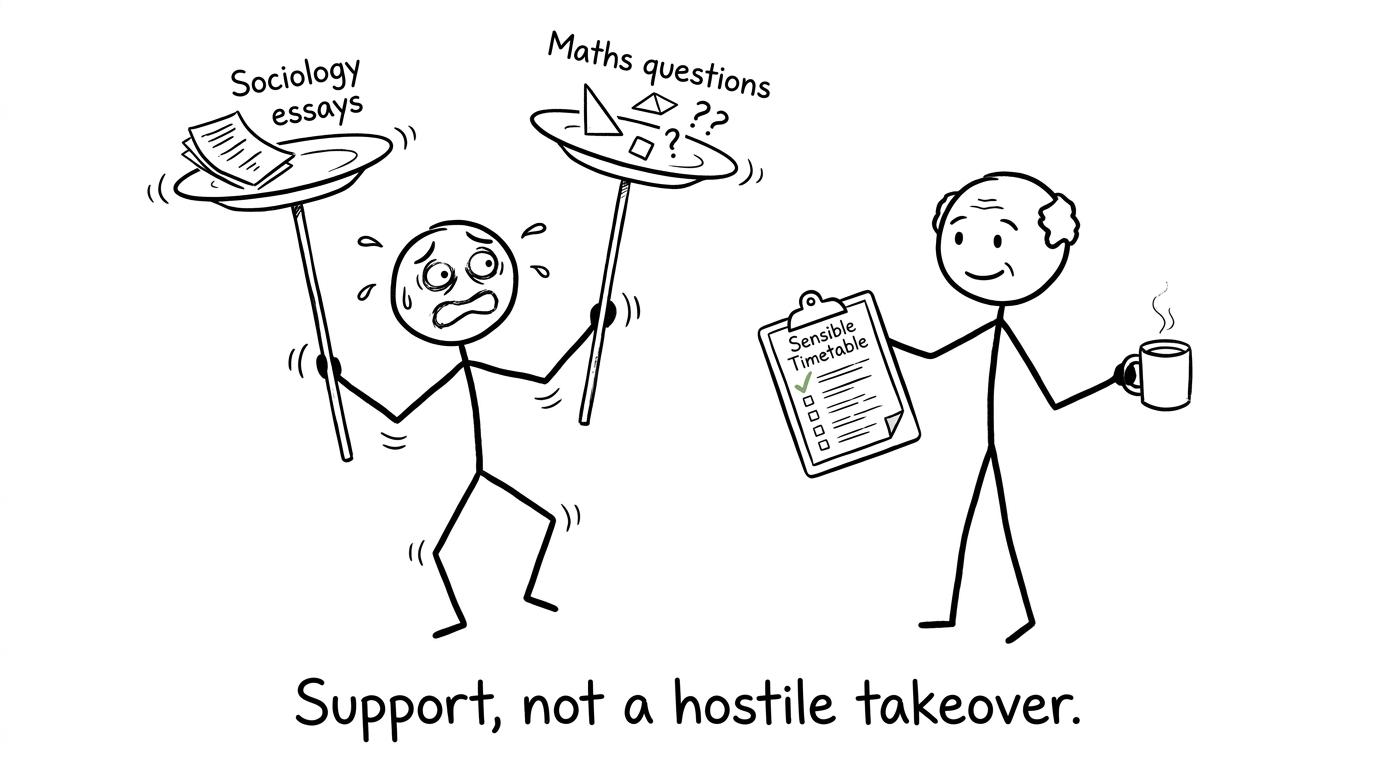 A student balances sociology and maths while a sibling offers a timetable rather than taking over
Common mistakes when revising with a sibling
Treating old notes as the specification
Old notes are supporting material, not a content authority. Check every topic against your current course.
Letting the sibling answer too quickly
Hints can make a session pleasant while hiding weak recall. Attempt the answer fully before receiving help.
Debating instead of practising
Sociological discussion is valuable, but the examination requires precise written responses. Convert at least part of each conversation into timed writing.
Copying their essay formula
A familiar structure may help organise thought, but every response must fit its command word, focus and mark allocation. Avoid forcing every argument into the same template.
Accepting unverified studies or statistics
A remembered name or number is not automatically accurate. Use current school materials and omit claims you cannot verify.
Making every session collaborative
The examination is independent. Some revision must therefore be independent too. Your sibling should gradually withdraw prompts as your confidence grows.
Make sibling support one tool, not the whole plan
A sibling who has already sat GCSE Sociology can be extremely useful. They can quiz you, listen to explanations, create accountability and share sensible lessons about timing and exam pressure. What they cannot do is freeze a qualification in the year they took it.
Keep their experience. Check their details. Build every session around current specifications, active recall, written practice and honest feedback.
Then give maths the same disciplined treatment. Start with the best order for learning GCSE maths topics, use MathsGenie's free revision lessons and practice questions to strengthen individual skills, and move on to mini tests, past papers and predicted papers. Mark schemes and video solutions show where marks were lost; focused practice helps you win them back.
Let your sibling provide encouragement. Let current evidence guide the work. And let MathsGenie give your GCSE maths revision a clear, free route from uncertain first attempt to exam-ready performance.