Revise GCSE English Alone or With Others?
Revise GCSE English Language and Literature alone or with others using a hybrid plan for quotations, analysis, essays and timed exam practice.
The quiet student has a problem. So does the sociable one.
The quiet student may complete pages of notes without discovering whether their interpretation makes sense to anyone else. The sociable student may spend an hour discussing Macbeth and write almost nothing.
So, is it better to revise GCSE English Language and Literature alone or with others? For most students, the strongest answer is both. Revise alone when you need concentration, retrieval and timed writing. Work with others when you need alternative interpretations, verbal explanations and useful feedback.
The choice should depend on the task, not simply whether you enjoy company.
The quick revision checklist
Use this as your starting point:
- Revise alone: quotation recall, close analysis, reading unseen extracts, planning independently and completing timed answers.
- Revise with others: testing quotations, comparing interpretations, discussing themes, checking paragraph logic and practising spoken explanations.
- Avoid passive sessions: rereading notes together is still rereading.
- Give group sessions a clear outcome: decide what everyone must produce before finishing.
- Return to solo writing: discussion helps you develop ideas, but your written examination answer must be your own.
- Keep other subjects moving: if English is taking most of the week, use the twenty-minute GCSE maths revision routine to maintain your maths skills.
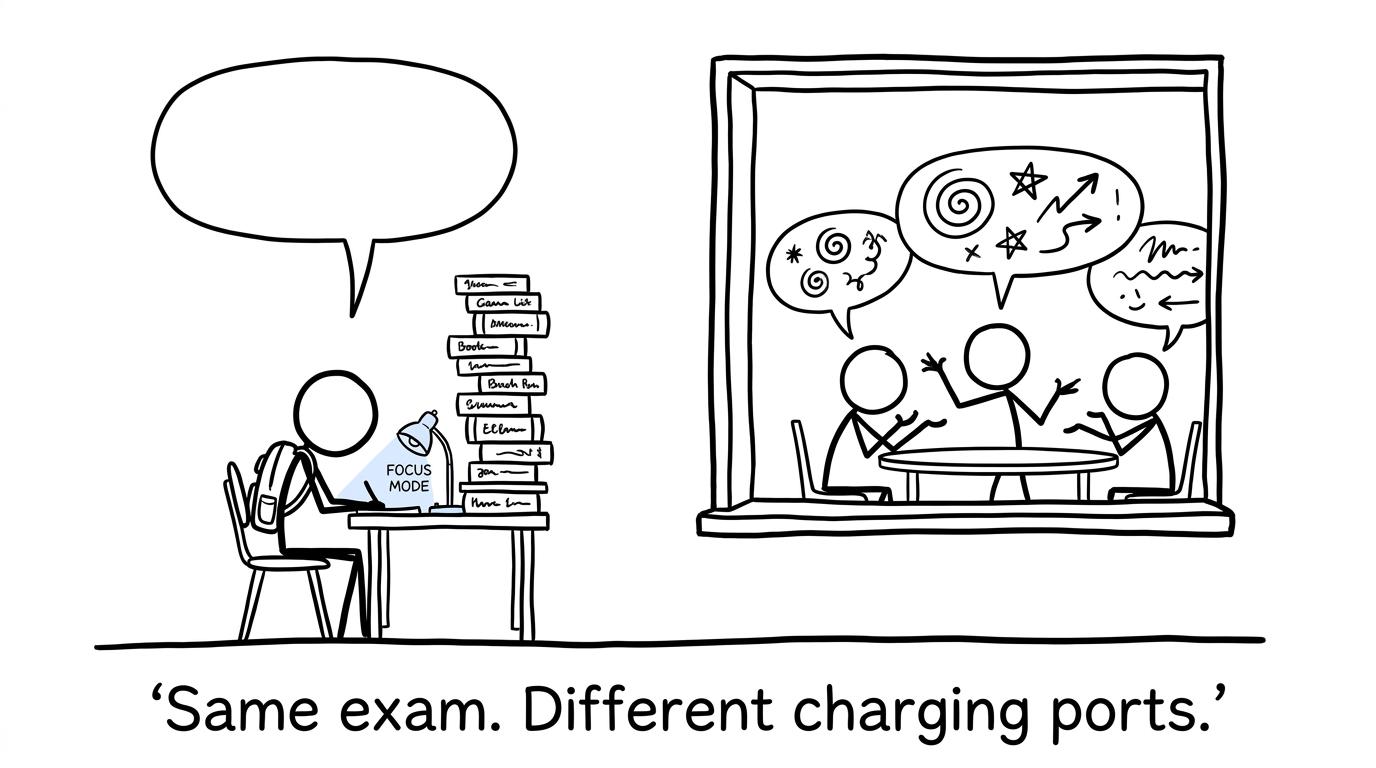 A student choosing between solo and group revision
When revising GCSE English alone works best
Solo revision is valuable because it reveals what you can do without prompts. That matters in an examination hall, where a friend cannot remind you of a quotation or suggest a second interpretation.
Quotation retrieval
Learning quotations is usually more efficient alone. Close the book, write or say everything you remember, check it and repeat the process later. Research on retrieval practice consistently indicates that attempting to recall material is generally more useful for long-term retention than repeatedly rereading it.
Keep the quotation bank selective. Choose short, versatile quotations connected to several characters, relationships or themes. For each one, recall:
- who says it and when;
- the relevant theme or character;
- one important word or structural feature;
- a possible alternative interpretation;
- useful contextual knowledge, where the question and specification require it.
The aim is not to memorise an entire essay. It is to build flexible evidence you can adapt to the question.
Close language and structure analysis
English Language extracts and Literature passages need uninterrupted attention. Solo work is well suited to identifying patterns, considering why a writer made a choice and turning an observation into a precise explanation.
Ask questions such as:
- What changes across the extract?
- Which word carries the greatest weight?
- How does the structure guide the reader's attention?
- What is the writer encouraging the reader or audience to think?
- Is there another reasonable interpretation?
This is slower than highlighting every technique, but it is closer to what examiners reward: a developed explanation rather than a list of labels.
Timed writing and independent planning
You should complete timed answers alone because timing is part of the challenge. A group can discuss an excellent essay for an hour, but that does not prove anyone can produce it independently under examination conditions.
Match your practice to your exam board and paper. AQA, Edexcel, OCR and Eduqas do not use identical paper structures, timings or mark schemes. Check your current specification, teacher guidance and official assessment materials before deciding how long to spend on a response.
After writing, use the relevant mark scheme to identify one improvement for the next answer. This plan, attempt, check, improve and retest, also underpins MathsGenie's guidance on finding your weakest GCSE topics.
When revising English with others works best
Collaborative revision can be powerful, but only when it is structured. Educational evidence distinguishes carefully designed collaborative learning from students merely sitting together. Everyone needs to participate, articulate their thinking and work towards a shared outcome.
Exploring Literature interpretations
Literature rarely improves through memorising one supposedly perfect interpretation. A small group can expose you to readings you had not considered.
Choose one character, relationship or theme. Each person should propose an interpretation and support it with textual evidence. Others can then ask:
- What makes that interpretation convincing?
- Is the evidence relevant to the whole text?
- Could the quotation suggest something different?
- How does form or structure strengthen the point?
- Is the contextual connection precise and relevant?
The purpose is not to agree. It is to make every interpretation more defensible.
Testing quotations and terminology
Paired retrieval can make recall less predictable. One student gives a theme, character or incomplete quotation; the other retrieves appropriate evidence and explains how it might be used.
Do not allow recognition to masquerade as recall. Seeing the beginning of a quotation and saying, "I knew that," is not the same as producing it without help. Keep a record of anything missed and test it independently later.
Receiving feedback on argument and clarity
A partner can often spot gaps that the writer cannot see. Ask them to read one paragraph and explain your argument back to you. If their explanation is different from what you intended, the writing probably needs greater precision.
Peer feedback is most useful when it answers narrow questions:
- Is the opening point relevant to the question?
- Does the evidence genuinely support the interpretation?
- Is the analysis developed beyond identifying a technique?
- Does each sentence advance the argument?
- Is the final sentence linked back to the task?
"It sounds good" is encouragement, not feedback.
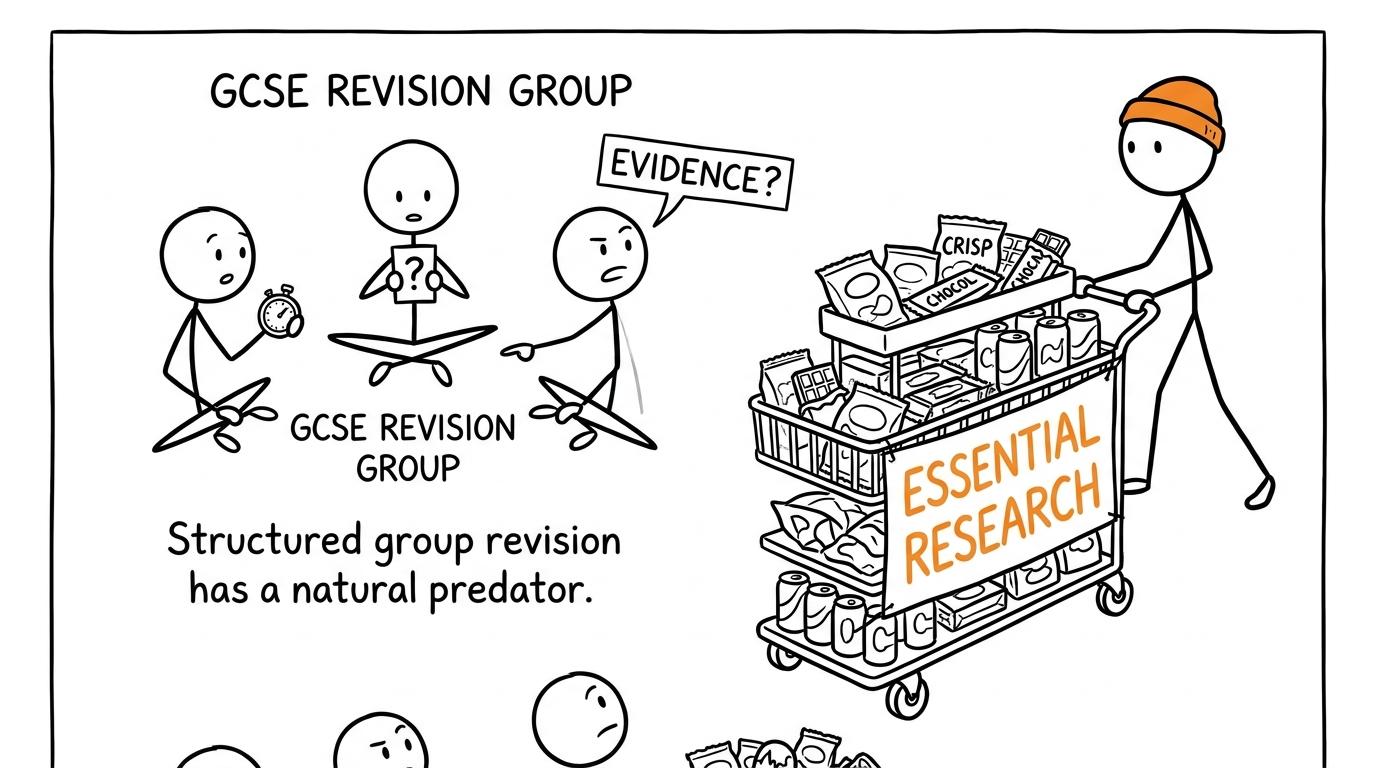 A structured revision group resisting distraction
Which method suits each English topic?
English Language reading
Start alone. Read the unseen text, annotate selectively and answer the question without assistance. Afterwards, compare interpretations with a partner and use the mark scheme to discuss what a stronger response would need.
This preserves the realism of unseen reading while still giving you the benefit of another perspective.
English Language writing
Plan and write alone, then seek focused feedback. Group brainstorming can generate ideas for narrative, descriptive or viewpoint writing, but relying on someone else's ideas can leave you stranded in the examination.
Feedback should consider purpose, audience, form, organisation, vocabulary, sentence control, spelling and punctuation. The exact assessment-objective labels and weighting depend on your specification, so use the mark scheme for your board.
English Literature themes and characters
Discussion is especially useful here. Compare interpretations, connect evidence from different parts of the text and challenge vague contextual claims. Finish by creating an individual essay plan from memory.
Unseen poetry
Use a hybrid sequence. Analyse the poem independently first, discuss different readings second and then write a fresh paragraph alone. If the group discusses before anyone has thought independently, the most confident voice can shape everyone's response.
Quotations and contextual knowledge
Retrieve these alone first, then test each other. Context should illuminate the text rather than become a detached history paragraph. Ask how a contextual idea changes or deepens the interpretation.
A hybrid session that produces written evidence
A useful English revision session can follow four stages:
- Independent retrieval: recall quotations, themes or question requirements without notes.
- Focused discussion: compare answers and challenge unsupported ideas.
- Independent production: write a plan, paragraph or timed response.
- Review: use the mark scheme, record one weakness and schedule another attempt.
The key principle is simple: talk should lead to something written. Something written should lead to feedback. Feedback should change the next attempt.
This is also a practical way to balance English with maths. MathsGenie's GCSE maths revision hub provides free revision lessons and practice questions, while the MathsGenie resources area brings together mini tests, practice papers and predicted papers.
If you are planning several subjects at once, adapt the weekly structure in the one-month GCSE maths revision plan. Give every session a precise task rather than writing broad instructions such as "revise English" or "do maths".
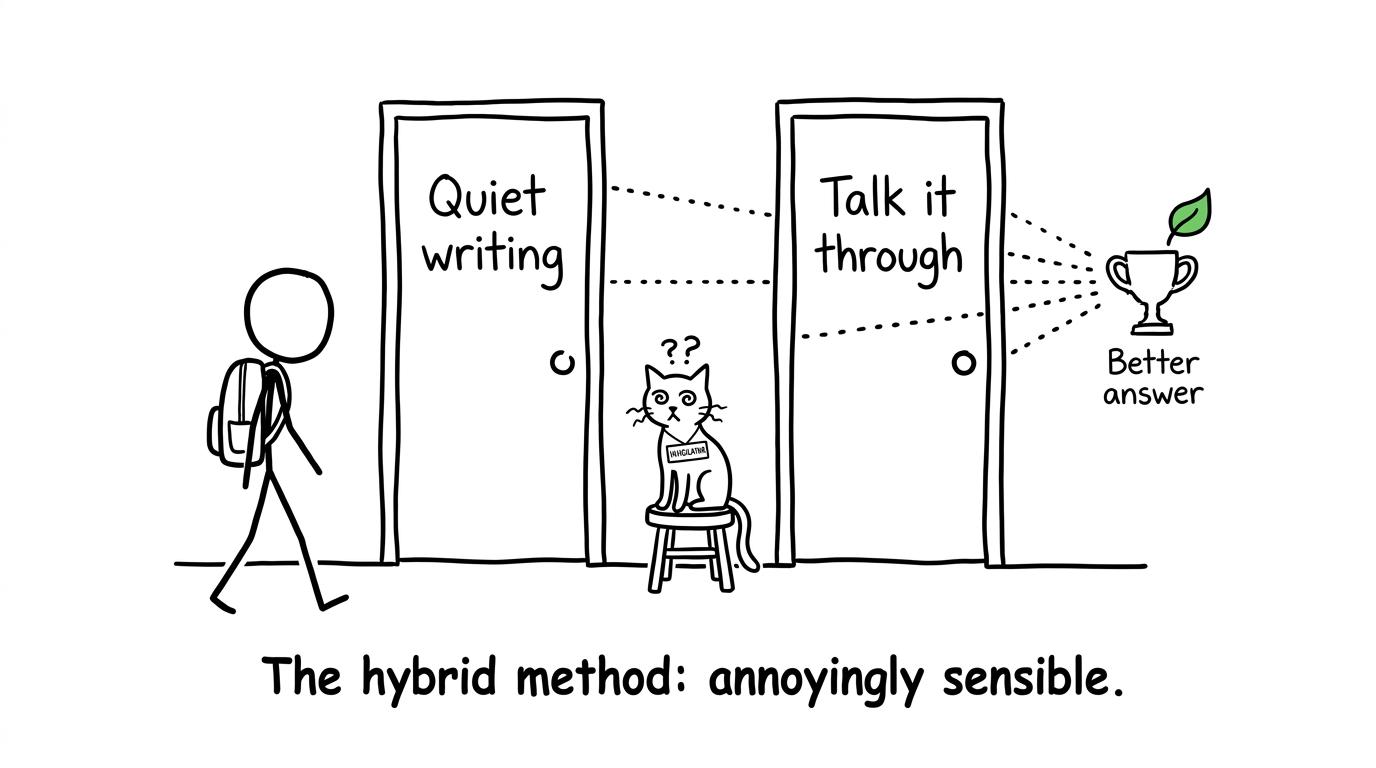 Two revision methods leading towards the same goal
Common mistakes when revising alone or together
Turning group revision into conversation
Set a question, a time limit and a final product. If the session does not produce recalled quotations, plans, paragraphs or corrections, it probably was not revision.
Letting one person do all the thinking
Rotate roles. One student asks questions, one answers, one challenges the evidence and one checks the mark scheme. Everyone should speak and write.
Revising only in your preferred way
Comfort can hide weakness. A student who loves discussion may avoid timed writing. A student who prefers silence may avoid testing whether their argument is understandable. Choose the method that the task needs.
Copying model answers
A model can demonstrate structure, but copying it does not build independent judgement. Read it, identify what makes it effective, close it and produce your own response to a different question.
Ignoring exam-board differences
Do not assume a friend's paper has the same questions as yours. Confirm whether you take AQA, Edexcel, OCR, Eduqas or another board, then revise from the correct specification and mark schemes.
Allowing English to replace maths revision
English essays can expand to fill an evening. Protect a short maths slot so methods remain retrievable. Use Edexcel GCSE maths past papers if that is your board, or begin with the main GCSE hub to choose the correct board and tier. MathsGenie's English Literature exam-week checklist also shows how to keep maths ticking during a demanding English week.
The best arrangement is deliberately mixed
You do not need to identify permanently as a solo learner or group learner. That label is less useful than asking what today's task requires.
Use quiet revision to retrieve quotations, analyse unfamiliar texts and practise timed writing. Use structured collaboration to test ideas, uncover alternative interpretations and receive feedback. Then return to independent work so you can prove the learning belongs to you.
As your exams approach, let MathsGenie organise the maths side of that balance. Start with free revision lessons and practice questions, check progress with mini tests, and then move to past papers, predicted papers, mark schemes and video solutions. Good revision is rarely about choosing one perfect method. It is about using the right method for the next weakness, and checking that it worked.