

Revise GCSE Engineering: Screen vs Paper
Revise GCSE engineering screen vs paper: learn which format helps knowledge stick and build a hybrid plan for calculations, recall and exam practice.
A screen can make revision feel effortless. The specification is open, a video is playing and every answer is one search away. Then the notes close, the blank page appears, and surprisingly little comes back.
If you are deciding how to revise GCSE engineering screen vs paper, the practical answer is to use both, but for different jobs. Screens are excellent for finding explanations, viewing processes, organising resources and receiving quick feedback. Paper is often better for concentrated reading, drawing, completing calculations and practising retrieval without digital prompts.
The format matters less than the mental action. Watching is not recalling. Highlighting is not applying. Effective revision requires you to produce knowledge, check it and improve it.
The screen vs paper revision checklist
Use this division of labour:
- Use a screen to learn: watch a focused lesson, inspect a diagram, access the specification or locate a weak maths topic.
- Use paper to retrieve: close the resource and write, sketch or calculate from memory.
- Use paper for exam realism: complete written questions with the equipment and space you expect to use in an examination.
- Use a screen to check: compare your response with a mark scheme or video solution.
- Keep one error log: digital or paper is fine, provided you revisit it.
- Repeat after a gap: return to the same knowledge later rather than treating one successful session as proof of mastery.
This is not a contest in which one medium must win. It is a workflow in which each medium does the job it handles best.
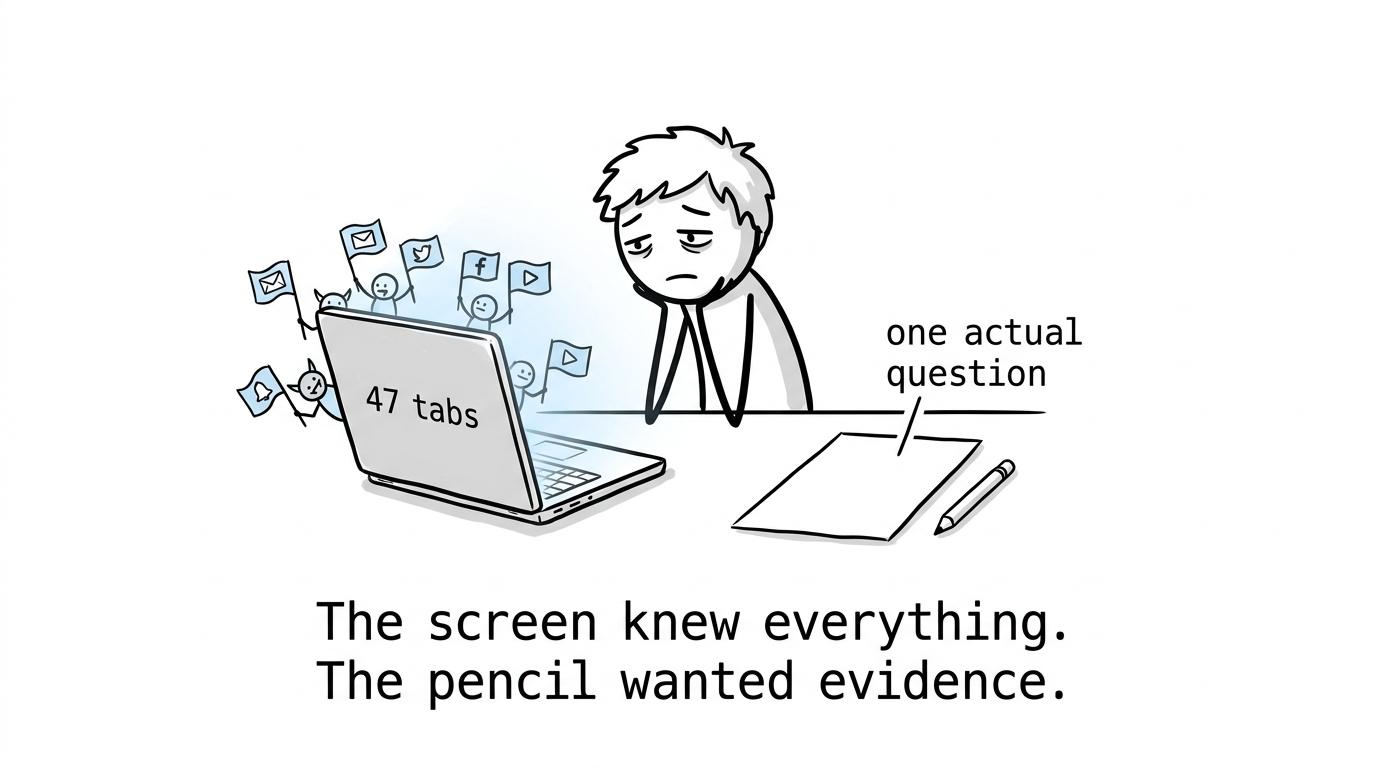 A student choosing between a distracting laptop and one calm paper question
Does digital GCSE Engineering revision actually stick?
Research comparing reading on screens with reading on paper does not support a simple claim that screens are always ineffective. Systematic reviews report mixed findings, influenced by the learner, device, text and task. However, several reviews have found a small overall comprehension advantage for print, particularly for informational or expository reading.
That distinction matters. Engineering material is rarely a light narrative. It may ask you to connect properties, processes, systems, units and evidence across a dense explanation. Paper can make your location within that material easier to judge, while removing notifications, extra tabs and the temptation to skim.
Yet reading research is not the whole story. GCSE Engineering revision also includes process videos, system diagrams, electronic resources and feedback. A well-designed screen session can therefore be more useful than passively rereading a printed page.
The better question is not, “Which format helps memory?” It is, “What am I doing in that format?”
A student who watches four videos without testing themselves may retain less than a student who studies one page and recalls its key ideas. Equally, a student who copies a textbook onto paper may learn less than someone who pauses a digital lesson and answers questions independently.
Match the medium to the Engineering task
For AQA GCSE Engineering 885288528852, the assessment includes a written paper and non-exam assessment. The written paper is worth 60%60\%60% of the qualification, while the practical engineering NEA is worth 40%40\%40%. The specification also requires engineering knowledge to be applied, analysed and evaluated rather than merely recognised.
Your school should confirm the exact qualification and specification you are taking. Whatever the course, your revision method should resemble the task you must eventually perform.
Use a screen for explanations and visual processes
Digital revision is particularly useful when movement or sequence carries meaning. Manufacturing processes, mechanisms, electronic systems and production stages can be easier to understand through animation or video than through a static paragraph.
Keep the viewing active:
- decide the exact question the resource should answer;
- pause before an explanation and predict the next stage;
- close the resource and describe the process from memory;
- draw the system or sequence independently;
- check only after you have committed to an answer.
The MathsGenie GCSE Maths revision hub is useful when an engineering difficulty is really a maths gap. Its revision lessons, exam-style questions and solutions let you isolate that weakness instead of repeatedly watching a broad engineering video.
Use paper for calculations and technical communication
Engineering calculations are not completed by recognising the right formula on a screen. You must select it, substitute accurately, use compatible units and communicate enough working to make the method clear.
The AQA specification includes mathematical skills such as ratio, percentages, standard form, trigonometry, Pythagoras, rearranging equations and interpreting graphs. It also identifies engineering relationships including density,
ρ=mV,\rho = \frac{m}{V},ρ=Vm,pressure,
P=FA,P = \frac{F}{A},P=AF,and Ohm's law,
I=VR.I = \frac{V}{R}.I=RV.Paper gives you room to annotate units, rearrange a relationship and spot whether an answer is physically sensible. It also makes accidental dependence on autofill, online calculators or visible hints less likely.
Unit errors are especially expensive because a correct method can be undermined by incompatible measurements. MathsGenie's conversions and units revision guide helps rebuild this skill, while the free units and conversions question booklet is suitable for paper-based practice.
Use both for drawings, graphs and data
A digital image can reveal details clearly, but you should still be able to create or interpret information without the model beside you. After studying a drawing or graph on screen, reproduce its essential features on paper and label them from memory.
This matters because engineering mathematics can involve plotting variables, drawing a trend line, finding a gradient and interpreting experimental data. Scale and proportion also connect engineering drawings with GCSE Maths. The MathsGenie Stage 4 learning journey brings together relevant skills including ratio, conversions and scale drawings.
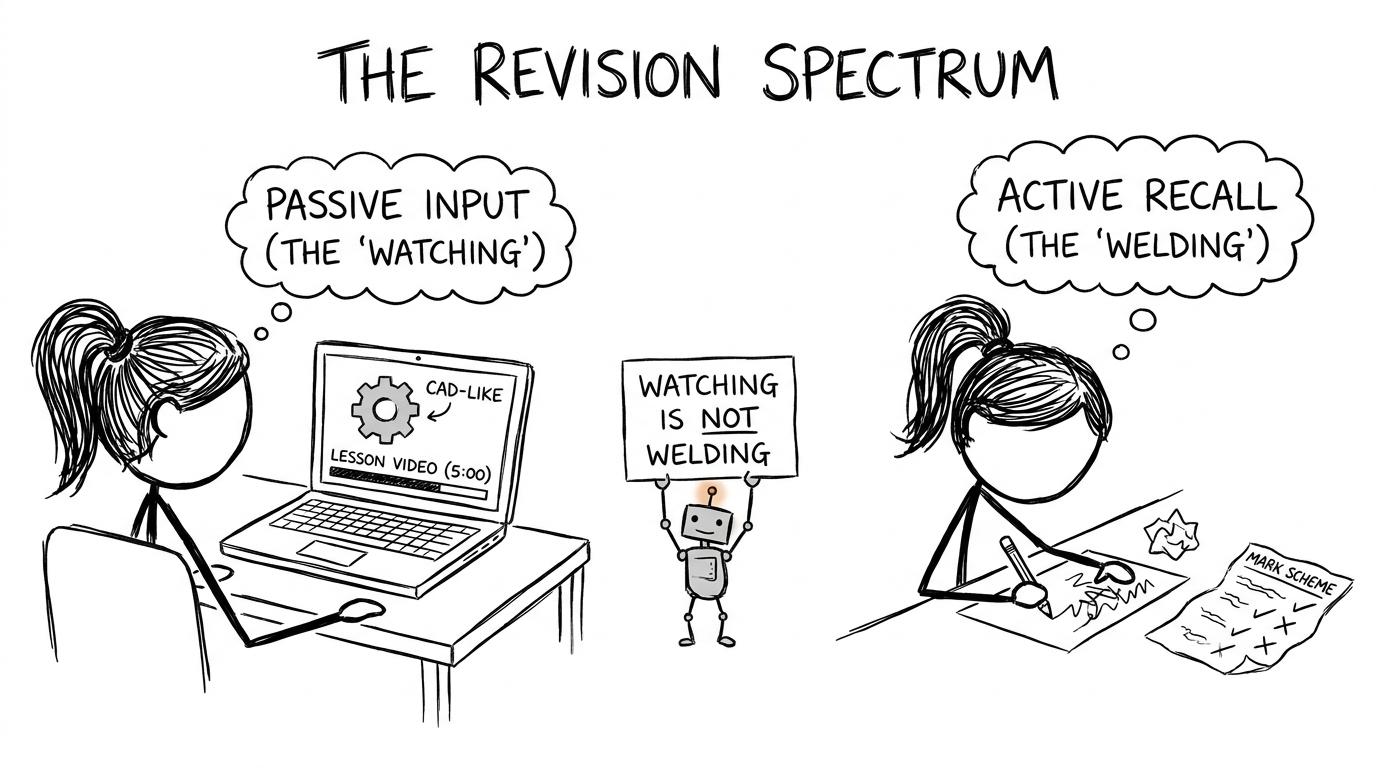 A hybrid revision workshop with a laptop, paper and a robot questioning passive watching
A hybrid revision cycle that makes knowledge stick
A productive session can move between screen and paper in five deliberate stages.
Find one precise weakness
Do not begin with “revise engineering”. Choose something observable, such as recalling material properties, comparing manufacturing processes, interpreting a system diagram or using units correctly in calculations.
If you are unsure where the maths weakness lies, use the GCSE Maths self-assessment sheet or review the GCSE Maths topics by exam board and tier. GCSE Maths boards such as Edexcel, AQA, OCR and Eduqas organise their specifications differently, so confirm your board and foundation or higher tier before choosing paper practice.
Learn briefly on screen
Spend a limited period reading or viewing a focused resource. Full-screen mode can help. Silence notifications and avoid opening extra tabs unless they answer the original question.
Create very few notes during this stage. Excessive transcription can make a session look productive while leaving retrieval untested.
Close the screen and retrieve on paper
Now remove the support. Depending on the topic, you might:
- sketch and label a system;
- list the stages of a process;
- compare two materials using relevant properties;
- write down equations and units;
- answer an exam question under a time limit;
- plan an extended response using technical vocabulary.
Leave gaps when you cannot remember something. A visible gap is useful evidence, not a failure.
Check against a reliable source
Reopen the resource and compare carefully. Mark schemes matter because they show what earns marks, not merely what sounds reasonable.
For the maths element, MathsGenie's guide to using GCSE past papers properly explains the cycle: complete, mark, diagnose, relearn and retest. If you take Edexcel Maths, the Edexcel GCSE Maths past papers provide papers with mark schemes and worked solutions where available.
Record and revisit the error
Write one short error-log entry containing:
- the topic;
- what went wrong;
- the missing fact, method or unit;
- what you will do next time;
- the date for a short retest.
Your error log can live on screen because digital sorting and searching are useful. The retest should usually happen without notes, and paper is often the cleanest way to remove prompts.
Build exam readiness, not just subject familiarity
Familiarity is the feeling that an explanation makes sense while you are looking at it. Exam readiness is the ability to produce a relevant response when the explanation has disappeared.
That is why some revision should copy the conditions of the assessment. Complete written calculations by hand. Read extended questions without switching tabs. Use a ruler and calculator where appropriate. Practise allocating time and leaving clear working.
This does not mean every session needs to become a full mock. Short, focused practice is valuable early on. As the examination approaches, gradually combine topics and extend the time. MathsGenie's mini tests, practice questions, past papers and predicted papers can support the mathematical side of that progression.
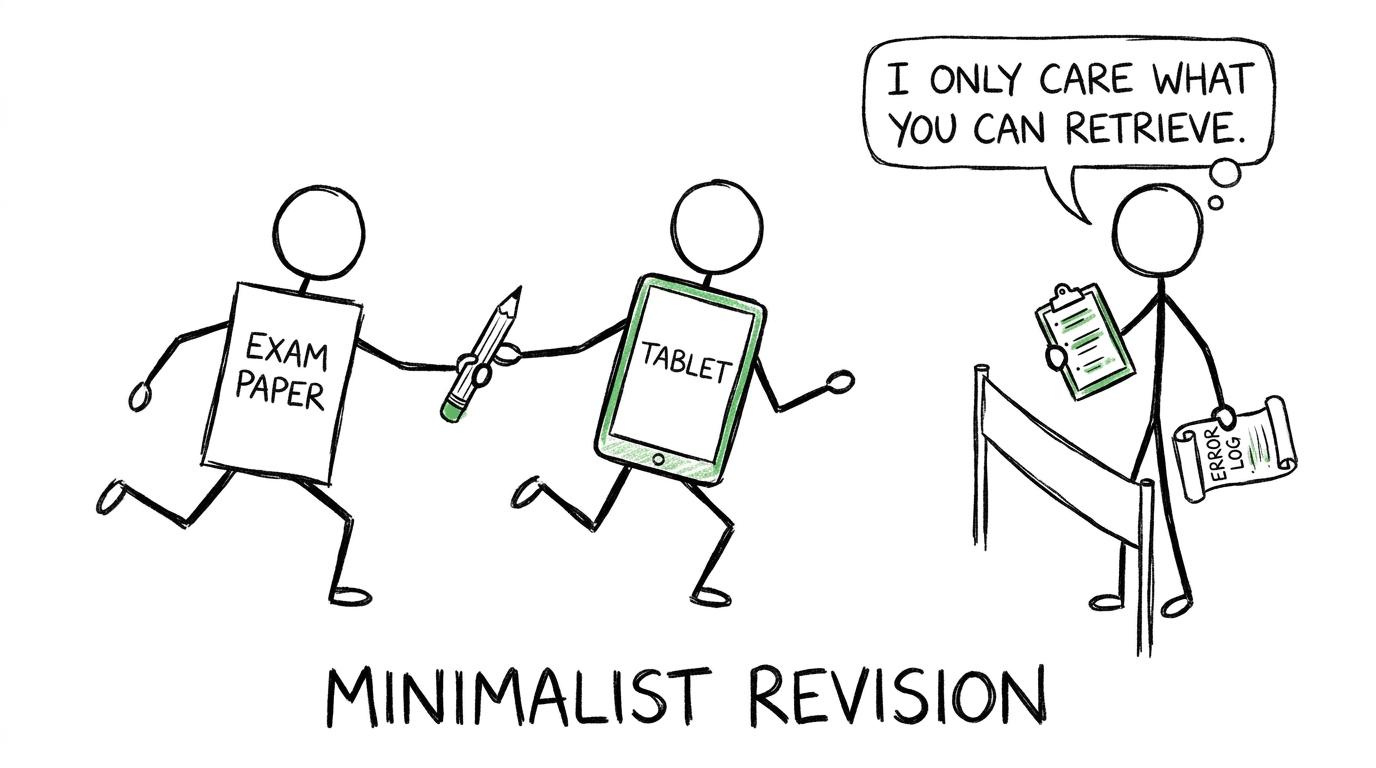 A tablet and exam paper passing a pencil baton towards a student with an error log
Common screen vs paper revision mistakes
Treating videos as completed revision
A finished video measures playback, not learning. Follow every digital explanation with an independent recall or application task.
Copying polished digital notes by hand
Neat copying can consume time without creating much retrieval effort. Convert the information instead: shorten it, classify it, sketch it or answer a question with it.
Doing everything on paper because the exam is written
Paper is useful for rehearsal, but refusing digital resources can remove strong explanations, visual processes and quick access to feedback. Learn with the most helpful medium, then practise in the assessment medium.
Checking answers too quickly
Opening the solution at the first difficulty trains recognition rather than persistence. Give yourself time to select a formula, inspect units or plan a response before checking.
Mixing up Engineering and Maths specifications
GCSE Engineering and GCSE Maths are separate qualifications. Engineering uses mathematical knowledge in applied contexts, while your Maths tier and exam board determine the Maths papers you sit. Check both specifications rather than assuming the topic lists or assessment arrangements are identical.
Ignoring units and presentation
An isolated calculator result is not a complete engineering solution. Write the relationship, keep units compatible, show substitution and state an appropriate final unit.
Choose the tool by what your brain must do
The screen vs paper debate becomes simpler once you stop asking which object is better. Screens widen access. Paper removes support. One helps you encounter knowledge; the other often makes you prove that you can retrieve and use it.
Start with one weak engineering topic today. Learn it briefly on screen, close the device, reproduce the idea on paper, check your response and schedule a retest. For the calculations behind engineering, use MathsGenie's free revision lessons, practice questions, mini tests, past papers, predicted papers, mark schemes and video solutions to turn vague familiarity into methods you can use under pressure.
The aim is not to revise digitally or traditionally. It is to arrive at the exam able to think without either resource doing the thinking for you.










